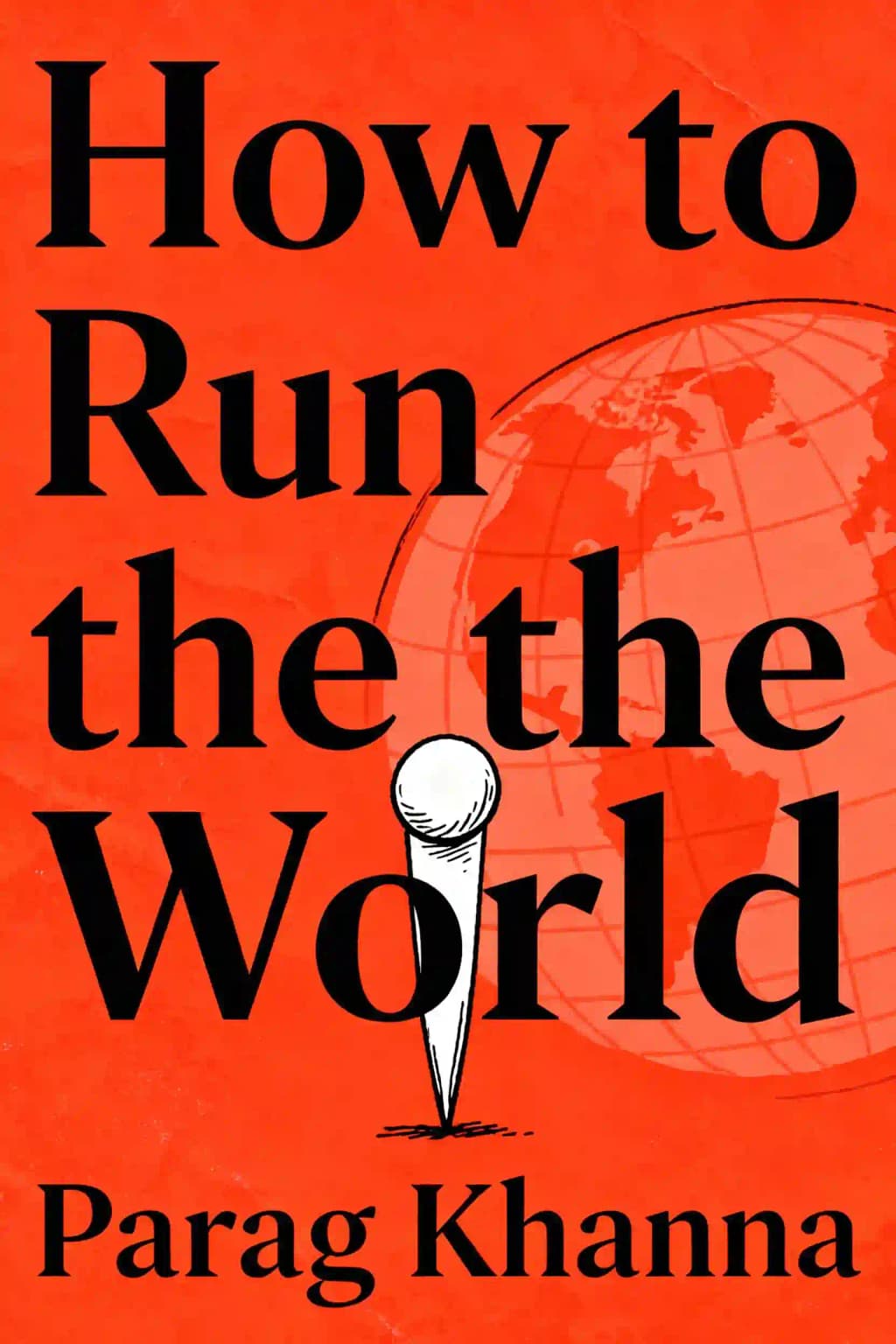
In "How to Run the World," geopolitical visionary Parag Khanna reimagines global governance through "mega-diplomacy" - a revolutionary framework endorsed by Google's Eric Schmidt. Could this provocative blueprint, blending corporate power with diplomatic finesse, be our roadmap through the "new Middle Ages" into a modern Renaissance?
Parag Khanna, internationally bestselling author of How to Run the World: Charting a Course to the Next Renaissance, is a leading global strategist and founder of AI-driven geospatial analytics firm AlphaGeo.
A Georgetown and London School of Economics graduate, Khanna’s work explores geopolitics, global governance, and civilizational evolution, informed by his roles at the Brookings Institution, U.S. National Intelligence Council, and Singapore’s Lee Kuan Yew School of Public Policy. His trilogy on world order—The Second World, How to Run the World, and Connectography—establishes frameworks for 21st-century diplomacy, while The Future is Asian (2019) redefines regional power dynamics.
A frequent commentator on CNN, BBC, and TED (with talks exceeding three million views), Khanna’s insights stem from advising governments and traveling to 150+ nations, including conflict zones like Iraq and Afghanistan. Recognized among Esquire’s “75 Most Influential People of the 21st Century,” his books have been translated into 20+ languages, cementing his status as a visionary in global affairs.
How to Run the World argues that today’s chaotic global landscape resembles the Middle Ages, requiring collaboration among governments, corporations, NGOs, and communities to build a stable, Renaissance-like future. Khanna proposes adaptive governance models that leverage diplomacy, technology, and grassroots networks to address crises like climate change and geopolitical competition.
Policymakers, business leaders, and readers interested in geopolitics or global governance will find actionable insights. The book appeals to those seeking strategies for managing globalization’s complexities, from climate agreements to public-private partnerships.
Yes, for its bold analysis of 21st-century challenges and hopeful roadmap for collective problem-solving. Khanna’s blend of historical parallels and futurist thinking makes it a standout in global strategy literature.
Key themes include:
Khanna compares today’s fragmented global order—marked by competing powers, hybrid warfare, and borderless threats—to the medieval era’s decentralized systems. He argues this chaos necessitates flexible, networked solutions rather than top-down control.
The book emphasizes:
It concludes his trilogy on global order, following The Second World (on emerging powers) and Connectography (on infrastructure’s role in globalization). Together, they outline a vision for 21st-century geopolitics.
Some scholars argue Khanna’s optimism about decentralized governance underestimates institutional inertia. Others note his focus on elite networks may overlook grassroots movements.
Khanna advocates for AI-driven climate models to allocate resources equitably and proposes “green coalitions” blending governments, tech firms, and activists to enforce sustainability pacts.
Amid AI disruption, climate migration, and multipolar tensions, its call for adaptable, inclusive governance aligns with efforts to mitigate global risks like cyber conflicts or supply chain collapses.
While The Second World analyzes regional power shifts and Connectography maps global infrastructure, How to Run the World synthesizes these into actionable governance strategies for a post-Western era.
著者の声を通じて本を感じる
知識を魅力的で例が豊富な洞察に変換
キーアイデアを瞬時にキャプチャして素早く学習
楽しく魅力的な方法で本を楽しむ
Cities, not nations, form the building blocks of global activity.
We live again in an age of superstition.
NGOs and corporations constitute a new colonialism.
Action-oriented networks have become the cornerstone of twenty-first-century diplomacy.
Govern globally, act locally.
『How to Run the World』の核心的なアイデアを分かりやすいポイントに分解し、革新的なチームがどのように創造、協力、成長するかを理解します。
『How to Run the World』を素早い記憶のヒントに凝縮し、率直さ、チームワーク、創造的な回復力の主要原則を強調します。

鮮やかなストーリーテリングを通じて『How to Run the World』を体験し、イノベーションのレッスンを記憶に残り、応用できる瞬間に変えます。
何でも質問し、声を選び、本当にあなたに響く洞察を一緒に作り出しましょう。

"Instead of endless scrolling, I just hit play on BeFreed. It saves me so much time."
"I never knew where to start with nonfiction—BeFreed’s book lists turned into podcasts gave me a clear path."
"Perfect balance between learning and entertainment. Finished ‘Thinking, Fast and Slow’ on my commute this week."
"Crazy how much I learned while walking the dog. BeFreed = small habits → big gains."
"Reading used to feel like a chore. Now it’s just part of my lifestyle."
"Feels effortless compared to reading. I’ve finished 6 books this month already."
"BeFreed turned my guilty doomscrolling into something that feels productive and inspiring."
"BeFreed turned my commute into learning time. 20-min podcasts are perfect for finishing books I never had time for."
"BeFreed replaced my podcast queue. Imagine Spotify for books — that’s it. 🙌"
"It is great for me to learn something from the book without reading it."
"The themed book list podcasts help me connect ideas across authors—like a guided audio journey."
"Makes me feel smarter every time before going to work"

How to Run the Worldの要約をPDFまたはEPUBで無料でダウンロード。印刷やオフラインでいつでもお読みいただけます。
In 2009, Andry Rajoelina seized control of Madagascar and immediately canceled a massive land deal with South Korea's Daewoo corporation. He was just 34. This wasn't just another coup-it was a perfect snapshot of our fractured world, where corporate deals rival state sovereignty, where youth movements topple governments overnight, and where traditional diplomacy arrives too late to matter. Welcome to what Parag Khanna calls our "neo-medieval" reality, where power no longer flows neatly through government channels but splinters across corporations, cities, NGOs, and even celebrity activists. The old rulebook for running the world has been shredded. The question isn't whether we like this new chaos-it's whether we can learn to navigate it before climate disasters, pandemics, and conflicts overwhelm our outdated systems entirely.