第1章
When Minds Transform: The Science of Belief Change
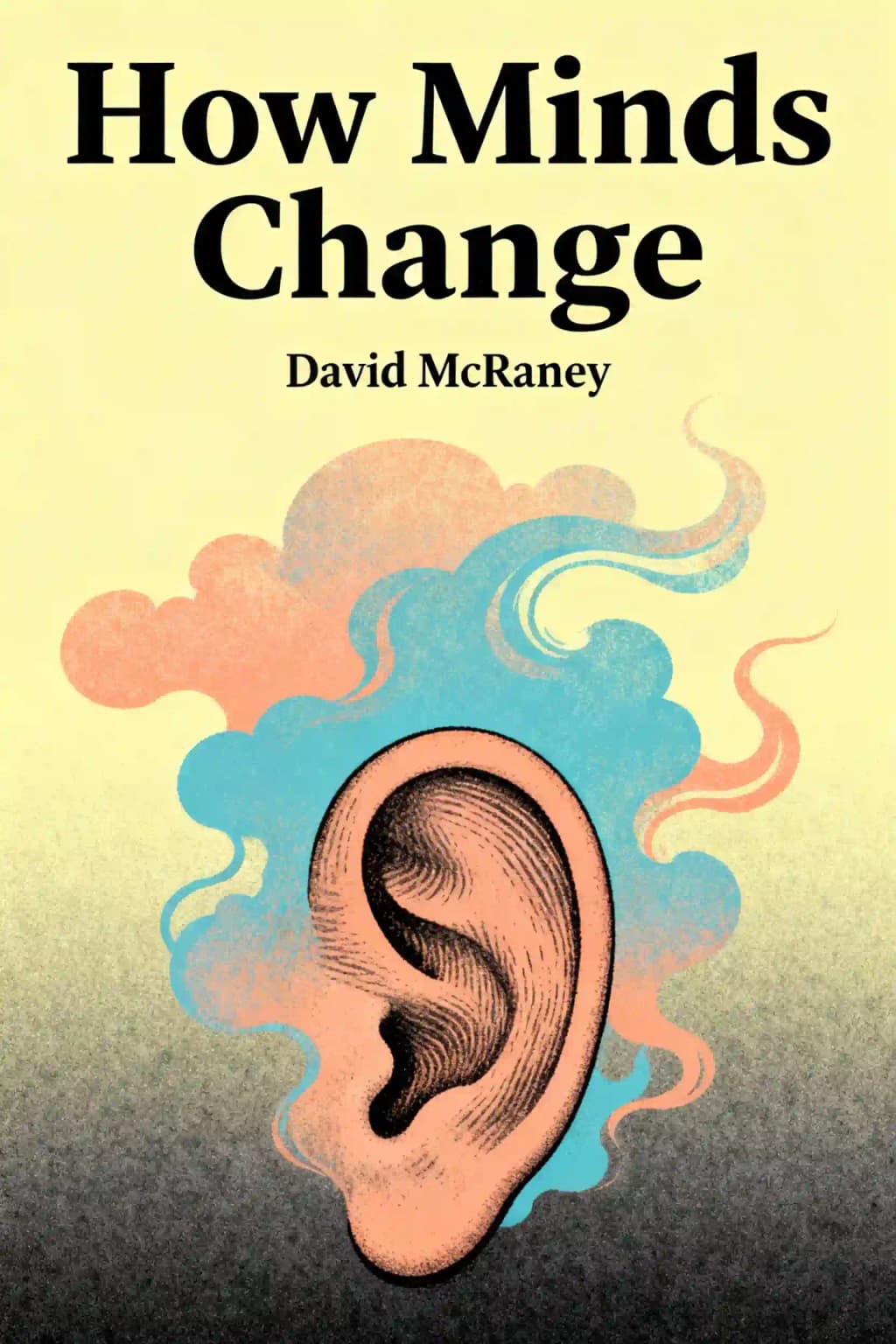
Have you ever wondered why some people can completely reverse their deeply-held beliefs while others seem immune to mountains of contradictory evidence? David McRaney's "How Minds Change" tackles this fascinating question with the precision of a scientist and the storytelling prowess of a novelist. This New York Times bestseller has become required reading in psychology departments nationwide and counts among its fans influential thinkers like Adam Grant and Daniel Pink. What makes this book particularly relevant today is how it illuminates our increasingly polarized world where facts alone seem powerless against entrenched beliefs. McRaney's journey from cynical journalist to optimistic mind-change researcher offers not just understanding but practical tools for bridging seemingly unbridgeable divides-whether at the family dinner table or across society's deepest fractures.
第2章
The Illusion of Unchangeable Minds
Growing up in Mississippi's Bible Belt, McRaney developed a deep pessimism about changing minds. Working in local news media only reinforced this cynicism as he moderated angry Facebook comments and once even had an enraged viewer come looking for him at the station after sharing climate change information. This experience led him to start a blog, write books, and launch the "You Are Not So Smart" podcast about motivated reasoning. He made a living telling people changing minds was futile.
Yet McRaney was never comfortable with this pessimism, especially after witnessing the sudden shift in opinion about same-sex marriage across America. Though the majority opposed it in 2012, by 2013 most supported it. This allowed his uncle to live openly as a gay man and his LGBTQ friends to marry.
When McRaney asked cognitive scientist Hugo Mercier about arguing's purpose, he explained we evolved to reach consensus by "banging our heads together." Groups better at reaching consensus through producing and evaluating arguments survived better. If we couldn't change minds, there would be no point in arguing at all.
This contradiction launched McRaney's journey to understand how minds truly change. He began with the story of Charlie Veitch, a former 9/11 conspiracy theorist who changed his mind after meeting experts and grieving families. Yet when Charlie publicly renounced his beliefs, his fellow conspiracy theorists didn't follow suit-they labeled him a government operative and subjected his family to horrific harassment. Why did the same evidence that changed Charlie's mind fail to convince others?
This paradox challenges the "information deficit model" that assumes access to facts naturally leads to consensus. In our "post-truth" era where facts seem to have lost their persuasive power, Charlie's transformation suggests something more complex is happening in how we form and change our beliefs.
第3章
The Deep Canvassing Revolution
McRaney's quest led him to Los Angeles, where he joined Steve Deline from the Leadership LAB (Learn Act Build) as they prepared for door-to-door canvassing. After the Supreme Court legalized same-sex marriage, the LAB's breakthrough persuasion method had made headlines worldwide. They called it deep canvassing-a technique that could often get someone to change a long-held opinion in less than twenty minutes.
The LAB is the political action arm of the Los Angeles LGBT Center, the largest LGBTQ organization globally. With a $100 million budget, most goes toward healthcare and counseling, but a portion funds the LAB's mission: changing minds about LGBTQ issues. When they began, the same-sex marriage debate was white-hot, with most believing minds could never be changed-we'd simply have to wait for generational turnover.
Deep canvassing emerged after California's devastating Proposition 8 defeat in 2008, when 52% voted to ban same-sex marriage despite favorable polling. Fleischer's team discovered that over 500,000 parents with children under eighteen had flipped their votes after being targeted by fear-based ads suggesting LGBTQ people would "indoctrinate" their children. This was actually promising news-these voters were persuadable, holding conflicting values between protecting their children and supporting others' rights.
The team began knocking on doors, even playing the opposition's attack ads directly to voters-an unprecedented approach. When they started recording these conversations on video, everything changed. They could analyze patterns, identify mistakes, and study moments when voters softened their positions.
Their core insight: facts don't change minds. Using a cake metaphor where "rapport" forms the small top layer, "our story" the middle, and "their story" the massive base, they explained that deep canvassing requires spending most of the conversation on the voter's personal experiences. Questions serve as keys on a ring-eventually unlocking doors to personal experiences that move conversations away from abstract ideological debates into concrete lived realities.
After a frustrating day, Steve finally made a breakthrough with Martha, a 72-year-old woman initially opposed to abortion. Rather than challenging her justifications, Steve evoked emotional responses by showing a video about a woman's abortion experience, then gently explored Martha's own experiences. This led her to share a powerful fifty-year-old memory of helping a friend who nearly died from a botched illegal abortion. By listening without judgment and "connecting on values," Steve helped Martha discover her own conflicted feelings.
Once the LAB abandoned fact-based arguing for their story-evoking approach, their success rate improved dramatically. Political scientists Broockman and Kalla conducted a meticulous study and found deep canvassing actually worked-producing mind changes in one in ten people that persisted for months. Their research showed a single conversation could produce attitude shifts greater than "the opinion change that occurred from 1998 to 2012 towards gay men and lesbians."
第4章
The Reality Inside Your Head
Our perception of reality isn't as straightforward as we might think. McRaney explores how our brains generate a virtual landscape of perpetual imagination and self-generated illusion informed by our senses and thoughts. This understanding was highlighted by "The Dress" phenomenon, which demonstrated that people can perceive the same object differently.
The scientific study of how brains generate reality began with Jakob Johann von Uexkull, who introduced the concept of "umwelt"-the idea that each creature experiences a private sensory world distinct from others. Different sense organs create different umwelts, with each organism perceiving only a small portion of objective reality while assuming what it perceives is all that can be perceived.
Neuroscientist Pascal Wallisch discovered that "The Dress" phenomenon revealed fundamental differences in visual perception. When people view ambiguous images, their brains resolve uncertainty without their knowledge by creating the most likely reality based on prior experiences. Pascal developed the concept of SURFPAD: when Substantial Uncertainty combines with Ramified (branching) Priors or Assumptions, it produces Disagreement.
After researching how different prior experiences affect perception, Pascal and colleague Michael Karlovich created their "cognitive nuclear bomb" by photographing pink Crocs with white socks under green lighting. As predicted, some viewers saw gray Crocs with green socks while others saw pink Crocs with white socks-with each group unable to see the alternative perception.
The data revealed that older people were more likely to see pink Crocs because they had more experience with white socks, unconsciously editing the image by subtracting the green light. Younger people, having more experience with colored socks, saw green socks and gray Crocs without any unconscious editing. Remarkably, the Crocs actually were pink in natural light, so those who saw them as pink were seeing the truth behind the image, while those who saw gray were seeing the truth of the photo itself-two different subjective truths from the same image.
Pascal was feverish about the implications: neither side was right or wrong, and only through combining perspectives could people discover the deeper truth. When our brains unconsciously eliminate uncertainty through more than thirty processing steps before an image reaches consciousness, we become victims of naive realism-the belief that we perceive the world as it truly is, free from assumption or bias.
This explains why people on opposing sides of debates believe only their view is rooted in reality. When disambiguations collide, people find it impossible to understand how others could see things differently when the evidence seems obvious. This explains why presenting challenging evidence often strengthens rather than changes beliefs-our brains, like with the white socks illusion, assume the "lighting is off" and delete contradictory information, subjectively feeling like objectivity.
第5章
The Mechanics of Mind Change
After studying how minds form, McRaney wanted to understand how minds change-what happens when we realize something we thought was true is false, or when we confront arguments that challenge our worldview.
Information in the brain exists as physical patterns-chemical and electrical activity rearranging molecules when we interact with the world. Like Pinker's thought experiment with tree rings, our brains encode patterns and correlations, continuously "burning marks" into neurons while "sanding away" others. Through evolution, biological machines emerged that could better sense these correlations, eventually developing second-order systems that could read their own internal information, leading to intelligence, evaluation, and planning.
Our ability to notice errors in predictions depends on dopamine, which regulates motivation and affects our response when outcomes don't match expectations. When we experience unexpected positive outcomes (like free ice cream at an airport), dopamine spikes, motivating us to repeat behaviors. When expectations aren't met, dopamine dips, discouraging those behaviors.
Our brains construct reality in hierarchical layers of patterns and predictive schemas, from raw sensations to concrete constructs to higher concepts. Learning happens through two processes identified by Jean Piaget: assimilation (adding new information to existing structures, like learning a new chicken recipe) and accommodation (making major updates to our mental frameworks, like witnessing something that fundamentally changes our understanding of chickens).
In 1949, psychologists Bruner and Postman demonstrated how minds update their models using playing cards with switched colors. At first, subjects didn't notice anomalies, then experienced discomfort and perceptual crises as anomalies increased. Eventually, they had a "shock of recognition" when they realized some cards had been manipulated. This illustrates how minds change: when expectations don't match experience, we feel visceral discomfort and resist accommodation by trying to apply current models. Only when the brain accepts that existing models cannot resolve incongruences does it update by creating new layers of abstraction.
When core expectations are massively subverted, people experience psychological trauma that can collapse their entire model of reality. Psychologists Tedeschi and Calhoun discovered that most people respond with "posttraumatic growth"-an adaptive spiral of positive development. After traumatic events like paralysis, terminal illness, or severe loss, people routinely report becoming better people as they shed outdated assumptions.
Political scientist David Redlawsk discovered there's a quantifiable threshold at which people switch from assimilation to accommodation. In his simulated election study, subjects receiving 10-20% negative information about their preferred candidates actually became more committed, while those receiving 40-80% eventually abandoned them completely. This "affective tipping point" typically occurred when about 30% of incoming information contradicted existing beliefs. Before reaching this threshold, incongruent information counterintuitively strengthens existing beliefs; beyond it, anxiety about potential error finally pushes people to update their worldview.
第6章
Leaving Westboro: How Communities Shape Beliefs
On a cold Valentine's Day in Topeka, McRaney visited Westboro Baptist Church, surprised to find it was just a large house in an ordinary suburban neighborhood. The property featured basketball courts behind layers of gates, an upside-down American flag, and marquees displaying hateful messages about homosexuality. The Southern Poverty Law Center describes Westboro as "arguably the most obnoxious and rabid hate group in America," a group so notorious they've become Hollywood shorthand for radical Christian extremism.
McRaney met with Zach Phelps-Roper, a former member and grandson of the church's founder. At twenty-five, Zach explained that he left Westboro not because he disagreed with their anti-gay teachings but because of their views on medical care. After injuring his back working as a nurse, his family refused him proper treatment, insisting his pain persisted because he wasn't praying hard enough. When Zach expressed interest in becoming a doctor, they forbade it without explanation, telling him his priority was to respect elders and obey without question.
Weeks after leaving Westboro, Zach's beliefs began changing during a meal with his sister Grace at Olive Garden. Their waiter, a gay man who recognized Zach as someone who had recently left the church, paid for their meal as an act of kindness. This gesture shattered Zach's lifelong belief that LGBTQ people were "beasts." He realized that had he still been in the church, he might have interpreted this kindness differently to preserve his worldview. This opened him to questioning everything he'd been taught. Zach emphasized that he didn't leave because his opinions changed; rather, his opinions changed because leaving created space for new possibilities.
Megan Phelps-Roper, Zach's sister, had a similar journey. Since leaving Westboro with her sister Grace in 2012, Megan had become an international figure-giving a TED Talk viewed over six million times, writing the bestselling memoir "Unfollow," and consulting for law enforcement on extremist groups.
Megan's deconversion began on Twitter through conversations with David Abitbol, who challenged Westboro's selective Biblical interpretations. The turning point came when Abitbol pointed out the contradiction in their "DEATH PENALTY FOR GAY PEOPLE" signs while claiming they weren't "casting stones." He noted they were advocating for governmental stone-casting, and highlighted how Megan's mother would have deserved death under their interpretation, without opportunity for repentance. This revelation stunned Megan, who realized Westboro applied mercy only to themselves.
After leaving Westboro, Megan was surprised how easily her beliefs changed about the groups they'd targeted. She explained that community was the key factor that had prevented change while inside-being surrounded by loved ones who constantly reinforced their worldview through Bible study, memorization, and daily street protests. The requirement to defend their beliefs publicly from age five had cemented her convictions, as "your ability to defend those things is a reflection of your salvation."
For both Zach and Megan, it wasn't disagreement with church teachings that prompted their departures-their attitudes about LGBTQ people changed after leaving. Rather, it was the loss of community that opened them to reconsidering evidence they'd previously dismissed, with outsiders who showed kindness helping pull them away.
第7章
The Tribal Nature of Truth
Charlie Veitch, the former conspiracy theorist from earlier in the book, shows how belonging drives belief. Growing up as a perpetual outsider-moving between Brazil, Tanzania, and various countries following his sailor father-Charlie was constantly bullied and never felt he belonged anywhere. After university, he fell into a meaningless banking job until discovering 9/11 conspiracy videos. The truther community gave him purpose and identity: "You're looking for a scapegoat; your life is meaningless; you're just a little nobody, but then suddenly you feel like you're part of an elite."
Neuroscientists Sarah Gimbel, Sam Harris, and Jonas Kaplan discovered that when people's deeply held beliefs are challenged, their brains react as if facing physical danger. While subjects readily changed their minds about neutral facts, political topics like abortion or gun control triggered a fight-or-flight response, with blood rushing to the default mode network-regions that process self-identity in relation to others. The amygdala and insular cortex, which regulate fear and anger, become highly active. As Kaplan explains, "The brain's first and primary job is to protect our selves," extending beyond physical protection to psychological identity.
Henri Tajfel, a Polish Jewish psychologist obsessed with understanding how genocide becomes possible, discovered there is no baseline for prejudice-any difference, no matter how minimal, activates our us-versus-them psychology. In his groundbreaking experiments, he randomly labeled boys as "overestimators" or "underestimators" of dots. Even with this meaningless distinction, subjects favored their own arbitrary group and would choose smaller rewards if it meant their group would be better off than the outgroup.
Humans are ultra-social animals who survive through group formation and maintenance. Our innate psychology prioritizes group cohesion over individual well-being-we're willing to sacrifice ourselves and others to keep the group strong. As sociologist Brooke Harrington puts it, "social death is more frightening than physical death." This explains why we feel deeply threatened when ideas that define our group identity are challenged.
During group conflicts, individuals work harder to identify themselves as loyal members. Anything can become a signal of loyalty-clothing, music preferences, car choices, and especially opinions on divisive issues. Psychologist Dan Kahan demonstrated this with the HPV vaccine controversy, which became politically polarized when introduced through partisan media rather than doctors.
We rely on trusted reference groups for much of what we believe about the world. Once we consider a group trustworthy, questioning any of their accepted beliefs threatens our entire worldview and group membership. For conspiracy theorists like Charlie's truther group, the pursuit of belonging barely overlaps with the pursuit of accuracy, as questioning dogma risks excommunication.
Charlie discovered that "the truth is tribal" through his experience with the film crew of Conspiracy Road Trip. Though they were "alternative, fun types" like himself, they didn't share his conspiracy beliefs. Spending ten days with them created a dissonance he couldn't ignore. Charlie realized he'd been seeking his tribe, but during the 9/11 trip, he began to see that "perhaps the tribe that welcomed me so much were not mentally healthy people." He suggests that changing minds requires appealing to deeper values rather than abstract arguments. "If you're going to change someone's mind you've got to hit them in the balls-which is the heart. The heartballs."
第8章
The Evolutionary Purpose of Arguing
Through examples like the Wason number sequence game, the Jane personality study, and Peter Ditto's disease test experiment, McRaney demonstrated how confirmation bias drives us to seek evidence supporting our hunches rather than challenging them. When motivated to find reasons for a particular position, we find them-and the more intelligent and educated we are, the better we become at justifying existing beliefs regardless of their accuracy.
Our ancestors' leaf-eating habits required large territories that needed defending, leading to tribal behavior bound by hard-earned trust. We evolved to identify group members through signals, developing communication abilities that allowed pooling perspectives into shared worldviews. This created an evolutionary advantage through culture, language, facial expressions, and emotional connections. However, this system introduced the dilemma of potential deception or misinformation from peers with personal goals, leading to the development of epistemic vigilance-a protective mechanism against updating beliefs too hastily based on potentially bad information.
Natural selection favored groups that could bypass trust bottlenecks through argumentation. Rather than anticipating all possible objections, we present weak initial arguments and refine them based on specific feedback. This lazy, biased approach allows individuals to quickly share perspectives while saving mental energy for evaluation. When arguing with ourselves, we typically win, drawing self-serving conclusions based on our unique experiences. Reasoning isn't logic but rather the creation of justifications we believe our peers will accept as reasonable.
Experiments reveal our tendency to choose options with more justifiable reasons (like choosing a chocolate cockroach over a heart) and our inability to make decisions without justifications (as in the coin flip experiment). While we're terrible at evaluating our own reasoning, we excel at critiquing others'. When subjects were tricked into evaluating their own arguments as if they came from others, 69 percent rejected their previously accepted poor reasoning.
Reasoning is intentionally biased and lazy because we're designed to contribute strong perspectives to a group process. This division of cognitive labor explains why collaboration produces our greatest achievements. Tom Stafford calls this the "truth wins scenario"-when groups tackle problems like those on the Cognitive Reflection Test, they consistently outperform individuals. While 83 percent of people get at least one answer wrong when working alone, groups of three or more solve all problems correctly through debate.
Social media feels like "soul poison" because proper context matters more than good reasoning. Online debates lack essential group dynamics, causing people to essentially argue with themselves. We fall prey to Cass Sunstein's "law of group polarization"-groups formed around shared attitudes become more extreme over time through a comparison feedback loop. Those wishing to appear centrist shift toward extremes when they discover others hold more radical positions, while those wanting to appear extreme must shift further to maintain distance from the center.
第9章
The Science of Persuasion
By the 1980s, persuasion research was in disarray despite being a major focus since World War II. Scientists had produced mountains of seemingly contradictory evidence about what made messages persuasive. The breakthrough came in 1984 when graduate students Richard Petty and John Cacioppo developed the elaboration likelihood model (ELM) to make sense of this chaos.
Frustrated by the contradictory research, Petty and Cacioppo painted an entire room with blackboard paint and organized psychological literature on the walls. They discovered that messages could be grouped by how likely a person was to reflect on their content, revealing two paths to persuasion: high elaboration and low elaboration. Unlike earlier approaches that focused solely on learning facts, they realized persuasion depends on how people contextualize messages after receiving them.
Petty and Cacioppo identified two paths to persuasion: the central route, where people carefully analyze arguments, and the peripheral route, where they rely on simple cues. When elaboration likelihood is high-influenced by motivation (relevance, accuracy incentives) and ability (lack of distraction, expertise)-people take the central route, scrutinizing logic and evidence. On the peripheral route, superficial elements like attractiveness or celebrity endorsements matter more.
Persuasion via the central route takes more effort but creates enduring attitude changes, while the peripheral route works quickly but produces temporary effects. For simple consumer products like vodka, peripheral cues like packaging and celebrity endorsements work well. However, for complex issues like immigration or healthcare, moving people to the central route is essential for fact-based persuasion.
Building on Lasswell's 1948 communication model ("who says what to whom in which channel with what effect"), research has identified key qualities of successful persuasion. The communicator must seem trustworthy and credible, evaluated through expertise, honesty, and group alignment. Messages become more impactful when paired with counterarguments (two-sided communication), with the audience's current position presented first. Messages must match the audience's processing abilities and motivations, with rhetorical questions often more effective than direct statements. Finally, face-to-face communication remains the most effective channel, as we're biologically hardwired to respond to human faces.
第10章
Practical Tools for Changing Minds
Anthony Magnabosco practices "street epistemology" at the University of San Antonio, engaging strangers in conversations about their deeply held beliefs. The technique involves respectfully questioning people about claims they believe are true, exploring their confidence levels and reasoning. The process guides people through metacognition-thinking about their own thinking-rather than trying to force new beliefs upon them.
The street epistemology method begins with establishing rapport and getting consent, asking for a specific claim, confirming understanding, clarifying definitions, identifying confidence levels, exploring reasoning, examining the methods used to evaluate evidence, listening carefully, and ending with gratitude.
Building rapport is crucial before diving into any challenging conversation. Ask for consent, be transparent, and genuinely listen to the person's story and emotions. This creates psychological safety-when people feel heard rather than judged, they're more likely to open up. Anthony compares it to good bedside manner in healthcare: trust develops when someone takes time to know you.
Most arguments fail because people use the same words with different meanings. For example, "the government" might mean civil servants to you but a cabal of billionaires to them. Without clarifying definitions, you end up arguing with your conception of their position rather than what they actually believe.
Ask them to quantify their confidence from zero to one hundred, which helps them begin examining their own certainty. This often creates a visible moment of reflection for people who've never considered measuring their confidence. If someone says they're at 80%, you can naturally ask "Why not 100%?"-opening space to explore their reasoning and doubts.
This crucial step encourages people to test the reliability of their reasoning methods. Questions like "Could your method also lead to completely different conclusions?" help reveal contradictions. Another technique is asking them to imagine someone reaching the opposite conclusion from the same evidence-how would a neutral third party determine which conclusion is correct?
Reflecting on these methods, McRaney noticed striking similarities between street epistemology, deep canvassing, and Megan Phelps's approach to reaching Westboro members. All incorporate elements from persuasion psychology: building trust through rapport, engaging face-to-face, reducing cognitive load, making messages personally relevant, and encouraging active processing. Though developed independently for different purposes, these approaches converged on similar principles-like inventors on separate continents discovering similar airplane designs because the underlying physics remains constant.
Each technique serves different purposes: street epistemology works best for empirical beliefs (like whether ghosts exist), deep canvassing for emotional attitudes, Smart Politics for value-based issues like immigration, and motivational interviewing for behavior change. Complete conversions are rare-most changes are incremental shifts in certainty or attitude.
第11章
How Societies Transform
Around 2.5 million years ago, our ancestors created basic implements, but technological development stagnated for over 100,000 generations despite evolving larger brains. Everything changed with the onset of the Pleistocene, commonly known as the Ice Age. While many species perished, our ancestors not only survived but thrived, breaking free from cultural stasis.
As zoologist Peter J. Richerson described it, this "fruit-cart upset world" with high-frequency environmental changes proved fatal for animals dependent on slow genetic evolution. When environmental changes occur on the scale of centuries rather than millennia, genes can't adapt quickly enough. Our ancestors, however, had developed crucial cognitive tools: plasticity, abstraction, metacognition, language, social learning, perfect imitation, theory of mind, argumentation, and reasoning.
The rapid shift in American attitudes toward same-sex marriage reflects an unprecedented cultural evolution. In 2012, President Obama publicly changed his stance, reflecting a national transformation where support had crossed the 50% threshold among Democrats. Within twenty years, opposition among Republicans dropped from 81% to 56%, while overall American support rose from 27% to 70%.
Social change accelerates when new conceptual categories emerge, signaling widespread accommodation. As technology created factories and a working class emerged with political power, the concept of dignity expanded to accommodate them. This progression continued through class, gender, race, and eventually all humanity, making slavery incompatible with society's evolving moral framework.
In complex social environments, individual conformity thresholds greatly influence cascades of change. Sociologist Mark Granovetter calls these "thresholds of resistance." Consider students waiting outside an empty classroom: the first person doesn't check if it's open due to past embarrassment, the second avoids awkward social interaction, and the third assumes the first two know something she doesn't. With each additional person, the courage required to break this behavioral cascade increases exponentially.
Social cascades spread through interconnected groups with varying conformity thresholds. When conditions are right, even small catalysts can trigger widespread transformation. Like a forest fire that needs both dry conditions and a spark, social change requires vulnerable network conditions. Once a patch of forest is vulnerable, any spark-from a cigarette to lightning-can start the blaze.
We continuously update our models of reality throughout human history. As James Burke explains, "We are what we know, and when the body of knowledge changes, so do we." Every era believed it knew the truth until realizing it didn't. Most attempted changes are absorbed by the system, but occasionally conditions align perfectly and a previously ineffective shock triggers global transformation. The key to changing minds at scale isn't genius but persistence-continuing to strike at the status quo until you find the vulnerable cluster. The people who change the world, like Dave Fleischer with his thirteen thousand door-knocks, are those who never put down their hammers.