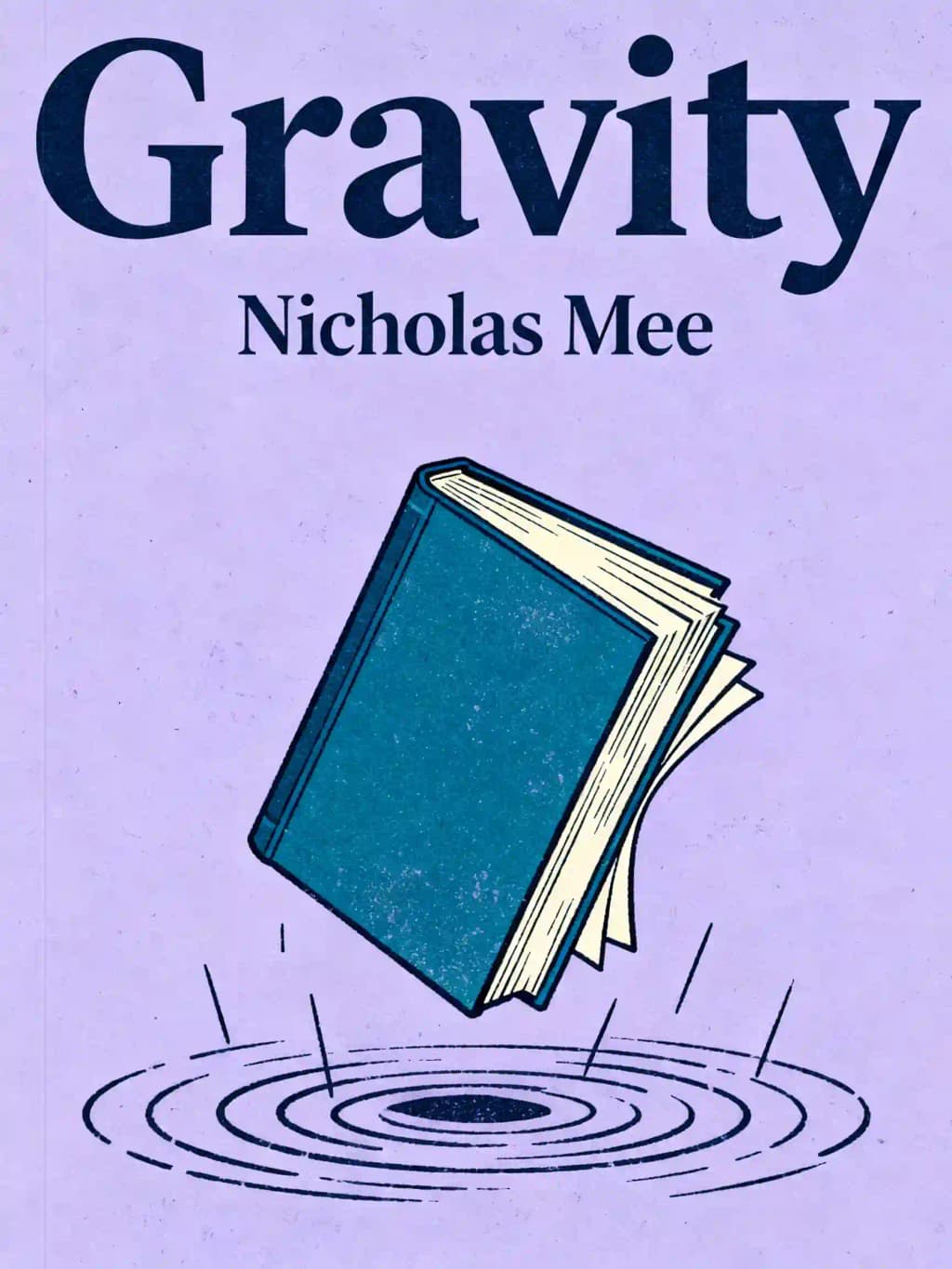
Dive into the universe's most mysterious force with "Gravity" by Nicholas Mee, where centuries of scientific pursuit culminate in recent breakthroughs like gravitational waves and black hole imaging. Endorsed by Astronomer Royal Lord Martin Rees, this 320-page journey makes spacetime curvature surprisingly accessible.
著者の声を通じて本を感じる
知識を魅力的で例が豊富な洞察に変換
キーアイデアを瞬時にキャプチャして素早く学習
楽しく魅力的な方法で本を楽しむ
Drop a hammer and a feather on Earth, and the hammer hits first. Drop them on the Moon-as Neil Armstrong did in 1969-and they land simultaneously. This simple demonstration revealed something profound: what we experience as "weight" isn't gravity at all. It's the ground pushing back against us, electromagnetic forces between atoms resisting compression. Gravity itself? We've never felt it. This counterintuitive truth sits at the heart of our cosmic story, one that begins with medieval monks arranging stones and ends with detectors capturing ripples in spacetime itself. The journey from Earth-centered cosmology to our modern understanding required overturning everything humanity believed about the universe-and it started with a beautiful mosaic on a church floor. The Cosmati Pavement in Westminster Abbey isn't just decorative stonework. This 13th-century mosaic encodes an entire worldview, declaring itself "the perfectly rounded sphere which reveals the eternal pattern of the universe." One inscription calculates the cosmos's lifespan as 19,683 years-derived from 3^9, the number three representing the Holy Trinity. This wasn't whimsy. Medieval thinkers built upon Aristotle's model: Earth motionless at the center, surrounded by crystal spheres carrying celestial bodies, all turned by angelic hierarchies, with nine corresponding levels of Hell below. Dante's Divine Comedy gave this vision its ultimate expression, structuring every realm around threes and nines. But while European philosophers debated cosmic architecture, Babylonian astronomers were doing something more practical: recording planetary positions with meticulous precision. They discovered the eight-year Venus cycle and eighteen-year eclipse patterns through patient observation. When Greek thinkers like Thales began predicting eclipses using this data, humanity took its first steps toward modern science.
『Gravity』の核心的なアイデアを分かりやすいポイントに分解し、革新的なチームがどのように創造、協力、成長するかを理解します。
『Gravity』を素早い記憶のヒントに凝縮し、率直さ、チームワーク、創造的な回復力の主要原則を強調します。

鮮やかなストーリーテリングを通じて『Gravity』を体験し、イノベーションのレッスンを記憶に残り、応用できる瞬間に変えます。
何でも質問し、声を選び、本当にあなたに響く洞察を一緒に作り出しましょう。

"Instead of endless scrolling, I just hit play on BeFreed. It saves me so much time."
"I never knew where to start with nonfiction—BeFreed’s book lists turned into podcasts gave me a clear path."
"Perfect balance between learning and entertainment. Finished ‘Thinking, Fast and Slow’ on my commute this week."
"Crazy how much I learned while walking the dog. BeFreed = small habits → big gains."
"Reading used to feel like a chore. Now it’s just part of my lifestyle."
"Feels effortless compared to reading. I’ve finished 6 books this month already."
"BeFreed turned my guilty doomscrolling into something that feels productive and inspiring."
"BeFreed turned my commute into learning time. 20-min podcasts are perfect for finishing books I never had time for."
"BeFreed replaced my podcast queue. Imagine Spotify for books — that’s it. 🙌"
"It is great for me to learn something from the book without reading it."
"The themed book list podcasts help me connect ideas across authors—like a guided audio journey."
"Makes me feel smarter every time before going to work"

Gravityの要約をPDFまたはEPUBで無料でダウンロード。印刷やオフラインでいつでもお読みいただけます。