第1章
A Dystopian Warning in the Digital Age
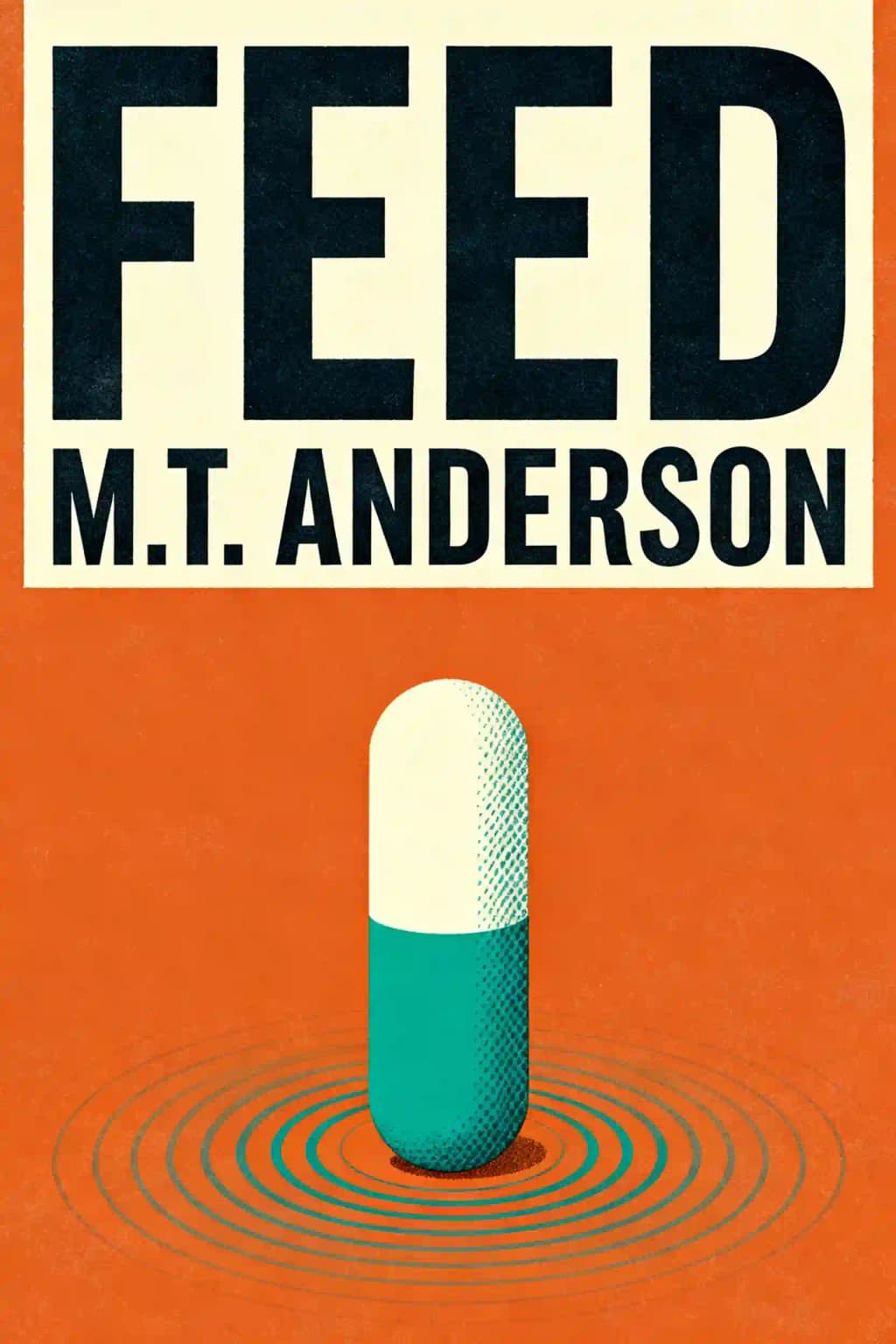
Imagine waking up one morning to discover that the internet isn't just something you access-it's become part of your brain. This is the chilling reality in M.T. Anderson's prophetic novel "Feed," which has become required reading in countless high schools and universities since its 2002 publication. The book earned Anderson the National Book Award Finalist honor and continues to gain relevance as our real-world digital consumption patterns increasingly mirror the dystopian future he envisioned. Tech mogul Elon Musk has cited it as one of the works that shaped his concerns about unchecked technological integration, while cultural critics regularly reference it when discussing social media addiction. What makes this novel particularly unsettling isn't just its technological predictions, but how accurately it portrays the way constant connectivity reshapes human relationships and erodes our capacity for empathy and critical thinking.
第2章
A World Where Consumerism Becomes Identity
In Anderson's dystopian future America, citizens have internet feeds directly implanted in their brains from birth - a technology that fundamentally reshapes human consciousness and society. The story follows teenager Titus and his friends during what should be an exciting spring break trip to the moon, a destination that has become a commercialized tourist trap rather than a symbol of human achievement. Their vacation takes an unexpected turn when a hacker attacks their feeds, temporarily disconnecting them from the constant stream of advertisements, entertainment, and communication that defines their existence. This disruption forces them to confront, however briefly, the emptiness of their feed-dependent lives.
The feed isn't just a convenience - it's the central organizing principle of society, seamlessly integrating commerce and consciousness. It anticipates desires with frightening accuracy, suggesting purchases based on sophisticated algorithms that track behavior patterns, emotional states, and social connections. The technology eliminates the need to learn anything, as information can be instantly accessed through neural pathways. Traditional skills like reading, writing, and critical thinking have atrophied. Even verbal communication seems tedious and outdated, as people can "chat" directly through their feeds, sharing not just words but sensations, emotions, and manufactured experiences called "feedcasts."
The worldbuilding is subtly horrifying in its plausibility. Earth has been environmentally devastated, with massive artificial air factories replacing the forests that once produced oxygen naturally. The oceans are dead zones, filled with synthetic compounds and devoid of marine life. Most food is grown in laboratory conditions - we see "meat farms" where tissue is cultivated in vast fields connected by blood tubes, a grotesque parody of traditional agriculture. Even the weather is controlled by corporations, with "CloudsTM" and manufactured seasons that can be sponsored by companies for marketing purposes.
Education has been completely privatized into "SchoolTM," where children learn primarily how to be better consumers rather than critical thinkers. Subjects like history and literature have been replaced by courses in brand awareness and trend analysis. The government has been largely replaced by corporate control, with companies like FeedTech and American Feedware wielding tremendous power over citizens' lives. These corporations don't just control commerce - they shape reality itself through their manipulation of information, entertainment, and basic human needs.
What makes this world so disturbing isn't just its environmental collapse or corporate domination - it's how normal it all seems to the characters living in it. They've never known anything different, so they accept their reality without question. The characters continue to consume products and experiences while the world literally falls apart around them, their attention constantly diverted by the feed's endless stream of distractions. Even physical mutations and environmental diseases are treated as fashion statements rather than warnings of systemic collapse. The feed has created a population so disconnected from reality that they can't recognize their own destruction, much less resist it.
第3章
The Hollow Lives of the Connected Generation
Titus and his friends represent the typical teenagers of this feed-dominated world. They speak in a degraded slang that reflects their diminished capacity for complex expression, constantly seeking the next thrill or purchase to alleviate their perpetual boredom. Their conversations are shallow, punctuated by corporate catchphrases and advertising jingles that have become part of their vernacular. Their attention spans are minimal - most can't focus on any single topic for more than a few minutes - and their knowledge of history or the world beyond their immediate experience is practically nonexistent, limited to whatever simplified versions the feed presents to them.
When we first meet them, they're engaging in mindless activities that highlight their desensitization to genuine experience. They give each other electric shocks for fun, treating pain as entertainment. They complain about how "the moon sucks" while visiting it - unable to appreciate what would once have been considered a miraculous experience. They obsess over their appearance, constantly monitoring their social status through the feed's metrics and rankings. They communicate primarily through their feeds, often having entire conversations without speaking aloud, their thoughts and responses mediated through corporate filters and algorithms that shape their very consciousness.
Their identities are defined entirely by what they consume, with fashion trends like artificial skin lesions ("birching") and clothing styles based on historical riots becoming status symbols. These trends change rapidly and meaninglessly, creating a constant churn of desire and obsolescence. Even their memories are commercialized, with advertising algorithms analyzing their experiences to better target them with products.
These teens aren't villains - they're victims of a system designed to keep them perpetually dissatisfied yet constantly consuming. Their emotional development has been stunted by the feed's influence, creating a generation unable to process genuine feelings or cope with real-world challenges. When confronted with serious issues like death or environmental collapse, they retreat into entertainment or shopping, their only learned coping mechanism. When Titus learns that the man who hacked their feeds was beaten to death by police, his primary reaction is annoyance that no one told him sooner - followed by excitement about his new upcar, demonstrating how thoroughly the feed has corrupted normal human emotional responses.
The feed has replaced authentic human connection with a simulation of it, creating a hollow facsimile of genuine interaction. Friends "chat" without speaking, share experiences without processing them, and navigate relationships through the lens of media they consume. Their understanding of love, friendship, and human connection is filtered through corporate narratives and advertising templates. When Titus tries to imagine what "really living" might look like, he can only conjure images from sitcom opening credits - revealing how thoroughly mediated his understanding of life has become, trapped in a cycle of artificial experiences and manufactured desires.
Anderson brilliantly portrays how technology designed to connect people can actually isolate them, creating a generation unable to form deep connections or engage meaningfully with the world around them. The feed has become both their window to the world and the bars of their prison, limiting their ability to think, feel, or exist independently of its influence.
第4章
Violet: The Outsider Who Sees Too Clearly
The novel's most compelling character is Violet Durn, who enters Titus's life during their moon vacation. Unlike his other friends, Violet received her feed late in childhood because her academic father couldn't afford it earlier. This delay gave her something precious-the ability to see the feed as an intrusion rather than a natural extension of herself.
Violet is immediately distinctive. While others wear flashy synthetic clothes, she wears a simple gray wool dress. She speaks formally, using vocabulary that confuses and sometimes irritates Titus's friends. She reads books, writes with an actual pen, and knows historical facts that leave the others baffled. Most importantly, she actively resists the feed's influence by researching random products without buying them, deliberately confusing the algorithms designed to predict her behavior.
Through Violet, Anderson shows us what has been lost in this feed-dominated world. She values knowledge for its own sake, not just as a means to consumption. She questions the corporations' motives and recognizes the environmental devastation others ignore. She seeks authentic experiences-watching juice float in zero gravity, exploring a dead garden on the moon, contemplating the sea even as it changes unnatural colors.
Violet's resistance isn't just philosophical-it's literal survival. When the hacker damages her feed, the interface between technology and her brain begins to deteriorate. As her condition worsens, she loses motor function, memories, and eventually the ability to communicate. When she petitions FeedTech for assistance with repairs, they coldly reject her because her unpredictable purchasing history makes her "an unreliable investment." The corporation's message is clear: in this world, your value as a human being is determined solely by your value as a consumer.
Violet's decline becomes the novel's central tragedy. As her body fails her, she desperately tries to preserve her memories and experiences, sending them to Titus for safekeeping. Her "Definitive list of things I want to do" before she dies is heartbreaking in its simplicity-dancing, seeing volcanoes, growing old with someone who loves her. These basic human desires highlight how much has been lost in a world where experience is primarily mediated through technology.
第5章
The Failure of Human Connection
The relationship between Titus and Violet forms the emotional core of the novel. Their connection begins with genuine attraction and curiosity, blossoms into something like love, but ultimately collapses under the weight of their different worldviews.
Initially, Titus is captivated by Violet's uniqueness. He finds her beautiful in ways he can't quite articulate. He's intrigued by her vocabulary, her observations, her different way of moving through the world. When their feeds are temporarily disabled after the hacking incident, they connect more authentically than either has experienced before. They share quiet moments looking at a dead garden, discussing their families, and imagining different futures.
But as Violet's condition deteriorates, the fundamental gap between them becomes impossible to ignore. Titus, shaped by the feed's instant gratification, lacks the emotional tools to handle Violet's illness. He avoids her messages, lies about receiving her memories, and ultimately abandons her when she needs him most. During their final weekend together, when she tries to be intimate, he cruelly tells her it feels "like being felt up by a zombie."
This failure isn't entirely Titus's fault-he's a product of his environment, raised in a world that never taught him how to face suffering or mortality. When confronted with Violet's decline, he retreats into familiar patterns of consumption, ordering countless pairs of pants in a desperate attempt to feel something other than grief and guilt.
Anderson doesn't offer easy redemption. Titus does return to Violet's bedside after her father informs him that "everything stopped," but his attempts to connect come too late. He narrates their story as if it were a movie trailer, still filtering reality through media even in this most raw moment. As he holds her hand and cries, we see his tears reflected in her blank, staring eye-a final image that captures both his genuine grief and the unbridgeable distance between them.
第6章
The Corporate Takeover of Human Experience
One of the novel's most disturbing aspects is how thoroughly corporations control every aspect of human life. This isn't presented as a sudden takeover but as a gradual process that happened so naturally that most characters don't even question it.
Education has been privatized into "SchoolTM," which primarily teaches children how to use their feeds effectively for shopping. When Titus mentions learning about America being a democracy, Violet corrects him-it's actually a republic-revealing how even basic civic knowledge has been lost. The curriculum focuses on practical consumer skills like finding bargains and decorating bedrooms rather than critical thinking or history.
Environmental regulation has clearly collapsed, with corporations free to exploit resources until they're depleted. When Violet expresses concern about forests being cut down, Titus's father dismissively explains that trees are "inefficient" compared to air factories-completely missing the ecological importance of natural systems.
Even human bodies have become corporate property. Parents design their children at "conceptionariums," selecting features as if from a catalog. Titus learns his parents modeled him partly after a failed celebrity named DelGlacey Murdoch, treating their son's appearance as a consumer choice rather than a natural process.
Most insidiously, the feed has transformed human consciousness itself into a corporate asset. Every thought, preference, and experience becomes data to be harvested and monetized. When Titus and Violet visit a mall, they're immediately bombarded with personalized advertisements based on everything they look at. These ads aren't just annoying-they're inescapable, appearing directly in their minds.
The ultimate expression of this corporate control comes when FeedTech refuses to help Violet because she's not a valuable enough consumer. The company representative coldly explains that they've reviewed her purchasing history and don't consider her "a reliable investment." Her life is worth less than the potential profit she might generate. This moment crystallizes the novel's central horror: in a world where corporations control access to the technology necessary for participation in society, those who don't or can't consume properly are left to die.
第7章
Language as a Measure of Cultural Decline
Anderson's masterful use of language reveals the intellectual and cultural deterioration in this feed-dominated world. Titus and his friends speak in a degraded slang filled with placeholder words like "thing" and intensifiers like "meg" or "null." Their vocabulary is limited, their ability to express complex thoughts severely constrained. Even basic descriptions become challenging - characters struggle to articulate simple concepts without referencing corporate brands or feed-supplied terminology.
This linguistic poverty reflects their impoverished inner lives. Without the tools to articulate nuanced emotions or ideas, they're trapped in a perpetual adolescence, unable to develop the emotional intelligence necessary for deep relationships or critical thinking. When confronted with genuine tragedy or complex moral situations, Titus can only resort to cliches and feed-supplied responses. His attempts to comfort Violet during her decline are particularly painful, as he lacks the vocabulary to express genuine empathy or understanding.
The contrast between Titus's narration and Violet's speech highlights this decline. While Titus struggles to express himself beyond basic observations and reactions, Violet uses words like "malevolent," "filigree," and "picayune" - terms that confuse and sometimes anger his friends. Her rich vocabulary isn't just showing off; it represents an entirely different way of perceiving and engaging with the world. Through Violet, Anderson demonstrates how expanded vocabulary enables expanded consciousness. Her ability to name and describe subtle phenomena allows her to think about them more deeply.
Language deterioration serves as a warning about what happens when we outsource our thinking to technology. If information is always instantly accessible, why bother learning or remembering anything? If communication is reduced to brief messages and shared media, what happens to our ability to construct complex arguments or express subtle emotions? The novel suggests that language isn't just a tool for communication - it's the architecture of thought itself, and its degradation represents a fundamental loss of human capacity.
The feed's impact on language manifests in multiple ways: the disappearance of complex sentence structures, the loss of historical and cultural references, and the replacement of descriptive language with brand names and marketing slogans. Characters can barely distinguish between their own thoughts and feed-generated content. Even their dreams are described in the simplified language of advertisement copy - a chilling suggestion that their very consciousness has been colonized by corporate discourse.
The erosion of language parallels the erosion of independence and critical thinking. Without the vocabulary to question or challenge their reality, the characters become passive consumers rather than active citizens. Their restricted linguistic capabilities lock them into predetermined patterns of thought and behavior, making resistance to the feed's influence nearly impossible.
第8章
Environmental Apocalypse as Background Noise
One of the most chilling aspects of Anderson's world is how environmental catastrophe has become normalized. The characters casually mention dead oceans, artificial air, and manufactured weather without any sense of loss or concern. This environmental collapse isn't presented as a sudden disaster but as a gradual process that happened while people were distracted by their feeds - a haunting parallel to our own society's response to climate change. The characters' conversations about environmental destruction carry the same weight as discussions about fashion trends or weekend plans, highlighting how thoroughly disaster has been absorbed into daily life.
When Titus and Violet visit the sea, they must wear protective suits because the water has become toxic. The sea shifts through unnatural colors - blue, purple, yellow, green - a beautiful but horrifying indication of its death. The scene is particularly powerful because the characters treat their protective gear as casually as we might treat sunscreen, showing how thoroughly environmental precautions have been normalized. Violet tries to make Titus understand the magnitude of this loss, but he can only respond with platitudes about scientific progress eventually fixing everything. His reaction mirrors contemporary attitudes of technological optimism in the face of environmental crisis.
The novel includes brief interludes titled "America: A Portrait in Geezers," where an older narrator remembers when "the last forests fell" and hawks appeared in cities. These passages provide glimpses of the transition period between our world and the novel's dystopia, suggesting that the environmental collapse happened within living memory. The narrator recalls people walking outside more often when temperatures "rarely exceeded a hundred degrees" - indicating how quickly abnormal conditions became the new normal. These interludes serve as a powerful counterpoint to the main narrative, showing how one generation's catastrophe becomes another generation's status quo.
What makes this environmental backdrop so effective is how unremarkable it seems to the characters. They've never known anything different, so they accept artificial air and dead oceans as simply how the world is. Their acceptance mirrors our own tendency to normalize environmental degradation, adapting to each new level of loss without recognizing the cumulative catastrophe. The novel shows how each generation's baseline for "normal" shifts - what was once considered an environmental emergency becomes standard background conditions for the next generation.
The manufactured environment in the novel extends beyond just air and water. Characters live in climate-controlled bubbles, eat synthetic food, and experience nature primarily through corporate-sponsored simulations. Even the clouds are artificial, created by weather corporations that have monetized the very sky. This commodification of basic natural elements serves as a stark warning about the intersection of environmental destruction and corporate control. The characters' complete disconnection from the natural world is reflected in their language - they lack the vocabulary to even describe what's been lost, much less mourn it.
第9章
The Illusion of Choice in a Predetermined World
Throughout the novel, Anderson explores how the feed creates an illusion of freedom while actually limiting and directing choices. Characters believe they're making independent decisions about what to buy, watch, or experience, but these choices are carefully curated by algorithms based on their previous behavior.
When Titus shops for an upcar, the dealerships show him personalized visions based on his profile. Nongen shows him driving romantically with Violet (with "bigger boobs and sparkly cheeks"), while Dodge shows him surrounded by bikini-clad people at a beach party. These aren't just advertisements-they're carefully constructed narratives designed to make him feel that purchasing a particular product will fulfill his deepest desires.
The feed doesn't just respond to preferences-it actively shapes them. It creates trends like the artificial lesions that become fashionable among Titus's friends, then quickly replaces them with new fads, keeping consumers in a perpetual cycle of dissatisfaction and purchase. When Violet tries to resist this manipulation by researching products without buying them, the system eventually punishes her by denying her life-saving repairs.
Even rebellion becomes commodified. When Titus and his friends attend a party wearing "Riot Gear"-clothing designed to look beaten up from historical riots-their attempt at political expression has been packaged and sold back to them as fashion. They wear the symbols of resistance without understanding their meaning or engaging with the issues that sparked the original protests.
This illusion of choice extends beyond consumption to identity itself. Characters believe they're expressing their unique personalities through their purchases and media preferences, but these expressions are actually selected from a limited menu of options provided by corporations. The feed has so thoroughly colonized their consciousness that they can't imagine alternatives to the consumer identity it offers them.
第10章
The Tragedy of Awareness in a Numbed World
The novel's most profound tragedy is that awareness itself becomes a burden in this feed-dominated world. Those who see clearly-like Violet and eventually, to some degree, Titus-suffer more than those who remain comfortably numb.
Violet's ability to recognize the feed's manipulation and the world's environmental collapse doesn't empower her-it isolates her. Her resistance can't change the system; it can only mark her as an outsider, someone who doesn't fit the consumer profile the corporations value. Her awareness becomes a kind of curse, preventing her from enjoying the simple pleasures others take for granted while offering no real alternative.
As Titus begins to see his world through Violet's eyes, he too experiences this burden of awareness. He notices the emptiness of his friends' conversations, the meaninglessness of their activities, the horror of environmental collapse that others ignore. But this awareness doesn't lead to meaningful action or change-it only increases his discomfort and alienation.
During Violet's final decline, Titus retreats from this painful awareness back into the numbing comfort of consumption. When confronted with grief he can't process, he orders pants compulsively until his credit is depleted-a desperate attempt to feel something other than pain. This retreat isn't portrayed as villainous but as tragically human, a response to suffering that the system has deliberately engineered.
The novel's final scene, with Titus sitting beside Violet's unresponsive body, captures this tragedy perfectly. He has gained enough awareness to recognize what's been lost, to feel genuine grief, but not enough to imagine or create a different way of living. He narrates their relationship as if it were a movie trailer-"a normal guy" meeting "a dissident with a heart of gold"-still filtering reality through media even in this most raw moment. His tears are real, but his understanding remains shaped by the very system that destroyed Violet.
This is Anderson's most powerful warning: awareness without action, insight without change, becomes just another form of suffering in a world designed to resist transformation.