第1章
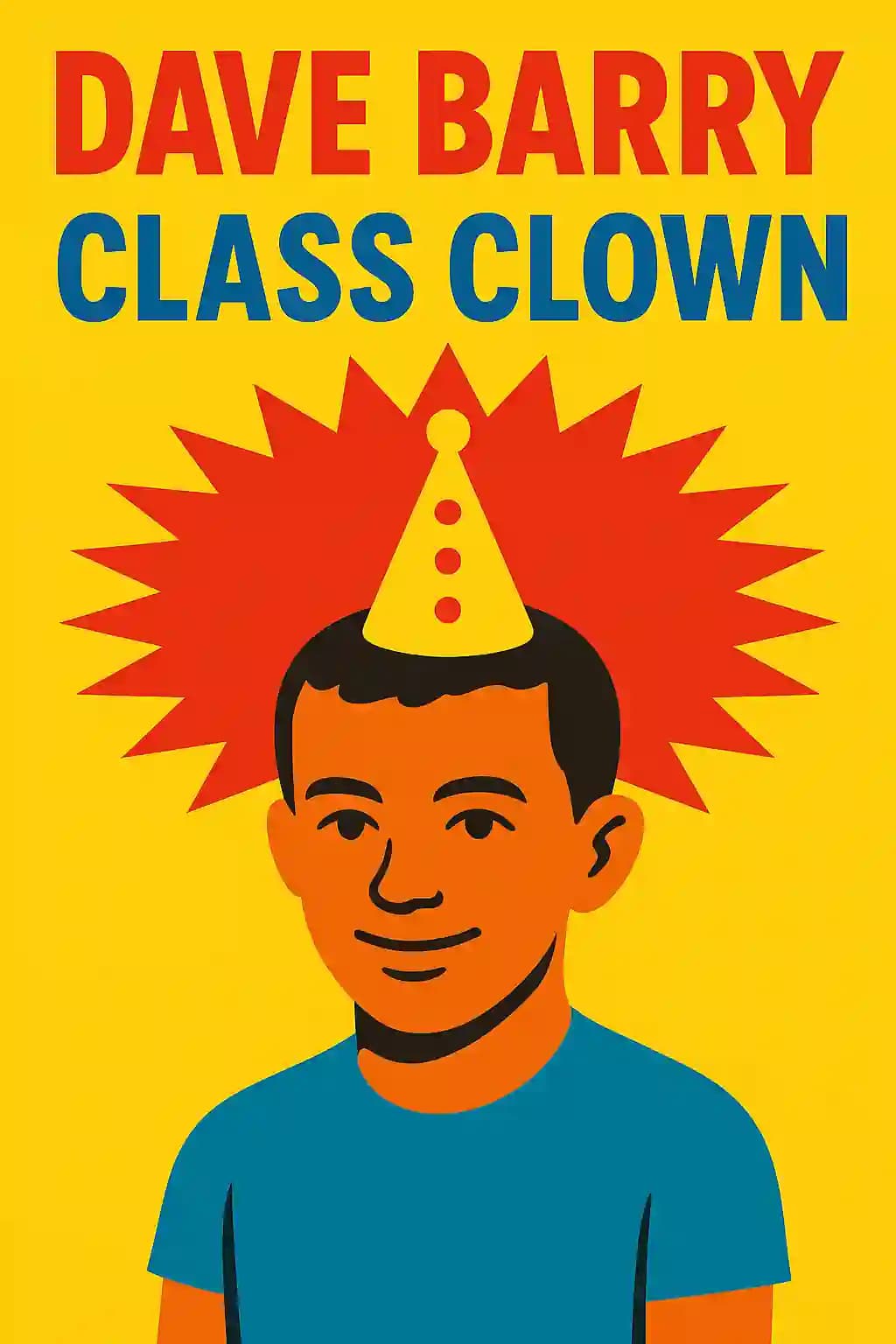
When Humor Meets Genius: The Life of a Class Clown
What happens when a kid who can't stop making jokes grows up to become one of America's most beloved humorists? Dave Barry's journey from small-town class clown to Pulitzer Prize-winning columnist is a testament to the power of finding your unique voice. His memoir isn't just a collection of funny anecdotes-it's a masterclass in how humor can help us navigate life's complexities. The book has earned praise from everyone from Stephen King (his bandmate!) to Jon Stewart, who called Barry "one of the funniest writers alive." With over 30 books translated into 25 languages and millions of devoted newspaper readers, Barry has created a legacy of laughter that spans generations. His influence extends beyond the page-he's inspired a TV show, a Broadway play, and even an international holiday (Talk Like a Pirate Day). Through it all, he's remained remarkably grounded, reminding us that sometimes the best response to life's absurdities is simply to laugh.
第2章
The Foundation: Parents Who Shaped a Humorist
My childhood in Armonk, New York during the 1950s provided the perfect breeding ground for a budding humorist. Our modest home, built by my Presbyterian minister father's own hands, was perpetually under construction-a metaphor, perhaps, for the ongoing development of my sense of humor. Behind our house stretched "the Woods," acres of undeveloped land where neighborhood kids roamed freely, climbing trees, damming creeks, and getting into the kind of mischief that would give today's helicopter parents heart attacks.
My father was the moral compass of our family-wise, kind, and deeply committed to helping others through his work with the New York City Mission Society. People naturally trusted him, calling at all hours with their problems, and he would listen calmly before putting on his hat and coat to help, regardless of the time. Despite the seriousness of his work, Dad was far from self-righteous. He loved parties, dancing, drinking, and humor of almost any kind. His appreciation for Robert Benchley's writing introduced me to the author who would significantly influence my own style.
When asked where I got my sense of humor, however, I always point to my mother. Born near Longmont, Colorado, she had a harder childhood than my father, growing up with little money during the Depression. After working her way through the University of Nebraska, she moved to Chicago where she unknowingly worked as a secretary for the Manhattan Project-and where she met my dad. They made each other laugh and eventually married-two funny people in love who raised four children together.
On the surface, Mom was a typical 1950s suburban housewife, but her sharp, dark sense of humor set her apart. She'd cheerfully call out "Don't drown, kids!" when we headed to the pond, or comfort us with "Oh well, someday we'll all be dead" when things went wrong. This gallows humor shaped my own comedic sensibilities in ways I'm still discovering decades later.
After Dad died of heart problems in 1984, Mom struggled with depression that worsened over time. During our last trip together, I was all business, lecturing her about making decisions while she just wanted connection. Shortly after, she took a massive overdose of Valium and alcohol. I still feel guilty about that visit-how selfish I was, thinking I knew what she needed when I had no idea what she was going through. Despite this guilt, the dominant emotion I feel about Mom is gratitude. She was the sharpest, funniest person I knew, and I owe much of my personality and career to her.
第3章
Education of a Wiseass: School Days and Discovering My Voice
Elementary school in the 1950s meant duck-and-cover drills against nuclear annihilation and terrifying polio fears. Despite these anxieties, school was generally positive-learning to read with Dick and Jane books (whose characters spoke "like actors in the climactic scene of a porn movie"), mastering basic math, and creating art projects with delicious white paste that tasted better than the cafeteria food from "giant government cans left over from some previous war, possibly the French and Indian."
When the Russians launched Sputnik in 1957, America's adults panicked while America's first rocket attempt reached "approximately the height of a mailbox, then blew up." Somehow, the blame for America falling behind landed on us fifth graders, who were suddenly expected to excel in math and science. We were the ones burdened with understanding the "cosine" while the actual responsible leaders avoided accountability.
Junior high brought the "deeply disturbing" experience of puberty-or in my case, the lack thereof. While my classmates transformed dramatically, I remained a late bloomer with thick glasses and my dad's amateur haircuts that left me with "an expanse of bare forehead that appeared to be the size of a regulation volleyball court." My dating life was nearly non-existent, with one painfully awkward date where my arm nearly required "amputation" from being perched nervously behind a girl's seat. At parties, while others slow-danced, I operated the record player and made hand farts-"the genesis of my career in humor."
At Pleasantville High School, I eventually found my niche as a "wiseass" alongside my best friend Lanny Watts. We "prided ourselves on taking nothing seriously" and "lived to make fun of things." We joined the fencing club just to mock it, with Lanny famously charging at an opponent while blowing a trombone instead of using a sword. My English teacher Regina Adams encouraged my attempts at humorous writing, even reading one of my essays anonymously to the class. In senior year, I published my first humor piece in the school newspaper, covering the unofficial "loadball game"-a chaotic, beer-fueled tackle football game played by senior boys. Seeing my work in print gave me a taste for publication that would shape my future career.
The comfortable high school bubble was gradually punctured by the sixties. I attended the 1963 March on Washington, standing near the Lincoln Memorial as Martin Luther King Jr. delivered his "I Have a Dream" speech-a feeling of certainty about being "on the good side" that would become rarer as I aged. Three months later came Kennedy's assassination, which left us stunned. After Dallas, the sixties brought an uneasy feeling that "nobody was in control" of events.
In January 1964, everything changed when the Beatles exploded onto the scene. My generation loved them immediately-not just for their music, but because they were smart, funny, and didn't take themselves seriously. We loved that older people hated their haircuts. I graduated from Pleasantville in 1965, elected Male Class Clown by my classmates, and headed to Haverford College where I spent more time playing in rock bands than studying literature. As the Vietnam War escalated, I performed alternative service as a bookkeeper after graduation, feeling guilty that I could avoid the draft when so many others couldn't. Despite my utter lack of direction, I would eventually find the best job any English major could have.
第4章
Finding My Lane: From Cub Reporter to Humor Columnist
In fall 1971, with no career plan beyond not remaining a bookkeeper, I landed a reporter job at the Daily Local News in West Chester, Pennsylvania for $98 a week. The paper was intensely local-covering everything from county commissioners to unusually large zucchinis. I loved the chaotic newsroom atmosphere, the unpredictability of assignments, and the camaraderie. During Tropical Cyclone Agnes in 1972, photographer Larry McDevitt and I spent days documenting the flooding disaster, once nearly getting swept away in waist-deep water. Late that night, toasting our survival with scotch in the empty newsroom, I realized: I love this job.
While reporting was my primary responsibility, I started regularly writing humor columns in the paper's Ad Lib feature. My first published humor piece on November 18, 1971 poked fun at mundane newspaper reporting. Though cringe-worthy now, these early columns showed the rudiments of my developing style, including my "Wildly Incorrect Authority" voice inspired by Robert Benchley, where I'd confidently spout nonsense about topics like wilderness survival or chess.
My career advanced quickly-first to city editor supervising stringers, then to news editor managing full-time reporters. After four years, believing I needed to move to "Big Time Journalism," I joined the Associated Press Philadelphia bureau-a decision I immediately regretted. The AP job involved mostly clerical work with little opportunity for creativity or humor. After a miserable year, I escaped to a business writing consultancy.
While this corporate job wasn't my passion, it proved valuable in three ways: I learned to speak confidently to tough audiences using humor, gained broader perspective beyond journalism's government-centric view, and improved my own writing by having to explain grammar mechanics to skeptical technical professionals. During downtime in hotels and airports, I continued writing humor columns, submitting them to my old paper for $22 each.
My big break came when Dave Boldt from the Philadelphia Inquirer's Sunday magazine published my essay about my son's birth and natural childbirth classes. The piece resonated with fellow Baby Boomers in journalism, leading to reprints in major papers, freelance opportunities, and even a book offer. Soon after, Gene Weingarten from the Miami Herald's Sunday magazine Tropic called with a job offer-one weekly column about anything I wanted. Despite competing offers from more prestigious publications, I chose the Herald because of the creative freedom and Gene's brilliant, boundary-pushing editing style. By spring 1983, I left the business world entirely for what was too much fun to be called work, becoming the Herald's humor correspondent from my home in Pennsylvania.
第5章
Tropic Magazine: The Mad Laboratory of Journalism
When I joined the Miami Herald in 1983, newspapers were thriving behemoths with no internet competition. The Herald boasted half a million circulation and over four hundred staff in its chaotic, cigarette-smoke-filled newsroom. But Tropic magazine operated in its own separate universe, both physically and philosophically.
The magazine was led by Gene Weingarten (who later won two Pulitzer Prizes at the Washington Post) with Tom Shroder as second-in-command. Both were brilliant editors and writers but organizational disasters. Gene's desk resembled a landfill covered in chewed, drool-soaked Bic pens. His management style was equally chaotic, exemplified by the time Knight Ridder executives visited and Gene, unprepared, accidentally asked the art director to "find the picture of the guy getting blown" (referring to a hurricane researcher). While everyone else chuckled briefly, Gene collapsed in uncontrollable, tear-streaming laughter until the bewildered executives simply left.
Tropic operated like a mad scientist's laboratory-unpredictable, experimental, and willing to risk catastrophe. Gene and Tom weren't interested in conventional journalism; they wanted to surprise, move, shock, and delight readers. They constantly pushed boundaries, frequently angering Herald management but producing remarkable journalism. One example: my 1989 cover story deliberately fomenting a basketball rivalry between Miami and Orlando, which began with a vicious assault on Orlando and culminated in a contest where winners joined us on a bus to the first Heat-Magic game. What truly outraged readers was the cover photo Gene convinced the executive editor to approve-me in a Heat jersey giving the middle finger while spinning a basketball.
I had two functions at Tropic: writing a weekly humor column on whatever topic amused me, and occasional longer cover stories. For my columns, Gene and Tom granted me remarkable freedom, cheerfully approving travel expenses for anything potentially entertaining. Once, I attended the First Annual French Wine Sommelier Contest at the Waldorf-Astoria, where I spent an evening among Serious Wine People while drinking "just gallons of wine" and mocking their pretentious approach. Walking unsteadily out afterward, notebook full of increasingly illegible notes ("BAT URINE"), I thought, "I cannot believe I am getting paid to do this."
My profile subjects had varied reactions to my approach. Florida Governor Bob Graham revealed himself as "deeply goofy" beneath his serious public persona, happily playing along with my ridiculous questions about harmonica safety and mailbox-sized toads. Miami Dolphins coach Don Shula, however, never forgave me for Gene's cover concept featuring a close-up photo of Shula's stomach, which he was notoriously sensitive about.
After traveling between Pennsylvania and Florida for Tropic stories, I realized I loved Miami despite its chaos-the highways where "everyone drives according to the laws of his or her individual country of origin," and lawns that "grow like a venereal disease." Though tempted by offers from the Los Angeles Times and Washington Post, I chose Miami in 1986. I didn't want to be trapped in Washington's political bubble when I'd come to love the freedom at Tropic to write about whatever random topic struck my fancy.
In 1987, I unexpectedly won a Pulitzer Prize for Commentary. The day of the announcement, I had planned to take my seven-year-old son Rob to Key West. When Gene called insisting I come to the Herald for a "mandatory meeting," I reluctantly agreed, telling Rob we'd go to Key West afterward. At the Herald, the newsroom was packed with people in on the surprise. To console my devastated son, I promised him a Nintendo-his greatest desire at that time. The front page photo the next day showed Rob hugging me ecstatically, which everyone assumed was joy about my Pulitzer when it was actually about the Nintendo. Ironically, Rob later became an investigative journalist at the Wall Street Journal and won his own Pulitzer in 2015.
第6章
The Reader Connection: From Flaming Pop-Tarts to Sewage Stations
My readers were a source of both inspiration and entertainment. When I conducted experiments like testing whether Rollerblade Barbie could ignite hairspray-soaked underwear, they became part of my journalistic process. This experiment-which confirmed that Rave Extra Hold hairspray on underpants would indeed burst into flames when struck by Barbie's sparking wheels-led to an appearance on David Letterman's show. I later returned to Letterman to demonstrate how strawberry Pop-Tarts could shoot flames several feet in the air when trapped in a toaster-another reader-inspired experiment.
My columns frequently provoked passionate reader responses, especially when I criticized beloved music. After mentioning Neil Diamond's "I Am... I Said" had questionable lyrics about chairs not hearing him speak, I unleashed a tsunami of outrage from Diamond's devoted fans. They furiously defended their idol, calling me an idiot, jealous, and talentless while listing his many hit songs as evidence of his genius. Rather than feel remorseful, I used their rage as material for another column, which generated even more passionate responses about other hated songs.
I similarly enraged the entire state of North Dakota by mocking their attempt to rebrand as simply "Dakota" and ridiculing Grand Forks' marketing language. North Dakotans responded with proud defenses of their state, including a letter from Grand Forks' mayor offering to name a sewage lifting station after me-an honor I accepted during a frigid January visit. Despite temperatures "minus four hundred degrees," they welcomed me warmly, took me ice fishing (which I described as pointless since "there are no fish under the ice"), and hosted a traditional potluck featuring hotdishes, Jell-O "salads," and dessert bars. The highlight was the dedication ceremony for the "Dave Barry Lift Station No. 16," capable of pumping 450,000 gallons of untreated sewage daily.
My readers enthusiastically joined my various crusades, most notably against telemarketers. In 2003, when telemarketers were challenging the National Do Not Call Registry in court, claiming a constitutional right to call people who didn't want to be called, I published the toll-free number of the American Teleservices Association and invited readers to share their "constitutionally protected views." The response was overwhelming-thousands called, completely overwhelming their phone system. The ATA's executive director complained that my column showed "malice" and would cost them in toll charges and staffing. Even the New York Times covered the incident, with me noting this reader reaction was "the most intense I've ever gotten. Even more than low-flow toilets."
Another unexpected success came when I promoted "International Talk Like a Pirate Day" after receiving a letter from two Oregon men who'd been celebrating it privately on September 19. I wrote a column explaining how everyday office conversations could be enhanced with pirate terminology ("Avast, me beauty" instead of "Hi, Mary"), and to my surprise, the idea caught on immediately. Years later, people worldwide still celebrate this "utterly pointless tradition" every September 19, mainly by saying "Arrrr."
Perhaps my most meaningful reader impact came from my colonoscopy column. After my brother Sam's early colon cancer diagnosis scared me into getting my long-overdue screening, I wrote candidly about the experience-from the nuclear laxative effects of MoviPrep to the surprisingly pleasant procedure itself. The column went viral, with gastroenterologists worldwide sharing it with patients. I've heard from people who got colonoscopies because of my column and discovered serious issues requiring immediate treatment-some even said it saved their lives.
第7章
Politics Through a Humorist's Lens: Campaigns and Conventions
In 1984, the Miami Herald sent me to cover the New Hampshire presidential primary, despite some editors doubting whether a humor columnist could handle serious political reporting. The campaign trail offered perfect comedy material-exhausted candidates with fake smiles, accompanied by even more exhausted staff and grumpy reporters, all pretending to care about local voters' concerns while performing demeaning photo ops like flipping pancakes or bowling.
My irreverent coverage upset some Herald staffers who thought it demeaned the paper's reputation, but I maintained that nobody could possibly be more cynical about our political system than our politicians themselves. The Herald let me continue, and I went on to cover the 1984 national conventions, where I mocked Mondale's running mate selection process and the Republicans' attempt to reclaim "the indoor record for Mindless Patriotism Displays."
At the 1988 Democratic convention in Atlanta, I witnessed the absurdity of political media coverage firsthand. With the Dukakis-Bentsen ticket already decided, no actual news could occur, yet a massive press corps descended on the event, transforming trivia into headlines. To expose this media circus, I enlisted fellow columnists Erik Lacitis and Bob Morris in an experiment. We cut eyeholes in cardboard boxes, placed them on our heads, and stood in the protest zone as "People with Boxes on Their Heads." Within seconds, photographers swarmed us. We gave dozens of interviews explaining nothing more than that we were people wearing boxes on our heads. Our "protest" became the lead item in the AP's convention roundup and appeared in multiple newspapers nationwide.
Bill Clinton's presidency provided unmatched political entertainment. Like a pudgy Tom Cruise in a Mission: Impossible movie, he constantly escaped seemingly inescapable predicaments. I witnessed this talent during the 1992 New Hampshire primary when, despite being written off by the media after draft-dodging and philandering accusations, he managed to stay viable. One night in Manchester, he worked the kitchen staff at our restaurant before approaching our table of cynical journalists who'd been trashing him all week. Remarkably, he greeted each of us as if he knew exactly who we were-even those of us who specialized in "booger jokes" rather than political reporting. His charm was so effective that after he left, one journalist joked about voting for him, another about campaigning for him, and a third about having sex with him.
When Barack Obama won the 2008 election, two historic things happened on Inauguration Day: Barack Obama became our first Black president, and I marched in his inaugural parade. As a proud member of the World Famous Lawn Rangers-an elite marching unit whose membership is "strictly limited to anybody who wants to join"-I performed precision maneuvers with a lawnmower and broom alongside fifty-five other Rangers. Years earlier, Obama had posed for a photo with the Rangers while campaigning for Senate, triumphantly holding a toilet plunger aloft. This connection somehow got us into the parade. Despite the cold January night and sparse crowds, we executed our two precision maneuvers-"Walk the Dog" and "Cross and Toss"-for the presidential party. Obama pointed to the mower displaying his plunger photo and laughed with the First Lady.
The 2016 election proved that "smart, highly educated, impressively credentialed people sometimes have no clue what is actually going on." At a private dinner with journalists and political professionals during the Republican convention, everyone knew "with 100 percent certainty that Hillary Clinton was going to defeat Donald Trump." I had been making fun of Trump for decades but, like other journalists, viewed his 2016 candidacy "as basically a joke." After Trump's victory, politics has been "a shitstorm ever since," and I've largely stayed away from the campaign trail.
第8章
Beyond Columns: Books, TV, and Rock Stardom
In June 1984, I received an unexpected call from a talent coordinator for The Tonight Show, who was considering booking me as a guest for JOHNNY FREAKING CARSON. At that time, Carson's show was enormous-an appearance could make a comedian's career. Despite being an unknown author with just two modest books under my belt, I somehow landed this opportunity after she saw a tape of my local Philadelphia TV appearance.
My Tonight Show experience was surreal-flying from Los Angeles to Philadelphia, riding in my first limo, and having a dressing room with my name on it. The interview went wonderfully. Carson proved to be "really good at interviewing," setting me up for jokes and letting me have the laughs. When the cameras stopped rolling, Carson lit a cigarette, turned to me and joked about my book's do-it-yourself premise: "I used to try to do it yourself. [Pause.] You can't do shit yourself."
This experience taught me where authors rank in the celebrity ecosystem-near the bottom. While occasionally feeling famous during moments like a Carson interview, most times authors are reminded of their low status. The book industry is "small potatoes" compared to other entertainment forms. A New York Times bestseller might sell only about a thousand copies in a week-"slightly less than the average attendance at a single game of the Central California minor league baseball team the Modesto Nuts."
My books did well enough that CBS turned them into a sitcom called "Dave's World," which ran for four seasons. Many people wrongly assumed I wrote the show and that it resembled my actual life. In reality, professional TV writers created stories about "Dave" getting into wacky situations with his fictional newspaper colleagues at the "Miami Record-Dispatch," while my real life consisted of "sitting in a room with two dogs and zero other humans" trying to write funny material.
My first venture into fiction came when Tom Shroder organized thirteen South Florida writers to collaborate on a serial story for the Herald's Sunday magazine. I wrote the first chapter about a manatee named Booger, and the story grew increasingly bizarre, involving "two severed heads, both allegedly belonging to Fidel Castro" and a manatee that became "like some kind of big fat aquatic Lassie." To our surprise, Putnam published it as a book.
I met Ridley Pearson as original members of the Rock Bottom Remainders, a rock band of authors founded in 1992. Despite including literary stars like Stephen King, Amy Tan, and many others, we were terrible musicians-our genre was "hard-listening music" and we had t-shirts saying "This Band Plays Music as Well as Metallica Writes Novels." Nevertheless, being in the band has been "one of the highlights of my life"-both for the camaraderie with other writers and for making music again after my Federal Duck days.
The pinnacle came in 1994 at a booksellers convention in Los Angeles when Bruce Springsteen joined us onstage. I handed him my guitar (forever after able to claim Bruce Springsteen played my guitar) and during our performance of "Gloria," Bruce actually sang backup for me-which I joke is when his career really took off.
Ridley and I became coauthors in 2004 when his daughter asked how Peter Pan met Captain Hook. What began as a "quick, fun little project" evolved into a 450-page YA novel, "Peter and the Starcatchers," that dominated my writing life for six years. The book was wildly successful, even becoming a Tony-winning Broadway play.
In 2003, I received an email from Steve Martin inviting me to join his writing team for the Oscars. Initially intimidated by the experienced showbiz writers, I discovered they were remarkably generous and collaborative. On Oscar night, we writers watched from a small room offstage with direct access to the teleprompter operator. After Michael Moore's controversial anti-Bush speech, we had just minutes to craft a response for Martin, who quipped: "It's so sweet backstage, you should see it. The Teamsters are helping Michael Moore into the trunk of his limo."
第9章
The Last Word: Life Lessons from a Professional Wiseass
On January 2, 2005, I ended my weekly column despite its continued success in roughly 500 newspapers. I quit for two reasons: first, to stop before joining "the horde of people who think I used to be funnier," and second, to work on other projects without constant deadlines. Though I still write occasional pieces and an annual Year in Review, I don't miss the weekly column. However, the newspaper business I loved has changed dramatically as the internet destroyed its revenue model and political discourse has grown increasingly toxic.
Looking back at a list of twenty-five life lessons I created when I turned fifty, five still strike me as fundamentally true and worth sharing:
1. You should not confuse your career with your life.
2. A person who is nice to you, but rude to the waiter, is not a nice person.
3. No matter what happens, somebody will find a way to take it too seriously.
4. Your friends love you anyway.
5. Nobody cares if you can't dance well. Just get up and dance.
I'd add one more wisdom nugget that seems truer as I age: "It's gonna be OK." Throughout my life, I've heard countless apocalyptic predictions about nuclear war, climate catastrophes, resource depletion, economic collapse, and government takeovers. Yet life continues. While we should educate ourselves about serious issues, spending all your days worrying about catastrophes that never materialize means wasting the only days you get. Despite industries and political parties profiting from fear, life goes on.
As I approach the end of this book, I contemplate mortality-wondering when and how death will come, whether I'll die with dignity or "Elvis-style," and what my obituary might say beyond mentioning International Talk Like a Pirate Day (which wasn't even my idea). Though I don't have answers to these questions, I claim to have experienced being dead through a humorous anecdote involving an opera performance. After writing a column suggesting opera could be fatal to humans (based on an okapi dying from stress triggered by opera singers), I received hate mail but also an invitation to play a corpse in Puccini's Gianni Schicchi. The experience involved itchy costumes, makeup, and lying motionless while professional singers bellowed in a foreign language. My conclusion about death: it's loud and itchy, and I don't plan to repeat it unless absolutely necessary.
So that's my memoir. You now know where I got my ideas (Costco) and you're up to date on my life, as of age seventy-seven. If anything major happens to me in the future, I believe I'd be legally required to write another memoir, which I am hoping to avoid. So my plan from now on is to lead a quiet, event-free life-to take it easy as I drift, at a leisurely pace, toward age eighty, and whatever lies beyond. Whatever it is, I think it's gonna be OK.