Transform education with "The Blended Workbook," the hands-on guide revolutionizing how schools integrate technology. Endorsed by Harvard's Clayton Christensen, this companion to Horn's acclaimed "Blended" gives educators the practical blueprint that's reshaping learning environments across America. Ready to design tomorrow's classroom today?
Michael B. Horn and Heather Staker, co-authors of Blended: Using Disruptive Innovation to Improve Schools, are leading voices in education innovation and blended learning design.
Horn, co-founder of the Clayton Christensen Institute, brings expertise in disruptive innovation frameworks, building on his prior work as co-author of the bestselling Disrupting Class. Staker, an education strategist and founder of ReadytoBlend, was named one of Scholastic’s “Five People to Watch in Education” for her research on K-12 blended models.
Their collaborative work combines rigorous theory with actionable strategies for integrating online and in-person learning to personalize education, optimize resources, and align classrooms with student motivation. The book, rooted in real-world case studies and data from schools nationwide, has become a foundational resource for educators seeking to implement sustainable, student-centered systems.
Horn’s insights have been featured in Education Week and TED Talks, while Staker’s frameworks for blended learning classification are widely cited in academic and policy circles. Published by Jossey-Bass with a foreword by Clayton Christensen, Blended remains a critical text for district leaders and teachers navigating the intersection of technology and pedagogy.
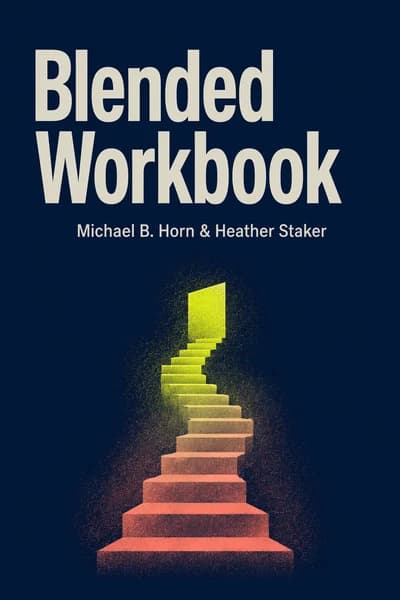
The Blended Workbook is a practical guide for designing blended learning programs in K-12 education. Co-authored by Michael B. Horn and Heather Staker, it provides hands-on exercises, case studies, and frameworks to help educators transition from traditional classrooms to student-centric models. The workbook complements Blended: Using Disruptive Innovation to Improve Schools, offering step-by-step modules for rallying stakeholders, budgeting, culture-building, and selecting blended learning models.
This book is ideal for K-12 educators, administrators, and policymakers seeking actionable strategies to implement blended learning. It’s particularly valuable for school leaders forming innovation teams, curriculum designers reimagining physical/virtual spaces, and teachers aiming to personalize instruction. The workbook’s exercises and templates cater to both beginners and those refining existing programs.
Yes, for its actionable tools and real-world insights. Unlike theoretical guides, it includes 50+ case studies, worksheets for budget planning, and modules for overcoming implementation hurdles. Educators praise its focus on “discovery-driven planning” to test ideas cheaply and adapt quickly. However, it requires commitment—the 352-page workbook demands hands-on engagement.
Key ideas include:
The book applies Clayton Christensen’s disruptive innovation theory to education, arguing that blended learning can transform “monolithic, factory-model systems” into flexible formats. It guides schools to start small (e.g., labs or afterschool programs), prove effectiveness, then gradually replace traditional structures—avoiding backlash from abrupt overhauls.
Yes, it analyzes 50+ case studies, including successes and failures. Examples span rural districts using blended learning to expand course access and urban schools personalizing for English learners. Each case ties to workbook exercises, like redesigning a school’s schedule or evaluating EdTech tools.
It advocates “jobs to be done” theory, urging schools to design around students’ emotional/academic needs. Modules help educators map student journeys, create flexible pacing, and integrate choice—such as letting students pick project topics or learning modalities (videos, apps, peer groups).
Some note its intensive time requirement—completing all modules takes months. Others argue it underestimates systemic barriers like outdated policies or underfunded broadband access. However, most praise its balance of ambition and practicality.
While Disrupting Class explains why education needs innovation, The Blended Workbook focuses on how. It translates Christensen’s theories into checklists, surveys, and budgets, making it a tactical sequel. For example, it expands on “disruptive innovation” with a 10-step implementation plan.
As schools adopt AI tutors and hybrid post-pandemic models, the workbook’s frameworks help navigate new tools. Its emphasis on iterative testing aligns with agile development trends, while modules on equity address persistent opportunity gaps.
著者の声を通じて本を感じる
知識を魅力的で例が豊富な洞察に変換
キーアイデアを瞬時にキャプチャして素早く学習
楽しく魅力的な方法で本を楽しむ
Blended learning isn't simply adding technology to classrooms.
Personalization at scale.
Smart school leaders implement a two-part strategy.
Technology for technology's sake.
Successful blended learning implementations begin with clearly defined problems.
『Blended Workbook』の核心的なアイデアを分かりやすいポイントに分解し、革新的なチームがどのように創造、協力、成長するかを理解します。
『Blended Workbook』を素早い記憶のヒントに凝縮し、率直さ、チームワーク、創造的な回復力の主要原則を強調します。

鮮やかなストーリーテリングを通じて『Blended Workbook』を体験し、イノベーションのレッスンを記憶に残り、応用できる瞬間に変えます。
何でも質問し、声を選び、本当にあなたに響く洞察を一緒に作り出しましょう。

"Instead of endless scrolling, I just hit play on BeFreed. It saves me so much time."
"I never knew where to start with nonfiction—BeFreed’s book lists turned into podcasts gave me a clear path."
"Perfect balance between learning and entertainment. Finished ‘Thinking, Fast and Slow’ on my commute this week."
"Crazy how much I learned while walking the dog. BeFreed = small habits → big gains."
"Reading used to feel like a chore. Now it’s just part of my lifestyle."
"Feels effortless compared to reading. I’ve finished 6 books this month already."
"BeFreed turned my guilty doomscrolling into something that feels productive and inspiring."
"BeFreed turned my commute into learning time. 20-min podcasts are perfect for finishing books I never had time for."
"BeFreed replaced my podcast queue. Imagine Spotify for books — that’s it. 🙌"
"It is great for me to learn something from the book without reading it."
"The themed book list podcasts help me connect ideas across authors—like a guided audio journey."
"Makes me feel smarter every time before going to work"

Blended Workbookの要約をPDFまたはEPUBで無料でダウンロード。印刷やオフラインでいつでもお読みいただけます。
Imagine a classroom where every student receives personalized instruction perfectly tailored to their needs, learning at their optimal pace with exactly the right content. This educational ideal - one-on-one tutoring - dramatically outperforms traditional instruction but remains prohibitively expensive at scale. Enter blended learning: the practical solution that combines online learning (where students control time, place, path, and pace) with supervised brick-and-mortar experiences to create an integrated learning journey. This isn't simply adding technology to classrooms - it's a fundamental shift enabling what was previously impossible: personalization at scale. The traditional factory model of education is giving way to competency-based approaches where students must demonstrate understanding before advancing, embedding perseverance and grit into the learning process. Just as technology has enabled mass customization in other sectors, online learning allows students to fast-forward through mastered concepts, pause to digest information, or review difficult material - freeing teachers to become learning designers, mentors, and facilitators who can reach each student in previously impossible ways.