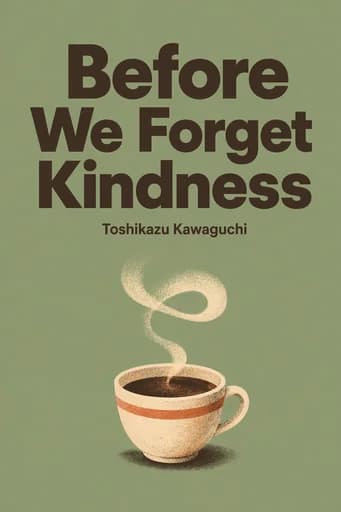
『やさしさが忘れないうちに』の要約の概要
川口俊和による「コーヒーが冷めないうちに」シリーズ第5弾では、不思議な喫茶店でコーヒーと共にタイムトラベルを体験できます。数百万部を突破したこのベストセラーシリーズは、受賞歴のある舞台作品から始まり、記憶が薄れゆく前に交わされる優しさを深く掘り下げ、読者を魅了し続けています。
やさしさが忘れないうちにの要約をダウンロード
やさしさが忘れないうちにの要約をPDFまたはEPUBで無料でダウンロード。印刷やオフラインでいつでもお読みいただけます。
川口俊和による「コーヒーが冷めないうちに」シリーズ第5弾では、不思議な喫茶店でコーヒーと共にタイムトラベルを体験できます。数百万部を突破したこのベストセラーシリーズは、受賞歴のある舞台作品から始まり、記憶が薄れゆく前に交わされる優しさを深く掘り下げ、読者を魅了し続けています。
やさしさが忘れないうちにの要約をPDFまたはEPUBで無料でダウンロード。印刷やオフラインでいつでもお読みいただけます。
コロンビア大学卒業生が開発 | サンフランシスコ発
平均評価
7,840件以上のアプリ評価
BeFreedコミュニティ
正直、まだアプリを使いこなせていませんが、この数日使っただけで本当に感動しました… BeFreed は、今まで使ったどの学習アプリともレベルが違います。夢中になれるうえに集中力も実際に上がるので、スマホをだらだら見てしまう人にぴったりです!
@ladyInfinity
ちょうど 23 日前に BeFreed を購入して、それから毎日欠かさず使っています。仕事の流れと学習習慣に完全に溶け込みました。
@jayallen
正直なところ、このアプリは期待をすべて超えてきました。どんなテーマでも音声を生成してもらえて、その結果には驚かされます。私の専門は心理療法で、多分野にまたがる領域ですが、それでも回答はとても正確です。
@Raguipa
何よりありがたいのは、スマホをだらだら見る時間が減ったことです。探す時間が減って、吸収する時間が増えました。オーディオブック、ポッドキャスト、学習プランの組み合わせが素晴らしいです。
@colonyofcreatorsNGO
私は 24 年間、PhotoReading 加速学習のインストラクターをしています… 本と読書と学びが私の専門ですが、BeFreed は情報を消化しやすい形で届ける革新的なアプローチを見事に実現しています。
@BeFreed user
ただの本の要約アプリではありません。「ファン」スタイルを使ってみたら、従来のやり方よりずっと良い要約で、アイデアもつかみやすいです。これだけでも十分元が取れます。
@austinakon
このアプリが大好きです。数日使っただけで、聞くのが止まらなくなりました。始め方として最高です。
@jcrules328
本当に気に入っています。約 1 か月試していますが、まさに掘り出し物だと感じます。BeFreed で自分だけのテーマを作れるのが便利で、声も素晴らしく、ナレーションの選択肢は無限です。
@DanielCZ
役立つ情報やアイデアを 8〜15 分のポッドキャスト風音声にぎゅっとまとめて聞けるのが最高です。ポッドキャストは余計な話が多くて苦手でしたが、これは無駄を全部そぎ落としてくれます。
@BeFreed user
博士課程の仕上げの段階で、なじみのない資料を大量に読む必要があります… BeFreed ならプロンプトを入力するだけで、アプリが資料を探して音声ポッドキャストを作ってくれます。BeFreed のほうが NotebookLM よりも流れがスムーズだと感じます。
@Brad
朝食を作りながら、散歩しながら、通勤しながら聞くものを YouTube でよく探していましたが、BeFreed は広告も余計な話もなしで、もっと的を絞った聞き方をさせてくれます!
@BeFreed user
このプラットフォームの一番の魅力は、その万能さです。扱えないテーマは文字どおりひとつもありません。何を投げても応えてくれます… 制限がまったくないのに約束をきちんと果たしてくれる学習ツールには、なかなか出会えません。
@jayallen
BeFreed は素晴らしいです。使いやすいデザインのおかげで、操作に迷う時間が減り、学ぶ時間が増えました。オーディオブック、ポッドキャスト、学習プランの組み合わせは天才的で、毎日の習慣がすっかり変わりました。
@BeFreed user
最初はイタリア語でポッドキャストを作る方法を理解するのに少し時間がかかりましたが、わかった瞬間、最高でした!どんなテーマでも説明してもらえて、しかもとても賢く、うまく話してくれます!
@matteo77
BeFreed は毎日使うオーディオブックアプリになりました… 一番気に入っているのは、自分のテキストを入れると、外出先でも聞ける音声にしてくれるところです。
@kotanzu1




やさしさが忘れないうちにの同じアイデアを、あなたに合う声・深さ・ペースで学べます。いつでも切り替えられます。
In a quiet corner of Tokyo's Jimbocho district sits an unassuming cafe called Funiculi Funicula, where magic brews alongside the coffee. This cafe has become a cultural phenomenon in Japan and beyond, captivating readers with its blend of magical realism and profound human emotion. Toshikazu Kawaguchi's novel isn't just another fantasy story-it's a meditation on regret, connection, and the healing power of confronting our past. The book has developed a cult following among celebrities like Emma Watson and Natalie Portman, who have praised its unique approach to time travel as a vehicle for emotional growth rather than plot-driven adventure. What makes this story particularly resonant in our fast-paced digital age is its insistence on limitations-even magic has rules, and time travel comes with strict constraints. This tension between magical possibility and human limitation creates a framework for exploring what truly matters when we're given a second chance.
Funiculi Funicula isn't your ordinary cafe. Operated by the towering, stoic Nagare Tokita and his cousin Kazu, it occupies an unremarkable basement in a quiet Tokyo neighborhood. Despite its modest appearance - wooden chairs, vintage coffee equipment, and warm yellow lighting - it offers something no other establishment can: the chance to travel through time via a special cup of coffee. The cafe's ambiance itself seems frozen in time, with its antique clock perpetually showing 8:00 and the lingering aroma of freshly ground coffee beans. The rules governing this extraordinary ability are non-negotiable and meticulously enforced by Nagare, who recites them with the gravity of ancient wisdom. Travelers can only remain in the past for the duration it takes for coffee to cool, approximately ten minutes - barely enough time for a meaningful conversation, yet long enough to speak words left unsaid. Nothing done in the past can change the present, a rule that proves both frustrating and liberating for visitors. The designated time travel chair must be previously occupied by someone else, creating an invisible thread connecting past and present patrons. Visitors can only meet people who have themselves visited the cafe, forming an exclusive community of temporal travelers. Most critically, travelers must finish their coffee before it gets cold, or they risk becoming permanent ghostly observers, forever trapped between times - a fate that befell a previous visitor whose story is whispered as a cautionary tale. These constraints aren't merely plot devices - they're the philosophical foundation of the narrative. In our modern world where technology promises unlimited possibilities and instant solutions, Kawaguchi deliberately presents a more nuanced view of human connection. The cafe's rules mirror life's fundamental limitations: we can revisit our memories but cannot alter what happened; we have precious little time with those we love; and often, the most significant moments occur in unexpected or uncomfortable settings. Each rule serves as a metaphor for the boundaries that shape authentic human experience. What makes these rules particularly poignant is how they force characters to confront their true motivations. Without the ability to change outcomes, travelers must instead focus on transforming themselves - their perspectives, their understanding, and their capacity for acceptance and forgiveness. The cafe becomes a sacred space of reflection and revelation, where the real transformation occurs not in the timeline but in the human heart. Some visitors initially rage against these limitations, but eventually discover that the rules create the very conditions necessary for genuine emotional growth. This approach stands in stark contrast to typical time travel narratives where protagonists desperately attempt to rewrite history. Here, the inability to change events creates a profound shift in focus - from doing to being, from fixing to accepting. It's a powerful metaphor for how we might approach our own regrets and missed opportunities, suggesting that perhaps the real purpose of revisiting the past isn't to change it, but to change how we carry it with us into the future.
『やさしさが忘れないうちに』の要約の一語一語が音声に合わせてリアルタイムでハイライトされ、自然に読み進められます。
Seven-year-old Yuki Kiriyama arrives at the cafe with an unusual request - to revisit the moment his parents announced their divorce. His story offers a heartbreaking glimpse into how children process family dissolution and the extraordinary emotional intelligence they sometimes develop in response to adult decisions. Clutching his favorite stuffed penguin, which his parents bought him during happier times, Yuki displays a maturity that belies his young age. Yuki's parents, Kenji and Aoi, had a marriage that deteriorated through mutual resentment and misaligned expectations. Aoi, formerly a successful marketing executive, felt increasingly isolated in her role as a stay-at-home mother. She watched Kenji advance his career while she handled every aspect of Yuki's care - from doctor's appointments to school events. Meanwhile, Kenji, climbing the corporate ladder at a prestigious tech firm, expected Aoi to return to work after Yuki turned three, viewing her continued focus on motherhood as unnecessarily intensive. Their arguments escalated over childcare responsibilities, with Kenji dismissing childcare as "different from work" and Aoi feeling unappreciated for the countless invisible tasks of motherhood. Despite maintaining cheerful facades during a Christmas trip to Disneyland for Yuki's sake - complete with matching Mickey ears and professional family photos - they announced their divorce that same evening at a small cafe near the park. What makes Yuki's story particularly moving is his sophisticated motivation for time travel. After two years of living between households, experiencing both his father's new girlfriend Kaede - who teaches elementary school and brings Yuki science projects - and his mother's boyfriend Nishigaki - who takes him fishing and remembers his favorite snacks - he realized his parents are genuinely happier in their new relationships. Rather than trying to prevent the divorce - as we might expect from a child - Yuki wants to return to that painful moment to replace his tears with a smile of acceptance, honoring the wish he made while watching the fireworks at Disneyland for his parents' happiness. This remarkable selflessness challenges our assumptions about children's capacity for emotional processing and empathy. Yuki has somehow transcended his own pain to prioritize his parents' happiness - a reversal of the natural order that leaves even the cafe's most cynical regulars speechless. His understanding that love sometimes means letting go shows wisdom beyond his years. Yet when he actually travels back to that winter evening, seated in the same booth with his hot chocolate growing cold, Yuki finds himself crying even harder than before, unable to control his emotions despite his best intentions. This scene brilliantly captures the gap between intellectual understanding and emotional reality - a divide that exists regardless of age. No matter how much we prepare ourselves for difficult moments, some pain simply cannot be rationalized away. Through Yuki's experience, we see how even the most well-intentioned emotional suppression often fails in the face of genuine feelings. His story suggests that perhaps authentic emotional expression - not stoic acceptance - is sometimes the truest form of love. The cafe staff, watching this young boy struggle between his desire to be strong and his need to grieve, realize that his inability to fake happiness might actually be his greatest gift to his parents. His story asks us: Is it really better to hide our pain to make others comfortable, or is there healing in allowing ourselves and others to witness our genuine feelings?
Perhaps the most poignant story involves new mother Megumi Sakura, who visits the cafe with her newborn daughter. Her husband Riuji was fatally assaulted before their child was born, leaving Megumi to face motherhood alone and their baby without a name-a profound cultural significance in Japan, where names are registered within fourteen days of birth and rarely changed. Megumi's desire to travel back in time so her husband can name their child and see her at least once reveals the devastating incompleteness that death leaves behind. Unlike other characters who seek to resolve conflicts or express unspoken feelings, Megumi's journey addresses something more fundamental-the creation of family identity through shared experience. When she arrives in the past with their baby, Riuji immediately recognizes that she's from the future and quickly deduces what this means about his own fate. This moment subverts our expectations-instead of being shocked or devastated by the knowledge of his impending death, Riuji focuses entirely on meeting his daughter, gently touching her face and sharing his dreams of fatherhood. As Megumi's time grows short, she realizes the true nature of what she had previously dismissed as Riuji's childish behavior-it was always his fundamental kindness. When he had once asked about drinking her coffee, he wasn't being immature; he was intuitively protecting her, knowing she wouldn't be able to bring herself to leave him crying alone. This realization transforms her understanding of their relationship. Sometimes what we perceive as immaturity in others is actually emotional intelligence expressed differently than we expect. Riuji's "childishness" was often his way of carrying emotional burdens so Megumi wouldn't have to-a profound form of love she only recognizes in retrospect. Their final exchange captures the bittersweet beauty of their relationship. Rather than burden him with her grief, Megumi chooses to lighten his heart: "If Yu ever brings a lousy guy home, I'll punch him in your place!" Riuji laughs through his tears and whispers, "Make sure you do that." In this moment, they create a shared future neither will experience together but both can imagine-a form of connection that transcends Riuji's death. When Megumi returns to the present, she names their daughter "Yu"-a simple yet perfect tribute to this moment of connection across time. The beauty of this resolution lies in its recognition that while death creates absences that cannot be filled, love creates meanings that cannot be erased.
The story of Fumio Mochizuki and his estranged daughter Yoko explores how pride and poor communication can fracture family relationships-and how time travel offers not an escape from consequences but a path toward acceptance and reconciliation. Mochizuki had opposed his daughter Yoko's marriage after she knew her fiance for only two months, seeing it as another impulsive decision in a pattern of following others' leads. What he interpreted as lack of conviction, his wife Kayoko recognized as responsibility. Their disagreement led to Yoko's elopement and years of estrangement, with Mochizuki unaware that Kayoko had maintained secret contact with their daughter. The complexity of this family dynamic is revealed layer by layer. We learn that Yoko's marriage to Tetsuya had indeed been disastrous-he became violent during her pregnancy and had affairs. After divorcing him, she kept the truth from her mother while raising her son Mitsuru alone, working multiple jobs and living in a newspaper delivery office. When she was scammed by another man who stole her savings, she considered calling her father, only to learn he had died from a stroke. What makes this story particularly compelling is how it explores the ways families protect and hurt each other simultaneously. Kayoko hides her contact with Yoko to maintain peace with her husband. Yoko hides her struggles to preserve her mother's happiness. Mochizuki's gruff exterior masks his deep care for his daughter's wellbeing. Each character thinks they're doing what's best, yet their secrecy and assumptions create deeper wounds. When Mochizuki travels to the future to meet his daughter after his own death in that timeline, he finally does what he couldn't do in life-apologize and admit he was wrong. This simple act of humility creates the space for Yoko to express what she couldn't say before her father died-the traditional words a daughter tells her father before marriage, thanking him for his care and expressing her honor in being his daughter. The power of this exchange lies in its recognition that sometimes the most important words are the simplest ones. "I was wrong" and "Thank you" can heal wounds that years of silence have created. The cafe's magic doesn't change the past or erase the years of estrangement, but it offers something perhaps more valuable-the chance to die without regret and to grieve without bitterness.
The final story delves into perhaps the most universal of all human regrets - words of love left unspoken until it's too late. Tsumugi and Ayame's friendship blossomed in junior high school, initially bonding over their shared fascination with historical castles. Their relationship was characterized by a unique dynamic where they communicated in elaborate samurai language, complete with archaic honorifics and theatrical declarations that became their special code. However, beneath this playful exterior, Tsumugi harbored a complex web of emotions, dominated by an intense jealousy of Ayame's natural grace, academic success, and effortless popularity. The story takes a pivotal turn when Tsumugi learns that Hayato, a popular classmate, had confessed to Ayame but was turned down. This incident triggers deep-seated insecurities in Tsumugi, who had always measured herself against Ayame's seemingly perfect life. Convinced that she could never find true happiness while remaining in Ayame's shadow, Tsumugi makes the fateful decision to distance herself, systematically avoiding all contact with her once-closest friend. The weight of this decision only becomes apparent years later at their high school reunion, where two devastating revelations shatter Tsumugi's world: Ayame had rejected Hayato because she harbored romantic feelings for Tsumugi, and more crushingly, Ayame had succumbed to cancer seven years prior. The truth forces Tsumugi to confront the destructive nature of her jealousy. A forgotten message from Ayame requesting to meet at "that mysterious cafe" - their old favorite hangout spot - haunts her with its implications. This was likely Ayame's final attempt to reveal her feelings before her death, making Tsumugi's rejection all the more painful in retrospect. The cafe, once a symbol of their friendship, becomes a monument to missed opportunities and unspoken truths. Through the mysterious power of time travel, Tsumugi encounters an Ayame dramatically changed by her illness. Her once-envied beauty is altered by aggressive cancer treatments, yet her spirit remains undiminished. She maintains their cherished samurai speech pattern - a detail that emphasizes how some bonds transcend physical appearance. In this bittersweet reunion, Ayame finally presents Tsumugi with Valentine's chocolate, along with a heartfelt confession of her romantic feelings. The return to the present brings another revelation: Ayame's interest in castles had been fabricated from the start, a pretense to spend time with Tsumugi whom she had loved since their first meeting. This narrative masterfully explores how personal insecurities can create emotional blindspots, preventing us from recognizing genuine love and connection. Tsumugi's obsession with comparing herself to Ayame created a self-imposed barrier that blocked her from seeing the depth of Ayame's affection. Her journey illustrates that jealousy often acts as a distorting lens, magnifying our perceived inadequacies while obscuring the authentic connections we already possess. The Valentine's chocolate emerges as a powerful metaphor for lost and reclaimed opportunities. While Tsumugi cannot alter the past or prevent Ayame's death, the supernatural intervention allows for a kind of emotional resolution. Ayame dies having expressed her true feelings, while Tsumugi gains the bitter wisdom that sometimes the most precious gift we can give or receive is the courage to be honest about our feelings before it's too late. Their story serves as a poignant reminder that time, once lost, cannot be reclaimed except in memory and regret.
『やさしさが忘れないうちに』の要約の一語一語が音声に合わせてリアルタイムでハイライトされ、自然に読み進められます。
Beneath these interconnected stories lies a profound philosophical exploration of time, regret, and human connection. The cafe's magical premise allows Kawaguchi to examine how we might approach our deepest regrets if given a second chance - especially when that chance doesn't include the power to change outcomes. This limitation creates a unique lens through which to examine the nature of human relationships and the weight of past decisions. The novel delves deep into the psychology of regret, illustrating how different characters process and cope with their past actions. Some arrive at the cafe bearing guilt over words left unsaid, others struggle with choices that altered the course of multiple lives, and still others grapple with moments of inaction that haunt them. Through their journeys, we see how regret shapes not only our memories but our present-day relationships and self-perception. This limitation forces characters to confront what truly matters in human relationships. If we can't alter events, what purpose does revisiting the past serve? The answer emerges through each story: understanding, forgiveness, expression, and closure become the true objectives. A mother seeking to reconnect with her estranged daughter discovers that witnessing past events from a new perspective helps her understand both her child's actions and her own mistakes. A man hoping to prevent his friend's death learns that the value lies not in changing the outcome but in fully appreciating the depth of their connection. The inability to change external circumstances shifts focus to internal transformation - how we perceive, interpret, and make peace with our experiences. Characters discover that the real power lies not in altering past events but in changing their relationship to those memories. This insight reflects Buddhist principles about attachment and suffering, suggesting that peace comes not from controlling external circumstances but from transforming our internal response to them. The novel suggests that regret itself isn't the enemy - it's our response to regret that determines whether it becomes destructive or transformative. Characters who approach time travel with the goal of changing others leave disappointed, while those who seek understanding find unexpected peace. This distinction becomes particularly poignant in stories where characters must accept the death of loved ones or the irreversible consequences of their choices. This philosophy extends to how we view time itself. Western conceptions often treat time as linear and progressive, while the cafe's magic suggests a more Eastern perspective where past, present, and future exist simultaneously in different dimensions. The cafe becomes a metaphysical space where these different temporal planes intersect, allowing for a deeper exploration of how memory, presence, and anticipation shape human experience. This view creates space for meaningful connection across time even when physical circumstances can't be altered. Perhaps most powerfully, the book challenges our cultural obsession with fixing and solving. In a world that promises technological solutions to every problem, the cafe reminds us that some experiences can't be optimized or corrected - they can only be embraced, understood, and integrated into our ongoing story. This acceptance becomes a form of healing, suggesting that true growth often comes not from changing our past but from changing our relationship to it.
What makes Kawaguchi's novel truly special is how it finds magic in the mundane. The time-traveling cafe doesn't transport characters to historical events or fantastical realms - it sends them back to ordinary moments that gained extraordinary significance only in retrospect: a family dinner where unspoken tensions finally surfaced, a casual conversation that contained hidden declarations of love, or a missed meeting that altered the trajectory of multiple lives. The novel masterfully demonstrates how seemingly insignificant moments crystallize into pivotal memories. A mother realizes too late that her daughter's request to attend art school wasn't mere teenage rebellion but a genuine calling. A businessman discovers that his daily coffee routine with a colleague contained countless opportunities for connection he never seized. Through these carefully crafted scenarios, Kawaguchi illustrates how life's most transformative events often arrive disguised as ordinary days. This focus on everyday interactions suggests that the most important moments of our lives often don't announce themselves as such when they're happening. The Christmas dinner where parents announce their divorce, the casual rejection of a daughter's marriage choice, the ignored message from a dying friend - these seemingly ordinary exchanges can shape relationships for years to come. Each character's story reveals how small decisions and brief encounters accumulate to create the tapestry of our relationships and regrets. By placing magical possibility within the context of a neighborhood cafe, Kawaguchi reminds us that transcendence doesn't require grand settings or circumstances. The most profound human connections happen over cooling cups of coffee, in quiet conversations, through simple gestures of kindness and understanding. The cafe's worn wooden chairs, the gentle clink of cups against saucers, and the familiar aroma of freshly ground beans create an intimate stage where life's most poignant dramas unfold. The cafe itself becomes a metaphor for how we might approach our own lives - with attention to the present moment, awareness of time's passage, and recognition that every interaction carries the potential for both wounding and healing. The magic isn't really in the time travel; it's in the human capacity for growth, forgiveness, and love. Each cup of coffee served becomes a meditation on presence, a reminder that time itself is the most precious commodity we possess. In a world that increasingly values speed and efficiency, Kawaguchi's novel offers a counter-narrative - one where waiting, listening, and being present constitute their own form of magic. The cafe's rules about finishing your coffee before it gets cold mirror life's own limitations: we must act within the constraints we're given, and every moment of connection is fleeting. Perhaps the most valuable lesson from Funiculi Funicula is that the time we have with each other, however limited, is the true miracle. The novel suggests that by paying closer attention to these ordinary moments, we might discover they were extraordinary all along.
“23日間、毎日使い続けています。今では日課の一部です。”
jayallen
Analyze Colorless Tsukuru
This learning plan offers a comprehensive framework for engaging with one of Haruki Murakami's most psychologically complex novels. It's ideal for literature students, book club members, and readers seeking to move beyond surface-level understanding to appreciate the novel's layered symbolism, psychological depth, and place within both Japanese and global literary contexts.

Kafka’s Heart and the Modernist Muse
This learning plan offers a unique psychological lens into Franz Kafka’s literature by examining the real-world relationships that fueled his creative output. It is ideal for literature students and history buffs seeking to understand the human vulnerability behind the 'Kafkaesque' archetype.

The Philosopher's Guide to Time
This guide is designed for high-achievers and thinkers struggling with the modern paradox of being busy yet unfulfilled. It bridges the gap between ancient wisdom and neuroscience to help you reclaim agency over your most finite resource.

The Scent of Time
In an era of hyper-productivity and digital saturation, we often lose our sense of presence and duration. This plan is essential for professionals and creatives feeling burnt out by the 'achievement trap' who seek to restore depth and contemplation to their lives.

The World of Three Pines
This plan is essential for readers and literary enthusiasts who want to look beyond the mystery and understand the profound human themes of Louise Penny’s work. It is ideal for aspiring writers, book club members, or fans of the series seeking a deeper analysis of Armand Gamache’s character and the healing power of community.

The Art of Aging Gracefully
This plan is designed for individuals seeking to redefine their relationship with time by focusing on holistic well-being and character depth. It is ideal for those who want to trade the pursuit of youth for a life of vitality, emotional steadiness, and profound social connection.

Compassionate Self-Talk: Zen & Psychology
This plan is essential for anyone struggling with a harsh inner critic or chronic self-doubt. It offers a unique bridge between clinical psychology and Zen philosophy, making it ideal for those seeking practical emotional regulation tools.

The Art of Instant Connection
In an age of digital isolation, the ability to forge genuine human bonds is a vital superpower. This plan is designed for professionals and individuals looking to transform fleeting encounters into meaningful, lasting relationships.