第1章
The View from Above: How Space Changed My Perspective on Earth
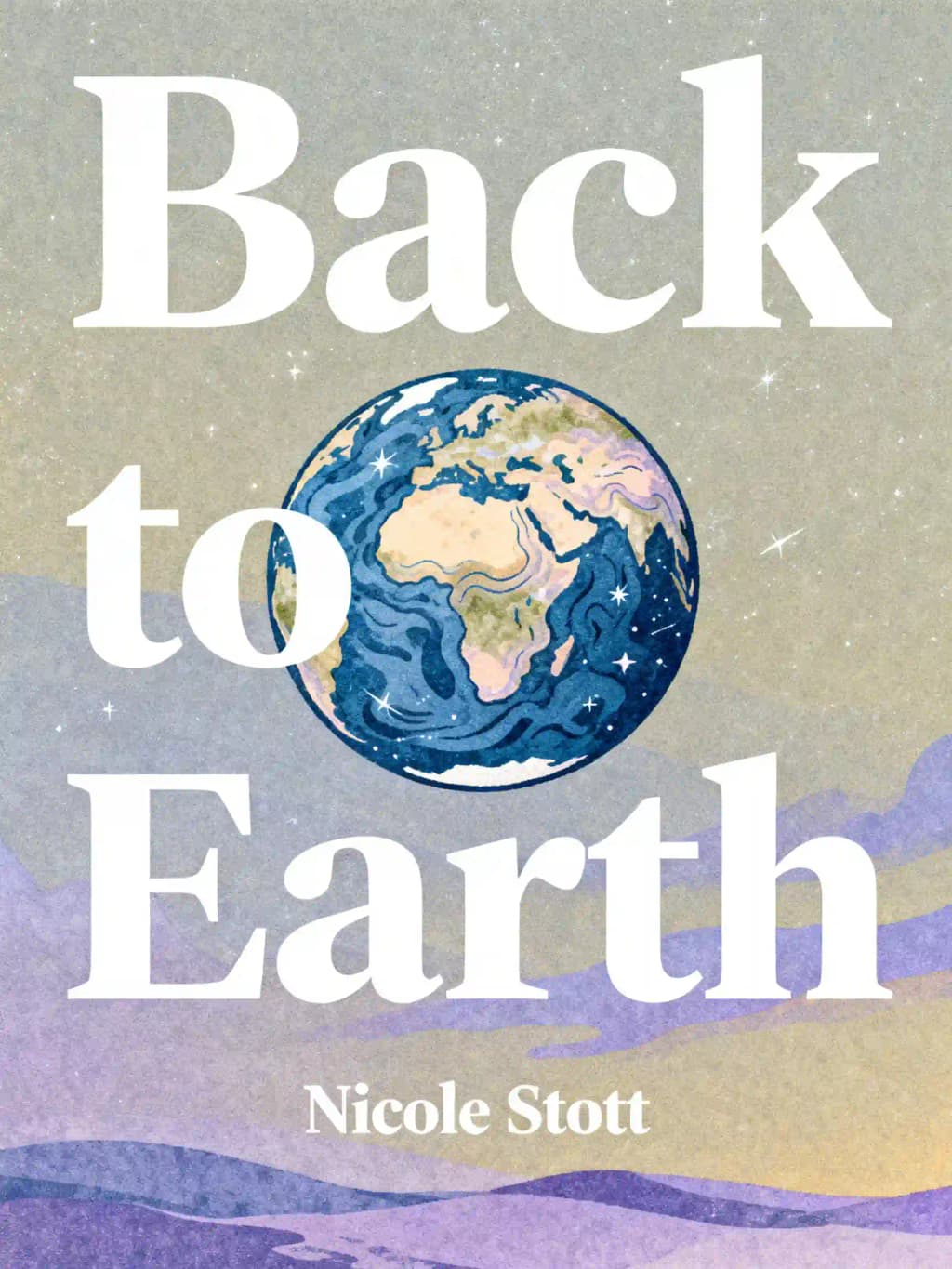
When Bill Anders captured the iconic "Earthrise" photograph during Apollo 8's lunar orbit in 1968, he forever changed humanity's relationship with our home planet. That single image-showing our vibrant blue Earth suspended in the blackness of space-sparked a revolution in environmental consciousness that led directly to Earth Day and the EPA's formation. Forty years later, I experienced my own Earthrise moment aboard the International Space Station, gazing at our planet's iridescent sphere against the infinite darkness. The view revealed three simple truths: we live on a planet, we are all Earthlings, and the only border that matters is the thin blue atmosphere protecting all life. As TIME magazine's Jeffrey Kluger noted after reading this book, "Nicole Stott has the rare ability to make you feel what it's like to experience Earth from orbit." Now, through my art and advocacy, I'm sharing how the astronaut's perspective can help us solve our most pressing planetary challenges by working together as the crew of Spaceship Earth.
第2章
Seeing Earth as One Interconnected System
Living on the International Space Station transformed my understanding of our planet. From orbit, Earth appears as a perfect, self-contained ecosystem where everything is connected. The arbitrary political boundaries we've drawn disappear, replaced by the natural features that truly define our world-oceans, mountains, deserts, and the thin blue line of our atmosphere.
This perspective reveals the true meaning of "local." When you can see the entire planet in a single glance, you realize that everything happening on Earth affects us all. The smoke from wildfires in Australia drifts across oceans, plastic pollution from one continent washes up on another's shores, and carbon emissions anywhere impact the climate everywhere.
The ISS itself demonstrates this interconnectedness. Despite being roughly the size of a six-bedroom house, it houses astronauts from fifteen different countries working together in harmony. We share resources, solve problems collectively, and depend on each other for survival-just as we do on Earth, though we don't always recognize it.
Our bodies in space also reveal this interdependence. In microgravity, astronauts lose bone density twelve times faster than elderly people with osteoporosis on Earth. Without the constant resistance of gravity, our muscles atrophy and fluids shift toward our heads, affecting vision. These changes remind us that we evolved specifically for Earth's conditions-we are literally made for this planet.
The most profound example of interconnection I witnessed was during an emergency alarm indicating possible depressurization. Without hesitation, our international crew responded as one unified team. We never considered which section of the station might be affected or which country's module might be compromised. We understood instinctively that a failure anywhere threatened everyone equally. This is precisely the mindset we need to address our planetary challenges-recognizing that environmental threats anywhere endanger people everywhere.
As my Russian colleague once said during an improvised Thanksgiving celebration in Star City, we are truly "one big international family." The sooner we embrace this reality on Earth, the better equipped we'll be to preserve our shared planetary home.
第3章
The Fragile Shield That Protects All Life
From space, Earth's atmosphere appears shockingly thin-a delicate blue line wrapping our planet, no thicker than the skin of an apple relative to the fruit itself. This fragile layer, which we take for granted, is all that stands between us and the harsh vacuum of space. It regulates our temperature, shields us from deadly radiation, provides the air we breathe, and enables the water cycle that sustains all life.
The vulnerability of this protective shield became even clearer during my underwater mission at the Aquarius Reef Base, 60 feet below the ocean's surface. There, another thin barrier-the hull of the habitat-protected us from a different but equally hostile environment. Whether in space or underwater, these experiences highlight how dependent we are on these protective boundaries.
This perspective is shared by those who study our oceans. Marine scientist Rowan Henthorn participated in the all-female eXXpedition to study the Great Pacific Garbage Patch. Unlike the floating island of trash many imagine, she discovered something far more insidious-an "oceanic smog" of trillions of microplastic particles distributed throughout the water column across an area twice the size of Texas.
"For me," Rowan explained, "trillions of microscopic plastic pieces are much scarier than a plastic island. A plastic island seems manageable-scary, but manageable." These particles have now contaminated the deepest ocean trenches and highest mountains, infiltrating the food chain and even our own bodies.
The parallels between space and ocean exploration are striking. Both environments are hostile to human life yet critical to our survival. Both require specialized equipment and careful preparation. And both provide profound perspective shifts that change how we view our planet.
When I asked Rowan if she experienced something like the Overview Effect-the cognitive shift reported by astronauts seeing Earth from space-she nodded enthusiastically. Lying in her bunk at night under incredible stars, she would mentally "zoom out" to imagine their tiny boat crossing the vast ocean, gaining a new appreciation for our planet's fragility and interconnectedness.
This perspective transforms how we think about environmental challenges. Problems that once seemed distant or abstract become immediate and personal. The plastic in our oceans, the carbon in our atmosphere, the chemicals in our soil-these aren't someone else's problems to solve. They're threats to the thin blue line that keeps us all alive.
As Rowan wisely noted when faced with doubt about individual impact: "'What difference can I make?' said seven billion people." Each of us has both the ability and responsibility to protect our planetary life support system.
第4章
Embracing Our Role as Planetary Crew Members
There's a fundamental difference between being a passenger and being crew. Passengers expect to be served, remain passive during emergencies, and bear little responsibility for the journey's success. Crew members actively contribute, respond to challenges, and share accountability for everyone's wellbeing.
On the International Space Station, everyone functions as crew. We each have specific responsibilities, but we're all trained to handle emergencies, maintain life support systems, and support the mission. There are no passengers in space-the environment is too dangerous, the margins for error too slim.
Earth is no different. We're all traveling together on Spaceship Earth, completely dependent on its life support systems. Yet too many of us behave like passengers, expecting others to solve our environmental problems while we continue business as usual.
This passive approach won't work anymore. The challenges we face-climate change, biodiversity loss, pollution, resource depletion-require everyone to step up as crew members. As Guy Laliberte, Cirque du Soleil founder and space traveler, demonstrated, even a short spaceflight can inspire meaningful action.
During his eight-day stay on the ISS, Guy orchestrated a two-hour live global event called "Moving Stars and Earth for Water" featuring performances across fourteen nations to raise awareness about global water issues. Through his One Drop Foundation, he's helped provide clean water access to over two million people in thirteen countries.
Similarly, Scott Harrison transformed from a self-described selfish nightclub promoter to humanitarian after witnessing extreme poverty in Liberia. His "Earthrise moment" came when he saw 5,000 sick people waiting for just 1,500 surgery slots-many having walked for a month just to see a doctor. This stark contrast to his former life selling $10 water bottles in nightclubs inspired him to found charity: water, which has since funded over 50,000 water projects serving 11 million people.
These examples show how individual actions, when guided by a crew mentality, can create significant positive impact. Whether it's developing water recycling technology (like the ISS system that turns "yesterday's coffee into this morning's coffee"), supporting conservation efforts, or simply reducing our personal consumption, each of us has a role to play.
As astronauts, we train for years in uncomfortable situations-simulators, underwater, in jets, learning Russian, surviving in wilderness-discovering our strengths and weaknesses while learning to rely on each other. The best crews are those who enjoy sharing experiences and have each other's backs when plans go awry.
Our crew photo with Guy Laliberte-all wearing red clown noses, floating in different directions, and flashing peace signs-epitomizes "putting the human in human spaceflight." Similarly, Earthrise is our planetary crew picture, showing our shared life support system surrounded by blackness. It's time we all recognized our responsibilities as crew members on this magnificent spaceship we call Earth.
第5章
The Essential Role of Biodiversity in Earth's Life Support System
Growing up at Clearwater Airpark in Florida, I spent countless hours chasing damselflies across grassy runways. These delicate creatures with bulbous eyes that looked like tiny flight goggles would land on my outstretched finger if I stood perfectly still. Today, these once-abundant insects have largely disappeared from places they thrived-my personal wake-up call to environmental change.
While my NASA "Bug" astronaut class (nicknamed for the millennium bug of 2000) has received accolades for our space missions, actual bugs play a far more critical role in Earth's survival. With approximately 900,000 known species and likely millions more undiscovered, insects vastly outnumber mammals, birds, and fish in diversity. Their total population reaches an estimated ten quintillion individuals-a number so vast I'd never even heard of it before.
Yet despite these mind-boggling numbers, human activity has led to alarming declines. A 2018 global study warned that over 40% of insect species are declining, prompting concerns about an "Insect Apocalypse." As Dr. Pedro Cardoso emphasized, "the fates of humans and insects are intertwined"-a world without insects means a world without humans. As the foundation of our food webs, their disappearance would collapse entire ecosystems.
Photographer David Liittschwager's "One Cubic Foot" project powerfully demonstrates the biodiversity surrounding us that we often overlook. By placing a green metal frame measuring exactly one cubic foot in various global ecosystems and photographing all visible life within it over 24 hours, he revealed extraordinary diversity-from Central Park to South Africa's Table Mountain to coral reefs in French Polynesia.
In South Africa, one scientist noted David could touch fifty plant species while seated in one spot. Each location revealed different biodiversity patterns-like Central Park's missing night-flying insects, drawn away by city lights. The project demonstrates Earth's delicate balance and the incredible biodiversity surrounding us that we typically fail to notice.
E.O. Wilson, one of the most important biological theorists since Darwin, has transformed our understanding of biodiversity through his research on ants and broader ecological principles. His Half Earth Project aims to preserve Earth's biodiversity, recognizing that the smallest organisms-the bugs and microorganisms in soil-form "the heart of life on Earth."
These tiny creatures maintain the exact environment humans need to survive, with precision exceeding our technology. The chemical cycles passing through their bodies sustain all life. As our astronaut class was ironically named for the fictional "millennium bug" in 2000, we now face the very real threat of essential insect extinction.
The disappearance of these creatures, caused by our failure to appreciate their diverse functions and the interconnectedness of all life, could lead to our own extinction-unless we recognize that what seems insignificantly small often has the greatest impact.
第6章
Finding Balance Between Urgency and Precision
The ancient Roman emperor Augustus favored the phrase "Festina Lente" (make haste slowly), symbolized on coins by images like a tortoise with a sail. This philosophy emphasizes balancing urgency with diligence-"That which has been done well has been done quickly enough." Similar to the Navy SEALs' "Slow Is Smooth. Smooth Is Fast," ISS crews respond to emergencies with deliberate, choreographed movements rather than panic-fueled reactions.
I learned this lesson during a challenging swim test in full flight gear. Despite not being a strong swimmer, I had to complete three lengths without stopping or grabbing the side. After struggling through the first two lengths, I was sinking during the backstroke when a cadet called out, "Ma'am! Relax! Slow down! The helmet floats!" This simple advice saved me-by slowing down and using the helmet's buoyancy, I completed the test.
This "slower's faster" philosophy has profound implications for addressing environmental challenges. After decades of "going slow" and assessing climate problems, we've reached a critical juncture where response time is crucial. Like running a boldface checklist on a space station during an emergency, we must act quickly to stabilize Earth's life support systems before addressing root causes.
Mark Tercek, former CEO of The Nature Conservancy, exemplifies environmental leadership by bridging business and conservation. His journey began with the Cuyahoga River fire in 1969-an environmental disaster that, along with other events, catalyzed the formation of the EPA and Clean Water Act. Today, the once-burning Cuyahoga has been revitalized, and Cleveland is among hundreds of cities committed to climate goals despite political fluctuations.
The International Space Station represents nations finding common purpose despite differences. Buckminster Fuller's "Spaceship Earth" perspective reminds us "to see what unites us rather than what separates us." What unites humanity is living under the same sky, seeing the same moon, and sharing basic survival needs.
We've delayed too long-it's time to execute the climate action plans we already know are required so humans can "behave as Earthlings in partnership with all life on our planet."
第7章
Staying Connected to Our Planetary Home
To astronauts, being "grounded" carries dual meaning-the negative connotation of being on the "Do Not Fly" list, but also the essential quality of being level-headed and sensible. Contrary to the "space cadet" stereotype, successful astronauts must be exceptionally grounded people.
Looking at Earth from space transformed my understanding of "home." Initially excited to spot Florida below, I soon realized the entire planet was my home. The view was captivating-hurricanes appearing as peaceful swirls, heart-shaped islands, river bends resembling elephants, and nighttime lights revealing human presence. Though physically separated from humanity, I felt profoundly connected to everyone and everything on Earth.
To reconnect with the transcendent window-gazing experience from space, I discovered meditation and "Earthing"-mindfulness practices that connect sensory experience with heart and mind. Tom Cronin, creator of the Stillness Project, introduced me to meditation as a way to find the same stillness and calm I experienced while observing Earth from orbit. Earthing-simply walking barefoot on the planet-creates a physical connection that grounds the body, improving sleep, reducing inflammation, and decreasing stress levels.
After retiring from NASA, I found purpose through the Spacesuit Art Project, which began when Gordon Andrews invited me to collaborate on space-themed art therapy at MD Anderson Children's Cancer Hospital. Working with artist Ian Cion, we created "Hope"-a spacesuit made from children's artwork. This evolved into the Space for Art Foundation, which has now created five art spacesuits with children from over fifty countries, with three having flown to the ISS.
During one art session, an eight-year-old girl undergoing chemotherapy made a profound observation that transformed my understanding of my purpose. As we painted fabric for the "Unity" spacesuit, she casually remarked, "Being an astronaut must be a lot like what happens to me." She explained the similarities: separation from family, restricted movement, unusual food, bodily changes, constant testing, and radiation exposure. Her wisdom revealed the unexpected parallel between space travel and cancer treatment.
These hospital visits consistently humble me. Though I wear my blue astronaut suit hoping to inspire the children, they invariably inspire me more with their courage and resilience. I've witnessed countless children arrive disinterested and depleted, only to become engaged and animated through the creative process, transcending their circumstances through art and imagination.
Research into the "Overview Effect," a term coined by space philosopher Frank White in 1987, shows that astronauts consistently report positive psychological changes after seeing Earth from space-particularly increased universalism and appreciation for our shared planetary home. As humans venture farther into space, maintaining this connection to Earth becomes increasingly important for psychological wellbeing.
Dr. Jay Buckey, a former astronaut now researching at Dartmouth, is testing self-directed behavioral health tools in Antarctica's isolated environment to help with conflict resolution, stress management, and mood improvement. His work, which includes virtual reality forests, beaches and cities, draws on established theories like E.O. Wilson's "biophilia" hypothesis and the Kaplans' "attention restoration" theory, which suggest humans have evolutionary preferences for natural environments that help us recover from stress and mental fatigue.
Staying grounded means maintaining awareness of our place in the universe-as tiny yet meaningful parts of a greater whole-and embracing our shared identity as Earthlings.
第8章
Creating a Future Where All Life Can Thrive
The Earth observation satellites currently orbiting our planet provide critical data about our changing environment. Twenty-eight such satellites measure everything from moisture and air quality to carbon dioxide levels, with fifteen more planned for launch through 2026. This comprehensive monitoring system makes invisible threats to our planetary life support system visible.
The space industry, worth roughly half a trillion dollars annually and expected to nearly double by 2040, includes both government agencies and a thriving private sector. Companies like Planet Labs deploy Earth-imaging satellite constellations to improve agriculture, energy, and forestry, while nonprofits like the Environmental Defense Fund build specialized satellites like MethaneSAT to precisely measure global methane emissions-the fastest way to slow global warming today.
Anousheh Ansari exemplifies making life better through space exploration. Born in Iran during revolutionary turmoil, she found refuge in stargazing. After emigrating to the United States, she pursued engineering despite language barriers, eventually founding a successful technology company. The proceeds funded both the Ansari XPrize, which sparked the commercial spaceflight industry, and her own 2006 spaceflight, making her the first Iranian-descent astronaut and first Muslim woman in space.
From the ISS, Anousheh experienced the profound perspective shift astronauts describe. "I felt this amazing warmth and energy," she recalls of seeing Earth from orbit. "If everyone could see this beauty, this energy-this energy of life-it's so strong... life would be different on Earth." Now as CEO of the XPrize Foundation, she channels her space experience into designing incentive competitions to solve humanity's grand challenges.
Creating a future where all life on Earth can thrive requires everyone working together as the crew of Spaceship Earth. When discussing "saving the planet," we're really concerned with saving ourselves. Earth has survived for 4.5 billion years through much greater disruptions than humanity's brief presence. As George Carlin noted, "The planet isn't going anywhere. WE are!" We need to shift the narrative from "saving the planet" to saving ourselves by healing and preserving the ecosystem that supports life.
Dr. David Vaughan, an acclaimed marine biologist, demonstrates this approach through his groundbreaking coral restoration work. His accidental discovery of "micro-fragmentation"-a technique allowing coral to grow up to forty times faster than in the wild-has enabled the restoration of reefs that would have taken centuries to grow naturally. Through his nonprofit Plant A Million Corals, Vaughan has already helped plant over 200,000 corals in the Florida Keys and Caribbean.
On August 9, 2020, scientists witnessed the first-ever spawning of restored massive star corals that had been planted just five years earlier using Vaughan's technique. This "broadcast spawning" released billions of coral sperm and millions of eggs in a delicate blizzard of tiny white spheres-a powerful symbol of hope for coral reefs and, by extension, humanity.
Vaughan's work exemplifies all the lessons from this book: the degradation of coral reefs impacts everyone because everything is local on our one planet; coral reefs help maintain the thin blue line of our atmosphere; the tiny coral polyps demonstrate how even the smallest organisms play crucial roles; his micro-fragmentation technique illustrates the "go slow to go fast" approach; the wonder of coral reefs grounds us in understanding the interconnectivity of all life; and ultimately, his work is driven by the motivation to make life better.
第9章
Bringing the Astronaut's Perspective Back to Earth
You don't need to see Earth from space to have an "Earthrise moment"-that awakening to the reality of our shared planetary home and responsibility. The people I've interviewed all experienced such moments that transformed their perspectives and actions.
Serena Aunon-Chancellor found connection while caring for cellular biology experiments on the ISS, seeing the cells as "little crew members" whose warm chambers "felt like home." Rowan Henthorn, exploring the Pacific Ocean, contemplated how her "tiny boat of girls" would look from space while realizing "there is no away"-we're all connected. Guy Laliberte saw Earth as "a beacon in the darkness" needing our help. Scott Harrison's moment came through witnessing mass human suffering and lack of clean water access in Africa. David Liittschwager finds wonder in understanding "the way the world is made," even making eye contact with an octopus.
Each person took action following their Earthrise moment, behaving like crewmates rather than passengers. As David Vaughan suggested, "If everybody could just get a few minutes each day of connecting themselves to nature and the whole cosmos... I think we would do a lot more to preserve what we have."
Like coral polyps that individually seem insignificant but collectively build mighty reefs, humans can gather forces and create something bigger than themselves. The successful coral spawning in August 2020 demonstrates what's possible when humans choose to behave like crewmates on Spaceship Earth.
Going to space brought me back to Earth in a profound way. While supporting the international mission of science and exploration, my connection to home deepened. When I was farthest from the planet, I felt more connected than ever before. This awareness of Earth as our home is both humbling and awesome.
Next time you're outside-at the beach, stargazing, or even in the city-notice where you're standing. You're on a planet spinning through space. If you see the Moon or Sun, recognize you're observing celestial bodies while standing on one. Ground yourself in the awareness of how incredible it is to live in a place that provides everything we need for survival.
The quality of life on Earth depends on our planetary stewardship. How we treat each other and our planet determines the quality of our shared future. Though challenges can feel overwhelming, connecting these simple lessons to everyday life makes them manageable. Being grounded through mindfulness can help us solve our seemingly impossible problems if we keep our minds and hearts open.
This mindfulness is a call to action. The awe I experienced seeing Earth from space left me feeling obligated to share it meaningfully-through artwork, the Space for Art Foundation, this book, daily choices, activism, and community involvement. We must all commit to practices that make a difference, acting as the crew of Spaceship Earth with the shared goal of improving life for all.