第1章
A Journey Through Grief, Duty, and Madness
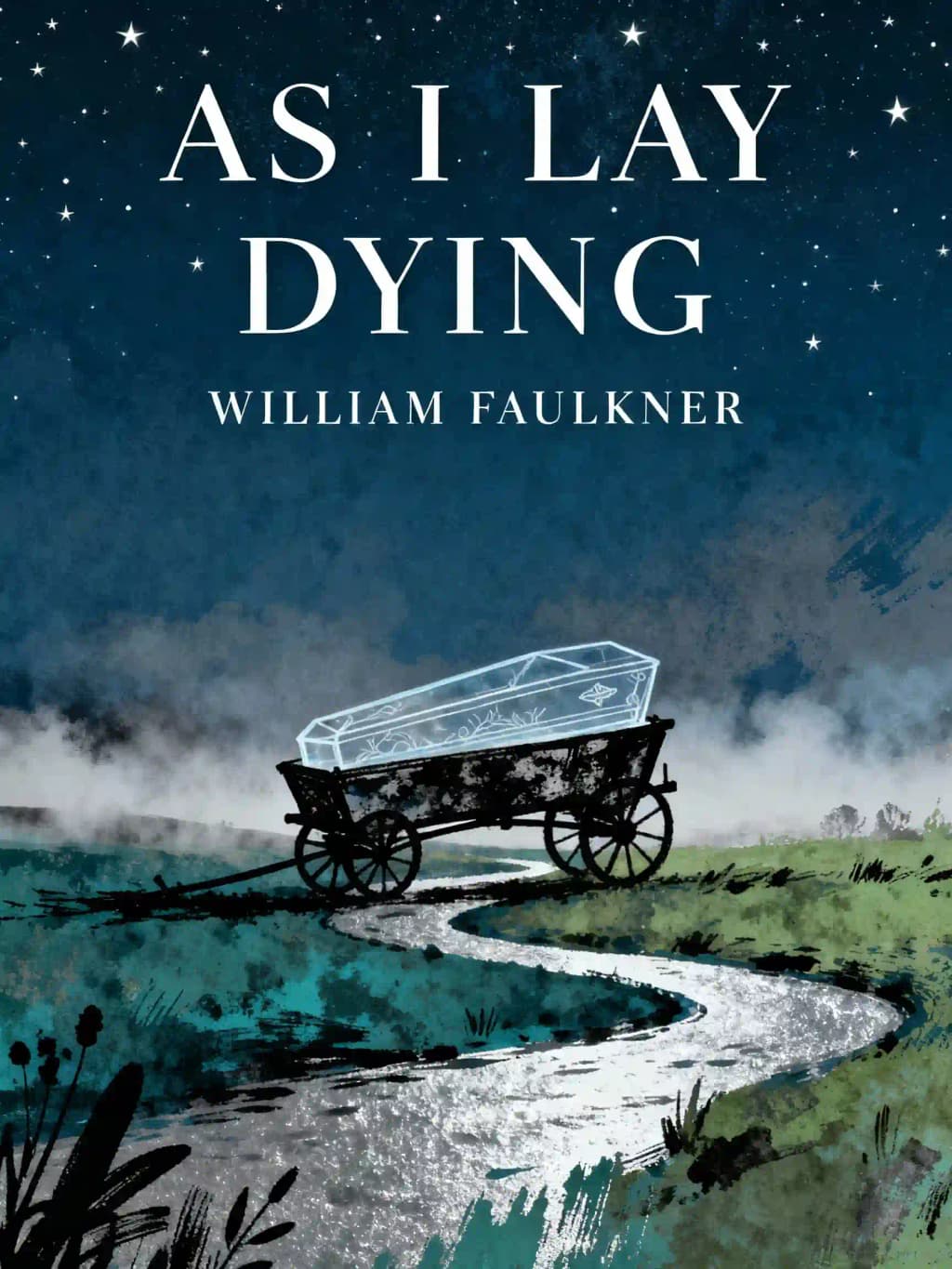
William Faulkner's masterpiece has captivated readers since its publication in 1930, earning its place among the greatest American novels ever written. The experimental stream-of-consciousness narrative-told through 15 different characters' perspectives-revolutionized modernist literature and secured Faulkner's reputation as one of America's literary giants. Oprah Winfrey famously selected it for her book club in 2005, bringing renewed attention to this challenging but rewarding work. What makes this novel so enduring is its unflinching portrayal of a poor Southern family's harrowing journey to bury their matriarch-a journey that reveals the complex web of love, resentment, duty, and madness that binds them together. Through the Bundren family's odyssey, Faulkner explores universal themes of death, obligation, and the human capacity for both selfishness and sacrifice.
第2章
The Bundren Family: A Cast of Broken Characters
The novel opens with Addie Bundren lying on her deathbed while her oldest son Cash meticulously builds her coffin outside her window. This striking image sets the tone for the entire narrative-practical preparation for death happening in full view of the dying. The Bundren family consists of Anse, the selfish patriarch; Cash, the skilled carpenter; Darl, the perceptive and eventually mad son; Jewel, the intense, action-oriented son born of an affair; Dewey Dell, the only daughter hiding her pregnancy; and Vardaman, the youngest who struggles to comprehend his mother's death.
Each character's distinct voice reveals their peculiar relationship with Addie and with each other. Darl, with his almost supernatural insight, narrates most sections, observing his family with detached precision: "Despite being fifteen feet ahead, my brother's broken straw hat stands a full head above mine." His relationship with Jewel is particularly fraught with tension, as he seems to know Jewel's true parentage. Cash approaches life methodically, evidenced by his careful construction of the coffin and his logical explanation of why he "made it on the bevel." Jewel expresses himself through action rather than words, his fierce love for his mother manifesting in rage and physical exertion. Dewey Dell remains consumed by her secret pregnancy, while young Vardaman processes grief through bizarre associations, famously declaring "My mother is a fish" after catching a fish the day of her death.
Anse Bundren, perhaps the novel's most despicable character, manipulates others through a facade of helplessness while pursuing his own selfish ends. His repeated refrain-"I'm a luckless man"-serves as cover for his exploitation of his family's loyalty. His true motivation for the journey to Jefferson isn't to honor Addie's wishes but to get new teeth, revealing the grotesque selfishness that drives much of the novel's action.
第3章
The Promise: Addie's Final Request
At the heart of the narrative lies Addie's pivotal request to be buried with her blood relatives in Jefferson, forty miles away from the family farm. This promise, extracted from Anse years earlier during a moment of apparent lucidity, sets the entire journey in motion and serves as the catalyst for the family's subsequent trials. When Addie finally speaks in her own section-remarkably, after her death-we learn of her profound disillusionment with language itself: "I learned that words are no good; that words don't ever fit what they're trying to say." This posthumous monologue reveals the depths of her isolation and the philosophical underpinnings of her final request.
Addie's complex relationship with language reflects Faulkner's modernist preoccupation with the limitations of human expression and communication. For her, words like "love" and "motherhood" are merely empty vessels that cannot contain or convey genuine lived experience. She sees language as a barrier rather than a bridge, a system of arbitrary signs that fails to capture the raw reality of existence. This skepticism toward words extends to social institutions and relationships, particularly her marriage to Anse, which she describes as a kind of death: "I took Anse. And when I knew that I had Cash, I knew that living was terrible and this was the answer to it." Her profound alienation helps explain her passionate affair with Minister Whitfield, which produced Jewel, her favorite child-a relationship that represents her one genuine attempt to break free from the suffocating conventions of her life.
The promise to bury her in Jefferson represents Addie's final, calculated act of agency-forcing her family to acknowledge her existence through an arduous journey that will disrupt their lives long after her death. It's simultaneously a punishment, a demand for recognition, and a last attempt at self-definition from a woman who felt erased by the conventional roles of wife and mother. The journey becomes her way of inscribing herself into her family's consciousness, ensuring they cannot forget her presence even in death. As Dr. Peabody astutely observes, "I knew that she is going to die. Not because she's sick. She's just full of the same cold malicious satisfaction that she's always had."
The significance of Jefferson as her chosen burial place extends beyond mere family connections. It represents a return to her origins, a rejection of the life she lived with Anse, and a final assertion of her independent identity. Through this request, Addie transforms from a passive participant in her family's life to the primary agent of their collective destiny, orchestrating a journey that will test each family member's commitment and reveal their true characters. Her promise becomes a posthumous act of revenge, redemption, and self-realization, forcing her family to physically enact the emotional labor she felt they never performed during her lifetime.
第4章
The Disastrous Journey Begins
After Addie's death, the family immediately prepares for the journey to Jefferson despite warnings of bad weather. Cash completes the coffin with meticulous care, and they place Addie inside with her wedding dress and a mosquito net veil covering the holes Vardaman drilled into the coffin (and inadvertently into his mother's face) to "let her breathe." This macabre detail illustrates the novel's grotesque elements and Vardaman's confused understanding of death.
The journey quickly becomes nightmarish as heavy rains swell the river and wash out bridges. Neighbors like Vernon Tull try to dissuade Anse from attempting the crossing, but he insists on fulfilling his promise. This stubbornness-presented as duty but masking selfish motives-leads to catastrophe when they attempt to ford the flooded river.
The river crossing scene stands as one of the novel's most dramatic moments. As the wagon enters the rushing water, a log strikes it, overturning the coffin and breaking Cash's leg. Jewel risks his life to save the coffin while Cash, despite his injury, tries to protect his mother's body. Darl, in contrast, jumps clear of the wagon-a pragmatic but seemingly callous action that highlights his emotional detachment. Vardaman, watching from shore, confuses his mother with a fish in his traumatized mind: "I see Darl coming in slow, and I know he has her, but when his hands come up out of the water, they're empty."
This disaster sets the pattern for the journey-a series of increasingly grotesque obstacles that test the family's commitment to their mission and expose the fractures in their relationships. The river crossing transforms a simple burial journey into an odyssey of almost mythic proportions, with the decomposing body becoming both literal and metaphorical burden.
第5章
Deterioration and Grotesque Comedy
As the journey continues, Addie's body begins to decompose in the oppressive Mississippi summer heat, creating an increasingly unbearable stench that follows the family like a toxic cloud. This physical deterioration serves as a powerful metaphor for the psychological deterioration of the family members, particularly Darl, whose sanity gradually unravels as he becomes increasingly obsessed with the futility of their mission. The coffin becomes a grotesque presence that dominates their journey-buzzards circle constantly overhead, forcing young Vardaman to chase them away with sticks and rocks, while the nauseating smell causes townspeople to recoil in horror and cross to the other side of the street when the Bundrens pass through settlements.
Cash's broken leg develops into another source of profound suffering when the family, displaying their dangerous ignorance of medical care, decides to encase it in cement. This misguided attempt at healing becomes its own form of torture as the cement hardens and cracks, cutting deeply into his flesh and turning the leg black with gangrene. Cash bears this excruciating pain with characteristic stoicism, repeatedly insisting, "It feels fine now," even as his condition worsens. His suffering, like the decomposing body in their midst, becomes normalized through the family's matter-of-fact acceptance of it, highlighting their peculiar ability to adapt to increasingly horrific circumstances.
Faulkner masterfully balances horror with dark comedy throughout these scenes, creating a narrative that teeters between tragedy and absurdity. When the family stops at Samson's farm, his wife Rachel becomes the voice of moral outrage, expressing what any reasonable person would feel: "It's a outrage... a outrage to the living. It's a desecration to the dead." Meanwhile, Anse continues to insist they must fulfill their promise to bury Addie in Jefferson, though his real motivation-getting new teeth-remains carefully hidden beneath a veneer of pious duty. The next morning, Samson discovers a rain-soaked buzzard in his barn, its bedraggled presence serving as a grotesque reminder of the death that stalks the Bundrens' every move.
The novel's gallows humor reaches its devastating peak when Vardaman, in his childish confusion about death, drills holes in the coffin to help his mother "breathe," accidentally drilling into her face in the process. This horrifying act, born of innocent misunderstanding and genuine love, perfectly captures the novel's unique blend of tragedy and absurdity. The incident becomes even more poignant through Vardaman's inability to comprehend the permanence of death, believing his mother is suffocating in the sealed coffin. As Tull observes with weary philosophical resignation: "If it's a judgment, it ain't right. The Lord's got more to do than that." His comment underscores the fundamental question of whether the family's tribulations represent divine punishment or merely the cruel vagaries of fate in an indifferent universe.
第6章
Secrets and Hidden Motivations
Beneath the surface narrative of the journey to Jefferson runs a current of secrets and hidden motivations that drive the characters' actions. Jewel's parentage-he is the son of Addie and Minister Whitfield rather than Anse-creates tension between him and his half-siblings, particularly Darl, who seems to know the truth. This knowledge fuels Darl's antagonism toward Jewel, culminating in his taunting: "Your mother was a horse, but who was your father, Jewel?"
Dewey Dell's pregnancy remains her consuming secret throughout the journey. Her desperate attempts to find abortion medication in Jefferson lead to exploitation by a pharmacy clerk who poses as a doctor and gives her talcum powder instead of medicine. Her sections reveal her resentment toward Lafe, who impregnated her, and her conflicted feelings about her mother's death: "I wish I had time to let her die." Her predicament illustrates the limited options available to young women in this rural society.
Anse's secret motivation-getting new teeth in Jefferson-drives the entire journey, though he masks it as devotion to Addie's wishes. When he steals Dewey Dell's abortion money to pay for his teeth, he reveals the depth of his selfishness. His quick remarriage at the novel's end-"Meet Mrs. Bundren"-completes his transformation from grieving widower to opportunistic predator.
Even Minister Whitfield harbors secrets. His section reveals his plan to confess his affair with Addie to Anse, but when he arrives to find Addie already dead, he convinces himself that "He will accept the will for the deed" and never reveals the truth. This moral cowardice contrasts sharply with his public persona as a man of God.
第7章
The Burning Barn: Darl's Descent into Madness
The novel's climactic scene occurs when Darl sets fire to Gillespie's barn where Addie's coffin is stored. This desperate attempt to end the journey by destroying his mother's decomposing body marks Darl's final break with reality. The fire scene unfolds with nightmarish intensity as Jewel rushes into the burning barn to save the coffin: "Jewel has run into the burning barn... he appears suddenly amid a flurry of sparks... carrying the coffin in his arms as though it were something of enormous value."
This heroic act reveals the depth of Jewel's devotion to his mother, fulfilling Addie's prophecy that "Jewel would save her from water and from fire." The contrast between Jewel's physical courage and Darl's destructive action highlights their opposing responses to grief-Jewel channels his emotions into protective action, while Darl's perceptiveness curdles into madness.
The family's response to Darl's arson seals his fate. Rather than acknowledge his mental breakdown, they have him committed to the state asylum in Jackson to avoid paying damages to Gillespie. Cash rationalizes this betrayal: "There wasn't nothing else to do. It was either send him to Jackson, or have Gillespie sue us." Even in this moment of family crisis, financial considerations outweigh compassion.
Darl's final section, narrated in the third person as he's taken away on the train, shows his complete dissociation: "Darl has gone to Jackson. They put him on the train, laughing... 'Is it the pistols you're laughing at?' I said. 'Why do you laugh?' He said 'Yes yes yes yes yes.'" This tragic end for the novel's most perceptive character suggests that clear-sightedness in a world of delusion leads only to madness.
第8章
Arrival in Jefferson: The Journey's Bitter End
When the Bundrens finally reach Jefferson, the journey has transformed them all, leaving each family member permanently altered by the ordeal. Cash's broken leg, improperly set in cement, requires urgent professional medical attention to prevent permanent disability. Jewel, having demonstrated his devotion through heroic actions, bears painful burns across his back and arms from rescuing the coffin from the burning barn. Dewey Dell, increasingly desperate, makes multiple failed attempts to obtain an abortion, facing exploitation from both a fraudulent pharmacist and a predatory store clerk. Vardaman, still struggling to process his mother's death, continues to conflate her with fish and trains, his young mind unable to grasp the finality of loss.
Most tragically, Darl's mental state has deteriorated to the point where his own family conspires to have him committed to the state asylum in Jackson. His prophetic insights and questioning of social conventions have marked him as dangerous to the community's stability. Only Anse, the perpetual opportunist, seems to emerge from the journey having gained rather than lost, securing both new teeth and a new wife with a swiftness that suggests premeditation.
The burial itself happens offstage-a striking omission in a novel centered around a funeral journey. This deliberate narrative gap emphasizes the hollow nature of the achievement. Through Cash's matter-of-fact narration, we learn the mechanical details: they borrowed spades to dig the grave, completed the task efficiently, and immediately afterward, "them fellows" came to take Darl away. The anticlimactic conclusion to Addie's journey suggests not just the emptiness of the ritual itself, but the futility of human ceremonies in the face of death's finality. The promise has been kept, but the cost to the family-physically, mentally, and emotionally-has been catastrophic.
The novel's final scene delivers a bitter punchline when Anse introduces his children to their new stepmother-a "duck-shaped woman" carrying the very graphophone Cash had longingly observed in town. Her possession of this item suggests a preexisting relationship and calculated opportunism on Anse's part. This hasty remarriage, coming before the dirt has settled on Addie's grave, confirms that Anse's devotion to his wife was always a performance, a social obligation rather than genuine feeling. His physical transformation is complete and symbolic: "He had got his hair cut... his face was different... He had new teeth." The new Mrs. Bundren represents not just Anse's callousness but the novel's cyclical view of life and death-one mother is replaced by another with mechanical efficiency, and the family will continue its dysfunctional patterns, trapped in an endless cycle of poverty, obligation, and unfulfilled desires.
第9章
Language, Perception, and the Nature of Reality
Throughout the novel, Faulkner explores how language shapes-and fails to shape-our understanding of reality. Each character's distinctive voice reveals their worldview: Cash's methodical lists reflect his carpenter's precision and need for order, Vardaman's fragmented associations mirror his childish confusion, Dewey Dell's sensual immediacy shows her physical awareness, and Darl's poetic perceptions demonstrate his philosophical nature. These varying perspectives suggest that reality itself is subjective, constructed through individual consciousness and colored by personal experience.
Addie's section provides the novel's philosophical core, articulating her deep distrust of language: "Words are no good; words don't ever fit what they're trying to say." For her, words like "love," "fear," and "sin" are empty sounds used by those who have never truly experienced these states. She particularly resents how people use words to create artificial connections, noting how her father claimed that the reason for living is to get ready to stay dead a long time. This critique extends to social institutions built on language-marriage, motherhood, religion-which Addie sees as hollow constructs that fail to capture lived experience. Her rejection of words manifests in her preference for physical action, whether through violence toward her students or through her affair with Whitfield.
Darl's madness stems partly from his hyper-awareness of these limitations of language and perception. His ability to perceive what others cannot-including events happening miles away, like Addie's death and Dewey Dell's pregnancy-makes him both insightful and increasingly alienated from his family and community. When he asks Jewel, "Do you know that Addie Bundren is going to die?" he's not merely testing whether Jewel shares his perception of reality but challenging the very nature of knowledge and communication. Jewel's angry response confirms their fundamentally different ways of seeing the world and highlights the gulf between those who question reality and those who simply live it.
Vardaman's famous declaration-"My mother is a fish"-represents the most extreme attempt to make sense of death through language. Unable to comprehend his mother's transformation from living being to corpse, he creates an association with the fish he caught and cleaned that same day: "Then it wasn't and she was, and now it is and she wasn't." This childish logic, while seemingly absurd, reveals the fundamental inadequacy of language to capture the mystery of death and transformation. His confusion extends to his understanding of existence itself, as he struggles with questions of identity and continuity: "Where is ma, Darl?" becomes both a physical and metaphysical query about the nature of being and non-being.
The novel ultimately suggests that language, while necessary for human interaction and understanding, is an imperfect tool for capturing reality. Each character's distinct narrative voice serves as both a window into their perception of reality and a demonstration of how language shapes, limits, and sometimes distorts our understanding of the world.
第10章
The Legacy of "As I Lay Dying"
Faulkner's novel stands as a towering achievement of modernist literature, combining experimental technique with profound insights into human nature. Through the Bundren family's journey, he explores universal themes-death, duty, family, and the search for meaning-while grounding them in the specific culture of the rural South. The novel's unflinching portrayal of poverty, ignorance, and dysfunction challenged romanticized views of rural life prevalent in American literature of the 1930s, offering instead a raw, unvarnished look at the struggles of poor white farmers in Mississippi. The characters' desperate circumstances, from Dewey Dell's unwanted pregnancy to Cash's steadfast dedication to his craft despite extreme poverty, paint a complex portrait of rural life that transcends simple stereotypes.
The multiple narrators technique, revolutionary for its time, allows readers to experience events from different perspectives, creating a prismatic view of reality that resists simple interpretation. Each narrator's distinct voice reveals not only their individual story but also their limitations and biases, forcing readers to piece together truth from conflicting accounts. This approach influenced countless writers who followed, from Gabriel Garcia Marquez's multi-voiced narratives to Toni Morrison's layered perspectives in "Beloved." The novel's stream-of-consciousness style, with its fractured syntax and associative leaps, opened new possibilities for representing human thought in fiction, particularly in showing how trauma and grief distort perception and memory.
Perhaps most remarkably, Faulkner achieves this formal experimentation while telling a compelling story filled with unforgettable images: Cash methodically building his mother's coffin outside her window, each plank a testament to his devotion; Addie's coffin floating away in the flooded river, a powerful symbol of nature's indifference to human plans; Vardaman drilling holes in the coffin, convinced his mother can't breathe; Jewel carrying the coffin from the burning barn, his heroic act revealing deep love beneath his apparent coldness; buzzards circling overhead throughout the journey, a constant reminder of mortality and decay. These powerful visual moments anchor the novel's philosophical explorations in concrete, often grotesque reality, creating a work that operates simultaneously on visceral and intellectual levels.
Through the Bundren family's disastrous journey, Faulkner suggests that human motivations are rarely pure, that language often fails us, and that we are all-like Darl-potentially one perception away from madness. The novel explores how words themselves can be inadequate tools for expressing deep truths, as demonstrated by Addie's posthumous chapter questioning the relationship between words and meaning. Yet the novel also acknowledges the stubborn persistence of life, as embodied in Anse's immediate remarriage and his new teeth, suggesting an almost comic resilience in the face of tragedy. The journey ends, but life continues its relentless cycle-a truth as unsettling as it is undeniable, reflected in the novel's circular structure and its blend of the profound with the darkly humorous.