第1章
The Authoritarian Playbook: How Democracy Became an Endangered Species
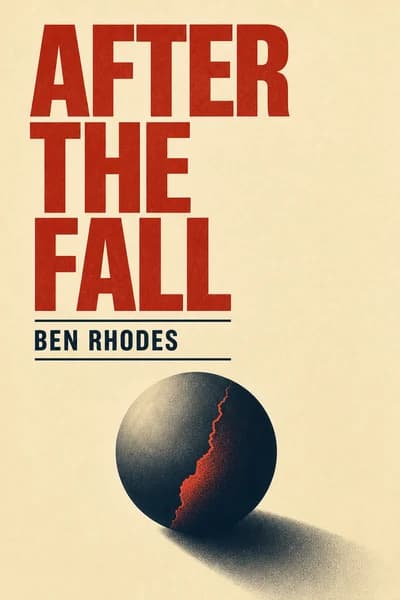
In March 2017, Ben Rhodes found himself in Myanmar, witnessing Aung San Suu Kyi's transformation from democracy icon to tacit collaborator in ethnic cleansing. Later that year, he discovered he'd been spied on by Black Cube, a private intelligence firm of former Mossad operatives hired by Trump associates. These experiences weren't isolated incidents but symptoms of a global shift. "After the Fall" has become a sensation among political insiders and foreign policy experts, with figures from Hillary Clinton to Samantha Power praising its insights. The book arrived at a pivotal moment when democracies worldwide face unprecedented challenges from authoritarian movements using remarkably similar tactics across different contexts. Rhodes, drawing on his unique position as Obama's former deputy national security advisor, takes readers on a journey through the global democratic recession that followed the hopeful post-Cold War era.
第2章
Freedom's High-Water Mark: The Unfinished Promise of 1989
When the Berlin Wall fell in 1989, six-year-old Sandor Lederer witnessed Hungary's transformation from Soviet totalitarianism to the promise of an open society. That same year, a young Viktor Orban-then a liberal politician and George Soros beneficiary-rallied 100,000 Hungarians during the reburial of Imre Nagy, boldly denouncing Russian imperialism and one-party rule.
This period marked freedom's zenith as Communist regimes collapsed across Eastern Europe and the Soviet Union, apartheid ended in South Africa, and right-wing dictatorships fell worldwide. The liberal democratic order seemed triumphant, with its system of international treaties, norms, and institutions shaping everything from nuclear weapons development to trade rules and human rights expectations within the "free world."
Yet Hungary failed to reconcile its painful past-Nazi collaboration and Communist rule-as teachers avoided sensitive topics that touched every family. Instead of forging a renewed national identity, post-Cold War Hungary embraced American-led globalization as its new identity, leaving unresolved the question of what it meant to be Hungarian in the political sense.
This unresolved identity question created fertile ground for nationalist resurgence. By July 2014, Viktor Orban-once a fiery young anticommunist-delivered a pivotal speech declaring the end of liberal democracy and the rise of nationalist illiberalism. Speaking to ethnic Hungarians in Romania rather than Hungary itself, Orban tapped into historical grievances about borders redrawn after World War I. He identified the 2008 global financial crisis as the catalyst for a "great redistribution of global financial, economic, commercial, political, and military power"-the starting point for his nationalist project focused more on consolidating his own power than addressing global economic inequities.
Think about it: How many countries today are grappling with unresolved questions of national identity that authoritarian leaders exploit? The pattern Rhodes identifies isn't limited to Hungary but represents a global playbook.
第3章
The Putin Model: From Anti-Soviet Activist to Authoritarian Architect
Boris Nemtsov's journey from promising reformer to assassinated opposition figure illustrates Russia's post-Soviet trajectory. Born in 1984, Zhanna Nemtsova grew up during the Soviet collapse, experiencing food shortages and economic hardship. Her father Boris, a physicist, entered politics in 1987 by opposing a nuclear plant construction after Chernobyl. After supporting Yeltsin during the 1991 coup, Nemtsov became governor of Nizhny Novgorod, implementing reforms and gaining such prominence that Yeltsin publicly suggested he could be his presidential successor.
In 1997, Nemtsov became deputy prime minister under Yeltsin, describing the move to Moscow as becoming "like a kamikaze." He confronted the emerging oligarchs during the privatization of telecommunications utility Svyazinvest. When Nemtsov insisted on transparent rules rather than allowing oligarchs to control the process, they retaliated through their television channels with character assassination campaigns that destroyed his reputation. "They ruined his political future forever," Zhanna explained, comparing their tactics to how Fox News would later target Obama and Clinton.
The 2004 Beslan school hostage crisis marked a turning point in Russian politics. After Chechen militants took over a thousand people hostage at a school in Beslan, resulting in nearly two hundred children's deaths, Putin's response speech revealed his worldview. Unlike expected condolences, Putin framed the tragedy within Russia's post-Soviet narrative: "We are living in conditions formed after the disintegration of a huge, great country." He portrayed Russia as vulnerable after the Soviet collapse, crystallizing his message in one powerful statement: "We demonstrated weakness, and the weak are beaten."
Putin announced a "complex of measures" to strengthen Russian unity-eliminating direct election of governors, new parliamentary election rules favoring his party, and crackdowns on foreign NGOs. The counterrevolution had begun.
This model-using security threats to justify dismantling democratic institutions-would later be emulated by authoritarian leaders worldwide. Putin abandoned inconvenient rules while weaponizing aspects of the American order-oil wealth, capitalism's corruption potential, and internet propaganda-to reshape Russia and eventually project his influence globally.
What's particularly striking is how Putin, once an anti-Soviet figure, now praises the very system he once opposed-making "his country great again" through a transformation that parallels the Republican Party's shift from anti-Russia positioning to alignment with Putin's nationalist, Christian identity politics.
第4章
The Chinese Dream: An Alternative to Western Democracy
Unlike Hungary and Russia, China never pretended to embrace liberal democracy after the Cold War. With its size, wealth, and confidence, China threatens to eclipse liberal democracy's influence globally. While Europe was the geopolitical center for centuries, the center has shifted to China in just three decades.
America enabled this shift through our symbiotic economic relationship-American businesses moved to China for cheap manufacturing while China became a massive market for American goods. Throughout this relationship, profit motives consistently trumped democratic values, with American business leaders like Kissinger and Bloomberg offering one strategy: "Do what the Chinese want, and you can make money there."
The result resembles "American capitalism and culture devoid of liberal values and democratic politics." Meanwhile, America increasingly mirrors China with "growing economic inequality, grievance-based nationalism, vast data collection, and creeping authoritarianism"-a reality starkly revealed during COVID-19.
Bao Pu, who participated in the 1989 Tiananmen Square protests, describes them as "an accident" triggered by reformist Hu Yaobang's unexpected death rather than society reaching "a boiling point." The protests represented elite debates spilling into public spaces. Crucially, Deng Xiaoping delayed cracking down until after Mikhail Gorbachev's May visit to Beijing, creating "the illusion that the Communist Party had no power to contain the protests. But they had all the power."
As democracy bloomed globally in the early 1990s, China's Communist Party drew a different lesson from the Soviet collapse: "if we don't actually strengthen Party control, we're finished." They abandoned Marxism for capitalism as "a practical choice" to accumulate wealth and power, while simultaneously cultivating Chinese nationalism against the West and Japan. This strategy succeeded spectacularly-living standards improved dramatically, lifting hundreds of millions from poverty through a blend of American capitalism and Chinese governance, all while constructing a nationalism defined in opposition to the very Western countries buying Chinese goods.
Have you noticed how China's model of authoritarian capitalism has become increasingly attractive to leaders worldwide? The combination of economic growth and political control offers a tempting alternative to messy democratic processes.
第5章
The Authoritarian Toolkit: Technology, Nationalism, and Information Control
Technology has become central to Xi Jinping's model of governance, with U.S. innovations often copied and repurposed to secure Party control. China's Police Cloud system integrates vast amounts of personal data-contacts, purchases, travel, payments-while a "social credit" system scores citizens on reliability and potential threat level. This creates powerful incentives that shape behavior, as citizens know their actions are constantly evaluated with real consequences.
Putin didn't need to suppress ideas-he merely overwhelmed them with content from state trolls and "voluntary supporters" spreading nationalism and hate. This created a destabilizing effect where people lived in bubbles, bombarded with contradictory information that left them dizzy and unable to form coherent political visions. The discourse tapped into unresolved historical traumas-Stalin's purges, Afghanistan, the Soviet collapse, Chechnya, Beslan-as Putin made Russians feel they were reentering history.
In Hong Kong, Beijing's control intensified gradually. The first decade after the 1997 handover was relatively calm, but China began asserting more control in ways that were "imperceptible day to day, but transformative over time." Beijing employed a "whole-of-society approach"-mainland tycoons bought up media outlets, businesses pressured employees against expressing political views, and certain speech disappeared without explicit bans.
The detention of Hong Kong booksellers-taken from Hong Kong and even Thailand-demonstrated Beijing's reach and instilled fear. Wilson Leung found the lack of widespread resistance as disturbing as Beijing's actions: "The most shocking thing is that it was not shocking." This reveals the success of China's control model-fear silences people as effectively as government dictates.
Isn't it fascinating how authoritarian regimes have weaponized the very technologies that were once heralded as democratizing forces? Social media, big data, and surveillance systems have become tools of control rather than liberation.
第6章
America's Role in the Democratic Recession
The forever war's consequences extended beyond creating more terrorists-it provided a template for authoritarians worldwide. Chinese journalist Ching Cheong identified America's PATRIOT Act as the moment America embraced nationalism over universal values, violating "the spirit of your Founding Fathers." America's post-9/11 security apparatus-surveillance powers, immigration restrictions, detention without trial, torture-sent signals that authoritarian leaders eagerly adopted.
Putin used security laws to transform Russia while hiding under the wing of America's War on Terror. Xi Jinping explicitly cited America's approach when launching China's "People's War on Terror" against Uighurs, placing a million in concentration camps. Meanwhile, America's political hysteria over releasing cleared Uighur detainees from Guantanamo Bay-with senators claiming they had "radical religious views which make it difficult for them to assimilate"-provided China with language to justify genocide.
In the aftermath of Tiananmen, American presidents quickly made amends with the Chinese Communist Party-George H.W. Bush moved to normalize relations and Bill Clinton welcomed China into the World Trade Organization despite China routinely breaking trade rules. This created an economic relationship where American manufacturing jobs were displaced to China while cheaper goods flowed back to American consumers.
Obama continued this consensus, consumed by the need to rescue the global economy after the financial crisis-a system that depended on Chinese spending and stability. But over thirty years since Tiananmen, the balance of influence between America and China has shifted dramatically, with China now testing the limits of how much they can control foreign entities' actions.
During the 2014 Umbrella Movement, Obama raised Hong Kong with Xi Jinping during a Beijing visit primarily focused on climate change negotiations. The author acknowledges the trade-off in prioritizing climate cooperation over pressing harder on Hong Kong rights, noting that "saving the planet seemed like even more of a progressive priority." Yet he expresses discomfort with being "part of a broader enterprise that has allowed itself, over time, to see human rights as a secondary or even unattainable objective."
Have we been complicit in our own democratic decline? By prioritizing economic relationships and security concerns over democratic values, did America help create the very authoritarian models now challenging us?
第7章
Resistance in the Face of Authoritarianism
Despite the grim global picture, Rhodes finds hope in resistance movements worldwide. In Hong Kong, despite months of turmoil, the author finds orderly, patient lines at polling stations during district council elections. Some voters had flown back from abroad specifically to participate in this symbolic democratic exercise. Campaign workers, many still in their early twenties, distribute flyers for progressive candidates, possibly experiencing both their first and last free election.
David, a frontline protester in his twenties, speaks dispassionately about his regular participation in demonstrations, being teargassed, and joining human chains against police. Despite believing the movement would likely fail, he views participation as both means and end. The protests have evolved into a sophisticated operation-what once took days to organize now happens rapidly through Telegram groups with hundreds of thousands of members.
Following Bruce Lee's "Be water" philosophy, protesters maintain flexibility and anonymity, giving them advantages against formal police tactics. The movement has spawned its own culture of songs, slogans, and artwork, with different supporters contributing in various ways-from sewing clothes to setting up supply stations to offering legal expertise.
Despite potential disagreement with protest tactics, many Hong Kong businesses quietly support demonstrators. When David and fellow protesters fled tear gas, shops opened their doors to shelter them, and an upscale hotel allowed them to pose as customers. The solidarity extends across the city through an unspoken ethos of mutual protection.
The protests lack clear strategy, representing instead "a collective of everyone's anger and vision and depression." Beyond democracy and economics, David identifies the core achievement: "Hong Kong identity has been created during this movement." Despite the seemingly impossible odds against China, protesters like David remain committed, prepared for imprisonment, having discovered who they are through resistance-something that can't be taken away.
Alexey Navalny represents a complex challenge to Putin as an opposition figure who doesn't simply parrot Western positions. He criticizes Putin not for wanting Crimea but for using anti-Western propaganda to justify imperial ambitions that impoverish ordinary Russians. "These delusions about empire," Navalny argues, have historically kept Russia poor while leaders enrich themselves. His core argument against Putin is that he exploits patriotic sentiment ("Make Russia Great Again") for personal profit while Russia could become "one of the best countries in the world, without that stuff."
Isn't there something profoundly inspiring about people willing to risk everything for democratic values, even when victory seems impossible? These resistance movements remind us what's truly at stake.
第8章
The Ocean Liner: America's Structural Challenges
Obama often compared the U.S. government to an ocean liner-a massive, lumbering structure difficult to redirect once pointed in a certain direction. This metaphor cut both ways: the system's genius was limiting any president's potential damage, but it also made meaningful change frustratingly slow. Eight years in office might feel substantial in a young staffer's life, but represented merely a blip in America's journey.
Despite the 9/11 generation's disillusionment, they maintained a persistent idealism-resettling refugees displaced by America's wars, negotiating the Iran nuclear deal to avoid another Middle East conflict, addressing climate change, opening relations with Cuba, and running programs to assist civil society in forgotten places. America embodied these contradictions, simultaneously breaking things and trying to repair them.
In 2008, Obama faced an impossible choice: let the economy collapse to rebuild differently, or rescue its fundamentally unequal structure. He chose the latter, averting a deeper crisis through bailouts, Federal Reserve actions, and stimulus that preserved American growth but also maintained the inequality multiplying within our system. With only two years of Democratic congressional control, Obama took frenetic action-Obamacare, auto industry rescue, Wall Street regulation-but couldn't change the fundamental nature of the economic ocean liner.
A senior asset manager explained that after the Cold War, markets gorged on three dividends: a peace dividend as nuclear war risk lifted, an ideology dividend as democratic capitalism defeated Soviet Communism, and a technology dividend from the Internet's expansion. When the 2008 crisis hit, rescuing the economy required pumping enormous money into the same hands that had spent down these dividends. Quantitative easing prevented depression but perpetuated structural flaws-excess capital flowed into tech companies that grew faster than our understanding of their impact.
At a summit in Lima just after Trump's election, Rhodes watched Obama meet with Mark Zuckerberg, who had claimed Facebook had no impact on the election results. Obama gently encouraged him to verify information sources on the platform, while Zuckerberg defensively retreated to talking points about openness and human connection. Walking away, Obama remarked, "I hope he gets it." Rhodes saw a thirty-four-year-old worth $44 billion, accountable only to wealth accumulation, whose company was remaking global economy, media, and politics for the worse-evidence of something fundamentally wrong with our society.
Do we need to rethink the fundamental structures of our economy and government to address the challenges of the 21st century? The ocean liner metaphor suggests incremental change may be insufficient when fundamental transformation is required.
第9章
After the Fall: Redefining American Identity
The COVID pandemic exposed America's profound failings-a superpower's collapse connected directly to who we are. Even allies abroad worried more for America than their own troubled nations. Viktor Orban seized emergency powers in Hungary, yet Sandor Lederer expressed more concern for the U.S. From Hong Kong, young activists anxiously watched American democracy falter while China seized the initiative through national security laws and decisive pandemic response.
History seemed at a hinge point, with everything at stake everywhere. Opposition movements swelled globally-protests in Budapest, Russia, Belarus, and Taiwan-while Black Lives Matter demonstrations sparked racial justice movements worldwide. As Maria Stepanova suggested, the pandemic might serve as a "circuit breaker" to nationalism's march toward violence: "a war without an enemy, without the language of hate."
It was terrifying that nearly half the country would embrace four more years of American carnage, but it made sad sense. Once you believe two plus two equals five-looking at a deer and calling it a horse-there's no easy return. The alternative reality offers belonging that floats above truth itself: America is for you, not the Others. The mediocrity of Trump makes turning back harder, as it requires acknowledging you were deceived.
When the Berlin Wall fell, America reached unprecedented global power. Perhaps any nation with such dominance inevitably misuses it. Though America was supposed to distribute power and resist its concentration, we became unmoored from this resistance. We allowed wealth to concentrate in few hands, launched invasions stirring nationalist sentiment, and embraced technological utopianism without anticipating consequences.
America is no longer a hegemon, and there's opportunity in that-to recover ourselves as a nation of outsiders comprising every strand of humanity. We can learn from young Hungarians constructing inclusive politics, from Russians like Navalny exposing corruption, from Hong Kongers defending individual agency. We live in a time when the world is emerging into a single history, with currents moving in the wrong direction. But most people worldwide can see it too.
America isn't exceptional, but can offer solidarity as people who came from everywhere. Despite barriers, each cycle of history offers opportunity for the underdog's dash toward home. The path forward requires drawing on our better history as a nation of outsiders distrustful of power, united by principles that allow individual freedom regardless of tribe. This redefinition of American identity is what we owe both ourselves and the world.
Could America's "fall" from global hegemony actually create space for a healthier, more sustainable American identity? Perhaps by letting go of exceptionalism and embracing our role as one nation among many, we might find a more authentic path forward.
第10章
Who We Are: The Battle for American Identity
Rhodes connects his personal awakening to American identity with other political awakenings he's encountered globally-Sandor Lederer witnessing Hungary's transformation, Alexey Navalny's disillusionment when Soviet greatness collapsed, and Hong Kongers hoping China would evolve toward their open society model. America loomed large in all these stories as the wellspring of capitalism and democracy.
Rhodes' own American consciousness began at age five, watching Brooklyn Bridge centennial fireworks in 1983. Despite his terror at the noise, he was captivated by the engineering marvel that represented America's capacity for greatness-"We do big things." This shaped his belief that he "lived at the center of the world."
His family background was a blend of opposites-a Jewish mother from New York and a Christian father from Texas; a liberal Democratic mother who revered the Kennedys and a conservative Republican father who loved Ronald Reagan. Despite their different perspectives, both parents were "ferociously patriotic"-not flag-waving patriotism but a sense that America could offer outsiders belonging.
As a thirteen-year-old during Operation Desert Storm, Rhodes dramatically wrote "War is upon us" in his journal, imagining himself like a British child during the Blitz. In his "patriotic frenzy," he felt superior to anti-war protesters, missing the complex reality behind America's intervention-the oil interests, the undemocratic Kuwaiti government, and how stationing troops in Saudi Arabia would eventually trigger Osama bin Laden.
In March 2015, Obama prepared for the fiftieth anniversary of Selma. He wanted to frame that moment as a metaphor for America's competing stories: John Lewis and civil rights protesters on one side, avatars of white supremacy on the other. Obama tasked his team with creating a list of underdogs who had made America better-a new American canon, secular saints. They assembled Sojourner Truth, Holocaust survivors, Tuskegee Airmen, creators of jazz and hip-hop, Langston Hughes. This was contesting American identity by assembling characters representing the American "Us."
Rhodes offered Jackie Robinson stealing home in the 1955 World Series-a subversive act allowed by rules but not by logic, representing the barrier-breaker who played by established rules while finding openings to dash home.
Obama and Trump perfectly encapsulate two separate Americas, two different stories about our future that reach back to our founding contradictions. To help fix what's gone wrong globally, we must first address what's gone wrong with ourselves. The Cold War's end removed the external threat that had provided national unity and purpose, but we never settled on a new national purpose. The real Cold War now is at home-between people living in reality and those choosing to live in a false reality of white supremacist grievances and conspiracy theories.
What version of America will prevail? The contest between these competing visions of American identity may be the most consequential battle of our time, with implications not just for Americans but for democracy worldwide.