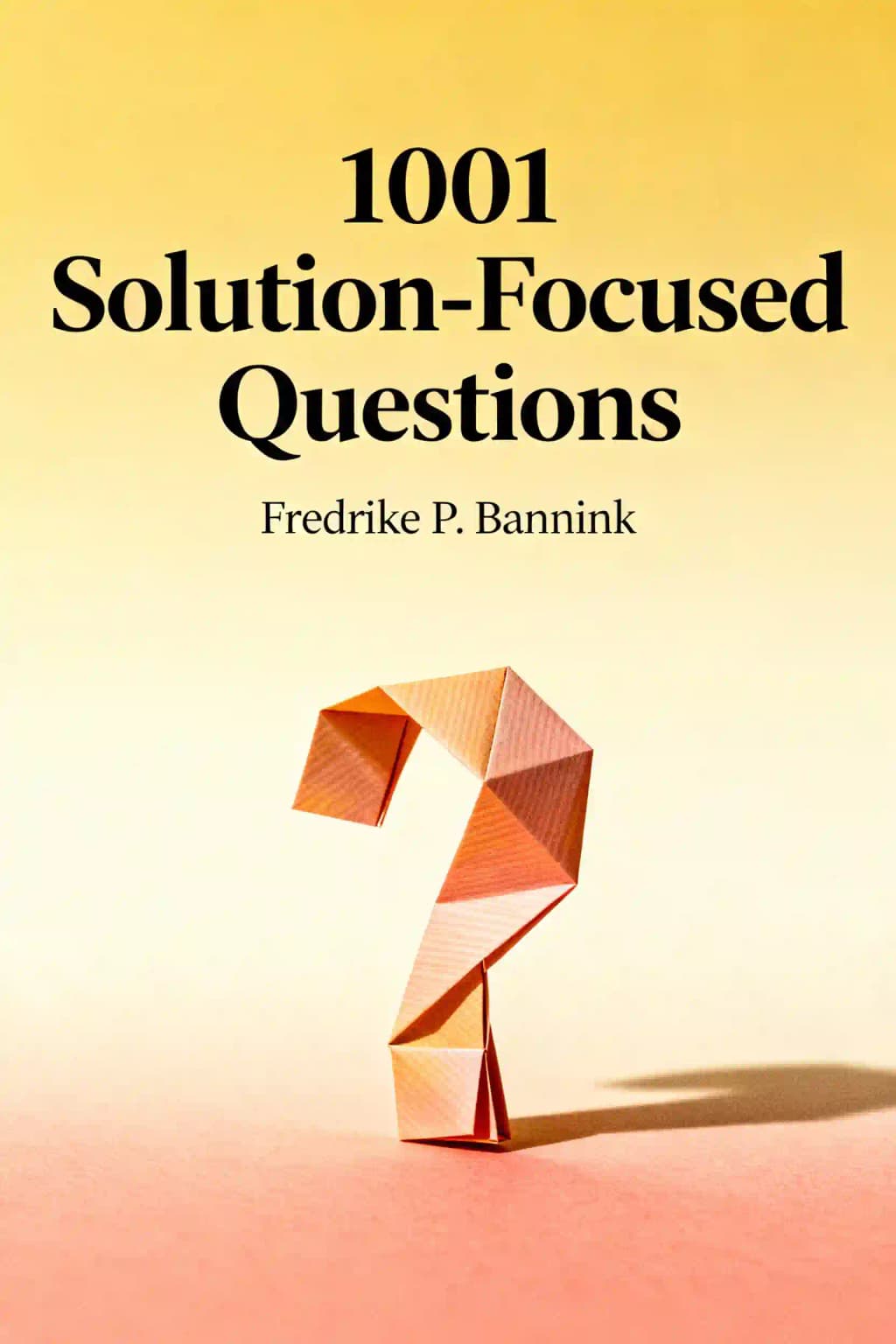
Revolutionize your therapeutic approach with "1001 Solution-Focused Questions" - the handbook that transformed clinical psychology by shifting focus from problems to solutions. Endorsed by solution-focused pioneer Insoo Kim Berg, it's the resource therapists credit with breaking their toughest client stalemates. What question will unlock your breakthrough?
Fredrike P. Bannink, clinical psychologist and acclaimed author of 1001 Solution-Focused Questions, is a pioneering figure in solution-focused therapy and positive psychology. With nearly 30 years of clinical experience, her work bridges cognitive-behavioral strategies with strength-based methodologies, emphasizing clients’ existing resources over deficits.
A trained mediator and international trainer, she has conducted workshops for mental health teams at Doctors Without Borders and delivered keynote addresses at events like the National Mediation Conference in Sydney.
Her influential titles, including Practicing Positive CBT and Post Traumatic Success, integrate solution-focused techniques with trauma-informed care and positive psychiatry, reshaping therapeutic practices globally. Bannink’s insights have been featured in Psychology Today and academic journals, while her books—translated into multiple languages—are staple resources in clinical training programs.
1001 Solution-Focused Questions remains a definitive guide, celebrated for its practical, accessible approach to fostering resilience and goal-oriented change in therapy and coaching contexts.
1001 Solution-Focused Questions provides therapists and coaches with a practical toolkit for client-centered interviewing, emphasizing goal-setting, resource identification, and future-oriented problem-solving. It offers 1,001 categorized questions for diverse scenarios – from trauma to family therapy – alongside exercises and case studies demonstrating the model’s effectiveness.
Mental health professionals (therapists, counselors), coaches, social workers, and educators seeking actionable techniques for client empowerment will benefit. Its structured frameworks and adaptable questions also aid mediators and organizational leaders navigating conflict resolution.
Yes – it balances theoretical foundations with immediately applicable strategies. Readers praise its comprehensive question bank, exception-seeking techniques, and exercises fostering creative client engagement. Therapists report enhanced session efficiency through its goal-oriented approach.
Unlike problem-focused approaches, it avoids analyzing root causes, instead prioritizing actionable steps toward clients’ desired futures. It contrasts with CBT by emphasizing strengths over cognitive distortions.
It provides targeted questions to help clients articulate coping strategies, recognize resilience, and formulate immediate goals. Examples include exploring “survival skills” used during past challenges and scaling current crisis severity.
Yes – its frameworks apply to workplace coaching, education, and family mediation. Questions like “What would a 10% improvement look like?” help teams break down complex problems into manageable steps.
Some argue its simplicity may oversimplify complex trauma cases. Others note the approach requires skill to avoid seeming dismissive of clients’ emotional experiences.
Bannink’s 30+ years in clinical practice and training inform the book’s balance of rigor and accessibility. Her background in positive psychology and international workshops ensures globally tested methodologies.
It categorizes clients as “visitors,” “complainants,” or “customers,” tailoring questions to their engagement level. For reluctant clients, it uses “soft” openers like “What would make this conversation useful?”
著者の声を通じて本を感じる
知識を魅力的で例が豊富な洞察に変換
キーアイデアを瞬時にキャプチャして素早く学習
楽しく魅力的な方法で本を楽しむ
If it works, don't fix it.
Clients are experts in their own lives.
Clients are always cooperating.
Problems differ fundamentally from solutions.
『1001 solution-focused questions』の核心的なアイデアを分かりやすいポイントに分解し、革新的なチームがどのように創造、協力、成長するかを理解します。
『1001 solution-focused questions』を素早い記憶のヒントに凝縮し、率直さ、チームワーク、創造的な回復力の主要原則を強調します。

鮮やかなストーリーテリングを通じて『1001 solution-focused questions』を体験し、イノベーションのレッスンを記憶に残り、応用できる瞬間に変えます。
何でも質問し、声を選び、本当にあなたに響く洞察を一緒に作り出しましょう。

"Instead of endless scrolling, I just hit play on BeFreed. It saves me so much time."
"I never knew where to start with nonfiction—BeFreed’s book lists turned into podcasts gave me a clear path."
"Perfect balance between learning and entertainment. Finished ‘Thinking, Fast and Slow’ on my commute this week."
"Crazy how much I learned while walking the dog. BeFreed = small habits → big gains."
"Reading used to feel like a chore. Now it’s just part of my lifestyle."
"Feels effortless compared to reading. I’ve finished 6 books this month already."
"BeFreed turned my guilty doomscrolling into something that feels productive and inspiring."
"BeFreed turned my commute into learning time. 20-min podcasts are perfect for finishing books I never had time for."
"BeFreed replaced my podcast queue. Imagine Spotify for books — that’s it. 🙌"
"It is great for me to learn something from the book without reading it."
"The themed book list podcasts help me connect ideas across authors—like a guided audio journey."
"Makes me feel smarter every time before going to work"

1001 solution-focused questionsの要約をPDFまたはEPUBで無料でダウンロード。印刷やオフラインでいつでもお読みいただけます。
A therapist sits across from a new client who launches into a detailed account of everything wrong in their life-failed relationships, workplace conflicts, persistent anxiety. The therapist listens, then asks: "Suppose tonight, while you sleep, a miracle happens and all these problems vanish. When you wake up tomorrow, what's the first small thing you'd notice that tells you something has shifted?" The client pauses, genuinely surprised by the question. In that pause, something fundamental changes. This isn't another session dissecting what's broken. This is an invitation to imagine what's possible. This moment captures the revolutionary shift that solution-focused questioning brings to helping conversations-a shift from endless problem analysis to deliberate solution building. For generations, helping professionals operated on a seemingly logical assumption: you must thoroughly understand a problem before solving it. Dig deep into causes, analyze patterns, explore origins. This medical model works brilliantly for diagnosing infections or broken bones. But when applied to human psychology and relationships, it often backfires spectacularly. The more we focus on problems, the larger they loom. Discussing failures repeatedly doesn't illuminate pathways forward-it reinforces feelings of helplessness.
