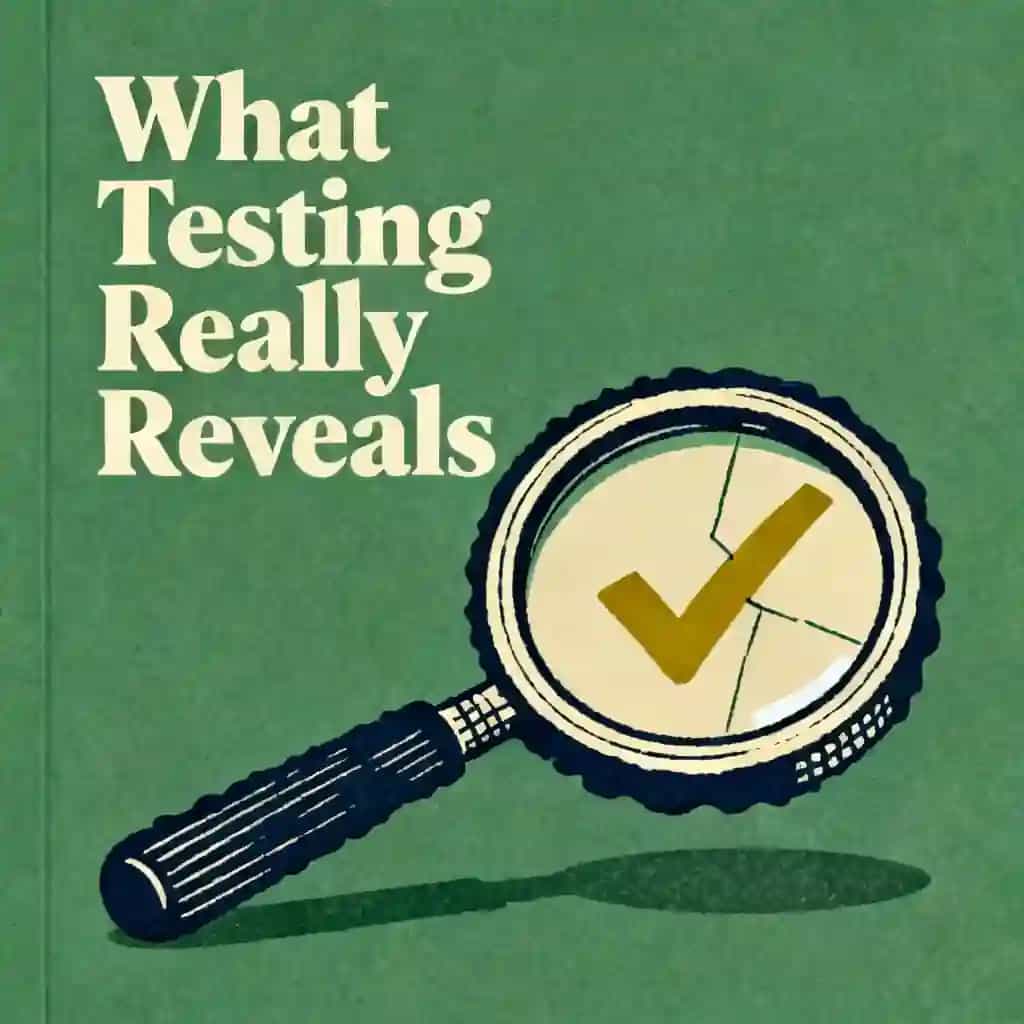
Testing Strategies That Actually Work
Struggling with testing anxiety or inefficient processes? Learn how to choose the right assessment methods to uncover the truth and improve outcomes.

Miglior citazione da Testing Strategies That Actually Work
The most common mistake people make is jumping straight into the 'legislation' of a test plan without ever establishing the 'constitution' of a testing strategy. Think of the strategy as your map and the test plan as your turn-by-turn navigation.
Generated by Howard Zane
test

Domande frequenti
A testing strategy acts as the "constitution" or high-level map of a project, defining the overall approach, tools, and goals. In contrast, a test plan is the "turn-by-turn navigation" or legislation that details the specific tactical steps for execution. Without a strategy, a team might execute tests perfectly but fail to address critical risks like performance bottlenecks or browser compatibility.
Shifting left refers to moving testing activities as early as possible in the development timeline, rather than waiting until the end. This involves "static testing," such as peer reviews and requirement inspections, to catch ambiguities before they are even coded. By addressing quality during the design phase, teams can avoid the "hundred-times multiplier," where a bug found in production costs significantly more to fix than one found during the initial planning.
Manual testing is most cost-effective for short-lived projects like a three-month MVP or a proof of concept where the upfront cost of building an automation framework isn't justified. It is also essential for tasks requiring human judgment, such as usability, accessibility, and "look and feel" evaluations. A general rule of thumb is that if a test will run fewer than eight times over the life of a project, it is often cheaper to perform it manually.
Risk-Based Testing prioritizes efforts by evaluating features based on the probability of failure and the business impact of that failure. High-probability, high-impact features (like a checkout button) are placed in "Tier 1" and receive the most rigorous automation and exploratory testing. Lower-risk areas receive less attention, ensuring that the team mitigates the most dangerous risks first when time and budget are constrained.
AI has evolved into "agentic" tools that handle repetitive tasks like regression testing and "self-healing" scripts that automatically update when UI elements change. This allows human testers to focus on high-value work that machines cannot do, such as exploratory testing, intuitive edge-case discovery, and strategic risk analysis. Because AI-generated code often has a higher defect density, human oversight and rigorous testing strategies are more critical than ever to ensure security and logic.
Creato da alumni della Columbia University a San Francisco
"Instead of endless scrolling, I just hit play on BeFreed. It saves me so much time."


"I never knew where to start with nonfiction—BeFreed’s book lists turned into podcasts gave me a clear path."


"Perfect balance between learning and entertainment. Finished ‘Thinking, Fast and Slow’ on my commute this week."
"Crazy how much I learned while walking the dog. BeFreed = small habits → big gains."
"Reading used to feel like a chore. Now it’s just part of my lifestyle."

"Feels effortless compared to reading. I’ve finished 6 books this month already."
"BeFreed turned my guilty doomscrolling into something that feels productive and inspiring."

"BeFreed turned my commute into learning time. 20-min podcasts are perfect for finishing books I never had time for."
"BeFreed replaced my podcast queue. Imagine Spotify for books — that’s it. 🙌"

"It is great for me to learn something from the book without reading it."
"The themed book list podcasts help me connect ideas across authors—like a guided audio journey."
"Makes me feel smarter every time before going to work"
 Ask ChatGPT
 Ask Claude
Creato da alumni della Columbia University a San Francisco
"Instead of endless scrolling, I just hit play on BeFreed. It saves me so much time."
"I never knew where to start with nonfiction—BeFreed’s book lists turned into podcasts gave me a clear path."
"Perfect balance between learning and entertainment. Finished ‘Thinking, Fast and Slow’ on my commute this week."
"Crazy how much I learned while walking the dog. BeFreed = small habits → big gains."
"Reading used to feel like a chore. Now it’s just part of my lifestyle."
"Feels effortless compared to reading. I’ve finished 6 books this month already."
"BeFreed turned my guilty doomscrolling into something that feels productive and inspiring."
"BeFreed turned my commute into learning time. 20-min podcasts are perfect for finishing books I never had time for."
"BeFreed replaced my podcast queue. Imagine Spotify for books — that’s it. 🙌"
"It is great for me to learn something from the book without reading it."
"The themed book list podcasts help me connect ideas across authors—like a guided audio journey."
"Makes me feel smarter every time before going to work"
"Instead of endless scrolling, I just hit play on BeFreed. It saves me so much time."
"I never knew where to start with nonfiction—BeFreed’s book lists turned into podcasts gave me a clear path."
"Perfect balance between learning and entertainment. Finished ‘Thinking, Fast and Slow’ on my commute this week."
"Crazy how much I learned while walking the dog. BeFreed = small habits → big gains."
"Reading used to feel like a chore. Now it’s just part of my lifestyle."
"Feels effortless compared to reading. I’ve finished 6 books this month already."
"BeFreed turned my guilty doomscrolling into something that feels productive and inspiring."
"BeFreed turned my commute into learning time. 20-min podcasts are perfect for finishing books I never had time for."
"BeFreed replaced my podcast queue. Imagine Spotify for books — that’s it. 🙌"
"It is great for me to learn something from the book without reading it."
"The themed book list podcasts help me connect ideas across authors—like a guided audio journey."
"Makes me feel smarter every time before going to work"
"Instead of endless scrolling, I just hit play on BeFreed. It saves me so much time."
"I never knew where to start with nonfiction—BeFreed’s book lists turned into podcasts gave me a clear path."
"Perfect balance between learning and entertainment. Finished ‘Thinking, Fast and Slow’ on my commute this week."
"Crazy how much I learned while walking the dog. BeFreed = small habits → big gains."
"Reading used to feel like a chore. Now it’s just part of my lifestyle."
"Feels effortless compared to reading. I’ve finished 6 books this month already."
"BeFreed turned my guilty doomscrolling into something that feels productive and inspiring."
"BeFreed turned my commute into learning time. 20-min podcasts are perfect for finishing books I never had time for."
"BeFreed replaced my podcast queue. Imagine Spotify for books — that’s it. 🙌"
"It is great for me to learn something from the book without reading it."
"The themed book list podcasts help me connect ideas across authors—like a guided audio journey."
"Makes me feel smarter every time before going to work"