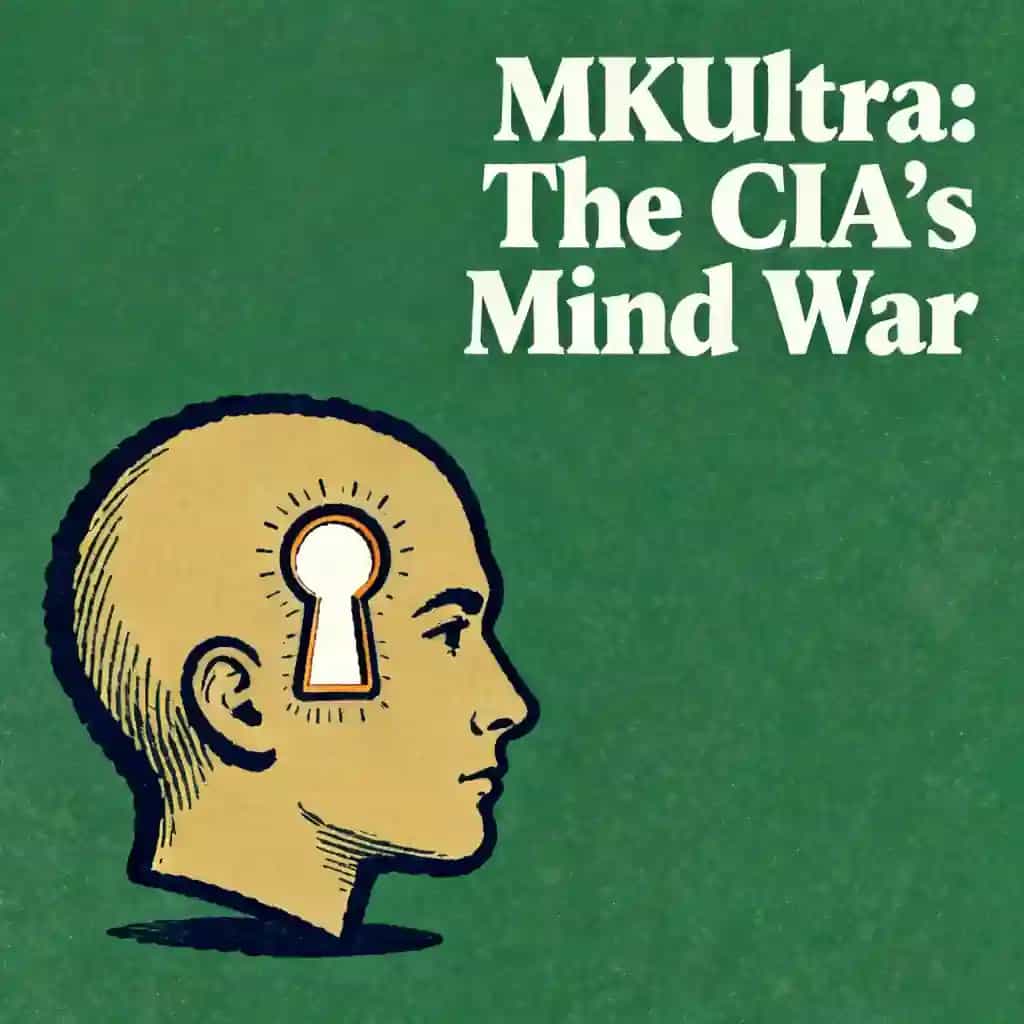
MKUltra: The CIA’s War for the Mind and Secret Experiments
Explore the dark history of Project MKUltra and the CIA’s war for the mind. Learn about declassified operations, Operation Midnight Climax, and secret experiments.

Miglior citazione da MKUltra: The CIA’s War for the Mind and Secret Experiments
The legacy of MKUltra is a permanent 'buyer beware' sticker on the concept of progress, revealing the friction between collective safety and individual liberty—a tension that is as alive today as it was in 1953.

Questa lezione audio è stata creata da un membro della comunità BeFreed
An exploration of wild, declassified CIA and FBI projects and experiments, such as Project MKUltra, Operation Midnight Climax, or investigations into the 'God Particle' (Higgs Boson) and fringe science. The lesson should cover the objectives of these projects, the extreme lengths and ethical boundaries crossed, and the eventual outcomes or discoveries.





Domande frequenti
Project MKUltra was a sprawling, multi-decade effort by the Central Intelligence Agency to master the human mind during the Cold War. This taxpayer-funded reality involved secret experiments where participants were often unwitting subjects in a quest to understand mind control. By utilizing declassified operations, we can see how the CIA attempted to dissolve the boundary between the state and the individual, fundamentally shifting our understanding of government transparency and the ethics of scientific pursuit.
During these experiments, individuals seeking treatment for minor ailments like anxiety were often given substances under the guise of revolutionary sedatives. Within minutes, these unwitting participants experienced intense hallucinations and a dissolving sense of self, memories, and identity. These high-stakes operations took place in various settings, ranging from nondescript doctor's offices to clandestine safehouses, as the Central Intelligence Agency sought to unlock the fundamental building blocks of human consciousness and control.
Operation Midnight Climax was a specific component of the broader MKUltra program involving clandestine safehouses. It represents the intersection of national security and extreme experimentation, where the government conducted declassified operations to test the limits of human psychology. These activities highlight the friction between state power and individual rights, serving as a chilling example of how the search for mind control techniques bypassed traditional scientific ethics and transparency during the Cold War era.
The legacy of Project MKUltra remains relevant because it dictates modern perceptions of government transparency and the ethics of scientific pursuit. While these experiments may seem like relics of a paranoid past, they reveal the historical friction between state operations and individual autonomy. Understanding these declassified CIA operations helps us navigate the ongoing boundaries of national security and the ethical standards required when the state engages in high-stakes psychological research.
Creato da alumni della Columbia University a San Francisco
"Instead of endless scrolling, I just hit play on BeFreed. It saves me so much time."


"I never knew where to start with nonfiction—BeFreed’s book lists turned into podcasts gave me a clear path."


"Perfect balance between learning and entertainment. Finished ‘Thinking, Fast and Slow’ on my commute this week."
"Crazy how much I learned while walking the dog. BeFreed = small habits → big gains."
"Reading used to feel like a chore. Now it’s just part of my lifestyle."

"Feels effortless compared to reading. I’ve finished 6 books this month already."
"BeFreed turned my guilty doomscrolling into something that feels productive and inspiring."

"BeFreed turned my commute into learning time. 20-min podcasts are perfect for finishing books I never had time for."
"BeFreed replaced my podcast queue. Imagine Spotify for books — that’s it. 🙌"

"It is great for me to learn something from the book without reading it."
"The themed book list podcasts help me connect ideas across authors—like a guided audio journey."
"Makes me feel smarter every time before going to work"
Creato da alumni della Columbia University a San Francisco
"Instead of endless scrolling, I just hit play on BeFreed. It saves me so much time."
"I never knew where to start with nonfiction—BeFreed’s book lists turned into podcasts gave me a clear path."
"Perfect balance between learning and entertainment. Finished ‘Thinking, Fast and Slow’ on my commute this week."
"Crazy how much I learned while walking the dog. BeFreed = small habits → big gains."
"Reading used to feel like a chore. Now it’s just part of my lifestyle."
"Feels effortless compared to reading. I’ve finished 6 books this month already."
"BeFreed turned my guilty doomscrolling into something that feels productive and inspiring."
"BeFreed turned my commute into learning time. 20-min podcasts are perfect for finishing books I never had time for."
"BeFreed replaced my podcast queue. Imagine Spotify for books — that’s it. 🙌"
"It is great for me to learn something from the book without reading it."
"The themed book list podcasts help me connect ideas across authors—like a guided audio journey."
"Makes me feel smarter every time before going to work"
"Instead of endless scrolling, I just hit play on BeFreed. It saves me so much time."
"I never knew where to start with nonfiction—BeFreed’s book lists turned into podcasts gave me a clear path."
"Perfect balance between learning and entertainment. Finished ‘Thinking, Fast and Slow’ on my commute this week."
"Crazy how much I learned while walking the dog. BeFreed = small habits → big gains."
"Reading used to feel like a chore. Now it’s just part of my lifestyle."
"Feels effortless compared to reading. I’ve finished 6 books this month already."
"BeFreed turned my guilty doomscrolling into something that feels productive and inspiring."
"BeFreed turned my commute into learning time. 20-min podcasts are perfect for finishing books I never had time for."
"BeFreed replaced my podcast queue. Imagine Spotify for books — that’s it. 🙌"
"It is great for me to learn something from the book without reading it."
"The themed book list podcasts help me connect ideas across authors—like a guided audio journey."
"Makes me feel smarter every time before going to work"
"Instead of endless scrolling, I just hit play on BeFreed. It saves me so much time."
"I never knew where to start with nonfiction—BeFreed’s book lists turned into podcasts gave me a clear path."
"Perfect balance between learning and entertainment. Finished ‘Thinking, Fast and Slow’ on my commute this week."
"Crazy how much I learned while walking the dog. BeFreed = small habits → big gains."
"Reading used to feel like a chore. Now it’s just part of my lifestyle."
"Feels effortless compared to reading. I’ve finished 6 books this month already."
"BeFreed turned my guilty doomscrolling into something that feels productive and inspiring."
"BeFreed turned my commute into learning time. 20-min podcasts are perfect for finishing books I never had time for."
"BeFreed replaced my podcast queue. Imagine Spotify for books — that’s it. 🙌"
"It is great for me to learn something from the book without reading it."
"The themed book list podcasts help me connect ideas across authors—like a guided audio journey."
"Makes me feel smarter every time before going to work"




![[PDF] MK-ULTRA/MIND CONTROL EXPERIMENTS - CIA](/_next/image?url=https%3A%2F%2Fd1y2du6z1jfm9e.cloudfront.net%2Fassets%2Fpodcast%2Fyellow.png&w=1024&q=50)