Capitolo 1
Democracy's Fragile Experiment: America at a Crossroads
In January 2021, America witnessed two starkly contrasting visions of its future within 24 hours. First came Georgia's historic election of Reverend Raphael Warnock, the state's first African American senator, and Jon Ossoff, its first Jewish American senator-a glimpse of a more inclusive democratic future. The very next day, an unprecedented violent insurrection stormed the U.S. Capitol, incited by a sitting president unwilling to accept electoral defeat. This jarring juxtaposition revealed both the promise and peril facing American democracy today.
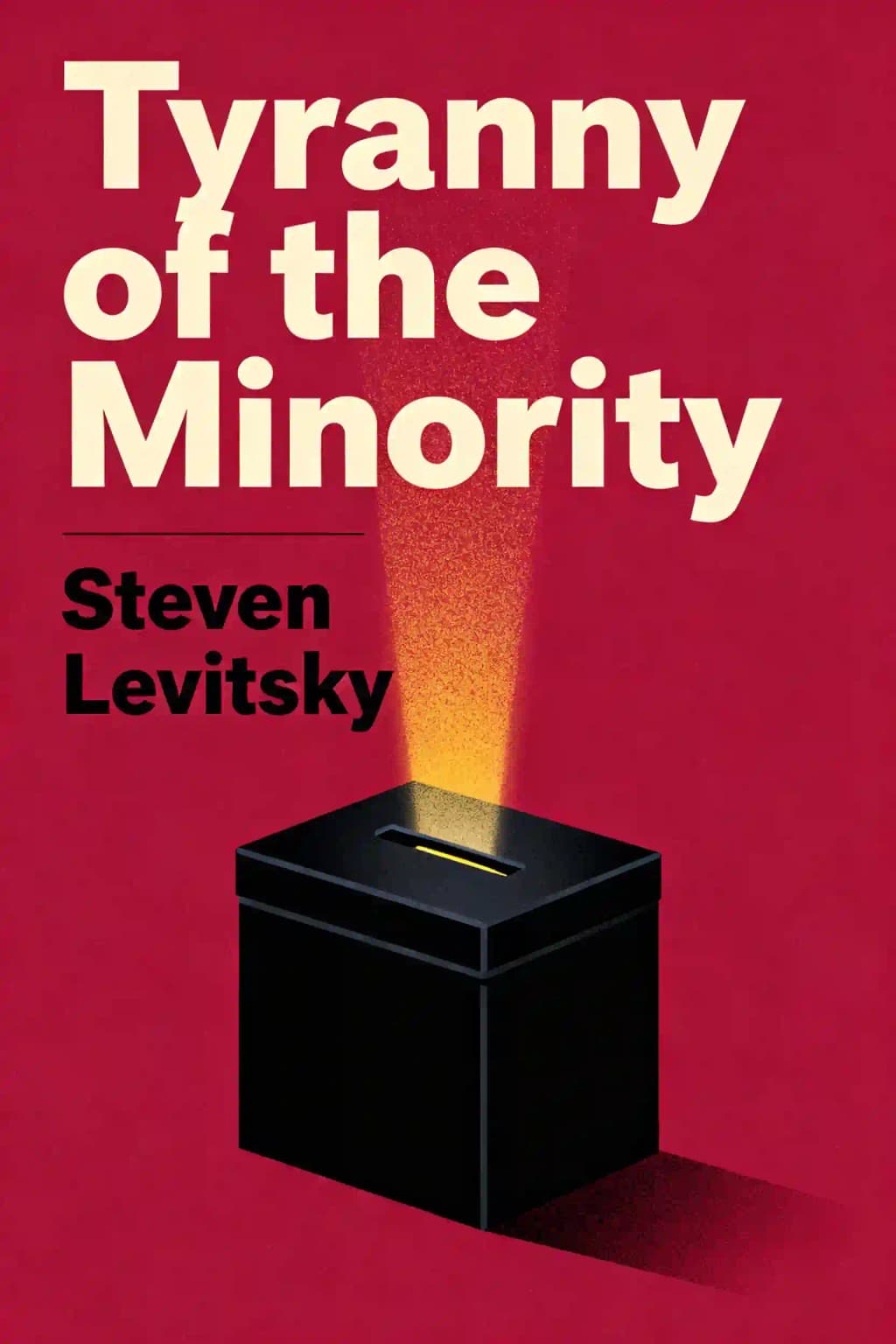
"Tyranny of the Minority" has become a cultural touchstone for understanding America's democratic backslide. Named one of Barack Obama's favorite books and praised by figures across the political spectrum, Levitsky and Ziblatt's analysis has sparked urgent conversations about institutional reform. The book's warnings about counter-majoritarian institutions have proven particularly prescient as the Supreme Court has made increasingly controversial decisions opposed by clear majorities of Americans. As our society becomes more diverse and inclusive, the book argues that our outdated institutions are empowering a shrinking demographic to maintain disproportionate control-a situation that threatens the very foundation of democratic governance.
Capitolo 2
The Democratic Imperative: Learning to Lose
Democracy fundamentally requires accepting defeat and peacefully relinquishing power. This principle was tested during America's first partisan transfer of power in 1801, when the election between Thomas Jefferson and Aaron Burr deadlocked in the Electoral College. The crisis nearly tore America apart, with Federalists considering desperate measures to prevent Jefferson from taking office, including extending debate past the inauguration deadline to install a Federalist Senate president.
Jefferson called this "stretching the Constitution," while his supporters prepared "resistance by force." Pennsylvania and Virginia mobilized militias and threatened secession. After 35 deadlocked ballots over six days, Federalist congressman James Bayard of Delaware finally withdrew his support for Burr, allowing Jefferson to win. Bayard later explained he changed his vote because he feared "constitutional breakdown or even civil war."
Two conditions help parties accept electoral defeat. First, they must believe they can win again in the future. Many Federalists in 1801 expressed confidence they would "soon stand on high ground" and "regain our influence." Second, parties must believe losing won't bring catastrophe. Despite campaign rhetoric casting Jefferson as an existential threat, key Federalists ultimately recognized him as a pragmatist who would protect their priorities.
When parties fear they'll lose more than just an election-when they believe their social status and way of life are threatened-accepting defeat becomes nearly impossible. This fear of falling in social hierarchy can destroy democracy, as seen in Thailand, where the once pro-democracy Democrat Party embraced military coups after losing five straight elections to parties representing rural voters. The Bangkok elite resented not just electoral defeat but the shifting balance of power as the poor's share of national income rose. A beer heiress declared rural Thais lacked "true understanding" of democracy, while a CEO admitted "I'm not really for democracy...I don't think we're ready for it." Their fear wasn't just about losing political power but losing their dominant status in society.
Capitolo 3
The Banality of Authoritarianism
In late January 1934, France's democracy faced a critical test. After years of political instability and economic depression, tens of thousands of angry young men from right-wing militias gathered near France's parliament. On February 6, the protest turned violent. Rioters armed with razor-tipped poles attacked police, set a bus on fire, and attempted to storm parliament while chanting "Hang the Deputies!" By evening, several people were dead, hundreds injured, and Prime Minister Edouard Daladier had resigned.
While left-wing parties united in condemnation, France's leading conservative party, the Republican Federation, showed remarkable tolerance toward the extremists. The Federation had become intertwined with groups like the Young Patriots, with at least thirty-five Federation parliament members belonging to the militia. This "semi-loyal" behavior toward democracy would eventually contribute to the collapse of France's Third Republic.
Loyal democrats follow four essential rules that distinguish them from "semi-loyal" ones. First, they expel antidemocratic extremists from their ranks, even at political cost. Second, they sever all ties with groups engaging in antidemocratic behavior. Third, they unambiguously condemn political violence even when committed by allies. Finally, loyal democrats join forces with ideological rivals to defeat antidemocratic extremists, temporarily setting aside policy differences to defend democracy itself.
Spain's February 1981 coup attempt provides a powerful example of loyal democratic response. After Spain's first democracy collapsed in the 1930s partly due to semi-loyal behavior from both left and right, democracy was restored in 1976 following Franco's dictatorship. When Lieutenant Colonel Antonio Tejero led 200 civil guardsmen in storming parliament with submachine guns, leaders across the political spectrum immediately condemned the attack. Right-wing leader Manuel Fraga, a former Franco official, shouted "This is an attack on democracy!" Days later, over a million Spaniards marched in Madrid's largest demonstration ever, with leaders from across the political spectrum marching side by side.
Semi-loyalty appears benign but can be devastating to democracy. When mainstream politicians tolerate or condone antidemocratic extremists, they enable democracy's collapse by protecting extremists from consequences and legitimizing their ideas. In 1930s France, many insurrectionists were shielded rather than prosecuted, with several later joining the Nazi-aligned Vichy regime. The once-unthinkable idea of dismantling parliamentary democracy became mainstream among conservatives who viewed the republic as corrupt and communist-infiltrated.
Beyond enabling extremism, mainstream politicians can undermine democracy through constitutional hardball-behavior that technically follows the letter of the law while deliberately violating its spirit. This dangerous tactic allows politicians to weaken democracy with clean hands, through exploiting constitutional gaps, excessive use of legal powers, selective enforcement of laws against opponents, and crafting seemingly impartial laws specifically designed to target political rivals.
Capitolo 4
It Has Happened Here
Most twenty-first-century autocracies are built through constitutional hardball-gradual, seemingly reasonable measures that incrementally tilt the playing field against opponents. Viktor Orban's Hungary exemplifies this approach. After winning a parliamentary supermajority in 2010, Orban systematically undermined democracy while maintaining a veneer of legality by capturing the courts, transforming public media into a propaganda arm, helping allies acquire private media outlets, packing the Electoral Commission, and gerrymandering districts to favor his party.
This playbook, though seemingly modern, was actually perfected centuries ago in the United States. In the late 1890s, Wilmington, North Carolina was a thriving port city with a booming economy and a prosperous Black middle class. The emergence of the Populist Party catalyzed a remarkable political transformation when they formed an alliance with Republicans, creating a "Fusion" coalition that won control of North Carolina's legislature and governorship. In Wilmington, this led to significant Black representation in government.
But this democratic promise triggered a violent white supremacist backlash. In 1898, Democratic Party leaders launched a campaign to restore white rule, forming "White Government Union" clubs and armed "Red Shirt" militias that terrorized Black neighborhoods. On Election Day, armed whites intimidated Black voters and stuffed ballot boxes. Then on November 10, they launched a violent coup-a mob of at least 500 white supremacists marched through the city, killing at least 22 Black residents, forcing the biracial government to resign at gunpoint, and banishing prominent Black citizens.
The Democrats then amended the state constitution to impose poll taxes, literacy tests, and property requirements. Black voter registration in North Carolina plummeted from 126,000 to just 6,100 within six years. In Wilmington, no Black person would serve on the city council again until 1972.
The Wilmington coup marked the tragic end of America's first major experiment with multiracial democracy. The post-Civil War Reconstruction era had transformed the American political system through what historian Eric Foner calls the "Second Founding"-a constitutional remaking that established equal rights and universal male suffrage through three constitutional amendments and the 1875 Civil Rights Act.
Reconstruction transformed southern politics dramatically. Within one year, the percentage of Black men eligible to vote rose from 0.5 percent to 80.5 percent. By 1867, over 1,300 Black Americans held public office during Reconstruction, including 16 elected to Congress. This sudden shift threatened white southerners economically, politically, and socially.
White reactionaries responded with unprecedented terrorist violence. Paramilitary groups like the Ku Klux Klan carried out a campaign of terror that killed thousands of Black Americans and targeted Republican politicians. By 1877, when federal troops were withdrawn, Democrats had seized power in nearly every southern state through violence and fraud, though Black voting persisted into the 1880s.
During the economic depression of the 1880s-90s, third-party movements like the Populists formed biracial coalitions with Republicans, winning governorships in Virginia and North Carolina. These biracial coalitions alarmed white Democrats, who warned of "Negro domination" and the "Africanization" of their states. Finding that violence and fraud weren't permanent solutions, Democrats turned to "legal" means of disenfranchisement through poll taxes, literacy tests, property requirements, and the secret ballot-all technically race-neutral but designed to prevent Black voting.
The final check against this disenfranchisement-the federal judiciary-failed spectacularly. In Giles v. Harris (1903), Justice Oliver Wendell Holmes Jr. refused to intervene against Alabama's discriminatory voting system. Without federal protection, democracy in the South was extinguished. Black turnout plummeted from 61 percent in 1880 to just 2 percent by 1912. The South fell into nearly a century of authoritarianism with single-party Democratic rule. As W.E.B. Du Bois wrote, "Democracy died save in the hearts of black folk."
Capitolo 5
Why the Republican Party Abandoned Democracy
Nearly a century after Reconstruction's end, President Lyndon Johnson addressed Congress in November 1963, declaring "We have talked long enough in this country about equal rights... It is time now to write the next chapter, and to write it in the books of law."
If Reconstruction was America's "second founding," the reforms culminating in the Civil Rights Act (1964) and Voting Rights Act (1965) constituted a "third founding," establishing a stronger legal foundation for multiracial democracy. These reforms passed with bipartisan support-indeed, they required Republican votes to overcome opposition from southern Democrats. Ohio Republican congressman William McCulloch co-sponsored the 1964 Civil Rights Act, with 80 percent of House Republicans voting for the bill. In the Senate, Republican Minority Leader Everett Dirksen rallied Republican support, with over 80 percent of Republican senators supporting the bill.
Sixty years later, that Republican Party is unrecognizable. The same party that was pivotal in passing the Voting Rights Act unanimously rejected federal legislation to restore it in 2021. The V-Dem Institute, which tracks global democracy, assigns political parties an annual "illiberalism" score measuring their deviation from democratic norms. By 2020, V-Dem concluded the Republican Party was "more similar to autocratic ruling parties such as the Turkish AKP and Fidesz in Hungary than to typical center-right governing parties."
Paradoxically, the roots of the GOP's transformation lie in its reaction to the very multiracial democracy it helped construct. Before the New Deal, Republicans represented business interests and the well-to-do, including northeastern manufacturers, midwestern farmers, small-town conservatives, and white Protestant voters outside the South. The Great Depression and New Deal reshaped American politics, establishing Democrats as the new majority party. Republicans now confronted the "conservative dilemma": how to appeal to a broader electorate while preserving elite constituencies' interests and power.
Changes within the Democratic Party created an opening. In the late 1930s, the liberal wing of the Democratic Party had forged an alliance with the NAACP and CIO to advance civil rights. This shift alienated southern whites, 98 percent of whom still supported segregation at the start of World War II. Republican leaders saw opportunity. By the early 1960s, journalist Robert Novak reported that right-wing Republican leaders "envisioned substantial political gold to be mined in the racial crisis by becoming...the White Man's Party."
These efforts accelerated in 1964 with the Civil Rights Act. Though most congressional Republicans supported the act, Senator Barry Goldwater, the GOP's 1964 presidential candidate, pursued the southern white vote by voting against it and championing "states' rights." Though Goldwater lost in a landslide, he won the Deep South easily.
The civil rights revolution reshaped America's party system. Democrats established themselves as the party of civil rights, attracting most Black voters, while Republicans repositioned as the party of racial conservatism. This racial conservatism paid electoral dividends. Nearly 90% of Americans were white in the 1960s, and polls showed considerable white anxiety over civil rights. By late 1966, 85% of whites felt Blacks were moving "too fast" toward racial equality.
This mounting white resentment propelled what strategist Kevin Phillips called the "emerging Republican majority." In a racially divided but overwhelmingly white society, Phillips argued, the GOP could regain majority status "if the Democrats could be labeled the 'black man's party' and the GOP established itself as the defenders of southern racial traditions."
Though openly racist appeals were no longer acceptable, Republicans could attract racially conservative whites through coded language emphasizing "law and order" and opposition to busing. This was Richard Nixon's southern strategy, and it worked: four-fifths of southern whites voted for either Nixon or third-party segregationist George Wallace in 1968. Ronald Reagan continued this approach, adding a white Christian strategy that successfully brought southern white and evangelical voters into the Republican fold.
The "Great White Switch" transformed the Republican Party into America's leading party, winning every presidential election between 1968 and 1988 except the post-Watergate election of 1976. But this success created a vulnerability-by the turn of the century, a majority of white Republicans scored high on "racial resentment" measures, making the party susceptible to capture by its racially conservative base. This posed a growing problem because while Republicans remained overwhelmingly white and Christian, America was rapidly diversifying.
American society transformed dramatically in the late twentieth and early twenty-first centuries. The percentage of non-Hispanic whites fell from 88 percent in 1950 to just 58 percent by 2020, with minorities constituting 40 percent of Americans and a majority of those under eighteen. Public support for immigration, diversity, and racial equality steadily increased, especially among younger Americans.
Barack Obama's election and reelection exposed the limitations of the GOP's southern strategy. While Mitt Romney won an even higher percentage of the white vote than Reagan had in 1980, Romney still lost the election. National Republican leaders recognized this threat, with RNC chairs like Ken Mehlman publicly renouncing race-baiting tactics and Reince Priebus commissioning a post-2012 "autopsy" that urged the party to become more inclusive toward nonwhite voters.
However, even as national leaders sought to broaden the party's appeal, state-level Republicans were moving in the opposite direction, working to make it harder for minority voters to cast ballots. Following their 2010 midterm victories, Republicans launched a wave of voting restrictions aimed at shrinking the electorate. Between 2011 and 2016, thirteen Republican-led states passed strict photo ID laws that disproportionately affected minority voters.
Beyond electoral fears, many Republican voters experienced America's demographic changes as an existential threat to their identity and status. The 2016 primaries revealed this divide clearly. While Jeb Bush embraced inclusivity, Donald Trump discovered the Tea Party's racially tinged mantra of "taking our country back" resonated powerfully with primary voters. By 2020, white resentment politics dominated the party, with 84% of Trump voters expressing worry about discrimination against whites. Many embraced the "great replacement theory" claiming elites were using immigration to replace America's "native" white population.
The Republican Party has abandoned three fundamental democratic principles: accepting electoral defeat, rejecting political violence, and breaking with antidemocratic extremists. While a few Republicans like Liz Cheney behaved as loyal democrats, most Republican leaders acted as "semi-loyal democrats," initially condemning the January 6 attack but reverting to appeasement when they realized most Republican voters remained loyal to Trump.
Capitolo 6
Fettered Majorities
The chapter opens with the death of civil rights icon John Lewis in July 2020. As a young civil rights leader, Lewis helped make the historic 1965 Voting Rights Act a reality after being brutally beaten during the "Bloody Sunday" march across the Edmund Pettus Bridge in Selma, Alabama.
In 2013, a conservative Supreme Court majority struck down a key provision of the Voting Rights Act in Shelby County v. Holder. Chief Justice Roberts argued the formula was no longer justified by "current needs," while Justice Ginsburg warned this was like "throwing away your umbrella in a rainstorm because you are not getting wet."
Despite John Lewis's pleas to restore these protections through new legislation before his death in 2020, and despite majority support in both chambers of Congress and among the American public, voting rights bills were repeatedly blocked by the Senate filibuster rule requiring sixty votes.
Modern democracy balances majority rule with minority rights through counter-majoritarian institutions. Two domains must be protected from majorities: civil liberties and the rules of democracy itself. While democracies need counter-majoritarian protections, they must also empower majorities. As Robert Dahl warned, fear of "tyranny of the majority" can obscure an equally dangerous "tyranny of the minority."
Democracy requires that two domains remain within majority reach: elections and legislative decision-making. First, those with more votes should determine who holds political office-there is no democratic justification for any other outcome. Second, those who win elections should govern. Legislative majorities should be able to pass regular laws that don't violate civil liberties or undermine democratic processes.
Counter-majoritarian institutions often serve authoritarian ends. In Thailand, after a 2014 coup, the military created a bicameral system with 250 appointed senators who could help elect the prime minister, allowing General Prayuth to maintain power despite opposition victories.
The U.S. constitutional system contains an unusually large number of counter-majoritarian institutions, including the Bill of Rights, Supreme Court with lifetime appointments, federalism, bicameral Congress, malapportioned Senate, filibuster, Electoral College, and extreme supermajority rules for constitutional amendments.
America has always been excessively counter-majoritarian because the Constitution was written in a pre-democratic era. The counter-majoritarian institutions weren't part of a master plan but resulted from pragmatic compromises made under pressure to forge a union of thirteen states.
The founders were practical politicians working to replace the failed Articles of Confederation amid fears of civil war and foreign intervention. Southern slave states demanded ironclad protections for slavery, threatening to abandon the convention if these weren't met. Small states insisted on equal representation in the political system, giving Delaware (with 59,000 residents) the same representation as states with five to seven times more people.
The Electoral College wasn't born of constitutional theory but adopted by default after all alternatives were rejected. The filibuster isn't in the Constitution despite being associated with our system of checks and balances. Many framers, including Hamilton and Madison, strongly opposed supermajority rules in Congress after experiencing dysfunction under the Articles of Confederation.
We've been taught to view our Constitution as a hallowed document with carefully crafted institutions, but this obscures the history of compromise and second-best solutions that produced them. This conflates essential democracy-enhancing institutions with unnecessary and undemocratic ones. The problem today isn't unfettered majorities but fettered ones-as one observer noted almost 75 years ago, "The American majority is an amiable shepherd dog kept forever on a lion's leash."
Capitolo 7
Minority Rule
In early 20th century Germany, conservative forces maintained power despite demographic shifts favoring progressives by exploiting counter-majoritarian institutions. As Germany industrialized and urbanized, the Social Democratic Party gained popular support but was thwarted by outdated electoral districts that overrepresented rural areas.
A similar dynamic is emerging in America today, where the conservative party benefits from institutions frozen in place despite societal change. While the U.S. system always contained counter-majoritarian elements, only in the 21st century have these institutions taken on a partisan cast, regularly benefiting one party.
America risks descending into minority rule where a party with fewer votes maintains control over key levers of power. The Electoral College distorts the popular vote through winner-take-all allocation and small-state bias, allowing Republicans to win the presidency despite losing the popular vote in two recent elections. The Senate's rural bias is even more pronounced-Democrats need to win the nationwide popular vote by about five points just to gain control, and at no point in the 21st century have Senate Republicans represented a majority of Americans.
The Supreme Court constitutes a third pillar of minority rule, with four justices confirmed by Senate majorities representing less than half of Americans, and three nominated by a president who lost the popular vote. Finally, the first-past-the-post electoral system for legislative elections, combined with Democrats' concentration in urban districts, creates artificial Republican majorities in many legislatures.
Our first-past-the-post electoral system, where the winner takes all regardless of margin, combines with Democrats' urban concentration to create minority rule in state legislatures. Pennsylvania exemplifies this problem-Democrats routinely win statewide popular majorities but Republicans dominate the legislature. This pattern repeats across many states, further amplified by aggressive Republican gerrymandering.
Counter-majoritarian institutions don't just thwart public opinion-they risk entrenching minority rule. While democratic systems are supposed to be self-correcting through electoral competition, institutions that overrepresent certain groups can shield parties from competitive pressures. This electoral crutch weakens incentives for Republicans to broaden their appeal beyond their white Christian base, reinforcing extremism rather than encouraging moderation.
Capitolo 8
America the Outlier
The United States has proven especially prone to democratic crisis despite other Western democracies facing similar diversity backlash. What makes America different?
In 1814, 112 Norwegian men gathered to draft what is now the world's second oldest written constitution. Inspired by America's founding and Enlightenment ideals, Norway's founders viewed the American experiment as a model for their own independence from foreign rule. Yet over two centuries, Norway underwent far-reaching democratic reforms under its original constitution, transforming into one of the world's most democratic countries.
Norway's democratic transformation wasn't unique. Most European political systems began with profoundly undemocratic features but systematically dismantled their counter-majoritarian institutions throughout the 20th century. Universal suffrage spread across western Europe, Australia, and New Zealand. Indirect elections disappeared as France, the Netherlands, Norway, Prussia, and Sweden eliminated the powerful local councils that had previously selected parliamentarians. Electoral colleges vanished across Latin America, with Argentina being the last to drop it in 1994.
Most European democracies reformed their electoral systems, abandoning first-past-the-post systems for proportional representation with multimember districts. Undemocratic upper chambers were systematically tamed or eliminated beginning with Britain's House of Lords. Most 20th-century democracies also limited minority obstruction within legislatures by establishing cloture procedures allowing simple majorities to end debate.
While most counter-majoritarian institutions were weakened, judicial review actually expanded after 1945. However, democracies mitigated intergenerational counter-majoritarianism by imposing term limits or mandatory retirement ages for justices. Every democracy that introduced judicial review since 1945 has included either term limits or retirement ages, preventing long-tenured judges from binding future generations.
America wasn't immune to democratic reforms. The Nineteenth Amendment extended voting rights to women (1920), the Snyder Act granted citizenship to Native Americans (1924), and the Voting Rights Act (1965) finally established universal suffrage. The Seventeenth Amendment (1913) democratized the Senate by mandating direct popular election rather than selection by state legislatures.
Despite these reforms, America failed to keep pace with other democracies. While other presidential democracies abolished indirect elections, America retained the Electoral College despite hundreds of attempts to reform or abolish it. The United States also kept its first-past-the-post electoral system that enables minority rule, especially in state legislatures, while most Western democracies adopted more proportional systems.
America's Constitution is the hardest to amend in the democratic world. Of 11,848 amendment attempts, only twenty-seven succeeded-just twelve since Reconstruction, with the most recent in 1992. This rigidity has preserved counter-majoritarian institutions like the Electoral College despite overwhelming public support for reform.
Capitolo 9
Democratizing Our Democracy
America is engaged in an ambitious experiment: building a vast multiracial democracy, with the world watching. Unlike earlier failed attempts, today's experiment has majority support. But this majority alone can't save our democracy because in America, majorities don't truly rule. We stand at a crossroads: either America becomes a multiracial democracy or it ceases being a democracy altogether.
Other democracies have faced similar threats and offer guidance. One strategy is containment-corralling all democratic forces into broad coalitions to isolate extremists, as seen in 1930s Finland and Belgium. A second strategy-militant or defensive democracy-emerged from post-WWII Europe, particularly West Germany, where the constitution allows banning "anti-constitutional" speech, groups, and parties.
Beyond short-term defensive strategies, America must reform its institutions. As Jane Addams wrote, "The cure for the ills of Democracy is more Democracy." This means dismantling undue minority protections, empowering majorities at all levels of government, ending constitutional protectionism, and making politicians more responsive to most Americans.
The right to vote is fundamental to democracy, yet surprisingly, the U.S. Constitution never explicitly guarantees this right. To democratize voting, we should pass a constitutional amendment establishing a universal right to vote, implement automatic voter registration, expand early and mail-in voting, make Election Day a national holiday, restore voting rights to all ex-felons, reinstate federal oversight of election administration, and replace partisan electoral administration with professional, nonpartisan officials.
Democratic legitimacy requires that those who win the most votes win elections. Several reforms could ensure electoral majorities actually govern: abolish the Electoral College for a national popular vote; reform the Senate for proportional representation by population; replace "first-past-the-post" with proportional representation for Congress; eliminate partisan gerrymandering through independent commissions; and expand the House of Representatives to better reflect population growth.
To strengthen legislative majorities against counter-majoritarian institutions, we must abolish the Senate filibuster, establish term limits for Supreme Court justices, and make constitutional amendments easier by eliminating the requirement for three-quarters of state legislatures to ratify amendments.
While these democratic reforms might seem radical, they're already standard practice in successful democracies like Denmark, Germany, and Sweden. Though the barriers to change appear insurmountable, it's essential that constitutional reform enter national debate. History shows that seemingly impossible ideas-from abolition to women's suffrage-eventually became reality because someone started the conversation.
American history features rare but transformative moments of democratic progress. From Reconstruction's constitutional amendments to the democratizing reforms of 1913-1920 to the civil rights era, much of what defines American democracy emerged through constitutional and legislative changes once deemed impossible. These reforms didn't depend on singular transformative leaders but rather on robust political movements.
The women's suffrage movement exemplifies the persistence required for democratic reform. As Carrie Chapman Catt noted, it took "fifty-two years of pauseless campaign" including 56 voter referenda, 480 legislative campaigns, and 19 campaigns with successive Congresses. Today's democratic reform movement spans diverse groups across the political spectrum, from Gen Z activists to conservative groups like Mormon Women for Ethical Government.
Reforming American democracy requires confronting our undemocratic past while still appreciating our nation's achievements. Loving America with a broken heart means acknowledging our failures to provide liberty and justice for all while committing to build an inclusive, multiracial democracy that fulfills our ideals. As the civil rights generation passes, building a truly multiracial democracy falls to us, and future generations will hold us accountable.