Capitolo 1
The Philosopher's Hammer: Shattering the Idols of Western Thought
When Friedrich Nietzsche completed "Twilight of the Idols" in just over a week during the late summer of 1888, he knew he had created something extraordinary. "I have just finished the most independent, most subversive-more wicked-work I've ever written," he declared to a friend. This slim volume, composed during a burst of feverish creativity at Sils-Maria in the Swiss Alps, would become one of the most influential philosophical works in history. Though Nietzsche would collapse into madness just months after its publication, his intellectual dynamite continues to explode through modern thought. The book has influenced countless thinkers from Freud to Foucault, and remains a favorite of iconoclasts like Jordan Peterson and Nick Cave. Its irreverent wit, aphoristic brilliance, and fearless questioning of established values make it the perfect entry point to Nietzsche's revolutionary philosophy-a philosophy that would, as he boldly claimed, divide human history into two parts: before and after Nietzsche.
Capitolo 2
The Art of Philosophical Demolition
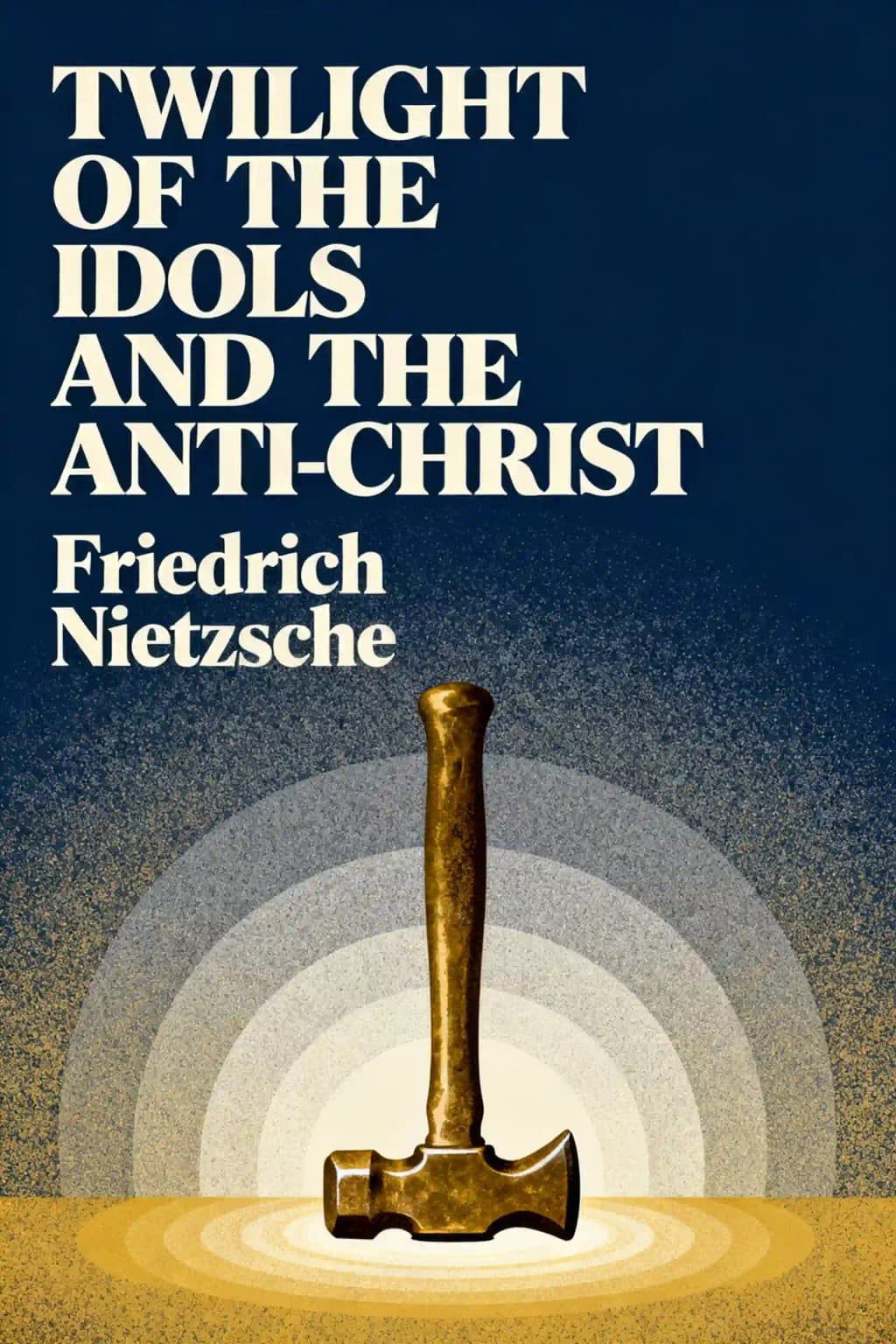
Nietzsche's "Twilight of the Idols" opens with a declaration of war against the most sacred cows of Western thought. The title itself is a mischievous play on Wagner's "Twilight of the Gods," signaling Nietzsche's intention to topple not just divine figures but philosophical idols that have been revered for millennia. His weapon of choice? A hammer that serves dual purposes: to shatter hollow idols and to "sound out" others like a tuning fork, revealing which ones ring empty.
This dual function perfectly captures Nietzsche's approach throughout the text. He is not merely destructive but diagnostic, examining the symptoms of what he considers cultural and philosophical illness. With surgical precision, he dissects the underlying psychology of great thinkers, revealing how their supposedly objective truths often mask personal weaknesses, physiological conditions, or hidden agendas.
"I mistrust all systematizers and avoid them," Nietzsche declares. "The will to a system is a lack of integrity." This rejection of systematic philosophy sets him apart from predecessors like Kant and Hegel. Instead of building grand theoretical edifices, Nietzsche employs a deliberately fragmented style-aphorisms, short essays, and provocative declarations that force readers to think for themselves rather than passively absorb doctrine.
His writing style itself becomes a philosophical statement. The text's extraordinary suppleness-paragraphs ranging from single lines to multiple pages-mirrors his belief in philosophical agility over rigid systematization. His use of dashes, ellipses, and questions creates a sense of ongoing conversation rather than final pronouncement. This open-endedness invites readers to participate actively in philosophical thinking rather than merely receiving wisdom from on high.
What makes "Twilight" so remarkable is its combination of intellectual depth and stylistic virtuosity. Nietzsche moves effortlessly between biting wit and profound insight, between personal confession and universal declaration. His self-described "cheerful and fateful tone" reflects his conviction that the most serious philosophical work need not be ponderous or dull. Indeed, for Nietzsche, the ability to dance with ideas-to maintain "light feet in intellectual matters"-is the mark of true philosophical strength.
Capitolo 3
Socrates: The First Decadent
One of Nietzsche's most provocative arguments targets Socrates, whom he portrays not as the founder of Western rationality but as a symptom of Greek decline. This represents a significant revision of his earlier position in "The Birth of Tragedy," where he had cast Socrates as the destroyer of tragic Greek culture. Now, Nietzsche sees Socrates as merely expressing a decadence already underway.
"All the great wise men throughout the ages have judged: 'Life is worthless,'" Nietzsche writes. "Even Socrates said, as he died: 'To live-that means to be sick a long time: I owe Asclepius the savior a rooster.'" For Nietzsche, this deathbed offering to the god of healing reveals Socrates' fundamental attitude toward life-that it is a disease from which death provides relief.
But why would a philosopher like Socrates adopt such a life-denying position? Nietzsche's answer is startlingly physiological: Socrates was ugly, and in the beauty-worshipping culture of ancient Greece, this physical deficiency marked him as an outsider. "Ugliness, in itself an objection, is among the Greeks almost a refutation," Nietzsche observes. This outsider status, combined with what Nietzsche diagnoses as "instinctual anarchy" and a "superfetation of the logical," drove Socrates to develop dialectics as a weapon against the aristocratic culture that excluded him.
Socrates' innovation was to make reason tyrannical over the instincts. His famous equation "reason = virtue = happiness" inverted the older Greek values that celebrated instinct, beauty, and noble passion. By insisting that everything be made conscious and rational, Socrates initiated what Nietzsche calls "the Socrates complex"-the belief that knowledge equals virtue and that evil stems from ignorance.
Yet Nietzsche's critique contains a surprising twist of admiration. Socrates recognized the decadence of Athenian culture and prescribed his rational method as medicine. "His extraordinary intelligence allowed him to recognize that behind all the distinguished Athenians stood degeneracy: old Athens was coming to an end." The problem was that Socrates' cure-making reason the tyrant over instinct-was itself another symptom of decadence, "merely another expression of degeneracy."
In Socrates, Nietzsche sees the birth of a fateful pattern that would dominate Western thought: the elevation of reason above life itself, the belief that life must answer to reason rather than reason serving life. This inversion would reach its apex in Christianity and Kantian morality, both of which Nietzsche will target in subsequent sections.
Capitolo 4
The 'Real World' Becomes a Fable
Perhaps the most celebrated section of "Twilight of the Idols" is Nietzsche's concise history of Western metaphysics titled "How the 'Real World' Finally Became a Fable." In just one page, he traces the evolution and ultimate collapse of philosophy's most persistent error: the belief in a "real world" beyond appearances.
The journey begins with Plato, who claimed the real world was "attainable for the sage, the pious, the virtuous man-he lives in it, he is it." This "oldest form of the idea" positioned truth as accessible to an elite few. Christianity transformed this concept, making the real world "unattainable for now" but promised to the faithful in the afterlife-"more subtle, more insidious, more incomprehensible-it became female, it became Christian."
Kant's philosophy represents the next stage, where the real world becomes "unprovable, indemonstrable, unpromisable" yet still thought of as a "consolation, an obligation, an imperative." By the dawn of positivism, this metaphysical world has become "an idea grown useless, superfluous" until finally, with Nietzsche himself, it is abolished entirely.
But Nietzsche's coup de grace comes in the final step: "We have abolished the real world: what world is left? The apparent world perhaps?... But no! With the real world we have also abolished the apparent world!" This dramatic conclusion shatters the entire binary opposition between appearance and reality that had structured Western thought for millennia.
This section exemplifies Nietzsche's talent for compression and his skill at philosophical genealogy. He shows how an idea evolves over time, gradually losing its vitality until it collapses under its own contradictions. The "real world" began as a positive affirmation with Plato but gradually transformed into an increasingly empty concept until it finally imploded, taking with it the very notion of appearance that had given it meaning.
The implications are profound: without the real/apparent distinction, we must reconceive truth itself. No longer can we speak of "seeing through" appearances to some underlying reality. Instead, we must recognize that what we call "reality" is itself a complex interplay of perspectives, interpretations, and valuations. Truth becomes something created rather than discovered, something bound up with life and its enhancement rather than standing in judgment over it.
Capitolo 5
Morality as Anti-Nature
Nietzsche's critique of morality centers on its fundamentally life-denying character. Traditional morality, especially Christian morality, treats human instincts and passions as enemies to be overcome rather than forces to be harnessed and refined. "The church combats the passions by cutting them off in every sense: its practice, its 'cure' is castration," Nietzsche writes with characteristic bluntness. This metaphor of castration is particularly significant, as it suggests not just suppression but a violent, irreversible elimination of natural drives.
This approach represents what Nietzsche calls "anti-nature," a turning against life's fundamental processes. He sees traditional morality as waging war against the very conditions that make life possible - desire, ambition, competition, and self-assertion. The moral systems that advocate such denial are, in Nietzsche's view, symptoms of a profound hostility to life itself. Instead of this castration, Nietzsche proposes "spiritualization"-what Freud would later call sublimation-whereby passions are not eliminated but redirected and refined. "To spiritualize a passion means: to give its coarseness a new name and to consider it something commendable."
Nietzsche offers several compelling examples of this spiritualization. With enmity, rather than eliminating it through Christian forgiveness, he suggests recognizing the value of having enemies-"being able to be an enemy, being an enemy." A worthy opponent, he argues, can drive us to greater heights and sharpen our capabilities. Similarly, rather than condemning sexuality as Christianity does, we might transform it into love, "which has been and is one of the best indirect glorifications of the sexual drive." He also points to how artistic creation often springs from sublimated sexual energy, and how intellectual combat can be a refined form of aggressive instincts.
This contrast between Christian morality and Nietzsche's alternative reveals his fundamental objection to traditional ethics: it denies life in the name of otherworldly ideals. "When one speaks of 'humaneness,' one has the notion that it might be a kind of milk of human kindness," he observes. "But precisely this is what makes it a mere phrase, a seduction, a 'Circe's potion.'" True humaneness, for Nietzsche, requires affirming life in all its aspects, including those deemed "evil" by traditional morality. He sees traditional moral concepts like humility, selflessness, and pity as disguised forms of life-denial that weaken both individuals and cultures.
The most damning indictment comes when Nietzsche reveals the psychological motivation behind anti-natural morality: "When the physiologist asks for the moral formula of life, he says: the morality is the instinct of decadence." Those who condemn life's fundamental drives do so because they themselves are declining, weakened specimens who cannot master their own impulses. Their solution-to condemn what they cannot control-represents not wisdom but weakness masquerading as virtue. This decadence manifests in various ways: the priest who denounces the body, the moralist who fears his own desires, the ascetic who makes a virtue of his inability to enjoy life's pleasures. For Nietzsche, this represents a fundamental dishonesty - a refusal to acknowledge the real motivations behind moral systems.
In contrast, Nietzsche advocates for a "naturalistic" morality that embraces and channels our basic drives rather than suppressing them. This approach requires strength, honesty, and the courage to face life's fundamental realities without seeking refuge in comforting illusions or life-denying ideals.
Capitolo 6
The Four Great Errors of Human Thought
Nietzsche identifies four fundamental errors that have distorted human understanding: confusing cause and consequence, false causality, imaginary causes, and the concept of free will. These errors form the foundation of religious and moral systems that have dominated Western thought.
The first error-confusing cause and consequence-appears when we mistake effects for causes. Nietzsche offers the example of Luigi Cornaro, who recommended a meager diet for longevity. But Cornaro's diet didn't cause his long life; rather, his slow metabolism (which caused his longevity) required minimal food. "A man is not 'corrupted' by his vices," Nietzsche explains. "Vice is a consequence of physiological degeneration."
The second error-false causality-stems from our mistaken belief that we understand causality through our "inner facts," particularly through the will. We believe that when we will something, our will causes the subsequent action. But Nietzsche argues this is an illusion: "The will no longer moves anything, hence does not explain anything either-it merely accompanies events; it can also be absent."
The third error-imaginary causes-arises from our need to explain our feelings and experiences. Rather than accepting certain feelings as simply given, we retroactively invent causes for them. "The memory, which in such cases goes into action without our awareness, brings up earlier states of the same kind, together with the causal interpretations associated with them-not their actual causes." Religion and morality thrive on this error, attributing unpleasant feelings to sin or divine punishment and pleasant ones to faith or divine grace.
The fourth and most dangerous error-free will-was invented "specifically for the purpose of punishment." By claiming humans freely choose their actions, priests could hold them responsible and guilty. "People were considered 'free' so that they could be judged and punished-so that they could be guilty." This concept of responsibility allowed priests to exercise power over believers by making them feel guilty for their supposed moral failures.
Nietzsche's conclusion is radical: "There are no moral facts at all. Moral judgment has this in common with religious judgment, that it believes in realities which do not exist." By exposing these errors, Nietzsche aims to "redeem the world" by restoring "the innocence of becoming" that had been lost through concepts of sin, guilt, and punishment.
Capitolo 7
The 'Improvers' of Humanity
Throughout history, those who claimed to "improve" humanity have actually weakened it. Nietzsche identifies two primary approaches to this supposed improvement: taming and breeding. The first approach, exemplified by Christianity, seeks to weaken the "beast of prey 'man'" by making him sick through guilt, shame, and self-denial. "To make sick is the true hidden intention of the church's humanitarian procedures," Nietzsche declares provocatively. This sickness manifests in various ways: the cultivation of bad conscience, the glorification of suffering, and the systematic devaluation of natural human instincts and desires.
The second approach-breeding-appears most notably in systems like the Indian caste system codified in the Laws of Manu. This ancient Hindu text establishes rigid social hierarchies and prescribes different moral codes for different classes. While Nietzsche finds this approach "healthier" than Christianity's sickness-inducing methods because it at least acknowledges natural hierarchies, he still considers it a "pious fraud" designed to maintain social order through deception. The contrast between these approaches reveals Christianity as "the counter-movement to any morality of breeding, of race, of privilege"-a religion that champions "the underprivileged of every kind" by inverting natural values and making weakness virtuous.
Nietzsche identifies several specific mechanisms through which these "improvements" operate. Christianity employs asceticism, self-denial, and the concept of sin to tame human nature. It creates what he calls "slave morality," where resentment and weakness are transformed into moral virtues. The breeding approach, on the other hand, uses strict social regulations, dietary laws, and marriage restrictions to maintain supposed purity and order. Both systems rely heavily on what Nietzsche terms the "ascetic ideal"-the belief that life must be justified by something beyond itself.
Despite his criticism of Christianity's life-denying tendencies, Nietzsche is not advocating for eugenics or racial superiority. His analysis serves a different purpose: to expose how all attempts to "improve" humanity through moral systems are fundamentally dishonest-they all employ what he calls the pia fraus (pious fraud). These systems claim to elevate humanity while actually diminishing it. "All the means by which one has so far attempted to make mankind moral were through and through immoral," he concludes.
This section reveals Nietzsche's fundamental skepticism toward any program of moral improvement. The problem isn't simply that we have chosen the wrong moral system; it's that morality itself represents a profound misunderstanding of human nature. Rather than trying to "improve" humanity according to some abstract standard or ideal, Nietzsche suggests we should affirm life as it is, recognizing that what traditional morality condemns as "evil" may actually be expressions of vital energy and strength. This requires accepting the fundamental plurality of human types and abandoning the quest for universal moral standards.
Capitolo 8
The German Cultural Crisis
Turning his critical gaze toward his homeland, Nietzsche laments Germany's cultural decline. Despite its growing political and military power under Bismarck, Germany has sacrificed its intellectual greatness. "Among Germans today, it is not enough to have spirit: one must arrogate it, one must have the arrogance to have spirit," he observes sardonically.
The culprits for this decline? "The two great European narcotics, alcohol and Christianity," along with "constipated, constipating German music" (a jab at Wagner). Nietzsche's seemingly eccentric diatribe against beer-drinking reveals his "somatopsychic" principle-that mental debilitation stems from physiological causes. "How much disgruntled heaviness, lameness, dampness, dressing gown-how much beer there is in the German intelligence!"
Universities, once Germany's pride, have become "hothouses for the instinctual atrophy of the spirit." Scientific specialization has created narrow experts rather than true intellectuals with breadth and depth. The result is a Germany that has become "Europe's flatland," lacking the peaks of intellectual achievement that once made German culture significant.
Nietzsche contrasts this decline with his ideal of education, which should be "an end in itself" rather than preparation for careers or service to the state. True education requires educators "who have proven themselves by their words and silences, mature and mellow cultures-not the learned louts whom secondary schools and universities today offer youth as 'higher wet nurses.'"
His prescription for cultural renewal focuses on three fundamental skills: learning to see, to think, and to speak and write. Learning to see means developing "patience of the eye" and "the art of not reacting immediately to a stimulus." Learning to think requires practice and technique-"one has to learn to dance, with the pen too"-while writing demands the ability to communicate with precision and grace.
Throughout this critique, Nietzsche reveals himself as a cultural physician diagnosing Germany's illness rather than a nationalist lamenting lost glory. His concern is not German power but German spirit-the capacity for profound thought, artistic creation, and cultural greatness that he sees being sacrificed to political and economic ambitions.
Capitolo 9
The Dionysian Vision: Affirming Life's Totality
At the heart of Nietzsche's philosophy lies the Dionysian-a concept he first explored in "The Birth of Tragedy" and develops further in "Twilight of the Idols." Dionysus, the Greek god of wine, ecstasy, and creative-destructive energy, represents for Nietzsche the affirmation of life in all its aspects, including suffering and destruction.
The Dionysian state is one of intoxication and plenitude-not the passive intoxication of narcotics but the active intoxication of heightened power. "The essential feature is the feeling of increased strength and fullness," Nietzsche explains. In this state, we don't merely observe beauty but create it through our overflowing energy. "Man enjoys himself as perfection here."
This creative power stands in stark contrast to the Christian denial of life, which Nietzsche sees as fundamentally nihilistic. "A Christian who is at the same time an artist-that does not exist," he declares provocatively. While Christianity teaches renunciation of this world for the sake of another, Dionysian affirmation embraces this world in its entirety, saying yes even to suffering and destruction as necessary parts of the creative process.
The tragic artist exemplifies this Dionysian attitude. Rather than offering catharsis or moral instruction, tragedy celebrates "the warlike in our soul" and communicates "fearlessness in the face of the fearful and questionable." Through tragedy, we learn to affirm life not despite its horrors but because of them-because creation necessarily involves destruction, because joy and suffering are inextricably linked.
This affirmation reaches its apex in the concept of amor fati-love of fate-which Nietzsche develops through his portrayal of Goethe as the Dionysian man who "stands amid the cosmos with a joyous and trusting fatalism" and believes "that only the particular is loathsome, and that all is redeemed and affirmed in the whole." This attitude represents the highest possible affirmation of life-not merely accepting necessity but loving it, not merely enduring fate but embracing it.
The Dionysian vision culminates in Nietzsche's doctrine of eternal recurrence, introduced in the final sections of "Twilight." This thought experiment-that one would have to live the same life over and over for eternity-serves as the ultimate test of affirmation. Only those who can say "Yes!" to their lives in their entirety, including all suffering and disappointment, truly affirm existence.
Capitolo 10
The Legacy of a Philosophical Dynamiter
"Twilight of the Idols" represents Nietzsche at his most concentrated and explosive. In this slim volume, he distills the insights of his mature philosophy into a form both accessible and profound. His hammer strikes at the foundations of Western thought-Socratic rationalism, Platonic metaphysics, Christian morality, and Kantian ethics-revealing them all as expressions of life-denial rather than wisdom.
Yet Nietzsche's destruction is not nihilistic but preparatory. He clears away the idols of the past to make room for new values based on life-affirmation rather than life-denial. His vision of the Dionysian represents not a return to primitive chaos but a higher synthesis that incorporates reason without making it tyrannical over the instincts.
The tragic irony of "Twilight" is that its author would soon enter his own twilight. Just weeks after completing the manuscript, Nietzsche suffered a mental collapse in Turin, never to recover his sanity. His "great health"-the psychological resilience he celebrated-proved more fragile than he imagined. Yet his words continue to resonate with uncanny power, challenging readers to question their deepest assumptions and to affirm life in all its complexity.
Nietzsche's legacy remains profoundly ambiguous. His critique of morality has been misappropriated by those seeking to justify cruelty and domination, while his affirmation of life has inspired artists, psychologists, and philosophers to embrace existence in all its tragic beauty. Perhaps this ambiguity is fitting for a thinker who celebrated contradiction and warned against the dangers of systematic thought.
In our age of collapsing certainties and competing value systems, Nietzsche's voice speaks with renewed urgency. His hammer continues to sound out our contemporary idols-progress, technology, democracy, equality-revealing which ring hollow and which solid. More importantly, his Dionysian vision offers a path beyond nihilism toward a life-affirming philosophy that embraces becoming rather than being, creation rather than preservation, and joy rather than mere happiness. In the twilight of old values, Nietzsche remains our most provocative guide to the dawn of new ones.