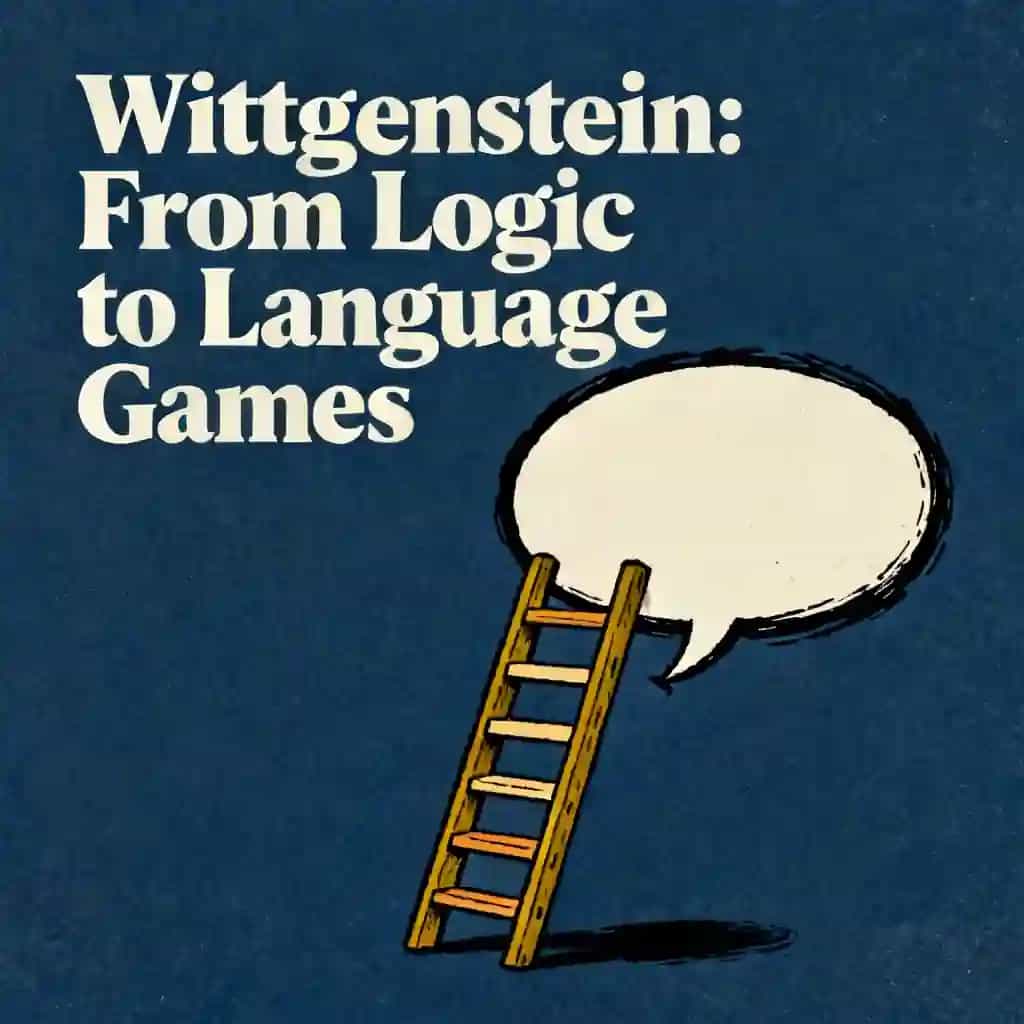
Wittgenstein's revolutionary manifesto on language and logic, written during WWI, silenced philosophers for generations. Bertrand Russell championed this enigmatic text that dares to define what can be said - and what must remain unspeakable. Can philosophy's boundaries ever recover?
Ludwig Josef Johann Wittgenstein (1889–1951) was an Austrian-British philosopher whose seminal work, Tractatus Logico-Philosophicus, redefined 20th-century analytic philosophy and logic. Born into a wealthy Viennese industrial family, Wittgenstein studied engineering before turning to philosophy under Bertrand Russell at Cambridge.
His Tractatus, written during World War I while serving in the Austrian army, argues that language and logic structure our understanding of reality, concluding with the famous dictum: “Whereof one cannot speak, thereof one must be silent.” The book’s stark, aphoristic style and focus on logical rigor influenced the Vienna Circle’s positivist movement and remains foundational in philosophical discourse.
Wittgenstein later rejected parts of the Tractatus and developed a radically different approach in Philosophical Investigations, emphasizing language’s fluid, context-dependent nature. A Cambridge professor from 1939 until his death, he became known for his intense, unconventional teaching style and ascetic lifestyle, having relinquished his inherited fortune. His works span logic, mathematics, and the philosophy of mind, blending technical precision with existential inquiry. Tractatus Logico-Philosophicus has been translated into over 20 languages and is frequently cited as one of the most influential philosophical texts of the modern era, still required reading in university curricula worldwide.
Tractatus Logico-Philosophicus explores the relationship between language, logic, and reality, arguing that meaningful propositions must mirror factual states of the world. Wittgenstein asserts that philosophical problems arise from misunderstandings of language, and he defines the limits of what can be logically expressed, relegating ethics, metaphysics, and aesthetics to the realm of the unspeakable.
This book is essential for philosophers, logicians, and linguists interested in the foundations of language and thought. It’s also valuable for readers exploring the boundaries of science, ethics, and metaphysics, though its dense, aphoristic style demands patience and familiarity with logical analysis.
Yes, for its revolutionary impact on 20th-century philosophy and its probing examination of language’s limits. While challenging, its insights into logical structure and the nature of meaning remain foundational in analytic philosophy and linguistics.
Wittgenstein structures the text as a hierarchical series of propositions (1–7) with decimal sub-sections to mirror logical rigor. This format reflects his belief that philosophy should emulate the precision of mathematics, systematically building from axioms to conclusions.
Language can only describe factual states of affairs, rendering ethics, metaphysics, and the “mystical” inexpressible. Logic reveals these boundaries: propositions about logic itself are nonsensical because they attempt to transcend the very framework enabling meaning.
Facts about the world can be said through propositions, while logical form, ethics, and aesthetics can only be shown through language’s structure. For example, grammar “shows” the limits of thought but cannot explicitly articulate them.
Ethics lie beyond language’s descriptive capacity, existing in the “unsayable” realm. Wittgenstein implies ethical values are transcendental, shaping how we engage with the world but never reducible to factual statements.
Critics argue its self-undermining conclusion—declaring its own propositions nonsensical—creates a paradox. Others note its narrow view of language ignores metaphorical or poetic expression. Bertrand Russell also critiqued its dismissal of traditional philosophy.
Logical propositions are tautologies, devoid of factual content but revealing the structure of reality. For example, “It is raining or not raining” is always true, exposing logic’s role in framing meaningful discourse.
“The mystical” refers to existential questions (e.g., meaning of life, death) that language cannot address. These lie outside the empirical world, accessible only through subjective experience, not logical analysis.
It pioneered the “linguistic turn,” emphasizing language’s role in structuring thought. Its ideas underpin logical positivism and later critiques of metaphysics, shaping debates in semantics, epistemology, and cognitive science.
Its analysis of language’s limits resonates in debates about AI, where algorithmic logic intersects with human meaning-making. The text also offers a framework for critiquing misinformation and epistemological overreach in digital discourse.
Senti il libro attraverso la voce dell'autore
Trasforma la conoscenza in spunti coinvolgenti e ricchi di esempi
Cattura le idee chiave in un lampo per un apprendimento veloce
Goditi il libro in modo divertente e coinvolgente
The world is all that is the case.
We make to ourselves pictures of facts.
What can be shown, cannot be said.
Only propositions have sense.
There are no surprises in logic; all possibilities are predetermined.
Scomponi le idee chiave di Tractatus logico-philosophicus in punti facili da capire per comprendere come i team innovativi creano, collaborano e crescono.
Distilla Tractatus logico-philosophicus in rapidi promemoria che evidenziano i principi chiave di franchezza, lavoro di squadra e resilienza creativa.

Vivi Tractatus logico-philosophicus attraverso narrazioni vivide che trasformano le lezioni di innovazione in momenti che ricorderai e applicherai.
Chiedi qualsiasi cosa, scegli la voce e co-crea spunti che risuonino davvero con te.

Creato da alumni della Columbia University a San Francisco
"Instead of endless scrolling, I just hit play on BeFreed. It saves me so much time."
"I never knew where to start with nonfiction—BeFreed’s book lists turned into podcasts gave me a clear path."
"Perfect balance between learning and entertainment. Finished ‘Thinking, Fast and Slow’ on my commute this week."
"Crazy how much I learned while walking the dog. BeFreed = small habits → big gains."
"Reading used to feel like a chore. Now it’s just part of my lifestyle."
"Feels effortless compared to reading. I’ve finished 6 books this month already."
"BeFreed turned my guilty doomscrolling into something that feels productive and inspiring."
"BeFreed turned my commute into learning time. 20-min podcasts are perfect for finishing books I never had time for."
"BeFreed replaced my podcast queue. Imagine Spotify for books — that’s it. 🙌"
"It is great for me to learn something from the book without reading it."
"The themed book list podcasts help me connect ideas across authors—like a guided audio journey."
"Makes me feel smarter every time before going to work"
Creato da alumni della Columbia University a San Francisco

Ottieni il riassunto di Tractatus logico-philosophicus in formato PDF o EPUB gratuito. Stampalo o leggilo offline quando vuoi.
Imagine standing at the edge of a vast ocean. You can see the waves, feel the spray, hear the roar - but you cannot fully capture this experience in words. This is the central insight of Ludwig Wittgenstein's Tractatus Logico-Philosophicus, a work written partly in the trenches of World War I and completed in an Italian prisoner-of-war camp. In fewer than 100 pages, this philosophical masterpiece attempts something audacious: to draw the boundaries between what can be meaningfully expressed in language and what must remain in silence. The world, Wittgenstein tells us, consists of facts, not things - and our language can picture these facts with remarkable precision. But beyond the realm of facts lies something more: the ethical, the aesthetic, the mystical - everything that gives life meaning but cannot be captured in propositions.