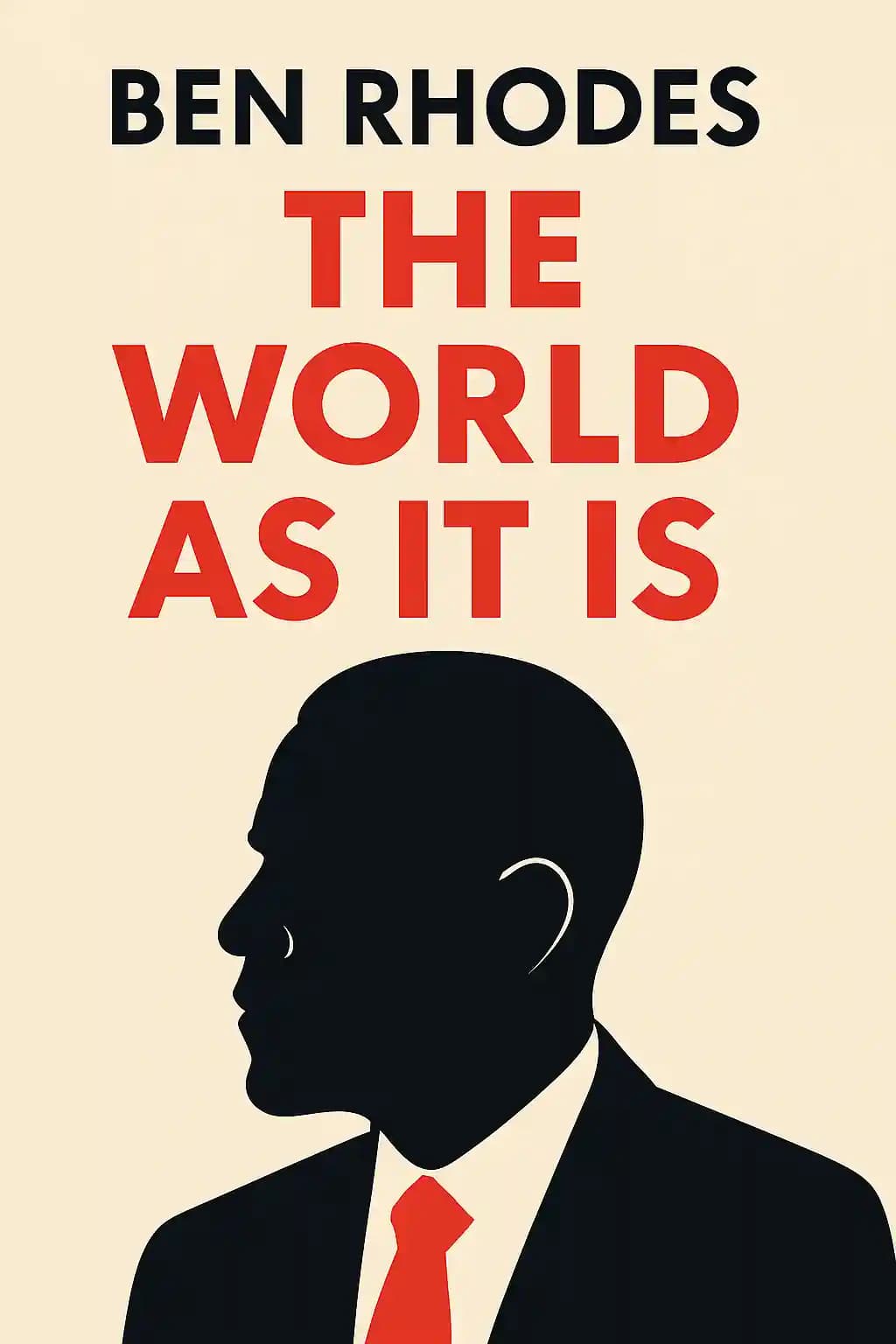
Step inside Obama's White House through Ben Rhodes' intimate memoir praised by The New York Times as "a classic coming-of-age story" - where idealism meets harsh geopolitics. What happens when your boss must navigate bin Laden's raid, Cuba, and the rise of nationalism?
Ben Rhodes is the New York Times bestselling author of The World As It Is: A Memoir of the Obama White House. As a political commentator and national security expert, his insider perspective shapes his revealing presidential memoir.
A key architect of Obama-era foreign policy, Rhodes served nearly a decade as Deputy National Security Advisor and speechwriter. During this time, he participated in landmark decisions like the Cuba normalization talks and Iran nuclear deal negotiations.
His second bestseller, After the Fall: Being American in the World We’ve Made, explores democratic challenges in the post-Obama era. Rhodes enhances his authority through frequent MSNBC commentary, co-hosting the Pod Save the World podcast, and co-founding National Security Action with current Secretary of State Jake Sullivan.
Rhodes's work appears in The Atlantic and Foreign Affairs, blending policymaking experience with literary craftsmanship honed through his NYU MFA. The World As It Is spent 12 weeks on the Times bestseller list, offering an unmatched view of presidential decision-making during pivotal global events.
The World As It Is is a memoir offering an insider’s perspective on Barack Obama’s presidency, chronicling Ben Rhodes’ role as a speechwriter and Deputy National Security Advisor. It details pivotal events like the Iran nuclear deal, the normalization of U.S.-Cuba relations, and the raid on Osama bin Laden’s compound, while reflecting on global challenges to democracy.
This book is ideal for political enthusiasts, students of foreign policy, and readers interested in behind-the-scenes accounts of the Obama administration. It appeals to those analyzing modern governance, U.S. diplomacy, and the intersection of leadership and global crises.
Yes—as a New York Times bestseller, it provides rare insights into presidential decision-making and global diplomacy. Critics praise its candid narrative style and its examination of idealism versus pragmatism in politics.
Key themes include the fragility of democracy, the complexities of foreign policy, and the tension between political ideals and real-world constraints. Rhodes also explores Obama’s leadership style and the ethical dilemmas of wielding power.
Rhodes portrays Obama as a pragmatic idealist who balanced moral convictions with political realism. He highlights Obama’s cautious deliberation, emphasis on diplomacy, and commitment to incremental progress, particularly in policies like the Iran deal and climate agreements.
Rhodes led secret negotiations with Cuba, culminating in the 2014 announcement to restore diplomatic ties. His memoir reveals the strategic risks, backchannel diplomacy, and personal stakes involved in ending decades of Cold War-era hostility.
Rhodes reflects on rising authoritarianism, misinformation, and political polarization, drawing parallels between global trends and U.S. domestic struggles. He underscores the need for resilient democratic institutions in an interconnected world.
Some critics argue the memoir downplays Obama’s policy shortcomings, such as handling Syria’s civil war, and question Rhodes’ insider perspective as overly sympathetic. Others note its focus on elite decision-making over grassroots perspectives.
Unlike traditional memoirs, Rhodes blends policy analysis with personal anecdotes, offering a staffer’s viewpoint rather than the president’s. It contrasts with memoirs like Obama’s A Promised Land by emphasizing bureaucratic challenges over autobiography.
The book’s exploration of democratic erosion, geopolitical shifts, and leadership crises remains pertinent amid ongoing global instability. Its lessons on diplomacy and governance offer frameworks for addressing modern authoritarian threats.
Notable quotes include Rhodes’ reflection: “I still believed in the truth within the stories of people around the world”, underscoring his faith in narrative-driven diplomacy. Another highlights Obama’s mantra: “Better is good”, emphasizing incremental progress.
Rhodes’ dual expertise in creative writing (MFA) and political science informs the memoir’s narrative depth and policy rigor. His speechwriting experience shapes its eloquent, accessible analysis of complex geopolitical issues.
Senti il libro attraverso la voce dell'autore
Trasforma la conoscenza in spunti coinvolgenti e ricchi di esempi
Cattura le idee chiave in un lampo per un apprendimento veloce
Goditi il libro in modo divertente e coinvolgente
What if we were wrong?
The situation in Iraq is grave and deteriorating.
The problems are in the Arab world, not Indonesia.
The young people saw him...why not me?
Obama's War.
Scomponi le idee chiave di World As It Is in punti facili da capire per comprendere come i team innovativi creano, collaborano e crescono.
Vivi World As It Is attraverso narrazioni vivide che trasformano le lezioni di innovazione in momenti che ricorderai e applicherai.
Chiedi qualsiasi cosa, scegli il tuo stile di apprendimento e co-crea intuizioni che risuonano davvero con te.

Creato da alumni della Columbia University a San Francisco
"Instead of endless scrolling, I just hit play on BeFreed. It saves me so much time."
"I never knew where to start with nonfiction—BeFreed’s book lists turned into podcasts gave me a clear path."
"Perfect balance between learning and entertainment. Finished ‘Thinking, Fast and Slow’ on my commute this week."
"Crazy how much I learned while walking the dog. BeFreed = small habits → big gains."
"Reading used to feel like a chore. Now it’s just part of my lifestyle."
"Feels effortless compared to reading. I’ve finished 6 books this month already."
"BeFreed turned my guilty doomscrolling into something that feels productive and inspiring."
"BeFreed turned my commute into learning time. 20-min podcasts are perfect for finishing books I never had time for."
"BeFreed replaced my podcast queue. Imagine Spotify for books — that’s it. 🙌"
"It is great for me to learn something from the book without reading it."
"The themed book list podcasts help me connect ideas across authors—like a guided audio journey."
"Makes me feel smarter every time before going to work"
Creato da alumni della Columbia University a San Francisco

Ottieni il riassunto di World As It Is in formato PDF o EPUB gratuito. Stampalo o leggilo offline quando vuoi.
The scene in Lima, Peru, during Obama's final international trip as president, captures the essence of Ben Rhodes' intimate memoir. As world leaders anxiously sought reassurance about America's future under Trump, Obama turned to Rhodes in their motorcade and asked a question that revealed his deepest doubts: "What if we were wrong?" Had they pushed too far with their progressive vision? Despite his public confidence, Obama wondered if perhaps he had been "ten or twenty years too early." This rare moment of vulnerability from a man who had inspired global hope forms the emotional core of Rhodes' account. As Obama's speechwriter, foreign policy advisor, and confidant for nearly a decade, Rhodes provides an unfiltered view into the presidency during a period of extraordinary global change. His perspective isn't just that of a staffer, but of someone who helped shape the administration's voice and vision from campaign days through the final hours in office.
Rhodes' journey with Obama began in 2007, when he helped with debate preparation for a relatively unknown senator considering a presidential run. Having witnessed the Iraq War's devastating reality through his work with the Iraq Study Group - soldiers in constant danger, vacant-eyed children, horrific sectarian violence - Rhodes was drawn to Obama's early opposition to the conflict. During that meeting, Rhodes advised Obama to vote against funding the Iraq surge, arguing it contradicted Obama's own position. Obama followed his advice and soon offered Rhodes a campaign position. The early days featured a sense of mission despite long odds. Working from a small Chicago apartment, Rhodes found camaraderie with fellow staffers who believed in something historic while trailing Hillary Clinton by 20 points. His intellectual anchor was Samantha Power, whose interventionist yet anti-Iraq War stance represented their alternative foreign policy vision. When Obama was criticized for saying he'd talk to Iran without preconditions, Rhodes learned to defend Obama's authentic positions against experienced advisors - a stance on diplomatic engagement that would later become a cornerstone of Obama's approach and eventually lead to the Iran nuclear deal.
Obama's 2009 Cairo speech aimed to reset America's relationship with the Muslim world. Rhodes gathered diverse input and found Muslims primarily concerned with poverty, corruption, and unemployment - wanting partnerships on education and entrepreneurship while feeling U.S. policy focused only on oil, Israel, and undermining Muslim societies. Obama addressed colonialism and the Cold War, leveraging his unique background to show cultural appreciation while acknowledging universal aspirations. The speech carefully balanced America's "unbreakable" bond with Israel alongside recognition of the "daily humiliations" of occupation. When Obama began with "Assalamu alaikum," the audience erupted. Years later, a Palestinian-born woman told Rhodes the impact transcended words: "The young people saw him, a black man as president of America, someone who looked like them. And they thought, why not me?" This revealed how Obama's very existence as president inspired hope beyond American borders - a recurring theme throughout his presidency.
On August 21, 2013, Rhodes learned of a catastrophic chemical weapons attack in Syria during his first vacation in over a year. This crisis stemmed from Obama's earlier warning that chemical weapons use would be "a red line" that would "change my calculus" - words that became defining in his presidency. After the attack, nearly everyone advised Obama to strike, with only Denis McDonough urging caution. Efforts for international support collapsed when British Parliament voted against joining. The Iraq War's legacy had left America approaching military intervention with minimal allies and a resistant Congress. In a surprising move, Obama decided to seek congressional authorization, telling Rhodes, "I've got a big idea." He maintained that presidents alone shouldn't keep America perpetually at war: "It is too easy for a president to go to war. That quote from me in 2007 - I agree with that guy. That's who I am." Despite endorsements from foreign policy experts, congressional support never materialized. At the G20 in Russia, Obama reflected candidly: "Maybe we never would have done Rwanda... People always say never again, but they never want to do anything." Days later, Syria agreed to surrender their chemical weapons. The congressional vote was abandoned. Thousands of tons of chemical weapons would be removed - far more than military strikes could have eliminated. The war continued, but Obama kept the United States out of it.
After Obama asked about his interests, Rhodes maintained a mental "affirmative agenda" of places where U.S. engagement could make positive differences: Cuba, Colombia, Burma, exchange programs, and African development. In June 2013, Rhodes met Cuban officials including Raul Castro's son Alejandro at a discreet Canadian-hosted meeting in Ottawa. Rhodes began by emphasizing generational change: "I wasn't even born when a lot of this happened. President Obama wasn't even born when the Bay of Pigs took place. He sent me here to look forward." Alejandro expressed surprise at being treated "with respect... as equals." Pope Francis became an unexpected ally, arranging identical letters delivered to both Obama and Castro. With Iran, a similar opening emerged after Hassan Rouhani's election. Using Oman as intermediary, a secret channel established a framework where Iran would freeze its nuclear program for limited sanctions relief. This led to the first direct presidential contact since 1979 - a fifteen-minute call between Obama and Rouhani. Though the conversation itself was unremarkable, its symbolism moved many, including Rhodes' Iranian-American former assistant who wept at this gesture of reconciliation.
The morning after Trump's victory, Rhodes struggled with sadness while Obama reassured his tearful staff: "We are leaving this country indisputably better off than we found it." After meeting Trump, Obama seemed perplexed that Trump focused on rally sizes rather than substantive issues. Obama quickly convened an NSC meeting on Russian election interference, ordering a comprehensive intelligence review: "We need to learn the lessons about what they did, because they're going to do it again." The briefing revealed extensive Russian meddling aimed at helping Trump. Obama remained composed while Biden appeared incredulous - their administration would be replaced by the very people Putin had worked to install. On Inauguration Day, Rhodes entered a transformed White House where Obama's photos had been replaced with empty frames. After the ceremony, he joined the small group accompanying the Obamas on their final flight. Obama likened the presidency to Pac-Man: "Sometimes I felt like I was just outrunning people, trying to avoid getting tripped up before I got to the end of the board." They landed at a regional airport with minimal ceremony. Flying back on the nearly empty plane, Rhodes reflected on countless once-urgent matters. Lying on the floor of the senior staff cabin, he contemplated Obama's legacy: recovered markets, idle Iranian centrifuges, refugees in camps, suffering Syrians, Putin's regime, troops in Afghanistan, the Paris climate accord - a complex mix of achievements and unfinished business in a world rarely conforming to our highest ideals.