Capitolo 1
Embracing the Unknown: Where Possibility Awaits
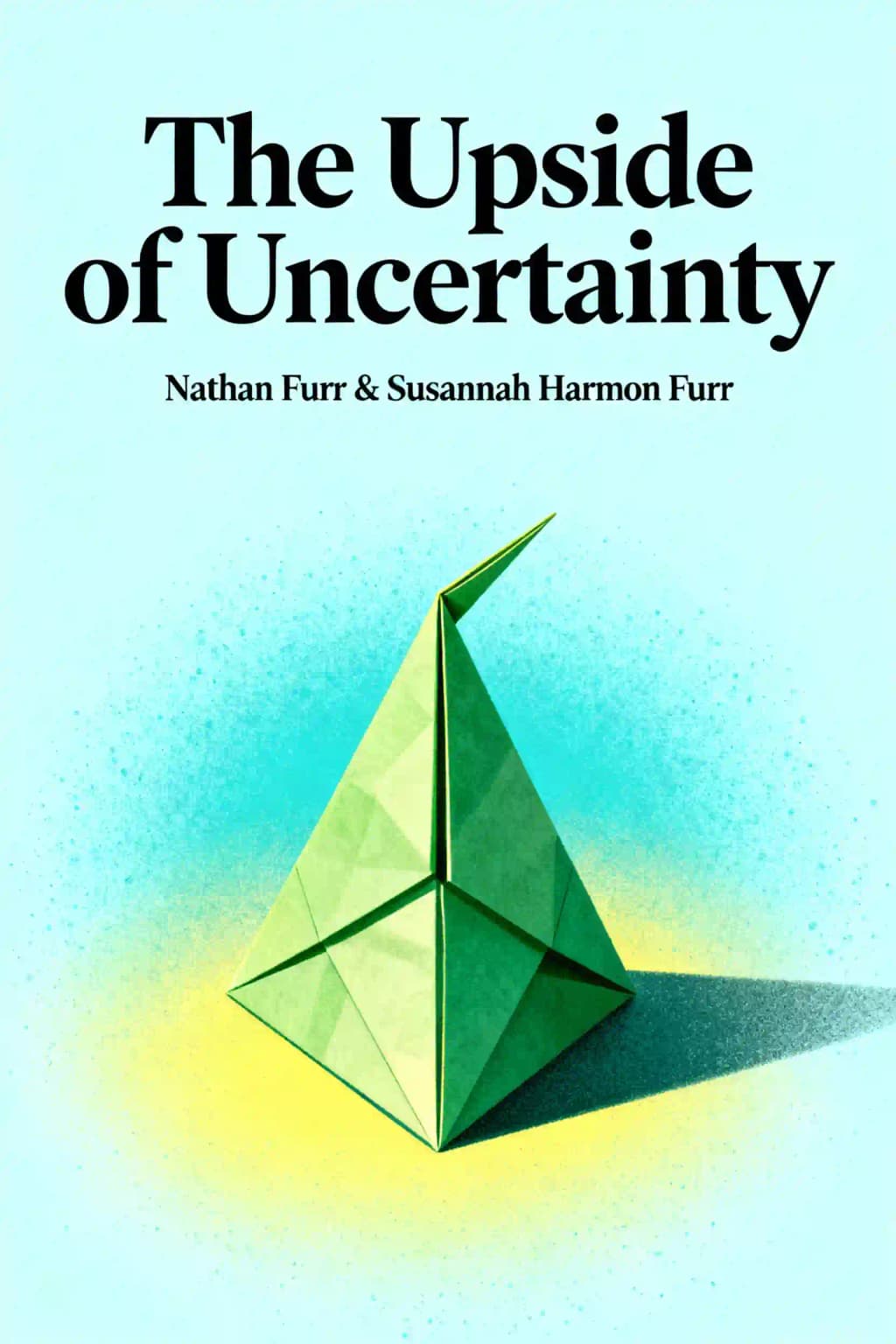
Have you ever noticed that everything you truly value in life came only after facing uncertainty? That promotion you worked for, the relationship you cherish, the creative breakthrough you achieved-all emerged from periods when outcomes weren't guaranteed. The Upside of Uncertainty, written by Nathan and Susannah Furr, isn't just another business book about risk management. It's a revolutionary framework for transforming how we view the unknown, embraced by leaders from Ben & Jerry's to SpaceX. The book has gained particular relevance in our post-pandemic world, where the World Uncertainty Index shows uncertainty rising steadily over recent decades. Drawing from thirty years of friendship and research spanning psychology, entrepreneurship, and art, the Furrs offer a refreshing perspective: uncertainty isn't just something to endure-it's the essential portal to every possibility worth pursuing.
Capitolo 2
The Paradox of Uncertainty: Fear and Possibility
Uncertainty triggers our brain's alarm systems-it's hardwired into our neural pathways to fear the unknown. This evolutionary response makes perfect sense: our ancestors needed to be cautious when facing unfamiliar situations that might conceal predators or other threats. The amygdala, our brain's fear center, activates within milliseconds of encountering uncertainty, flooding our system with stress hormones and preparing us for fight-or-flight. But this same protective mechanism creates a modern paradox-we desperately avoid uncertainty while simultaneously craving it in ways that shape our daily choices and long-term decisions.
Consider how people spend billions on "reverse insurance" through gambling, where they pay money to introduce more uncertainty into their predictable lives. Las Vegas alone generates over $6 billion annually from individuals seeking the thrill of uncertain outcomes. Or how sixteen thousand mid-career professionals surveyed didn't leave successful careers for more money but because they were bored with certainty-they deliberately chose less stable paths to feel more alive. Even relationship expert Esther Perel notes that maintaining passionate relationships requires reintroducing uncertainty to keep the spark alive, explaining why couples often report feeling most attracted to their partners when discovering new sides of them.
The truth is, we need a balance. Too much uncertainty overwhelms us, triggering anxiety and decision paralysis, but pursuing absolute certainty eliminates possibilities and adds frustrating responsibilities. Organizations face the same challenge-Harvard professors discovered that quality-control systems like ISO 9000 eliminated innovation arising from mistakes and changes, reducing error rates but also stifling creativity by up to 30% in studied companies. Meanwhile, top restaurants like Noma and Alinea purposely inject uncertainty into their processes by using unknown ingredients or reinstalling new kitchens annually to maintain creativity and prevent stagnation. Even tech giants like Google famously allow employees to spend 20% of their time on uncertain projects, leading to innovations like Gmail and Google News.
This delicate balance explains why some people thrive amid uncertainty while others collapse. The difference isn't personality but perspective and tools. Studies of successful entrepreneurs show they experience the same physiological stress responses to uncertainty as everyone else-elevated cortisol levels, increased heart rate, and anxiety. However, they've learned to meet uncertainty with greater courage, resilience, and skill. They've developed what the authors call "uncertainty ability"-a largely learnable set of practices that transform how we approach the unknown. This includes techniques like rapid prototyping, calculated risk-taking, and maintaining multiple scenarios simultaneously. Research shows these abilities can be strengthened like muscles through deliberate practice and exposure to controlled uncertainty.
Capitolo 3
Reframing: The Foundation of Possibility
The journey toward embracing uncertainty begins with a fundamental shift in perspective. Instead of viewing uncertainty as a threat to be eliminated, we must recognize it as the birthplace of every possibility. This reframing isn't just positive thinking-it's grounded in Nobel Prize-winning research by Kahneman and Tversky showing that our brains react more strongly to potential losses than gains (at least twice as much), requiring vastly more mental energy to process losses than gains. This "loss aversion" bias explains why uncertainty often triggers anxiety and resistance, even when the potential upside far outweighs the perceived risks.
By consciously reframing uncertainty as potential gain rather than loss, we transform our neurological response to it. This mindset shift can happen immediately, like flipping a light switch, though maintaining it requires practice and awareness. When expat friends Amy and Michael faced complete uncertainty during the pandemic-job offers rescinded, leaving them without employment or housing days before needing to relocate-Amy initially felt like a "loser." But when her friend Susannah reframed the situation as "graduate-level uncertainty" and being "heroes standing on the edge of possibility," Amy's entire perspective shifted, allowing her family to wait out the discomfort until finding a situation that worked for everyone. Six months later, they had secured better positions than their original offers and found their ideal living situation.
Reframing also means recognizing that many frontiers exist where comfort zones meet the unknown-places where we learn, discover, and grow. These frontiers might be geographical, like Denis O'Brien launching mobile networks in Haiti where others saw only risk, ultimately creating thousands of jobs and vital infrastructure, or personal, like filmmaker Benjamin Gilmour pushing "the boundaries of empathy" through his work documenting life in conflict zones. Even small acts like author Brad Modlin purposely getting lost without a smartphone can create frontiers of discovery in everyday life, leading to unexpected encounters and insights that wouldn't be possible with predetermined routes.
The most powerful reframe might be approaching life as an "infinite game" rather than a finite one. Finite players accept prescribed roles and follow rules to win, while infinite players experiment with roles and bend rules for the joy of playing. They challenge everything-their roles, the rules, and even the game itself. This approach transforms setbacks from failures into experiments, and obstacles from roadblocks into creative challenges. As Steve Jobs famously said, "Everything around you that you call life was made up by people that were no smarter than you, and you can change it." This perspective has driven innovations from the Wright brothers' first flight to modern breakthroughs in artificial intelligence, where embracing uncertainty led to revolutionary discoveries.
The practice of reframing requires regular exercise, much like building any other skill. Successful reframers often keep "possibility journals" where they list multiple perspectives on challenging situations, or practice "what if" scenarios to expand their thinking beyond conventional boundaries. Organizations like IDEO have institutionalized this approach through "How might we" questions that transform problems into opportunities for innovation.
Capitolo 4
Preparing for the Journey: The Prime Tools
While reframing addresses the cognitive aspects of uncertainty, we also need practical tools to prepare for action. These "Prime" tools help reduce anxiety while increasing our chances of success when facing the unknown.
Understanding your personal risk profile is crucial. Different types of risks exist-financial, intellectual, social, emotional, physical, and political-and we each have natural aversions to some and affinities for others. By recognizing these patterns, you can fortify yourself in areas of weakness and leverage your strengths. Nathan discovered this when considering leaving academia for entrepreneurship, realizing his aversion to financial risk was appropriate given his family responsibilities, while his comfort with intellectual risk made academia a good fit.
Contrary to popular belief, you don't need to go all-in to succeed. Nobel Prize-winner Ben Feringa advocates having multiple projects simultaneously-at least one risky and one safer-creating what he calls "personal real options." This portfolio approach decreases anxiety and increases success by providing security through diversification while allowing exploration of uncertainty. Studies show hybrid entrepreneurs who keep their day jobs while starting ventures are 33% less likely to fail, having time to discover what works with less stress.
Those who thrive in uncertainty often create surprising pockets of certainty elsewhere in their lives. Sam Yagan, founder of OkCupid and former Match.com CEO, claims to "love uncertainty" professionally while deliberately seeking stability in his personal life through long-term friendships and marrying his high school sweetheart. These "uncertainty balancers" help counteract the unknowns we face, providing comfort through habits, routines, objects, humor, and relationships.
When facing uncertainty, surrounding ourselves with supportive people who believe in our capabilities acts as powerful "Dumbo feathers"-named after the cartoon elephant who gained confidence to fly by holding a supposedly magic feather. We must distinguish between these supportive influences and "quest destroyers"-people, places or things that undermine our confidence and dreams. Sarah Mouchot and Nico Alary exemplify this principle through their journey founding successful Paris restaurants despite facing rejection from banks and skepticism from family members questioning their credentials.
Capitolo 5
Taking Action: The Do Tools
The Do tools inspire action in the face of uncertainty by reconsidering established realities. As philosopher John O'Donohue suggests, possibilities are more interesting than facts, which are merely "possibilities that have already been actualized." When we approach uncertainty with an expanded sense of possibility, action becomes imaginative and discovery-driven.
Rather than managing uncertainty, we should activate and unlock its potential. This insight came from studying Roberto Burle Marx, whose landscape designs were inspired by seeing Brazilian plants freed from constricting containers. This principle applies across domains: Maria Montessori revolutionized education by unlocking children's inherent capabilities rather than controlling them; Valve software company thrives by activating employees' creativity without hierarchical constraints; and innovative culinary teams purposely inject uncertainty into their process to unlock new ideas.
While many books promise that their tools guarantee outsize success, focusing on external metrics like fame and money actually exposes us more to uncertainty's downsides. Instead, focusing on values rather than goals makes us failure-proof because we control our values regardless of outcomes. David Heinemeier Hansson exemplifies this approach, focusing on learning, writing good software, treating employees well, and acting ethically rather than fixating on specific financial targets. Ironically, extraordinary outcomes often follow those motivated by purpose-studies show employees connected to meaning perform significantly better.
When navigating uncertainty, adopting an "attitude of wisdom" and cognitive flexibility allows us to update our mental maps as data changes. The Mann Gulch fire tragedy illustrates how clinging to established procedures can be fatal in unexpected situations. Research shows that founders with diverse experiences adapt better to changing environments than those entrenched in one industry. Scientists who narrowly missed Nobel Prize breakthroughs often failed because they couldn't recognize anomalies in their data or connect with outside disciplines.
Learning in uncertainty resembles driving through fog-you can't see far ahead, but you can use techniques to quickly understand the terrain. The best startup accelerators counteract founders' tendency to settle for suboptimal certainty by forcing them into rapid learning cycles. They arrange meetings with hundreds of mentors and customers in the first month, exposing entrepreneurs to more of the opportunity landscape before they commit to initial hunches. Simple rules-fast and flexible heuristics based on experience-help navigate uncertainty better than complicated plans or impulsive decisions.
Capitolo 6
The Power of Small Steps and Persistence
To achieve greatness in uncertainty, you must embrace failure as an essential part of the journey. Match.com CEO Sam Yagan powerfully demonstrated this principle when he showed his team SpaceX's failed rocket landing attempts, explaining that "by definition, grand achievements cannot be achieved without failure." This mindset shift proved transformative - after seventeen failed attempts at new business models, his team finally created Tinder, revolutionizing modern dating. The journey from repeated failures to breakthrough success exemplifies how persistence through setbacks ultimately leads to innovation.
History's greatest innovators consistently demonstrate that volume and persistence are key drivers of success. Charles Darwin wrote thousands of pages of notes and correspondence before developing his theory of evolution. Classical composers like Bach produced over 1,000 pieces, while Mozart composed over 600 works - their masterpieces emerged through relentless iteration and experimentation. Even modern tech giants follow this pattern: SpaceX experienced multiple spectacular rocket explosions and failures before transforming the space industry. Elon Musk has been remarkably candid about initially giving SpaceX only a 10% chance of success. Similarly, Amazon's Jeff Bezos openly discusses making "billions of dollars of failures" including the Fire Phone, Amazon Restaurants, and Dash Button, emphasizing that bold experiments are inherently prone to failure but essential for breakthrough innovation.
Big breakthroughs typically emerge through accumulated small experiments rather than dramatic leaps. Pokemon Go illustrates this perfectly - while many saw it as an overnight sensation, it actually represented twenty years of incremental development starting with primitive GPS technology at Google, evolving through Niantic's Field Trip app, then Ingress, before finally becoming Pokemon Go. Stanford research provides compelling evidence that tackling tasks sequentially rather than simultaneously leads to superior outcomes. The study contrasted startups like Zaarly, which attempted to launch multiple services simultaneously and failed, versus Paintzen, which succeeded by methodically focusing on one critical area at a time - first mastering painting services before expanding to other home improvements.
Small experiments serve as powerful tools to transform assumptions into validated knowledge. The development of the Owlet baby monitor exemplifies this approach perfectly. The founding team methodically tackled uncertainties one by one: first creating a concept video to confirm genuine customer demand, then investing $2,000 to build a working prototype proving technical feasibility. They conducted detailed pricing research across different market segments, and crucially, tested whether parents would purchase a monitor without an alarm feature. Through hundreds of carefully designed small experiments and iterations, they systematically reduced uncertainty and risk. This methodical approach enabled them to outmaneuver better-funded competitors and ultimately achieve a billion-dollar valuation. Their success demonstrates how breaking down large uncertainties into smaller, testable hypotheses can lead to remarkable achievements.
The power of small steps extends beyond just product development - it applies to personal growth, organizational change, and any complex endeavor. By embracing this incremental approach while maintaining persistence through inevitable failures, individuals and organizations can tackle seemingly impossible challenges and achieve extraordinary results.
Capitolo 7
Sustaining Through Uncertainty's Challenges
Even with the best tools and approaches, uncertainty brings profound emotional challenges that require robust sustaining practices. The Sustain tools provide essential nourishment and comfort through uncertainty's many downsides-including deep-seated regret, paralyzing anxiety, unexpected grief, persistent self-doubt, and social embarrassment. These emotional responses are not just reactions but crucial signals requiring attention and care.
Emotions shouldn't be dismissed as evolutionary weaknesses or inconvenient obstacles but recognized as sophisticated information providers about what truly matters and what actions to take next. Psychologist Guy Winch draws a compelling parallel between emotional and physical hygiene-just as the simple practice of handwashing revolutionized medicine and doubled human life expectancy, proper emotional care can dramatically reduce suffering and enhance resilience. Without consistent emotional maintenance, we often unconsciously sabotage ourselves through harsh self-criticism and destructive negative self-talk that keeps us functioning well below our potential. This can manifest in avoiding opportunities, undermining relationships, and diminishing our capacity for innovation.
Like childbirth doulas who deeply understand labor's natural cycles and provide crucial support during transitions, an "uncertainty doula" recognizes that emotions during uncertainty follow predictable cyclical patterns with both energizing highs and challenging lows. Entrepreneurs commonly describe their experiences as emotional roller coasters, with dramatic shifts sometimes occurring within the same day or even hour. Understanding these cycles helped Luca Belpietro rebuild his ecotourism lodge in Kenya after a devastating fire destroyed decades of work. By acknowledging he was at the lowest emotional point rather than surrendering to despair, he found the courage to restart with unprecedented support from the Maasai community, who contributed labor and materials to rebuild what they considered a shared asset.
Hope isn't mere wishful thinking but "a muscle, a practice, a choice" as journalist Krista Tippett eloquently explains-it means living wholeheartedly in the world as it is, not as we wish it to be. This active approach to hope sustained Jos and Alison Skeates through multiple devastating challenges in London. After building a successful jewelry business over fifteen years, they faced simultaneous disasters: major construction projects killing foot traffic to their store, the 2008 financial crisis decimating luxury purchases, and Alison's sudden leukemia diagnosis. Amid this perfect storm of uncertainty, they chose active hope as their family mantra, maintaining a deliberately lighthearted tone even during hospital visits and embracing gallows humor to ease tension. Their approach demonstrated how hope requires continuous practice and renewal, especially when circumstances seem bleakest.
The practice of emotional sustainability during uncertainty also involves creating specific rituals and routines that provide stability. This might include regular check-ins with mentors, maintaining physical exercise routines, or establishing daily gratitude practices. These anchoring behaviors help maintain perspective and emotional equilibrium even when external circumstances remain turbulent and unpredictable.
Capitolo 8
Embracing Reality While Finding Magic
Reality Check tools help us cut through negative stories to enable growth toward our values. Research shows focusing on positive information leads to three times more creativity, 31% more productivity, and 23% less stress. Martin Seligman's research shows optimism and pessimism aren't fixed personality traits but learned explanatory styles we develop over time. Optimists view problems as temporary, limited to specific situations, and having multiple causes beyond themselves. This allows them to decatastrophize situations, find specific responses within their control, and feel energized to seek change.
When facing uncertainty, we often narrow our thinking to binary outcomes like success/failure or disaster/salvation. Instead, we should consider both lateral options (alternatives available now) and longitudinal options (possibilities in the future). Another helpful approach is thinking in probabilities rather than binaries. Elon Musk exemplifies probabilistic thinking, viewing his ventures in terms of varying chances of success rather than guaranteed outcomes.
The world brims with infinite possibilities that appear, hover, evaporate, and reform repeatedly. This reality can feel paralyzing until we surrender to what lies beyond our control while still striving for possibility. Magic often manifests as sudden leaps of insight, like when German physicist Werner Heisenberg had his breakthrough on quantum mechanics while walking in a dark park.
Living "as if" something were already true can create powerful change. Christopher Hitchens describes how political activists like Vaclav Havel survived oppressive regimes by living "as if" they were citizens of free societies-a mild-sounding but actually deeply subversive approach that eventually helped topple totalitarian power. This philosophy has been validated by Ellen Langer's research, where hotel cleaners showed physical improvements merely by being told their work constituted exercise, and elderly men became measurably younger after living for a week as if it were twenty years earlier.
Helping others creates magic that transforms both giver and receiver. When AnnaLee Saxenian studied why Silicon Valley outpaced Boston as a tech hub, she found the difference wasn't education or funding but collaboration-Valley engineers openly shared problems while Boston maintained secrecy. This collaborative spirit created an ecosystem where failure became heroic rather than shameful.
Capitolo 9
Finding Your Path Through Uncertainty
Charlotte Bronte understood that hiding in artificial safety means missing the real beauty of a world full of possibility. Though uncertainty brings challenges, it's the only place where innovation and evolution happen. The upside of uncertainty feels more tenuous than the downsides that trigger our warning alarms, yet uncertainty is the portal to every growth, change, and courageous act we undertake. Like an artist facing a blank canvas or an entrepreneur launching a new venture, the unknown space before us contains infinite potential waiting to be discovered.
The authors share their personal experience applying these tools while helping their young adult son through severe depression. After a psychic break, their son was prescribed a harmful combination of medications that left him in despair. Unable to find local help in France, they canceled vacation plans, spent precious financial resources on a U.S. trip to consult a psychiatrist friend, and maintained constant vigilance while simultaneously meeting the deadline for this book. Their "whale love" approach-swimming on either side of their son like parent whales protecting a pup-eventually led to a small breakthrough when, after days of refusing, their son silently joined Nathan for a swim and returned with a smile. This metaphor of whale love illustrates how protective presence, rather than forceful intervention, can create safe spaces for healing and growth.
The authors reframed this exhausting, expensive summer as their "triumphant" summer rather than a happy one-demonstrating that finding the upside of uncertainty requires only "an earnest longing" to discover it. This reframing isn't about denial or toxic positivity, but rather about finding meaning in difficulty. They discovered that triumph often looks different than expected - sometimes it's found in small moments of connection or tiny steps forward rather than grand victories.
By applying the four critical approaches-reframing uncertainty as an essential portal to opportunity; priming yourself with self-knowledge and support systems; facing uncertainty with values, flexibility and curiosity; and sustaining yourself with emotional hygiene, reality checks, and magic-we can transform our relationship with the unknown. Each approach builds upon the others: reframing shifts our perspective, priming prepares us for challenges, facing uncertainty head-on builds courage, and sustaining practices keep us resilient for the long haul.
In a world where uncertainty continues to increase, these tools don't just help us survive-they enable us to thrive by discovering possibilities hidden within the unknown. Whether facing career transitions, relationship changes, or global challenges, these approaches provide practical ways to navigate ambiguity. As we learn to navigate uncertainty with greater skill, we develop not just resilience but "transilience"-the ability to leap across and transform from one state to another, finding meaning, growth, and even magic in life's most uncertain moments. This transilience becomes particularly valuable in our rapidly changing world, where adaptability and transformation are increasingly essential skills.
The journey through uncertainty, while challenging, offers unique opportunities for personal evolution and discovery. By embracing rather than resisting uncertainty, we open ourselves to new perspectives, unexpected solutions, and profound personal growth. The key lies not in eliminating uncertainty but in developing the tools and mindset to navigate it effectively.