Capitolo 1
Blooming Through Heartbreak: A Journey of Self-Discovery
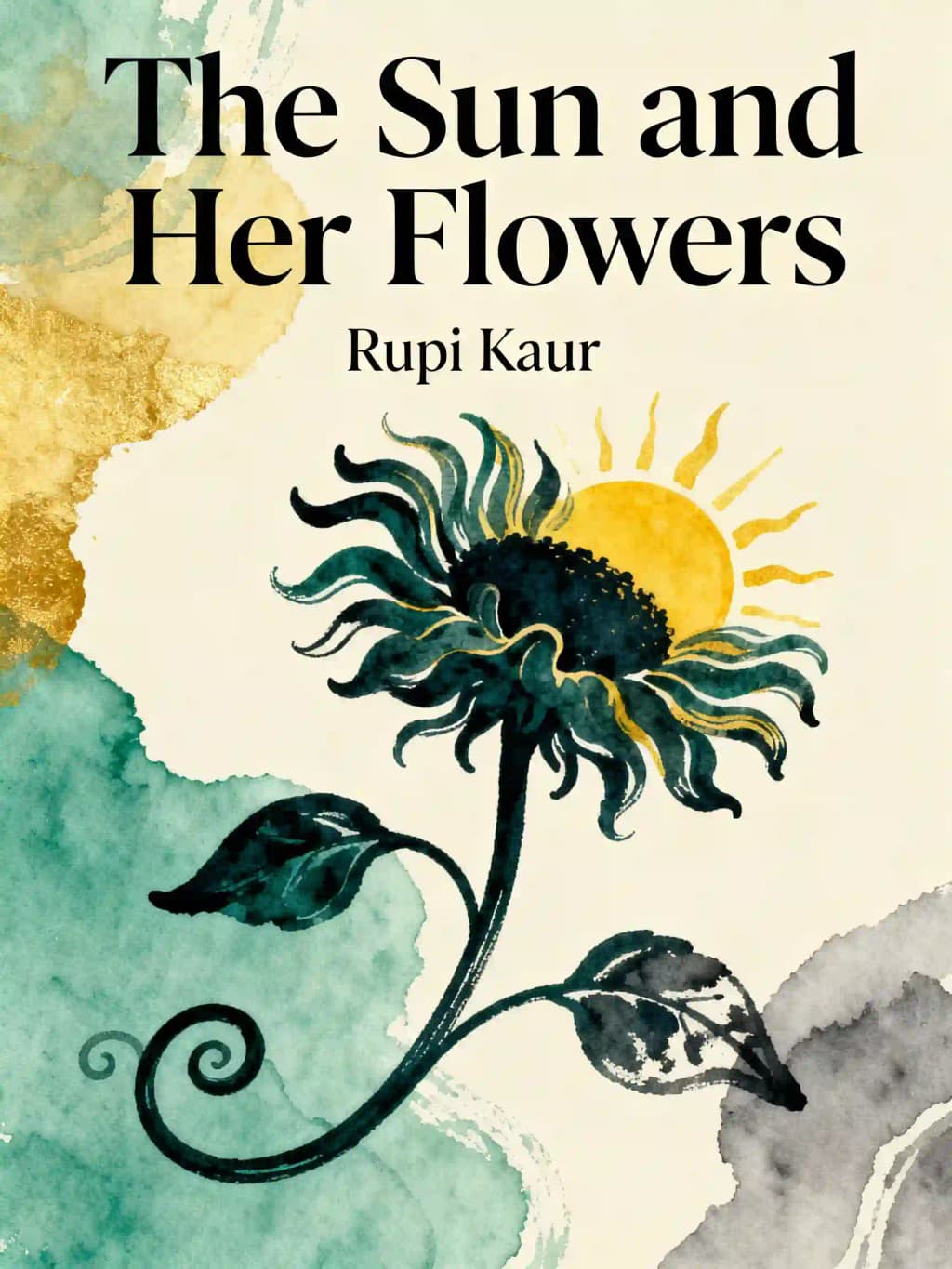
Rupi Kaur's "The Sun and Her Flowers" has become a cultural phenomenon since its release in 2017, selling over 3.5 million copies worldwide and being translated into 42 languages. This collection of intimate poetry has resonated deeply with readers, particularly young women, for its raw honesty about heartbreak, trauma, immigration, and self-love. Even celebrities like Emma Watson and Ariana Grande have publicly praised Kaur's work, with Grande quoting lines in her social media posts. What makes this collection so powerful is how Kaur transforms her personal pain into universal truth, creating a poetic journey that mirrors the natural cycle of flowers: wilting, falling, rooting, rising, and blooming. Her minimalist style, accompanied by simple line drawings, strips emotions to their essence, allowing readers to see themselves reflected in her words.
Capitolo 2
The Anatomy of Heartbreak
The journey begins with the raw, visceral experience of heartbreak. Kaur doesn't merely describe pain-she embodies it. "My heart cracked inside my body on the final day of our love," she writes, immediately pulling us into the physical manifestation of emotional trauma. This isn't just sadness; it's a bodily experience, where grief becomes a tangible force that transforms the narrator's entire being.
The poems in this section capture the disorienting nature of loss-how time becomes distorted, how physical spaces become haunted. "I stuffed a towel at the foot of every door," she writes, describing how she sealed her home from the outside world, "commanding air and light to leave me alone in my grief, creating a cemetery of isolation where nothing enters and nothing escapes." This powerful imagery shows how grief can turn even the most familiar spaces into tombs of memory.
What's particularly striking is how Kaur captures the contradictory impulses that arise during heartbreak. In one moment, the narrator is consumed by jealous rage, "tearing at the sky" for allowing the rain to touch her former lover's body. In another, she's desperately clinging to phantom sensations, imagining her lover's body curved behind hers just to find sleep. These opposing emotions-anger and longing, hatred and acceptance-race through her mind until mental exhaustion brings momentary silence.
Kaur also explores the particular pain of abandoned potential-not just what was lost, but what could have been. "What breaks me isn't what we abandoned," she writes, "but the potential future we could have built had we remained together." She visualizes their relationship as an abandoned construction site, with tools waiting and materials unused, wondering if flowers might someday grow there when they've both moved on to build new lives with others.
Throughout this section, natural imagery serves as a powerful counterpoint to emotional devastation. The narrator cherishes that brief moment upon waking when she hears "hummingbirds, flowers, bees" before consciousness fully returns and brings the shocking realization of her lover's absence, starting her grief cycle anew. This contrast between nature's continuity and human heartbreak underscores the narrator's isolation from the natural rhythms of life.
Capitolo 3
The Void After Loss
In the aftermath of heartbreak comes a peculiar emptiness-a void that seems both endless and suffocating. "I notice everything I do not have," Kaur writes, "and decide it is beautiful." This paradoxical statement captures the strange liminal space that follows intense grief, where absence itself becomes a presence to be reckoned with.
The narrator describes how previous loss has hardened her: "I used to crumble on demand, deeply emotional, but now the water has made its exit." This emotional numbness represents a different kind of pain-the loss of vulnerability itself. "I once dreamed of being so strong nothing could shake me," she reflects. "Now I am. So strong. That nothing shakes me. And all I dream is to soften." The very armor she built for protection has become a prison, cutting her off from authentic emotional connection.
This section also explores the complicated relationship with one's body after trauma. "Why are you so unkind to me, my body cries. Cause you don't look like them, I tell her." This internal dialogue reveals how cultural beauty standards become internalized, creating a battlefield within one's own skin. Later, Kaur writes, "I reduced my body to aesthetics, forgot the work it did to keep me alive with every beat and breath. Declared it a grand failure for not looking like theirs." This powerful realization-that she has been living in a miracle all along while searching elsewhere for one-marks the beginning of a shift toward self-acceptance.
Some of the most devastating poems in this section deal with sexual trauma. In "home," Kaur describes a sexual assault in unflinching detail: "You confused conversation with flirtation... drove me to a road that led nowhere... You took everything. You dove into me with fork and knife, eyes glinting with starvation." The violation transforms her relationship with her own body: "This home is empty now... When you broke in, it never felt like mine again." Yet even here, amid horror, Kaur plants seeds of reclamation: "The truth comes like sunlight-it takes monsters to steal souls and fighters to reclaim them. This is my home."
Throughout this section, Kaur explores how trauma disconnects us from ourselves and others. "The irony of loneliness," she observes, "is we all feel it at the same time." This insight points toward the possibility of connection through shared vulnerability-a theme that will grow more prominent as the collection progresses.
Capitolo 4
Immigrant Roots and Cultural Identity
"They have no idea what it is like to lose home at the risk of never finding home again," Kaur writes, "to have your entire life split between two lands and become the bridge between two countries." This powerful opening to the section on cultural identity immediately establishes the unique challenges of the immigrant experience-existing in a perpetual state of in-betweenness.
Kaur explores how displacement affects not just individuals but entire families. "Leaving her country was not easy for my mother," she observes. "I still catch her searching for it in foreign films and the international food aisle." This poignant image captures how the longing for homeland persists even decades after migration, manifesting in small, everyday moments of nostalgia.
The relationship between mothers and daughters forms a central thread in this section. Kaur imagines what advice she would have given her mother on her wedding day: "You are allowed to say no... Don't sacrifice yourself for us... Your isolation is our fault, not yours. There was no rulebook for raising a family in a strange land." This imagined conversation acknowledges both the mother's sacrifices and the impossible position she was placed in, trying to navigate between cultural traditions and a new reality.
Language itself becomes a site of both struggle and pride. "My voice is the offspring of two countries colliding," Kaur writes. "What is there to be ashamed of if English and my mother tongue made love?" This beautiful metaphor reframes the immigrant's accent not as a deficiency but as a unique creation-a new form of expression born from cultural fusion. Later, she defends her parents' imperfect English: "Don't mock your mother's broken English; her accent is thick like honey-the only thing she has left of home... We might write stories, but she made an entire world for herself-how is that for art?"
Kaur doesn't shy away from addressing the darker aspects of her cultural heritage, particularly regarding gender. In a devastating poem titled "1790," she traces a history of female infanticide from the 18th century to modern gender-selection practices in immigrant communities. This unflinching examination of cultural practices that devalue female lives stands alongside her celebration of cultural resilience and immigrant determination.
The section also explores how displacement creates a longing for roots and connection to ancestry. "I want to go back in time and sit beside her," Kaur writes of her mother's youth in India, "document her in a home movie so my eyes can witness a miracle." This desire to know her mother's life before migration-to witness "what she laughed about with friends in that village of mud and brick houses"-speaks to the gaps in family history created by displacement.
Throughout this section, Kaur emphasizes how immigrants build new lives through tremendous sacrifice and determination. "Papa sees loneliness in his woman's eyes where the iris was," she writes. "She left a village to be his wife, then a country to be a warrior... They turned a suitcase of clothes into a life so their children wouldn't hate being immigrants' children." This acknowledgment of her parents' struggles becomes a form of honoring their journey-recognizing that their apparent limitations were actually manifestations of their strength.
Capitolo 5
Finding Love After Trauma
"On the first day of love you wrapped me in the word 'special,'" Kaur writes, marking the beginning of a new emotional journey. After the devastation of heartbreak and the slow process of healing comes the terrifying, exhilarating possibility of new love. This section explores how past trauma complicates the ability to trust and connect, while still celebrating the transformative power of healthy relationships.
The early stages of attraction are captured with electric intensity: "We hadn't touched yet but we managed to travel in and out of each other with our words, our limbs dizzying with enough electricity to form half a sun." Yet this excitement is immediately tempered by fear: "I feel apprehensive cause falling into you means falling out of him and I had not prepared for that." The narrator stands at a threshold, caught between past attachment and future possibility.
One of the most powerful themes in this section is learning to recognize and accept healthy love after experiencing abuse. "How do I welcome in kindness when I have only practiced spreading my legs for the terrifying?" Kaur asks. "What am I to do with you if my idea of love is violence but you are sweet? If your concept of passion is eye contact but mine is rage?" These questions reveal how trauma rewires our expectations, making gentleness seem foreign and even uncomfortable.
The process of trusting again requires conscious effort: "I am trying to not make you pay for their mistakes. I am trying to teach myself you are not responsible for the wound." This struggle-to see a new partner clearly, without projecting past hurts onto them-becomes a central challenge of healing. "You are not cold or savage or hungry," she reminds herself. "You are medicinal. You are not them."
Kaur also explores how new love transforms our perception of past relationships. "When I walked into the coffee shop and saw you, my body did not react like it had the first time," she writes of encountering an ex-lover. "You looked like a regular guy with your regular clothes and regular coffee. My body must have cleansed itself of you long ago." This moment of non-reaction becomes a triumph-evidence of genuine healing rather than mere distraction.
The section includes beautiful celebrations of physical intimacy that heal rather than harm: "He makes sure to look right at me as he places his electric fingers on my skin... I am a switchboard, he is the circuits... He sparks enough electricity within me to power a city." This description of consensual, attentive sexuality stands in stark contrast to earlier poems about violation, showing how intimacy can be reclaimed.
Throughout this section, Kaur emphasizes the importance of choosing partners wisely: "If I'm going to share my life with a partner it would be foolish not to ask myself: twenty years from now, is this person going to be someone I still laugh with or am I just distracted by their charm?" She encourages looking beyond superficial attraction to deeper compatibility: "Deep at the core are our values the same? In thirty years will we still jump into bed like we're twenty?"
The section culminates in the metaphor that gives the book its title: "What is it with you and sunflowers he asks. I point to the field of yellow outside. Sunflowers worship the sun I tell him. Only when it arrives do they rise. When the sun leaves they bow their heads in mourning. That is what the sun does to those flowers. It's what you do to me. The sun and her flowers." This beautiful image captures how the right relationship can nurture growth and vitality, helping us turn toward the light.
Capitolo 6
The Body as Battleground and Temple
Throughout "The Sun and Her Flowers," the body emerges as both a site of conflict and a source of power. Kaur explores how cultural beauty standards, sexual trauma, and self-hatred can alienate us from our physical selves, while also charting a path toward reclaiming and celebrating the body's inherent wisdom and beauty.
The journey begins with disconnection: "I made change after change pursuing perfection, but when I finally felt beautiful enough, their definition of beauty suddenly changed." This observation highlights the futility of chasing external validation, as beauty standards continuously shift to keep women consuming products and feeling inadequate. "It is a trillion-dollar industry that would collapse if we believed we were beautiful enough already," Kaur notes, identifying the economic interests behind body dissatisfaction.
Cultural beauty standards intersect with racial identity in poems about skin color and body hair. "My girlhood was too much hair, thin limbs coated in velvet," Kaur writes, describing painful hair removal procedures: "I sit timidly in the waiting area... The auntie calls me in. I undress my lower half, lie down, positioned like an open butterfly." This clinical description of intimate grooming rituals raises powerful questions: "Why do I punish my body for being exactly as it's meant to be?"
In contrast to these experiences of bodily shame, Kaur offers celebrations of natural beauty: "Beautiful brown girl, your thick hair is a mink coat not all can afford. You hate the hyperpigmentation but your skin can't help carrying as much sun as possible-you are a magnet for light." This reframing of features often considered "flaws" in Western beauty standards as sources of power and uniqueness offers a radical alternative to self-criticism.
Sexual trauma creates a particularly profound form of bodily alienation. "Parts of my body still ache from the first time they were touched," Kaur writes, capturing how violation can leave lasting physical memories. In another poem, she describes feeling "thrown so far from myself I've been trying to find my way back ever since." This separation from one's physical self-the feeling that one's body has become foreign territory-represents one of the most devastating consequences of sexual assault.
The path toward healing involves reclaiming bodily autonomy and learning to trust physical instincts. "Trust your body," Kaur advises. "It reacts to right and wrong better than your mind does. It is speaking to you." This wisdom acknowledges the body's role not just as a vessel for consciousness but as an intelligent system with its own form of knowing.
The journey culminates in a profound homecoming: "Look down at your body, whisper: there is no home like you." This simple instruction encapsulates the transformation from bodily alienation to embodied presence-recognizing that our physical selves are not just temporary housing but the very ground of our existence. "It was when I stopped searching for home within others and lifted the foundations of home within myself that I found there were no roots more intimate than those between a mind and body that have decided to be whole."
Capitolo 7
Female Solidarity and Collective Power
As "The Sun and Her Flowers" progresses, Kaur's focus expands beyond individual healing to explore the power of female solidarity and collective action. "We need more love," she writes, "not from men, but from ourselves and each other." This shift from seeking validation externally to building support networks among women becomes a crucial element of sustainable empowerment.
Kaur addresses the ways women are often pitted against each other in a patriarchal system: "They threw us in a pit to end each other so they wouldn't have to. We've been starved of space so long we eat each other to survive, while the real monster is too big to take down alone." This powerful metaphor illustrates how competition between women serves existing power structures, distracting from larger systemic issues.
The collection also explores the unique pain of friendship breakups, which often receive less cultural recognition than romantic separations: "They did not tell me it would hurt like this. No one warned me about the heartbreak we experience with friends. Where are the albums? No songs sung for it. No ballads or books dedicated to writing the grief we fall into when friends leave." By acknowledging this under-discussed form of loss, Kaur validates an experience many readers will recognize.
Female mentorship and intergenerational support emerge as powerful antidotes to isolation. "Our work should equip the next generation of women to outdo us in every field," Kaur writes. "This is the legacy we'll leave behind." This vision of progress-where each generation builds upon the achievements of the last-offers a model of feminist solidarity that extends across time.
Kaur also addresses the challenge of comparing oneself to other women: "How do I shake this envy when I see you doing well? Sister, how do I love myself enough to know your accomplishments are not my failures?" This honest acknowledgment of competitive feelings, followed by a commitment to overcome them, models the internal work required to build genuine solidarity.
The strongest bonds between women are portrayed as soul-deep connections: "It isn't blood that makes you my sister, it's how you understand my heart as though you carry it in your body." This definition of sisterhood transcends biological relationships, encompassing all forms of female solidarity based on mutual understanding and support.
Throughout this section, Kaur emphasizes that women's empowerment requires both internal transformation and external action. "Now is not the time to be quiet or make room when we've had no room at all," she declares. "Now is our time to be mouthy, to get as loud as we need to be heard." This call to action recognizes that self-love alone is insufficient-women must also claim space in the public sphere and advocate for structural change.
The section concludes with a vision of motherhood as an opportunity to break generational patterns: "When my daughter is in my belly, I will speak to her like she's already changed the world. She will walk out of me on a red carpet, knowing she's capable of anything she sets her mind to." This determination to raise the next generation differently-to instill confidence rather than limitation-represents the ultimate form of feminist legacy.
Capitolo 8
The Cycle of Growth and Renewal
The final section of "The Sun and Her Flowers" completes the natural cycle that structures the collection, exploring how personal growth mirrors the seasonal patterns of nature. "This is the recipe of life," Kaur's mother tells her, "Think of those flowers you plant in the garden each year. They will teach you that people too must wilt, fall, root, rise in order to bloom."
This botanical metaphor provides a framework for understanding life's inevitable cycles of loss and renewal. Just as plants must experience dormancy before flowering, humans must move through periods of pain and transformation to reach new stages of growth. "You do not just wake up and become the butterfly," Kaur reminds us. "Growth is a process."
The collection emphasizes that healing is not a destination but an ongoing practice: "I woke up thinking the work was done, I would not have to practice today. How naive to think healing was that easy when there is no end point, no finish line to cross. Healing is everyday work." This perspective offers both challenge and comfort-while complete resolution may remain elusive, incremental progress is always possible.
Kaur also explores how our relationship with time shapes our experience of growth. "When snow falls I long for grass. When grass grows I walk all over it. When leaves change color I beg for flowers. When flowers bloom I pick them." This observation captures our tendency to desire what we don't have rather than appreciating what's present-a habit that keeps us perpetually dissatisfied despite life's continuous gifts.
Self-acceptance emerges as a crucial element of sustainable growth. "The universe took its time crafting you to offer something different from everyone else," Kaur writes. "When you doubt how you were created, you doubt an energy greater than us both." This perspective frames individual uniqueness not as accident but as intention-a specific contribution to the world's diversity.
The collection concludes with a vision of mortality that emphasizes celebration rather than mourning: "When I go from this place, dress the porch with garlands as for a wedding. Dance in the streets, send me off in my brightest clothing, serve ice cream with rose petals... Let it be a celebration, for I have lived, I have won at this game called life." This embrace of the full cycle-including its inevitable end-represents the ultimate form of acceptance.
In the final poem, Kaur writes: "There is nothing left to worry about. The sun and her flowers are here." This simple statement encapsulates the collection's journey from devastation to renewal. The presence of both sun and flowers-both nurturing light and the life it sustains-suggests that the narrator has found wholeness not by escaping pain but by integrating it into a larger understanding of life's continuous unfolding.
Capitolo 9
Reclaiming Voice and Agency
At its core, "The Sun and Her Flowers" is about reclaiming one's voice after experiences that threaten to silence it. Throughout the collection, Kaur documents the journey from voicelessness to self-expression, from passivity to agency, from being defined by others to defining oneself.
The struggle to speak begins in childhood: "No was a bad word in my home, met with the lash, erased from our vocabulary, beaten out of our backs until we became well-behaved kids who obediently nodded yes to everything." This early training in compliance has devastating consequences during sexual assault: "When he climbed on top of me, every part wanted to reject it, but I couldn't say no to save my life. When I tried to scream, only silence escaped."
The journey toward reclaiming voice involves first acknowledging its absence. "First I went for my words," Kaur writes, "the 'I can't's, 'I won't's, 'I am not good enough's. I lined them up and shot them dead." This metaphorical execution of self-limiting language marks the beginning of a new relationship with self-expression-one based on possibility rather than constraint.
Cultural expectations around female modesty and silence are directly challenged: "When my mother taught me silence-if you are drowning their voice with yours, how will you hear them? When speaking, she said do it with commitment, every word is your responsibility." This maternal wisdom about thoughtful communication is balanced with encouragement to speak with conviction and purpose.
Kaur explores how immigration and cultural hybridity create unique linguistic challenges and possibilities: "My voice carries my father's words and mother's accent. What does it matter if my mouth carries two worlds?" This question reframes the immigrant's divided linguistic identity not as a deficit but as a form of richness-an expanded capacity for expression.
The collection also addresses how women's voices are systematically devalued and dismissed: "Now is not the time to be quiet or make room when we've had no room at all. Now is our time to be mouthy, to get as loud as we need to be heard." This call for vocal assertiveness recognizes that women's silence often results not from personal choice but from cultural conditioning and institutional barriers.
Perhaps most powerfully, Kaur connects voice to representation: "Representation is vital, otherwise the butterfly surrounded by moths, unable to see itself, will keep trying to become a moth." This metaphor captures how the absence of diverse voices in media and literature limits our collective imagination-making it difficult for marginalized people to envision possibilities beyond dominant narratives.
By the collection's end, the narrator has found not just her voice but her purpose in using it: "I am the product of all the ancestors getting together and deciding these stories need to be told." This framing positions personal expression as part of a larger historical continuity-a responsibility to speak not just for oneself but for those who came before and those who will come after.
The final triumph is the integration of voice and identity: "I am a wild being with the spine of a mulberry tree and neck of a sunflower... It took time to become this sweet rebellion, to realize if I am the only one who can be the wilderness, then let me be the wilderness." This declaration celebrates uniqueness not as isolation but as contribution-the specific voice that only one person can offer to the world's ongoing conversation.
Capitolo 10
The Art of Healing Through Words
"The Sun and Her Flowers" ultimately demonstrates the healing power of language itself-how naming experiences, crafting metaphors, and sharing stories can transform trauma into art and isolation into connection. Kaur's poetic journey shows us that words can be both wound and medicine, both the articulation of pain and the beginning of its resolution.
The collection opens with language that embodies rather than merely describes emotional states: "My heart cracked inside my body on the final day of our love." This visceral imagery makes grief tangible, allowing readers to recognize their own experiences in the poet's words. By giving concrete form to abstract feelings, Kaur creates a shared vocabulary for emotions that often isolate us in their intensity.
Throughout the collection, metaphors drawn from nature provide frameworks for understanding human experience. Sunflowers that follow the sun become a way of understanding devotion; seasonal cycles illustrate personal growth; roots represent cultural heritage and family connections. These natural metaphors suggest that our emotional lives, however chaotic they may seem, follow patterns as ancient and inevitable as the turning of the earth.
Kaur also explores how language can be weaponized against the self: "The way you speak of yourself, the way you degrade yourself into smallness, is abuse." This recognition of negative self-talk as a form of violence opens the possibility of linguistic self-defense-consciously choosing words that nurture rather than diminish the self.
The collection acknowledges that some experiences resist language entirely. In poems about sexual trauma, Kaur captures the struggle to articulate what feels unspeakable: "I heard no pounding inside my mouth, begging to be let out, but I'd never built the emergency staircase." This image of a trapped "no" powerfully conveys how trauma can create a disconnect between internal experience and external expression.
Yet even in addressing the limitations of language, Kaur demonstrates its transformative potential. By finding words for experiences often shrouded in silence-immigration, sexual assault, female desire, cultural displacement-she creates space for readers to recognize and process their own similar experiences. This is the paradox at the heart of the collection: words may be inadequate to fully capture our deepest pain, yet they remain our most powerful tool for connecting across difference and distance.
In the end, "The Sun and Her Flowers" is not just a collection of poems but an invitation to dialogue-with oneself, with others who have experienced similar struggles, and with a world that often refuses to hear certain voices. By sharing her journey from wilting to blooming, Kaur creates a template for readers to understand their own cycles of loss and renewal, offering language as both map and companion for the journey.