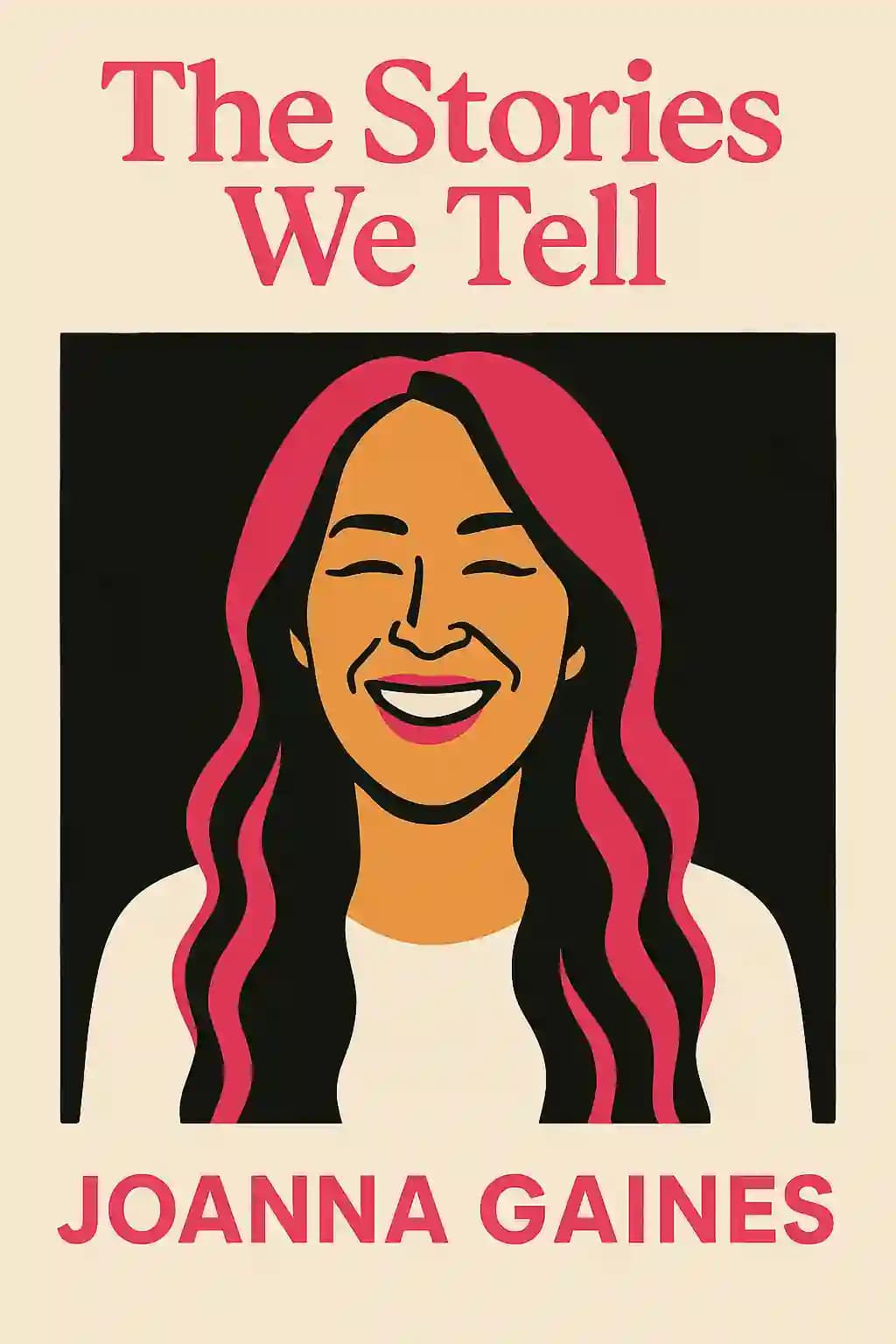
Joanna Gaines' NYT bestseller unveils the power of personal storytelling, inviting readers to confront insecurities and embrace vulnerability. What childhood memory shaped this design icon's philosophy? Discover why her journey of self-reflection has become a milestone birthday gift phenomenon.
Joanna Gaines, New York Times bestselling author of The Stories We Tell, is a celebrated lifestyle expert, interior designer, and co-founder of Magnolia. Known for her work on HGTV’s Fixer Upper and the Magnolia Network, Gaines infuses her memoir with themes of authenticity, vulnerability, and finding purpose through personal narrative.
Her background in communications (Baylor University) and hands-on experience renovating homes and building the Magnolia brand—including Magnolia Market, Magnolia Realty, and Magnolia Journal—anchor her authority on crafting spaces and stories that resonate.
This introspective work reflects Gaines’ signature Texan-rooted philosophy of embracing life’s imperfections while pursuing meaningful connections. As editor-in-chief of Magnolia Journal, she curates content aligned with the book’s focus on self-discovery and intentional living. The Stories We Tell debuted as an instant New York Times bestseller, solidifying Gaines’ status as a trusted voice in lifestyle and personal growth.
The Stories We Tell (2022) is a memoir where Joanna Gaines reflects on her personal journey, emphasizing how life’s challenges and triumphs shape identity. She shares intimate stories about family, faith, and building her Magnolia empire, weaving in lessons about authenticity and resilience. The book encourages readers to embrace their unique narratives and find meaning in both struggles and successes.
This book resonates with fans of Joanna’s design work, memoir enthusiasts, and anyone seeking inspiration to navigate life’s transitions. It’s ideal for readers interested in personal growth, faith-based storytelling, or behind-the-scenes insights into the Gaines family’s journey from small-business owners to HGTV stars.
Yes—readers praise its candid, relatable tone and actionable wisdom. Gaines balances vulnerability with uplifting takeaways, making it a compelling choice for those exploring self-discovery, entrepreneurship, or family dynamics. Reviews highlight its resonance with “anyone needing encouragement to own their story.”
Key themes include embracing vulnerability, finding purpose through adversity, and the power of faith. Gaines reflects on how societal expectations often clash with personal truth, urging readers to prioritize authenticity over perfection. Recurring motifs include home as a metaphor for selfhood and the importance of legacy.
Unlike her cookbooks (Magnolia Table) or design guides (Homebody), this memoir focuses on personal philosophy rather than practical tips. It complements The Magnolia Story (2016) by delving deeper into her emotional journey post-fame, including motherhood and balancing public visibility with private growth.
While direct quotes aren’t publicly excerpted, the book’s ethos mirrors Gaines’ signature lines like:
Gaines, who is Korean-American and Lebanese-German, discusses navigating her mixed heritage in Texas. She reflects on feeling “in between” cultures early in life and how embracing her roots influenced her design aesthetic and family values.
Gaines shares strategies for reframing setbacks as growth opportunities, such as journaling prompts to unpack personal narratives. She also emphasizes setting boundaries in relationships and work—a lesson learned from scaling Magnolia while raising five children.
Some readers note the book prioritizes introspection over concrete takeaways, which may disappoint those seeking step-by-step guidance. However, fans appreciate its reflective tone as a natural evolution from her earlier, more instructional works.
It aligns with movements around mindful living and storytelling-as-therapy but stands out by tying personal growth to community and faith. Unlike transactional productivity guides, Gaines frames resilience as a collective endeavor rooted in love and service.
Yes—Gaines discusses overcoming self-doubt as a female entrepreneur in male-dominated industries. She advocates for “starting small” (e.g., her early blog) and trusting incremental progress, making it relevant for creatives and business founders alike.
In an era of curated social media personas, Gaines’ emphasis on raw, unfiltered storytelling offers a counter-narrative. The book’s focus on mental health, legacy, and redefining success mirrors broader cultural shifts toward purpose-driven living.
Senti il libro attraverso la voce dell'autore
Trasforma la conoscenza in spunti coinvolgenti e ricchi di esempi
Cattura le idee chiave in un lampo per un apprendimento veloce
Goditi il libro in modo divertente e coinvolgente
Fear has always had its way with me.
Perfectionism, which is really just another form of control.
Vulnerability-not safety-was my path to freedom.
Our pain reveals our purpose.
These highlight reels offer only glimpses, obscuring reality.
Scomponi le idee chiave di The Stories We Tell in punti facili da capire per comprendere come i team innovativi creano, collaborano e crescono.
Vivi The Stories We Tell attraverso narrazioni vivide che trasformano le lezioni di innovazione in momenti che ricorderai e applicherai.
Chiedi qualsiasi cosa, scegli il tuo stile di apprendimento e co-crea intuizioni che risuonano davvero con te.

Creato da alumni della Columbia University a San Francisco
"Instead of endless scrolling, I just hit play on BeFreed. It saves me so much time."
"I never knew where to start with nonfiction—BeFreed’s book lists turned into podcasts gave me a clear path."
"Perfect balance between learning and entertainment. Finished ‘Thinking, Fast and Slow’ on my commute this week."
"Crazy how much I learned while walking the dog. BeFreed = small habits → big gains."
"Reading used to feel like a chore. Now it’s just part of my lifestyle."
"Feels effortless compared to reading. I’ve finished 6 books this month already."
"BeFreed turned my guilty doomscrolling into something that feels productive and inspiring."
"BeFreed turned my commute into learning time. 20-min podcasts are perfect for finishing books I never had time for."
"BeFreed replaced my podcast queue. Imagine Spotify for books — that’s it. 🙌"
"It is great for me to learn something from the book without reading it."
"The themed book list podcasts help me connect ideas across authors—like a guided audio journey."
"Makes me feel smarter every time before going to work"
Creato da alumni della Columbia University a San Francisco

Ottieni il riassunto di The Stories We Tell in formato PDF o EPUB gratuito. Stampalo o leggilo offline quando vuoi.
Fear doesn't vanish when you turn on the lights. As a child, I'd lie frozen in bed, convinced monsters lurked in the shadows. But here's what nobody tells you: those monsters don't disappear with age-they just change shape. They morph from imaginary creatures into very real anxieties about rejection, failure, and being truly seen. The first time I tasted social fear, I was in kindergarten during show-and-tell. I proudly displayed a button that had fallen off my jacket, expecting awe. Instead, I got laughter. That moment-so small, so ordinary-planted a seed that would follow me for decades. It taught me that the world could be unpredictable, that vulnerability could backfire, that maybe it was safer to hide. My family moved constantly for my father's job, and with each relocation, those fears intensified. By high school, I'd hide in the library rather than brave the cafeteria alone. Fear became my shadow, always there, whispering that I should protect myself, stay small, avoid risk. Perfectionism became my armor-if I could control everything, maybe I'd never feel that kindergarten humiliation again. Then I met Chip, whose fearlessness baffled me. He approached life with a boldness I couldn't comprehend. When we opened our first Magnolia shop, my fears screamed at full volume. During a buying trip with my mom, doubt overwhelmed me until I finally broke down. That day, something shifted. I realized I could acknowledge my fears and still move forward. Vulnerability-not safety-was my path to freedom. The journey beyond fear isn't about eliminating it completely. It's about recognizing fear's presence while still taking that next brave step, discovering that what waits on the other side isn't disaster but often the very thing your heart has been longing for all along.
I became an expert at building fortress walls, retreating whenever threatened. But walls shield you from pain while blocking out goodness and beauty. As a mother, I realized my children needed to see all of me - strengths and weaknesses, joys and sorrows. Pain from our past flows into exposed crevices with river-like strength. In these vulnerable moments, we tell ourselves familiar stories: Don't let yourself be hurt again. Don't show your differences. These narratives become the bricks in our walls, keeping others at a distance while we convince ourselves we're staying safe. But pain is actually trying to teach us something - connecting dots between past and present wounds to help us understand ourselves better. Once I could name my pain, I recognized it in others. This was genuine empathy - not sympathy or pity. True empathy isn't about fixing people or grand gestures. It's showing others you're willing to sit with them in their pain without shame. Our pain reveals our purpose. I deeply connect with those whose struggles mirror my own - the loneliness of being the new kid, feeling different. This allows me to guide my children through similar challenges, saying "I used to believe that lie too" rather than dismissing their hurt. The bridges we build through empathy connect us first to our own story, then to others' - carrying us forward into deeper connections.
By 2018, after fifteen years of running-raising four children, growing a business, filming five seasons of Fixer Upper-Chip and I were exhausted. We agreed our family needed rest. Two weeks later, I discovered I was pregnant at forty. Middle-of-the-night feedings weren't what I'd planned, yet something whispered, "Stay close." Looking back at our first four children born in quick succession, that period was a blur of survival. I coped with chaos by seeking control-our home's appearance, parties, schedules-building so much structure that I couldn't see life up close. I kept living for what was next, believing peace would come after the next project. Social media has redefined "presence," turning genuine sharing into calculated performances-critiquing backgrounds, retaking photos for perfect lighting, crafting witty captions. Presence isn't about making every second meaningful or waiting for perfect moments. It's about leaning in when you could easily lean out-noticing sunlight through windows or joining your kids' dance party. When I feel disconnected, I pause to look around and express gratitude. Whatever slows you down and steadies your heart is where presence waits.
The day Drake got his driver's license, I taught Crew to navigate stairs. This dichotomy-letting go of one child while another held tight-revealed life's essential rhythm. After tearfully watching Drake drive away, I found Crew waiting to play, a reminder that letting go reveals what else our arms can carry. I struggle to release things with meaning-my cupboards overflow with serveware, my closets are stuffed. This extends to emotional burdens that no longer serve me. The heaviest burdens land on our backs when we can't comfortably carry them in our arms. Pain has been my biggest learning curve-playground stories about what to hide became insecurities about my worth. I tried holding tightly to good things, hoping to dim my sadness, but bringing them closer magnified my unworthiness. Only by confronting pain could I see my present clearly. Nature teaches us about living in rhythm-blooming, growing, yielding, laying bare. When I first planted my garden, I envisioned abundance. But winter came, and I had to pull up plants I'd grown to love. This cycle proved essential for the garden and for all life. When Chip and I left *Fixer Upper* at its peak, rumors swirled. We weren't following career logic but soul stirrings that our family needed a break. Being good stewards means trusting today's cultivation matters for tomorrow.
At six, I wanted to be a roller skater. On my skates, I felt fast, bold, and carefree - spinning down our street with pure joy, not looking over my shoulder or wondering who might see me. By high school, life became a performance - exceeding expectations, avoiding failure, never letting anyone down. Perfection was my safety net. When our business struggled early in our marriage, I told no one, hosting elaborate dinners to hide our reality behind pretty facades. We've all experienced moments that shift everything - when you first noticed your actions drew attention, felt uncomfortable in your skin, or received a comment that made you question yourself. These moments slowly covered up who we once were. I've learned to ask myself why - every day, sometimes every hour. Why did that moment freeze me? Why am I feeling vulnerable? The why tells you everything about how much weight something should carry and whether you're in it for the right reasons. As 2021 ended, while Christmas shopping for my daughters' roller skates, I impulsively ordered myself a pair - green with pink laces. Now my girls and I skate around the farm, chasing dusk down our driveway. Every time I choose fun over fear, play over performance, vulnerability over perfection, it feels like a homecoming - giving others permission to do the same.
The best stories are page-turners with unexpected twists you secretly hope never end. I wrote this book in real-time, each chapter unraveling as healing led to clarity, clarity to rebuilding. My search for direction revealed that my story would never be polished or perfect - I exist in the space between what was and what could be, a chaotic collection of dreams, insecurities, hurts, and profound gratitude. Our stories aren't meant to exist in past tense, but to live and breathe and change as we do. In writing my story, I've discovered not just who I'm aiming to be, but who I already am - unabridged and through no one else's eyes. Armed with the spirit of storytelling, every day becomes a page worth writing. Deep in our souls simmers this tender knowingness: "I am building something beautiful." We find each other in the space of working things out - the failures, wins, and start-overs we all relate to. That's the extraordinary part of writing your story - you discover a secret technique to savoring life. Imagine if our painful chapters quieted and our beautiful pieces rose up - if our stories spoke of how we loved, lost, and tried our best, how we're still growing while building beautiful lives. What beautiful story is yours to tell?