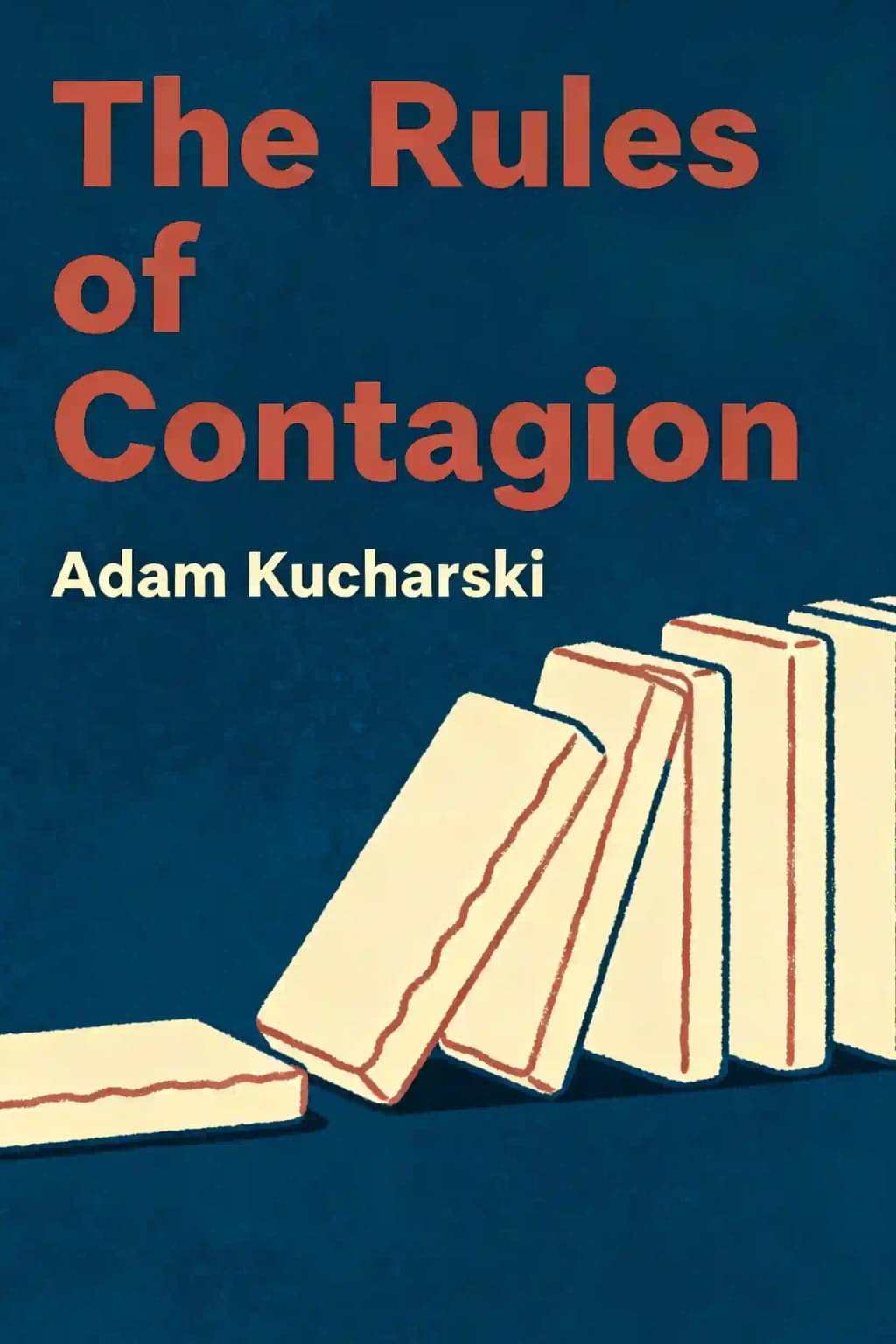
In "The Rules of Contagion," epidemic expert Adam Kucharski reveals why things - from diseases to misinformation - spread. Named among "Best Science Books of 2020" by major publications, this timely guide sold 18,000 hardbacks during lockdown. What invisible patterns connect pandemics to viral tweets?
Adam Kucharski is the author of The Rules of Contagion: Why Things Spread—and Why They Stop, and a professor of infectious disease epidemiology at the London School of Hygiene & Tropical Medicine, where he is a leading expert in outbreak analysis.
Blending science and storytelling, his bestselling book explores contagion dynamics across diseases, financial systems, and social behaviors—a theme rooted in his research using mathematical models to study COVID-19, Ebola, and Zika.
A TED Senior Fellow, Kucharski has delivered popular talks on pandemic science at events like TED2018 and the British Science Festival, and his work has been featured in The New York Times, The Guardian, and BBC Horizon documentaries. His articles appear in Wired, Scientific American, and the Financial Times, and his forthcoming book Proof: The Uncertain Science of Certainty (2025) continues his focus on risk and decision-making.
Recognized as a Times, Guardian, and FT Science Book of the Year, The Rules of Contagion has become a critical resource for understanding modern epidemics and societal trends.
The Rules of Contagion explores how contagion principles apply beyond diseases—including financial crises, social media trends, and violence—using mathematical models and epidemiology. Adam Kucharski explains concepts like the R value, superspreaders, and herd immunity, while showing how these frameworks help predict and manage outbreaks of all kinds.
This book is ideal for public health professionals, data scientists, and general readers interested in understanding contagion dynamics. It blends accessible storytelling with technical insights, making it valuable for those studying epidemiology, behavioral economics, or digital misinformation.
Yes, particularly for its timely analysis of outbreak science and interdisciplinary approach. While some sections on non-medical contagion (e.g., financial systems) feel less original, the book’s exploration of pandemic math, social behavior studies, and real-world case studies like Ebola provides critical insights.
Kucharski illustrates contagion principles in contexts like stock market crashes (e.g., herd behavior), gang violence (treated as a public health issue), and viral misinformation. These analogies reveal how risk perception, social networks, and intervention timing shape outcomes.
Critics note uneven depth in non-medical examples (e.g., financial contagion) and limited technical detail on models. However, the book’s strength lies in synthesizing cross-disciplinary contagion frameworks, not rigorous mathematical proofs.
Though written pre-pandemic, the book’s analysis of R values, lockdown trade-offs, and public compliance foreshadowed key challenges. Kucharski’s work became a primer for understanding real-time COVID-19 modeling and policy debates.
Kucharski is a Professor of Infectious Disease Epidemiology at LSHTM, with expertise in outbreak modeling (e.g., Ebola, Zika). His research integrates data science, behavioral studies, and open-source tools, grounding the book in academic and field experience.
Using network theory, Kucharski shows how superspreading depends on factors like clustered social connections (e.g., workplaces, events) and biological variability. These insights inform targeted interventions to reduce transmission “hotspots”.
Unlike Spillover (David Quammen) or The Pandemic Century (Mark Honigsbaum), Kucharski’s work emphasizes mathematical models over narrative history. It complements Atomic Habits by explaining how small changes propagate through systems.
As AI-driven misinformation and climate-driven diseases rise, the book’s lessons on predicting contagion thresholds, managing nonlinear growth, and balancing intervention costs remain critical for policymakers and technologists.
Senti il libro attraverso la voce dell'autore
Trasforma la conoscenza in spunti coinvolgenti e ricchi di esempi
Cattura le idee chiave in un lampo per un apprendimento veloce
Goditi il libro in modo divertente e coinvolgente
Financial bubbles follow a pattern remarkably similar to disease outbreaks.
Change requires understanding the underlying mechanisms of contagion.
Scomponi le idee chiave di The Rules of Contagion in punti facili da capire per comprendere come i team innovativi creano, collaborano e crescono.
Distilla The Rules of Contagion in rapidi promemoria che evidenziano i principi chiave di franchezza, lavoro di squadra e resilienza creativa.

Vivi The Rules of Contagion attraverso narrazioni vivide che trasformano le lezioni di innovazione in momenti che ricorderai e applicherai.
Chiedi qualsiasi cosa, scegli la voce e co-crea spunti che risuonino davvero con te.

Creato da alumni della Columbia University a San Francisco
"Instead of endless scrolling, I just hit play on BeFreed. It saves me so much time."
"I never knew where to start with nonfiction—BeFreed’s book lists turned into podcasts gave me a clear path."
"Perfect balance between learning and entertainment. Finished ‘Thinking, Fast and Slow’ on my commute this week."
"Crazy how much I learned while walking the dog. BeFreed = small habits → big gains."
"Reading used to feel like a chore. Now it’s just part of my lifestyle."
"Feels effortless compared to reading. I’ve finished 6 books this month already."
"BeFreed turned my guilty doomscrolling into something that feels productive and inspiring."
"BeFreed turned my commute into learning time. 20-min podcasts are perfect for finishing books I never had time for."
"BeFreed replaced my podcast queue. Imagine Spotify for books — that’s it. 🙌"
"It is great for me to learn something from the book without reading it."
"The themed book list podcasts help me connect ideas across authors—like a guided audio journey."
"Makes me feel smarter every time before going to work"
Creato da alumni della Columbia University a San Francisco

Ottieni il riassunto di The Rules of Contagion in formato PDF o EPUB gratuito. Stampalo o leggilo offline quando vuoi.
A teenage prankster's computer virus spreading through floppy disks. A doctor's mosquito theorem that would save millions. A market crash that wiped out Nobel Prize winners' fortunes. What connects these seemingly unrelated events? They all follow the same mathematical rules-rules that govern how everything from diseases to ideas to violence ripples through our interconnected world. Long before COVID-19 made "reproduction numbers" dinner table conversation, mathematicians and epidemiologists were quietly mapping the invisible architecture of contagion, discovering that bank failures, viral tweets, and measles outbreaks share a common DNA.