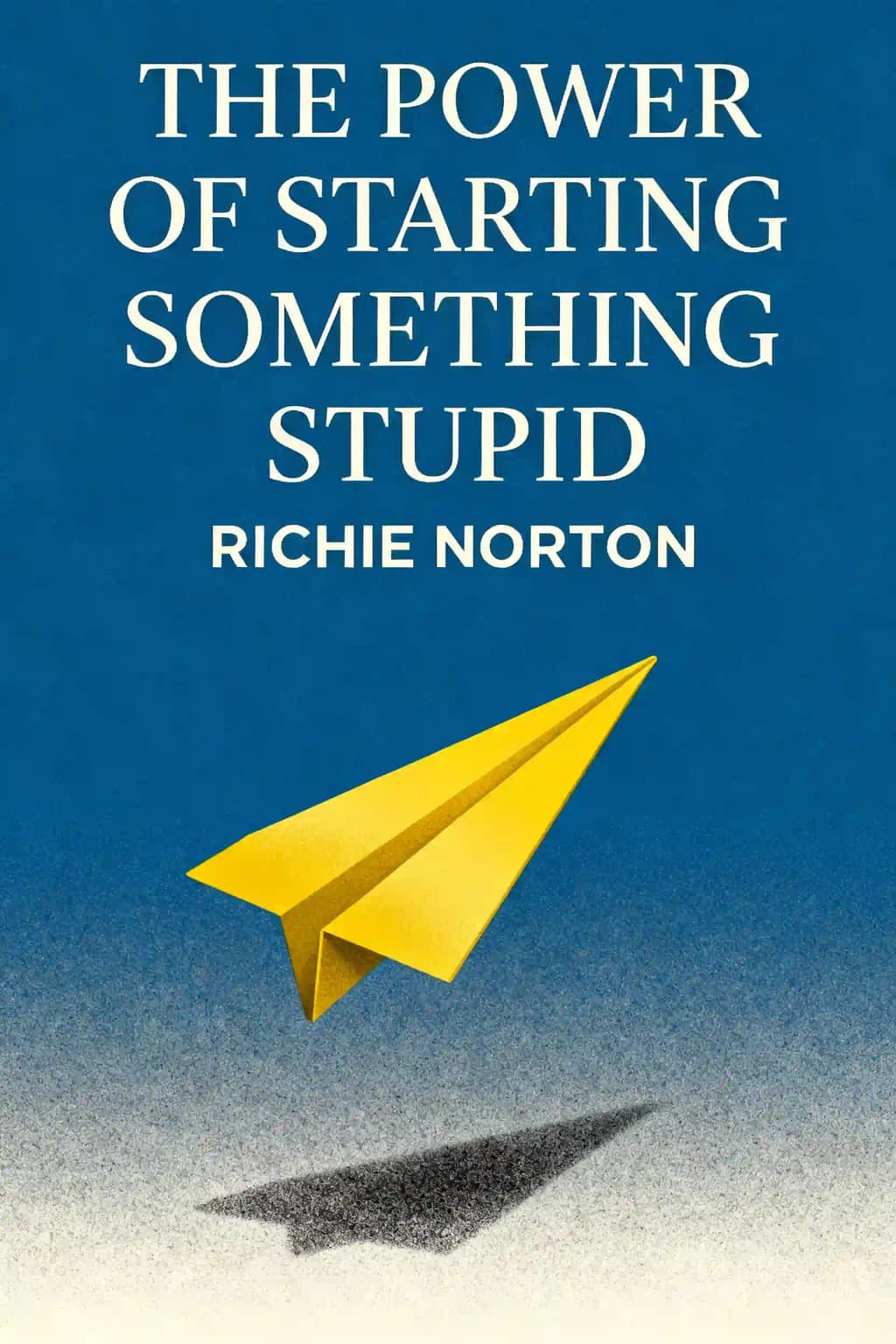
What if your "stupid" idea is actually brilliant? Endorsed by Seth Godin and Steve Forbes, Richie Norton's transformative guide proves that embracing seemingly foolish concepts - backed by interviews with hundreds of successful innovators - might be your smartest move toward authentic success and zero regrets.
Richie Norton is the bestselling author of The Power of Starting Something Stupid and a renowned entrepreneur, executive coach, and authority on innovation.
This self-help classic blends personal development with business strategy, tackling themes of overcoming fear, embracing risk, and redefining success—principles born from Norton’s MBA background, his role as cofounder of BYU Hawaii’s entrepreneurship center, and his leadership as CEO of PROUDUCT, an INC. 5000 global product-sourcing company.
A Top Forty Under 40 honoree, Norton has been featured in Forbes, Bloomberg Businessweek, and Entrepreneur, and hosts the Richie Norton Show podcast. His other works, including Resumes Are Dead and What to Do About It and Anti-Time Management, further cement his expertise in career innovation and productivity.
The Power of Starting Something Stupid won the 2013 San Francisco Book Festival’s Grand Prize and has been translated into 10+ languages, reflecting its global impact on entrepreneurs and Fortune 500 leaders alike.
The Power of Starting Something Stupid challenges conventional notions of "stupid" ideas, arguing they’re often gateways to innovation and success. Richie Norton teaches readers to reframe fear, overcome excuses (like lack of time/money), and leverage the "New Smart" framework to act on seemingly risky ventures. The book blends personal anecdotes, historical examples (e.g., Henry Ford), and actionable strategies to help readers pursue purpose over perfection.
This book is ideal for entrepreneurs, creatives, or anyone paralyzed by self-doubt or societal judgment. It’s particularly relevant for those seeking to transition careers, launch side hustles, or break free from regret. Norton’s emphasis on resilience and redefining failure makes it valuable for individuals navigating uncertainty or seeking motivation to act on "unconventional" ideas.
Yes, particularly for readers seeking a blend of mindset shifts and tactical advice. Endorsed by Seth Godin and Steve Forbes, the book offers fresh perspectives on risk-taking and includes frameworks like the "5 Actions of the New Smart." Its focus on action over theory makes it practical for both aspiring and seasoned innovators.
The five actions are:
"Good stupid" refers to ideas that align with purpose, involve calculated risk, and serve others, even if initially misunderstood (e.g., Airbnb). "Bad stupid" describes reckless ventures driven by ego or ignorance. Norton emphasizes assessing motives and societal impact to distinguish between the two.
Norton cites Henry Ford’s embrace of "stupid" assembly-line innovation and analogizes entrepreneurs to farmers who "don’t lay their own eggs" (focus on nurturing ideas, not doing everything alone). He also shares personal stories, including overcoming his son’s death to build a global company, PROUDUCT.
The book frames fear as a signpost for growth, urging readers to "crush it" by taking small, consistent actions. Norton argues regret stems from inaction, not failure, and provides tools like the "Stupid Equation" (Vision + Action = Success) to prioritize progress over perfection.
The equation Vision + Action = Success underscores that ideas alone are insufficient. Norton stresses pairing clarity of purpose with relentless execution, even amid criticism. For example, he highlights how Steve Jobs’ "stupid" insistence on design simplicity revolutionized tech.
Some readers may find the premise overly optimistic, lacking depth on mitigating financial/operational risks. Critics note the focus on mindset might overlook structural barriers. However, the book’s strength lies in its motivational framework rather than granular tactical guides.
As a serial entrepreneur and CEO (PROUDUCT) who faced personal tragedy, Norton blends professional resilience with emotional authenticity. His MBA-driven approach to "stupid" ideas merges academic rigor with real-world pragmatism, reflected in case studies and actionable systems.
Absolutely. The book provides tools to reframe self-doubt, identify transferable skills, and take incremental steps toward new opportunities. Norton’s "permanent beta" concept is especially relevant for professionals navigating industries disrupted by technology or economic shifts.
Key quotes include:
Senti il libro attraverso la voce dell'autore
Trasforma la conoscenza in spunti coinvolgenti e ricchi di esempi
Cattura le idee chiave in un lampo per un apprendimento veloce
Goditi il libro in modo divertente e coinvolgente
Life Is Too Short to Wait.
Live to start. Start to live.
Saving dreams for the future is bad.
Creativity and stupid are interchangeable.
Successful people keep going anyway.
Scomponi le idee chiave di The power of starting something stupid in punti facili da capire per comprendere come i team innovativi creano, collaborano e crescono.
Distilla The power of starting something stupid in rapidi promemoria che evidenziano i principi chiave di franchezza, lavoro di squadra e resilienza creativa.

Vivi The power of starting something stupid attraverso narrazioni vivide che trasformano le lezioni di innovazione in momenti che ricorderai e applicherai.
Chiedi qualsiasi cosa, scegli la voce e co-crea spunti che risuonino davvero con te.

Creato da alumni della Columbia University a San Francisco
"Instead of endless scrolling, I just hit play on BeFreed. It saves me so much time."
"I never knew where to start with nonfiction—BeFreed’s book lists turned into podcasts gave me a clear path."
"Perfect balance between learning and entertainment. Finished ‘Thinking, Fast and Slow’ on my commute this week."
"Crazy how much I learned while walking the dog. BeFreed = small habits → big gains."
"Reading used to feel like a chore. Now it’s just part of my lifestyle."
"Feels effortless compared to reading. I’ve finished 6 books this month already."
"BeFreed turned my guilty doomscrolling into something that feels productive and inspiring."
"BeFreed turned my commute into learning time. 20-min podcasts are perfect for finishing books I never had time for."
"BeFreed replaced my podcast queue. Imagine Spotify for books — that’s it. 🙌"
"It is great for me to learn something from the book without reading it."
"The themed book list podcasts help me connect ideas across authors—like a guided audio journey."
"Makes me feel smarter every time before going to work"
Creato da alumni della Columbia University a San Francisco

Ottieni il riassunto di The power of starting something stupid in formato PDF o EPUB gratuito. Stampalo o leggilo offline quando vuoi.
What if the idea you're dismissing as ridiculous right now is actually the key to your most meaningful success? That nagging thought about starting a business, switching careers, or pursuing a creative passion-the one you've labeled "too risky" or "impractical"-might be the exact opportunity you'll regret missing decades from now. This isn't motivational fluff. It's a pattern observed across history's greatest achievements. Thomas Edison was called "addled" by his teachers. Walt Disney was fired for lacking imagination. Elvis was told to stick with truck driving. The Wright brothers were dismissed as foolish bicycle mechanics. Steve Jobs was ousted from his own company. What united these pioneers wasn't avoiding stupid ideas-it was strategically pursuing them. They understood something most people miss: society's "stupid" is often innovation's birthplace. Some wisdom arrives through study. Other wisdom is forged in unimaginable pain. After losing his 21-year-old brother-in-law Gavin to a rare medical condition, then watching his infant son-also named Gavin-live just 76 days due to a congenital heart defect, a profound truth crystallized: we have no guarantee of tomorrow. Holding his dying child, making the impossible "do not resuscitate" decision, transformed everything. From this devastating crucible emerged "Gavin's Law": Live to start. Start to live. We postpone inspired ideas endlessly, waiting for perfect circumstances that never materialize. We need more credentials, more capital, more connections. We'll start when work settles down, when kids are grown, when we've saved enough, when we retire. But these perfect conditions are mirages. The language of "maybe someday" belongs to those who reach life's end wondering "what if?" Here's the counterintuitive truth: saving money for the future is wise, but saving dreams for the future is dangerous. The greatest risk isn't failure-it's dying with your music still inside you. The question isn't whether your idea seems foolish. It's whether you're brave enough to start anyway.