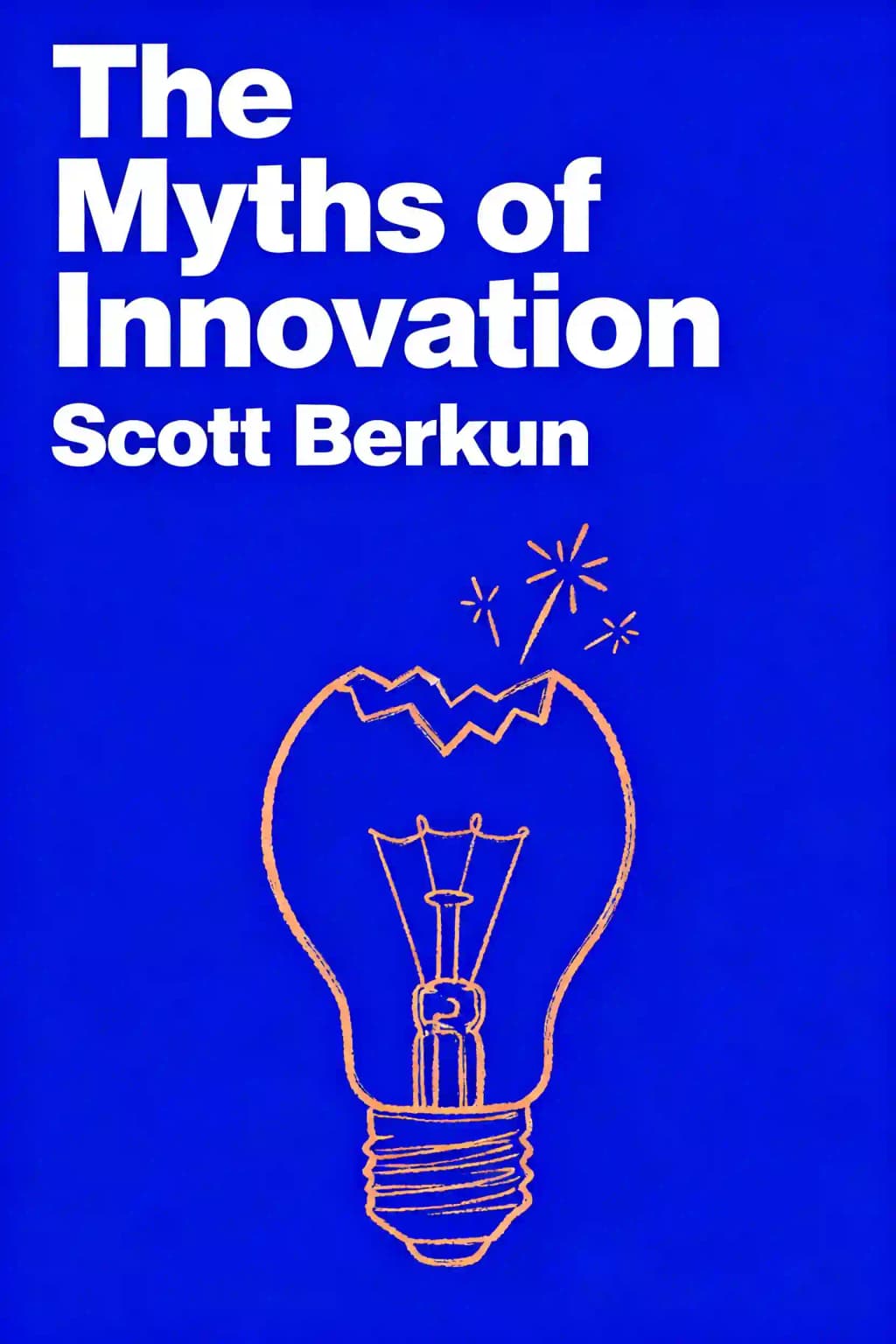
The myths of innovation
Panoramica di The myths of innovation
Forget "Eureka!" moments and lone geniuses. Scott Berkun's myth-busting masterpiece reveals innovation's messy truth, challenging what we thought we knew. Guy Kawasaki proclaimed it "sets us free to change the world" - because real breakthroughs come from hard work, not magic.

Temi chiave in The myths of innovation
- creative process demystified
- historical survival bias
- incremental insight accumulation
- technological path dependency
- innovation origin stories
Citazioni da The myths of innovation
We prefer myths to truth.
Innovation isn't about singular breakthroughs.
History primarily records successes.
There is no risk-free methodology for innovation.
Personaggi di The myths of innovation
- Scott BerkunAuthor and former Microsoft project manager
- Tim Berners-LeeCreator of the World Wide Web
- Gordon GouldInventor of the laser
- Johannes GutenbergInventor of the printing press
Sull'autore
Sull'autore di The myths of innovation
Scott Berkun, bestselling author of The Myths of Innovation and a leading voice on creativity and technology, blends his expertise in tech leadership and philosophy to dissect how breakthroughs truly happen. A former Microsoft program manager who contributed to Internet Explorer and Windows, Berkun bridges practical innovation experience with sharp historical analysis. His work explores the intersection of technology, design, and human behavior, themes further developed in his other acclaimed books like Confessions of a Public Speaker and The Year Without Pants.
Berkun’s insights have been featured in The New York Times, The Washington Post, and on NPR, while his popular blog and newsletter offer ongoing commentary on design and leadership. A sought-after speaker, he has lectured at institutions worldwide and hosted CNBC’s The Business of Innovation. The Myths of Innovation, winner of the 2008 Jolt Award, has been translated into over 20 languages and remains a staple in tech and business curricula.
Scarica il riassunto di The myths of innovation
Ottieni il riassunto di The myths of innovation in formato PDF o EPUB gratuito. Stampalo o leggilo offline quando vuoi.
FAQ su questo libro
The Myths of Innovation debunks common misconceptions about creativity and invention, arguing that breakthroughs rarely come from sudden "eureka moments." Instead, Berkun reveals how innovation stems from iterative problem-solving, collaboration, and learning from failure. The book blends historical case studies (like the Wright brothers) with modern examples to show how persistence and practicality drive progress.
This book is ideal for entrepreneurs, product managers, designers, and anyone involved in tech or creative industries. It’s also valuable for educators and students studying innovation, offering actionable insights for overcoming obstacles in turning ideas into reality. Berkun’s accessible writing style appeals to both professionals and general readers interested in the realities of inventing.
Yes—it’s a critically acclaimed, jargon-free guide that challenges romanticized views of innovation. Berkun’s blend of historical analysis, humor, and practical advice earned it a Jolt Award for productivity. Readers gain tools to navigate setbacks and foster creativity in teams, making it a staple for innovation-minded professionals.
Berkun dismantles myths like:
- The lone genius myth: Most innovations are collaborative.
- The epiphany myth: Breakthroughs result from incremental work.
- The “best idea wins” myth: Timing, luck, and marketing matter.
- The “overnight success” myth: Progress often takes decades.
Berkun defines innovation as solving meaningful problems in ways people value—even if the ideas themselves aren’t new. He emphasizes that adoption (not just invention) determines success, using examples like the slow acceptance of electricity to illustrate how context shapes impact.
Key strategies include:
- Embracing experimentation and learning from failure.
- Building diverse teams to challenge assumptions.
- Focusing on customer needs over technical novelty.
- Persisting through setbacks with disciplined iteration.
Unlike abstract theories, Berkun grounds his insights in historical research and his tech industry experience (e.g., leading teams at Microsoft and WordPress). It’s often compared to Atomic Habits for its actionable frameworks but stands out for its critical analysis of innovation’s cultural myths.
Some readers note the book focuses more on debunking myths than providing step-by-step innovation formulas. However, fans argue its strength lies in resetting expectations, helping teams avoid common pitfalls in product development.
Top lessons include:
- Innovation requires grit, not just genius.
- Feedback from diverse perspectives accelerates progress.
- Success depends on execution as much as ideas.
- Failure is a natural (and valuable) part of the process.
Berkun’s experience leading UX teams at Microsoft and WordPress informs his pragmatic approach. His work on Internet Explorer and WordPress.com exposed him to real-world challenges in scaling ideas—a theme central to the book’s analysis of historical and modern innovations.
As AI and rapid tech advances dominate, Berkun’s focus on human-centric problem-solving remains critical. The book’s principles help teams navigate AI-driven disruption by emphasizing adaptability, ethical considerations, and cross-disciplinary collaboration.
Notable quotes include:
- “The secret is that every innovator has a list of failures, but history only remembers the successes.”
- “If you want innovation, you need to make space for the many small failures required to learn what actually works.”
It complements his books on leadership (Making Things Happen) and public speaking (Confessions of a Public Speaker), offering a systems-thinking lens on creativity. Fans of The Year Without Pants will recognize his emphasis on teamwork and iterative design.