Capitolo 1
Decisions That Define Our Future
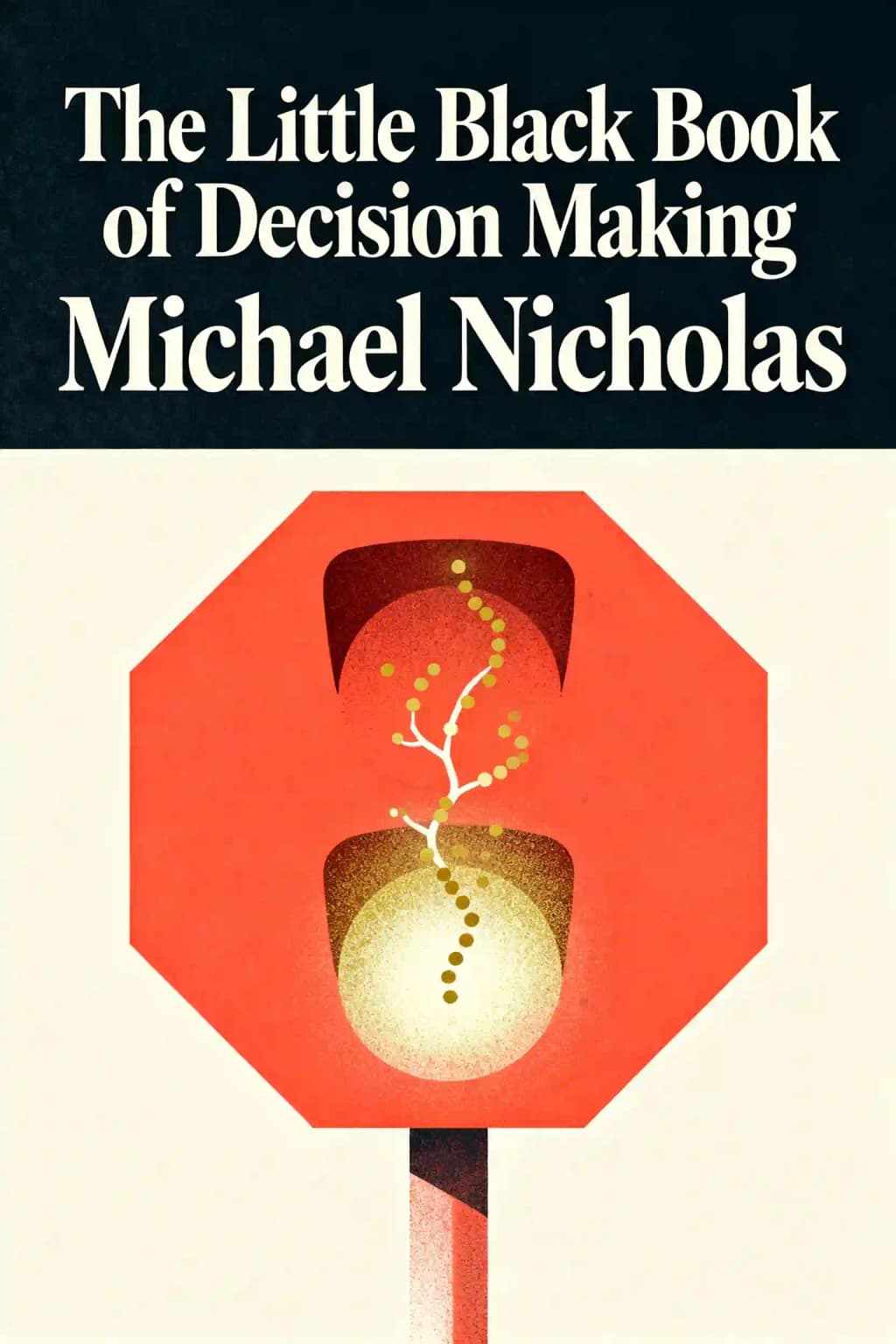
Have you ever found yourself staring at a seemingly simple choice, paralyzed by indecision? Perhaps it was a career move, a relationship decision, or even just which Netflix show to watch next. We make thousands of decisions daily, yet few of us have ever been taught how to make them well. In our rapidly changing world, decision-making capability has become the ultimate competitive advantage. Michael Nicholas's "The Little Black Book of Decision Making" arrives at a pivotal moment in human history, as artificial intelligence begins to outperform humans in many cognitive tasks while the complexity of our challenges grows exponentially. The book has become a favorite among Silicon Valley executives and military leaders alike for its practical wisdom on navigating uncertainty. Beyond its business applications, its principles have been incorporated into mental health programs and educational curricula worldwide. Nicholas draws from his unique background as both a chartered engineer and leadership coach to bridge the gap between analytical thinking and intuitive wisdom-a combination increasingly recognized as essential for thriving in our volatile, uncertain world.
Capitolo 2
The Hidden Mechanics of Decision Failures
The 1986 Challenger space shuttle disaster serves as a sobering reminder of how catastrophically wrong our decisions can go, even with the best minds involved. While most remember only the technical cause-O-ring failure in cold temperatures-the deeper story reveals something far more troubling about human decision-making. NASA's organizational culture and decision processes were ultimately responsible for the tragedy, not just a mechanical failure.
Looking beneath the surface exposes alarming patterns. The O-rings had never been tested below 10C yet were used at -2C. NASA managers had known about the potentially catastrophic flaw since 1977. Engineers explicitly warned about launching in low temperatures, but were ignored. Despite acknowledging the problem was potentially catastrophic in 1985, flights continued without redesign. Many critical components had never been tested at such low temperatures. After six previous postponements, NASA managers were resistant to further delays.
What makes these failures particularly instructive is how obvious they seem in hindsight. This "hindsight bias" makes uncertain outcomes appear inevitable once we know what happened. Baruch Fischoff's pioneering study on Nixon's 1972 diplomatic visits demonstrated this effect perfectly-people inflated their estimates for outcomes that occurred while downplaying those that didn't. Once we adopt a new understanding, we struggle to accurately reconstruct our past beliefs.
This creates serious decision-making problems: unsuccessful decisions get punished regardless of uncontrollable factors; decision-makers become risk-averse; irresponsible risk-takers receive undeserved rewards when gambles pay off; and most critically, we lose the ability to learn from past decisions.
We navigate complexity through heuristics-unconscious mental shortcuts-that often lead to serious mistakes in modern contexts. Even life-or-death decisions fall prey to presentation biases. When doctors received identical cancer treatment data presented as either "survival rates" or "death rates," 82% recommended surgery with survival framing versus just 56% with mortality framing-though mathematically identical.
Our unconscious mind processes information far beyond conscious capabilities. We recognize dogs instantly, identify caricatures, distinguish accents, sense emotional atmospheres, and use grammar-all without being able to explain how. Could we deliberately tap into these unconscious capabilities to improve decision making? Absolutely.
During WWII, aircraft recognition experts couldn't explain how they identified planes from tiny, fuzzy blobs. Traditional instruction failed completely. The solution? Trial and error with immediate expert feedback. Novices gradually trained their unconscious minds until achieving mastery.
The Challenger disaster illustrates how "truth" exists at multiple levels. The O-ring failure was the immediate cause, but NASA's ineffective safety procedures and organizational culture created the conditions for disaster. Most fundamentally, intelligent professionals made consistently poor decisions because psychological biases overrode rational judgment. Einstein's insight that "We cannot solve a problem from the level of consciousness that created it" suggests NASA started at the wrong level.
Capitolo 3
When Innovation Becomes Obsolescence
Change is inevitable, yet most people behave as if repeating past actions will yield identical results. This misconception persists despite centuries of wisdom to the contrary, from Marcus Aurelius noting the rise and fall of empires to Machiavelli advising that success requires changing conduct with the times. The common belief that "if you always do what you've always done, you'll always get what you've always got" proves dangerously false in our rapidly evolving world.
Before the 1600s, Western understanding was based on superstition and divine intervention. The Scientific Revolution transformed this worldview, introducing mathematical laws and predictability. Decision-making shifted from blind acceptance to evidence-based reasoning. Frederick Winslow Taylor applied scientific thinking to business management in the late 19th century, discovering that manufacturing was governed by tradition rather than rational principles. By meticulously analyzing every task, Taylor achieved remarkable results-increasing steel cutting speeds from 9 to 50 feet per minute. His breakthrough wasn't just the productivity gains but developing a replicable decision-making process that could transform almost any business field.
Blockbuster exemplifies how innovation doesn't guarantee lasting success. David Cook revolutionized video rental by applying computer database tracking to inventory management and creating family-friendly stores. From its 1985 Dallas opening, Blockbuster expanded phenomenally-opening a store every 17 hours by 1989, reaching 9,100 locations with 60,000 employees and a $5 billion market cap.
Yet by 2010, just 25 years after launching, Blockbuster filed for bankruptcy. The culprit? Netflix, ironically founded by Reed Hastings after receiving a $40 late fee from Blockbuster. Netflix innovated continuously-first with postal DVD delivery, then with subscription-based unlimited rentals without late fees, and finally pioneering video streaming. Blockbuster had its chance when Hastings offered to sell Netflix for $50 million in 2000, but they declined. Now Netflix is worth over $43 billion-a stark reminder that innovation must be continuous, not just a one-time achievement.
The Blockbuster story illustrates a universal business principle: everything innovative eventually becomes obsolete. Today's businesses face unprecedented volatility-they now have a one-in-three chance of being delisted within five years, six times the rate of 40 years ago, with average lifespans halving to just 30 years. As Bill Gates noted, "Success is a lousy teacher. It seduces smart people into thinking they can't lose."
Why do market leaders repeatedly fail despite their vast resources? The problem lies in our continued reliance on Frederick Taylor's scientific management principles. Rational analysis, logic, and business planning become so deeply embedded that they're assumed to be the optimal approach. But once any methodology becomes automatic through conditioning, we struggle to recognize when change becomes necessary.
Conditioning forms the foundation of our learning processes. Pavlov's famous experiments demonstrated how neutral stimuli could trigger physiological responses through repeated association. The critical insight is that it's not the original event but our habitual thinking about it that creates conditioning. These conditioned beliefs shape everything from our relationships and self-worth to our approach to decision-making.
Full-grown elephants restrained by light ropes illustrate conditioning's greatest danger-they remain captive because they were conditioned as calves to believe they couldn't break free. Martin Seligman's groundbreaking research identified this as "learned helplessness." In his experiments, dogs exposed to unavoidable shocks stopped trying to escape even when escape became possible. These unexplored assumptions severely impair decision-making.
Capitolo 4
The Illusion of Rationality
Our cherished belief in our own rationality is largely an illusion. Though we value logical thinking and associate it with intellectual strength and personal integrity, psychological evidence reveals we are fundamentally irrational beings.
After placing bets, we feel more confident in winning. We grow to like stimuli simply through repeated exposure. We're more likely to marry someone whose first name begins with the same letter as our own. We support identical political proposals when they come from our preferred party but reject them from opponents.
Neurological research explains this disconnect: we experience emotional reactions to decisions a split second before conscious rationalization begins. By the time we're thinking consciously, our emotions are already influencing us, leading to choices that defy logic-like eating that extra cookie while dieting or getting angry with customer service representatives for our own mistakes.
As David McRaney brilliantly summarized: "The misconception is that your opinions result from years of rational analysis. The truth is they result from years of paying attention to information that confirmed existing beliefs while ignoring challenging evidence."
In 2001, Takaru Kobayashi shattered the hot dog eating contest world record by consuming 50 hot dogs in 12 minutes-double the previous record of 25. Rather than simply eating faster, he completely reimagined the process: separating sausages from buns, dipping buns in water, and optimizing his body movements for maximum efficiency.
This pattern repeats across domains: someone develops a novel strategy, others imitate it, incremental improvements follow, and eventually "best practice" emerges with accompanying beliefs that become conventional wisdom. But these established approaches inevitably introduce limiting assumptions that block creativity and innovation.
Today's strategic planning reflects this mindset. Despite the mystique surrounding strategy development, it's essentially creating action plans to achieve long-term aims. Organizations gather historical data, analyze business models and competition, project technology advances, and make predictions about future environments. This approach-increasingly dependent on "big data"-assumes an orderly world where understanding past patterns enables accurate future predictions.
The fundamental problem? This system breaks down when sufficient order doesn't exist. Best practice is, by definition, past practice, and it relies on predictability in an increasingly unpredictable world.
Capitolo 5
Navigating Complexity in an Accelerating World
When Takaru Kobayashi shattered eating records and Frederick Taylor revolutionized factory efficiency, people needed proof to believe it. Similarly, Dick Fosbury transformed the high jump at the 1968 Olympics with his "Flop" technique. Despite physical limitations, he created an approach that changed the sport forever by utilizing new foam landing mats. While others clung to traditional methods, Fosbury's performance gap forced him to innovate - his disadvantage became his advantage.
We're entering the Fourth Industrial Revolution, as Professor Klaus Schwab describes it. Following mechanical power, electrification, and computerization, this era merges physical, digital, and biological realms at unprecedented speed. The fusion challenges our concept of humanity itself as we develop AI and alter life's fundamentals. Paradoxically, technology has created more complexity, not less.
Expert prediction struggles in this environment. Professor Philip Tetlock's 20-year study of 82,361 forecasts revealed that experts barely outperformed "dart-throwing chimpanzees," with simple algorithms consistently beating their predictions.
Warren Weaver's 1948 paper explains why: while science excelled at "two-variable problems of simplicity," real-world situations involve "organized complexity" with countless interrelated factors. Using billiards as an analogy, predicting one ball's movement is simple, but adding multiple balls creates exponential complexity.
Understanding system types is crucial for decision-making:
• Simple systems have clear cause-effect relationships and repeatable processes, like following a recipe
• Complicated systems require expertise but remain predictable once analyzed, like computer repair
• Complex systems contain "unknown unknowns" where minor changes trigger cascading effects through non-linear feedback loops
What distinguished innovators like Fosbury, Blockbuster's David Cook, and Netflix's Reed Hastings wasn't resources - it was their mindset. They recognized that conventional principles were belief systems, not immutable rules.
Capitolo 6
The Mind's Blind Spots
On December 20, 1954, a small group gathered in Dorothy Martin's living room awaiting midnight rescue by spaceship before an apocalypse Martin had prophesied. Social psychologist Leon Festinger and colleagues infiltrated this group to study what would happen when the prophecy inevitably failed.
Despite the aliens' no-show, Martin's followers-who had quit jobs and given away possessions-didn't abandon their beliefs. After initial distress, Martin received a new "message" claiming their spiritual light had saved the world. The group then enthusiastically proclaimed this miracle.
This famous case illustrates a universal human trait: we're remarkably skilled at explaining away contradictions that challenge our core beliefs. This warning applies to all of us, not just fringe doomsday believers.
Cognitive dissonance-the uncomfortable mental tension created when our beliefs clash with evidence-drives us to extraordinary lengths of self-deception. Like Dorothy Martin's doomsday believers who reinterpreted their failed prophecy as success, we all instinctively protect our worldviews by distorting contradictory information rather than changing our minds.
Jack Brehm's research demonstrated this brilliantly. When participants chose between similarly desirable products, they subsequently inflated ratings of their chosen item while devaluing the rejected one-especially when the initial choice was difficult. The greater the dissonance, the more extreme the mental adjustments to justify our decisions.
Brain research reveals why cognitive dissonance is so powerful: when we encounter information that contradicts our beliefs, our reasoning centers virtually shut down while emotional circuits activate intensely. Drew Westen's fMRI studies showed that resolving this dissonance triggers the same reward circuits involved in addiction, creating a neurological incentive to eliminate mental conflict regardless of accuracy.
Confirmation bias-our tendency to seek evidence supporting existing beliefs while ignoring contradictory information-may be our most dangerous mental blind spot. It operates through three mechanisms: selection bias (choosing which information to consider), interpretation bias (how we understand that information), and hindsight bias (how we remember it).
Research from Ohio State University found people spend 36% more time reading articles that align with their existing views. This selection bias intensifies with commitment to beliefs, as shown in Valdis Krebs' analysis of political book-buying patterns during the 2008 presidential election. As Election Day approached, the overlap between what Republican and Democratic supporters read disappeared completely.
The Stanford University study on interpretation bias revealed how people exposed to identical evidence about capital punishment reached opposite conclusions based on their pre-existing beliefs. Rather than moving toward middle ground, participants became even more polarized in their views. This demonstrates how we can read the same information yet reach entirely different conclusions, with each side absolutely convinced they're right. Counter-intuitively, contradictory information often strengthens existing beliefs rather than weakening them.
The fundamental challenge of decision-making is achieving sufficient objectivity to evaluate information impartially. While this comes relatively easily when we have no personal stake, it becomes exponentially more difficult when our beliefs or values are challenged. Those who become defensive or angry when their views are questioned demonstrate their lack of objectivity.
Capitolo 7
Perception Creates Our Reality
We naturally assume our conscious experience of the world is accurate, giving us a good grasp of external reality. Yet our perceptions are inherently subjective and relative to our unique position. The example of a police siren changing pitch as it passes illustrates how multiple observers can experience different "realities" that are all equally valid.
Shakespeare's observation that "there is nothing either good or bad, but thinking makes it so" captures a profound psychological reality. While we easily accept this subjectivity in trivial matters-like whether roller coasters are thrilling or terrifying-we struggle with it in more personal or extreme situations.
Viktor Frankl, who survived Nazi concentration camps, observed that even in those horrific conditions, some prisoners maintained positive attitudes and helped others. He concluded that "Everything can be taken from a man but one thing: the last of human freedoms-to choose one's attitude in any given set of circumstances." This radical idea-that we shape our inner experience rather than external circumstances-can be transformational, as demonstrated by Nelson Mandela, who emerged from 27 years of imprisonment not embittered but prepared for leadership.
Our minds constantly interpret ambiguous information, often without conscious effort. Consider the question "Do you beat your partner?" Most people immediately interpret this in one of two ways: either about winning in competition or about physical abuse. The interpretation we choose reveals our conditioning and experiences-a violent person would likely jump to the abusive meaning. Our emotional reactions don't come from the "reality" of what was asked, but from the meaning we assign.
We see the world not as it is, but as we are. The Sufi proverb "When a pickpocket meets a saint, all he sees are pockets" perfectly captures how our perceptions are filtered through our experiences and belief systems. Our judgments of others often reveal more about ourselves than about them.
As Carl Jung noted, "Until we make the unconscious conscious, it will direct our lives and we will call it fate." The key to transformation lies in raising our awareness of what drives our choices.
Take Susan, a managing director who sought coaching for "time management" issues. Despite successfully growing her business, work increasingly encroached on her home life. She insisted she delegated effectively, yet nothing changed. Only when examining her calendar did the truth emerge-she required her team to review all decisions with her. When asked if she'd be comfortable with them making decisions in her absence, her revealing answer came: "If I do what you are suggesting, what does the business need me for?" This unconscious belief that her value came from involvement in all decisions was driving her behavior, not her team's needs.
Our minds operate in three distinct states: unconsciousness (where heuristics and conditioning drive automatic decisions), awareness (where we notice external events and our emotions but still see them as externally caused), and self-awareness (where we can turn attention inward to understand what drives our emotions). Only with self-awareness can we recognize our role in creating our emotional experiences, understand our habitual patterns, and transform our inner world.
Capitolo 8
The Brain's Ancient Wiring in a Modern World
If we shape our own reality rather than merely perceive it, what inner model helps improve decision making? While many understand the need for change in our volatile world, what's missing is self-awareness of why our adaptive capabilities diminish precisely when we need them most, and how to develop the mindset needed to address this knowing-doing gap. To close this gap, we must examine the interaction between our primitive emotional brain and our newer intellectual brain to optimize performance under pressure.
Andy Grove's famous dictum "only the paranoid survive" seems to warn against complacency rather than advocate actual paranoia-a psychological state of irrational suspicion and fear. While Grove was undoubtedly a successful decision-maker who built Intel into a semiconductor giant, what he described was vigilant concern rather than debilitating paranoia. This distinction matters because fear-based emotions create a self-reinforcing perceptual loop that affects our decisions.
Stress is our instinctive biological response to fear-a prehistoric reaction triggered in primitive brain areas we inherited from our evolutionary past. When a threat appears, the amygdala activates the hypothalamus, mobilizing energy for fight-or-flight. This adaptive response prepares the body by increasing blood flow to muscles, optimizing heart rate and breathing, heightening senses, and intensifying concentration while suspending non-essential functions like digestion. But crucially for humans, this response also redirects blood away from the forebrain to the hindbrain, essentially shutting down our thinking capacity just when we need it most.
When we're in survival mode, our thinking brain shuts down as blood flows to the hindbrain for automatic reactions. Abraham Maslow's observation that "if the only tool you have is a hammer, to treat everything as if it were a nail" perfectly describes how our fight-or-flight mechanism operates-it has only one variable: how hard to hit its target.
Phobias demonstrate how we can create debilitating fear from essentially nothing. Up to 20% of people experience specific phobias in their lifetime, with reactions so extreme they lose all rational function. Pete's moth phobia exemplifies this-he couldn't eat after spotting a moth on the wall, despite the moth being present the entire time. His uncomfortable realization that "it must be in my mind" highlights how our minds create fear-based realities that don't serve us.
Our brains are wired to treat the unknown as threatening until proven safe-an evolutionary survival mechanism. Just as a gazelle treats any unfamiliar rustle as potential danger, humans instinctively experience the unknown as threatening. This explains why familiar places feel different at night or why we judge strangers' trustworthiness within fractions of a second.
Even minor stressors can trigger our fight-or-flight response, especially when small stresses accumulate. We create "tigers" out of trivial matters-someone taking our parking space, a text from the boss, or sitting in traffic. Once triggered, we focus exclusively on three survival priorities: physical safety (explaining stress-induced body obsession), environmental vigilance (constantly seeking external threats rather than solutions), and time obsession (feeling there's never enough).
Our modern challenges require creative thinking to navigate complexity, yet our brain's ancient fight-or-flight mechanism activates precisely when we most need our creative capabilities. This creates a fundamental dilemma: uncertainty itself triggers fear, blocking access to our creative mental resources just when we need them most. The solution requires shifting from external to internal focus-moving from reaction to response.
Capitolo 9
Balancing the Mind for Better Decisions
Einstein and Edison exemplify the power of creativity-a mental quality distinct from intellect and inaccessible through mere willpower. Scientific research confirms we can learn to improve our creativity, which requires gaining control over the mind to increase our ability to respond rather than react. To understand how, we need a model of how the mind works.
The Triune Brain model, while technically imperfect from a neuroscientific perspective, provides a useful framework for understanding our mental evolution and function. Each part represents a different evolutionary phase with distinct functions and priorities.
The "reptilian" brain or brain stem, refined over 500 million years, houses our survival-focused instincts and heuristics, including fight-or-flight responses and basic drives (the four Fs: fight, flight, feed, fornicate). The cerebellum controls learned, coordinated actions that become automatic through practice. These subconscious functions generate impulses based on attraction and avoidance but lack judgment capability, potentially driving our lives on autopilot if unchecked.
The emotional brain or limbic system evolved 150-300 million years ago, giving us the ability to experience feelings associated with our basic drives. It mediates the instinctive brain's "towards" and "away" motivations into a rich variety of emotions. Because we can name these emotions, they begin our shift into awareness. However, this part focuses on our internal state, potentially making emotions self-sustaining.
The neocortex enables conscious decision-making through free will. When absorbed in emotional experiences like music, we rarely reflect on why we enjoy it, but a simple question shifts our focus from emotional absorption to intellectual thinking. Though we have 50,000-60,000 thoughts daily, over 90% are repetitive, unconscious mental activity. Metacognition-thinking about thinking-offers the route to new conscious choices.
The industrial age's predictable environment has transformed into today's volatile, ambiguous landscape. Problem-solving-the memory-based approach taught in education-works well for simple and complicated situations where challenges have been seen before. However, this approach introduces danger: like a rat that can't adapt when the maze changes, memory-based habits only enable reactivity, not adaptation to change. The disruptive innovations of companies like Uber, Facebook, Alibaba and Airbnb didn't arise from analysis and predictability but from looking beyond existing belief systems.
Creativity requires several critical factors. First is tenacity-the persistence to keep attention focused on a problem long enough for solutions to emerge, as demonstrated by Einstein's eight-year development of relativity. However, tenacity alone can become rigid dogmatism. Creative geniuses differ through their second quality: openness-the willingness to consider all possibilities free from conventional wisdom's constraints, like Swiss inventor George De Mestral seeing everyday burrs as inspiration for Velcro. The third essential element is insight-the moment when a new solution emerges that isn't a logical progression from what came before, as seen in James Dyson's 5,000 prototypes before creating his revolutionary vacuum cleaner.
Our rational mind often takes credit for intuitive leaps, creating explanations for contradictions. Dick Fosbury's revolutionary high-jump technique wasn't calculated through physics (despite later claims); he said, "I didn't change my style. It changed inside me." Remarkably, Fosbury initially didn't believe in his own innovation, assuming it couldn't work-demonstrating how our feelings can mislead us without warning bells.
Capitolo 10
Rewiring the Brain for Better Decisions
The brain can repair, regrow and regenerate, as demonstrated by London taxi driver Fred Housego who, despite minimal education, won Mastermind by training his brain through "The Knowledge" - memorizing London's 25,000 streets. As uncertainty and volatility intensify, several critical capabilities become increasingly important, each presenting significant "how to" challenges: managing emotional impact on decisions, increasing self-awareness, becoming less reactive and more responsive, balancing different mind capabilities, developing tenacity for creativity, maintaining open-mindedness, and generating new insights.
Our approach to personal growth is typically skills-based, reflecting how we've been taught since childhood. While this works for "hard" skills like programming or accounting, it fails with mindset-based capabilities. The distinction between technical changes (skill-based, learned from outside-in) and adaptive changes (requiring deeper transformation through realization and self-discovery) is crucial for decision making. Like upgrading a computer's operating system rather than just adding applications, we need to transform our mindset from the inside-out to handle modern complexity.
Until the early 1980s, scientists believed our brains were fully developed by our twenties and became permanently fixed around age 40. We now know this is false. Daily experiences prove our neuroplasticity: adapting to a new phone ringtone, driving on the opposite side of the road, or learning a musical instrument all require our brain to create new neural pathways. Research with blind people demonstrates this remarkably - they can comprehend up to 25 syllables per second (versus 10 for sighted people) as their visual cortex rewires to process sound. Even blindfolded sighted people show measurable brain changes within days as their visual cortex begins processing tactile and auditory input.
Among the factors triggering neuroplasticity, our attention stands out for its power and controllability. This discovery in the 1980s ranks among neuroscience's most important findings. Research with monkeys showed that when they focused on discriminating between tones, their auditory cortex expanded; when they focused on touch, that brain area grew instead. The same principle applies to humans - pianists, jugglers, and London cabbies all develop specialized brain areas through focused practice. The principle is simple: "what fires together, wires together" (and conversely, "use it or lose it"). Most critically, when monkeys experienced identical stimuli but focused attention on only one aspect, only the corresponding brain region expanded. This reveals that attention - not what happens to us - determines how our brains physically change and which circuits strengthen.
The popular "10,000-hour rule" is only half true. Dr. Anders Ericsson's research did show that top violinists practiced around 10,000 hours, but the often-overlooked part is that it must be the right kind of practice. Peak performers in most fields have coaches who provide expert feedback on performance and guide further improvement. Most people plateau after just 50 hours of practice, lacking the motivation to progress further. Improving decision-making capabilities like tenacity, openness and intuition requires effectively targeted practice - there's no magic bullet.
Capitolo 11
Cultivating Mindfulness for Creative Decision-Making
Creative decision-making requires intuitive leaps and insights-capabilities machines cannot replicate. While we might think creativity belongs only to geniuses, science shows specific conditions in the brain enable breakthroughs, and these conditions can be developed. Most insights occur when we're relaxed rather than actively problem-solving, as creativity requires a brain state more like dreaming than thinking. This capability can be improved by harnessing neuroplasticity correctly. Significantly, stress inhibits creativity by triggering fight-or-flight responses that limit higher cognitive functions and physically shrinks the frontal lobe.
Einstein believed the most important question is whether we perceive the universe as friendly or hostile. When stressed, our brain handles threats as survival issues, focusing on immediate concerns rather than possibilities. This triggers instinctive behaviors based on old patterns, leaving no room for new, consciously selected responses. Our perception of the environment (hostile or friendly) creates either a stressed or open mental state, resulting in reactive or responsive orientation.
While conventional wisdom suggests some stress benefits performance (referencing the Yerkes-Dodson Law of Arousal), we experience three main action states: disengagement (low arousal leading to boredom), frazzle (overwhelming demands), and flow (optimal performance). In flow, positive emotions maximize learning as we become totally absorbed in our task, experiencing spontaneous joy or rapture.
The frontal lobe, particularly the prefrontal cortex, is the command center for our higher human functions. Research shows it remains quiet during familiar problem-solving but becomes highly active during creative decision making, especially with ambiguous situations requiring subjective interpretation. This brain region enables our most advanced capabilities: conscious awareness, self-reflection, emotional balance, empathy, abstract thinking, free will, moral judgment, and focused attention-essentially all the capabilities needed for balanced decision making.
Even mild stress impairs our higher cognitive functions by suppressing prefrontal cortex activity. While stress hormones can provide temporary energy for simple tasks, they diminish our capacity for complex, flexible thinking. The stress response evolved for temporary situations, not sustained states, and chronic stress leads to numerous health problems.
The prefrontal cortex and amygdala operate like a neural seesaw-each can enhance itself while suppressing the other. Under stress-free conditions, the prefrontal cortex releases hormones creating a virtuous cycle of improved emotional regulation. But when the amygdala triggers stress hormones, they impair prefrontal function while strengthening the amygdala's influence, creating a vicious cycle.
Through conscious attention focusing, we gain the ability to shift our entire experience from inside out, changing our perception of reality as our brain rewires to experience the environment as less hostile. This perceptual shift addresses the first four Big Questions and creates space for creativity by disengaging survival instincts. The change requires introducing a pause between external triggers and reactions. Conscious breathing offers a powerful centering technique - just five seconds can short-circuit neural hijacking, while twenty seconds allows the brain to reorganize with increased frontal lobe activity.
Mindfulness means being mentally calm, relaxed, open, accepting, fully present and non-judgmental. It creates stable attention that isn't easily distracted, diminishes thinking intensity, and allows us to experience sensory information in real time. This flexibility frees us from habits and assumptions, giving us the ability to notice our experience and make beneficial changes.
Capitolo 12
The Path to Transformative Decision-Making
William James noted that "without selective interest, experience is an utter chaos." Peak performance occurs in "flow" states - complete absorption with effortless concentration from an open mind. Stress impairs creativity by triggering fight-or-flight responses that limit cognitive functions and shrink the frontal lobe.
While breathing exercises enhance mindfulness, developing mastery requires deliberate practice - similar to learning complex skills like aircraft recognition or wine tasting. Masters demonstrate extreme mindfulness during performance, often isolating themselves to maintain focus.
Attention is fundamental for learning, achieving flow, and rewiring the brain. Though meditation is simply attention training, many abandon it due to skepticism, lack of motivation, or discomfort with stillness. The practice strengthens the prefrontal cortex while calming the amygdala by focusing on breath sensations that exist only in present moment. This develops detachment from thoughts and reduces reactivity.
Without mindfulness, perception becomes dangerously limited. "Inattentional blindness" explains phenomena like missing a gorilla in the famous Harvard basketball-counting experiment. Our conditioning determines what catches our attention, not necessarily what's important. "Bounded awareness" describes overlooking relevant information during decision-making, especially when focusing intensely or when emotions affect objectivity through confirmation bias.
We must accept we'll often be wrong - the illusion of knowledge can be more dangerous than ignorance. Scientific thinking works by seeking disconfirming evidence, which forces rational evaluation. Our capacity for attention isn't fixed; research shows meditation training allows easier attention shifts and requires less mental effort for focus.
While some experts doubt decision-making can improve without mistakes, evidence suggests otherwise. Technical knowledge of biases alone doesn't change unconscious patterns - mindful awareness is key for noticing biases in real-time. Scientific research confirms mindful awareness improves decision-making by rewiring the brain, transforming mindless reactivity to mindful responsiveness. As our world grows more complex, mental slowdown becomes increasingly vital.