Capitolo 1
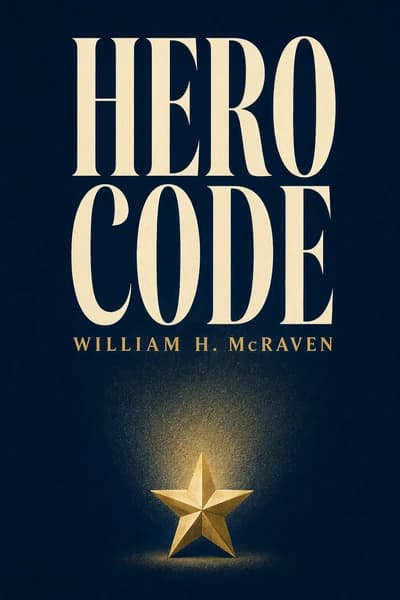
The Hero Within: Lessons from Navy SEAL Admiral McRaven
As a five-year-old living in France in 1960, William H. McRaven fell in love with Superman comics. Without television to distract him, these colorful tales of heroism became his window to a world where ordinary-looking people possessed extraordinary abilities. He'd fashion makeshift capes from towels and leap from furniture, convinced he too could fly. When his family moved to New York City in 1963, young McRaven secretly hoped to spot Superman soaring between skyscrapers in what he now realized was the real-life Metropolis.
One day, he confessed this hope to his father, who pointed to a police officer on the street and said, "Son, that's the man that protects New York City." This simple moment sparked an epiphany that would shape McRaven's life philosophy: ordinary people must save the world. During his subsequent 37-year career as a Navy SEAL, McRaven witnessed both humanity's darkest moments and its most inspiring triumphs. The book has resonated with readers worldwide, becoming a favorite of leaders like Bill Gates and Tim Cook, who cite it as essential reading for anyone seeking to develop character and purpose in an increasingly complex world.
Capitolo 2
Finding Courage in the Face of Fear
In 2008, as commander at Special Operations headquarters, Admiral McRaven established female Cultural Support Teams after recognizing a critical need for women soldiers who could interact with Afghan females during sensitive missions. These positions required exceptional women who possessed not just physical and mental toughness, but the courage to withstand combat stress while standing shoulder-to-shoulder with hardened warriors.
Ashley White exemplified this courage. Incredibly fit yet distinctly feminine, she earned her Combat Action Badge within weeks of arriving in Afghanistan. Night after night, she faced her fears, donned heavy armor, and flew into darkness not knowing if she would return. Her greatest fear wasn't death but disappointing her fellow soldiers. On October 22, 2011, Ashley's remarkable courage cost her her life during a mission.
Combat has a way of wearing down even the strongest spirits. Fear constantly whispers in your ear, playing on your deepest nightmares and insecurities. Yet heroes like Ashley somehow find the inner strength to face those fears repeatedly. They step into the darkness despite knowing the dangers that await.
What's remarkable is that this type of courage isn't limited to warriors on battlefields. It exists in emergency rooms where doctors make split-second decisions, in burning buildings where firefighters rush toward danger, in police officers confronting armed suspects, in parents protecting their children, and in individuals battling internal demons of addiction or depression.
Finding courage doesn't require dramatic circumstances. It begins with a single step forward rather than backward. Think about what frightens you most - public speaking, confronting a difficult colleague, standing up for someone being mistreated, or pursuing a dream you've always considered beyond reach. That first step toward what scares you is the beginning of courage.
What if Ashley White had decided the risks were too great? What if she had chosen comfort over service? Her courage reminds us that heroism often means feeling the fear fully but proceeding anyway. Sometimes courage means simply showing up day after day despite uncertainty and danger.
Have you ever wondered what you might accomplish if fear didn't hold you back? The path to becoming the hero you long to be begins with that first courageous step.
Capitolo 3
The Power of Genuine Humility
During a private dinner at Dr. Kenneth Cooper's Institute in Dallas, I found myself seated next to an older gentleman who introduced himself simply as "Charlie." Throughout our conversation, he mentioned being a former Air Force pilot who now lived in New Braunfels with his wife Dotty. Charlie showed genuine interest in my life and family while revealing remarkably little about himself.
Only after dinner did football legend Roger Staubach inform me that my dinner companion was General Charles Duke - the youngest person ever to walk on the moon. Throughout our entire conversation, Charlie never once mentioned this extraordinary achievement that places him among humanity's greatest explorers.
Charlie's humility wasn't accidental but hard-won. After the Apollo 16 mission, the fame and adulation nearly destroyed his marriage until he and Dotty found renewal through their Christian faith. His humility stemmed from recognizing that even walking on the moon - one of humanity's greatest achievements - pales in comparison to the vastness of creation.
This perspective on humility resonates across all great spiritual traditions. Christianity teaches that "whoever exalts himself will be humbled, and whoever humbles himself will be exalted." Islam emphasizes that "God does not love the arrogant." Judaism instructs followers to "walk humbly with your God." Confucianism, Hinduism, and Buddhism similarly value humility as essential to spiritual growth.
Paradoxically, humility may be simultaneously the simplest heroic quality to assume yet the least frequently expressed. In a world that celebrates self-promotion and personal branding, true humility feels almost countercultural. Yet it brings us closer together, allowing us to appreciate beauty in unexpected places and recognize the value of small acts of kindness.
Consider how differently conversations unfold when we approach others with genuine curiosity rather than waiting for opportunities to showcase our own accomplishments. What might we learn if, like Charlie Duke, we focused more on understanding others than impressing them?
The true power of humility lies in its ability to unite rather than divide people. In a world increasingly fractured by tribalism and polarization, the humble hero recognizes our shared humanity and fundamental interconnectedness. Every authentic hero's role is ultimately to bring people together, not drive them apart.
What might change in your relationships if you approached each interaction with the humility of someone who has walked on the moon yet introduces himself simply as "Charlie"?
Capitolo 4
Sacrifice: Small Acts That Change Lives
I sat silently as retired lieutenant Patrick "Clebe" McClary spoke about his experience in Vietnam. In 1968, on Hill 146 in the Quan Duc Valley, McClary's fifteen-man reconnaissance team came under fierce attack from North Vietnamese forces. During the intense battle, Private First Class Ralph Johnson, a nineteen-year-old Black Marine, made a decision that would echo through decades. When an enemy grenade landed in their position, Johnson didn't hesitate - he threw himself on top of it, sacrificing his life to save his fellow Marines.
This selfless act not only earned Johnson the Medal of Honor posthumously but also transformed countless lives and perspectives during America's racially charged 1960s. Johnson's sacrifice transcended the battlefield, becoming a powerful statement about human dignity and brotherhood during a time when America was deeply divided by race.
Years later in 2018, I attended the commissioning of the USS Ralph Johnson in Charleston, where Senator Tim Scott remarked that Johnson "began a legacy that should last an eternity" by demonstrating that "we are better together." One Marine's split-second decision to give his life for others continues to inspire half a century later.
Yet sacrifice rarely comes in such dramatic moments of valor. For most of us, it manifests in small daily acts of giving that accumulate over time - the single mother working two jobs to provide opportunities for her children, the teacher who stays late helping struggling students, the police officer who spends weekends coaching youth basketball in underserved neighborhoods.
These sacrifices require no adoring crowds or medals, just the quiet knowledge that your actions were noble and necessary. By giving a little of yourself every day - your time, your resources, your attention, your love - sacrifice becomes habit, and habit becomes character.
What makes these small sacrifices heroic isn't their visibility but their consistency. The parent who reads to their child every night despite exhaustion, the neighbor who checks on elderly residents during storms, the friend who consistently shows up during difficult times - these everyday heroes may never receive public recognition, but their impact ripples outward in ways they may never fully witness.
Consider what small sacrifice you might make today. Could you give thirty minutes to mentor someone? Could you donate resources to a cause that matters? Could you listen deeply to someone who needs to be heard? These small acts of giving, performed consistently, create a legacy worthy of admiration and build the heroic character that transforms ordinary lives into extraordinary ones.
Capitolo 5
Integrity: The Foundation of Trust
In the Pentagon, as a young Navy lieutenant, I learned a crucial lesson about integrity from my boss, Captain Ted Grabowsky. During a budget meeting with the intimidating Vice Admiral Joe Metcalf, Grabowsky surprised me by conceding to budget cuts rather than fighting for every dollar as I expected. Afterward, he explained his "Golden Rule" of Pentagon survival: "You must never lie or misrepresent the truth. If you do, you will get caught, and then you are of no value to me anymore."
This lesson revealed something profound - honesty isn't just morally right; it has immense practical value. When people trust you, they entrust you with important responsibilities, resources, reputation, friendship, family, and sometimes even their lives. Even those who disagree with your positions will respect your trustworthiness and integrity.
But integrity requires more than mere honesty; it demands action when faced with ethical dilemmas. Choosing the harder, virtuous path strengthens your character for future challenges, while taking the easy way out leaves you unprepared when greater tests inevitably come. My mother illustrated this through stories like John Adams defending British soldiers after the Boston Massacre - putting justice above self-interest despite intense public outrage.
Being a person of integrity means fighting against the natural human tendency to go along with the crowd, even when standing apart is difficult. It means speaking truth when silence would be easier. It means returning the extra change when the cashier makes a mistake in your favor. It means admitting your errors rather than deflecting blame.
Unlike comic book heroes, we aren't made of steel or cloaked in magical armor. We are human, facing difficult choices where good and evil aren't always clearly defined. You will occasionally fail in your integrity - we all do. When that happens, it should trouble you deeply, cause sleepless nights, and strengthen your resolve never to fail again.
The world will believe in you, follow you, and allow themselves to be influenced by you if they know you to be honest and trustworthy. The path of integrity is often rocky and treacherous, but that's precisely where you'll find true heroes walking.
What decision are you facing today where integrity is being tested? Remember that each choice either strengthens or weakens your character. Small compromises today make larger compromises easier tomorrow. Conversely, standing firm in small matters builds the strength needed for life's greater challenges.
Capitolo 6
Compassion: The Heart of Heroism
During a Commanders' Conference at Bagram Air Base in Afghanistan, our strategic meeting was unexpectedly interrupted by a visitor - actor Gary Sinise. When General Abizaid asked what he needed, Sinise requested a C-130 aircraft to deliver ten pallets of school supplies he had personally purchased for Afghan children. Despite being in an active war zone, Sinise had come personally to ensure these supplies reached children who desperately needed education. Within hours, Abizaid arranged the C-130, and the supplies reached hundreds of Afghan children.
Years later, I encountered Sinise again at Walter Reed hospital, visiting wounded soldiers with gifts and genuine care. Through his foundation and Lt. Dan Band (named after his character in Forrest Gump), he has raised millions for wounded warriors and families of fallen soldiers. What struck me most was how Sinise offered not just material support but sincere friendship with every interaction.
My mother often told me about the North Platte Canteen in Nebraska during World War II. What began with one woman making sandwiches for passing soldiers grew into a town-wide effort that eventually served over six million troops. Throughout my military career, I witnessed countless similar acts of compassion: Red Cross workers aiding earthquake victims, doctors volunteering in remote villages in Yemen, charity groups feeding the hungry in Congo, and neighbors supporting families of fallen heroes.
Science confirms what we intuitively know - that giving generates feelings of well-being and purpose. Compassion isn't just a nice addition to human character; it's embedded in our very nature and essential for society's survival. While some people naturally feel others' pain more acutely, most of us must consciously cultivate kindness as a practice.
The solution is remarkably simple: one dollar for the homeless person you pass on your commute, one hour at a soup kitchen on the weekend, one small act of kindness that strengthens your soul and connects you to humanity. These small acts compound over time, transforming both the giver and receiver.
Think about someone in your life who might be suffering silently - a colleague facing family difficulties, a neighbor dealing with illness, a friend struggling with loneliness. What single act of compassion could you offer today? Perhaps a thoughtful message, a home-cooked meal, or simply your undivided attention. These seemingly small gestures often mean more than we can imagine to those receiving them.
Compassion doesn't require grand gestures or significant resources - just the willingness to see others' suffering and respond with whatever you can offer. In doing so, you'll discover that compassion isn't just something heroes give; it's something that helps create the hero within you.
Capitolo 7
Perseverance: The Power of Not Quitting
Dr. Jim Allison, with his rumpled lab coat and Einstein-like appearance, continued his cancer research journey at Berkeley in 1985. There, he made a groundbreaking discovery - T-cells had receptors that acted as "braking mechanisms" when connected to healthy cells, while cancer cells exploited this by tricking the immune system. Allison theorized that blocking this mechanism with antibodies could allow T-cells to identify and destroy cancer cells.
In 1995, his experiment with mice initially appeared to fail when tumors grew larger, but just two days later, almost all tumors had vanished - results considered impossible by his stunned colleagues. Yet for the next fifteen years, Allison faced constant rejection from the research community and pharmaceutical companies who dismissed his work as "voodoo." Despite being told "no" everywhere he went, his obsessive perseverance eventually paid off when Bristol Myers Squibb agreed to fund human trials.
One early trial subject, a 23-year-old woman with metastatic melanoma that had spread to her liver and brain, had failed three different forms of chemotherapy. Within days of receiving Allison's drug, she began feeling better, and within a week her brain tumor had completely vanished. Fourteen years later, she remains cancer-free.
In 2011, the FDA approved his drug ipilimumab, which has since helped hundreds of thousands of cancer patients. In 2018, he received the Nobel Prize in Medicine - proof that perseverance, not just talent or intellect, makes the difference between success and failure.
The key to perseverance is taking each challenge as it comes. In SEAL training, we have a simple philosophy: don't quit. We say "Take it one evolution at a time," focusing on individual events rather than becoming overwhelmed by the entirety of what lies ahead. Those who look too far into the future often fear they cannot endure, but clearing one hurdle at a time eventually leads to completion.
Whatever challenges you're facing - whether in your career, relationships, health, or personal goals - remember that these are the same obstacles billions of humans have faced throughout history. Those who conquered them share one essential trait: they never gave up. Neither should you.
What goal have you abandoned because the path seemed too difficult? What dream have you deferred because progress was slower than expected? Consider reframing your approach to focus on the next small step rather than the distant finish line. Perseverance isn't about having superhuman strength; it's about continuing to move forward even when progress seems imperceptible.
Capitolo 8
Duty: The Quiet Commitment to Service
Meeting Senator John McCain was humbling. As I waited in his office before my confirmation hearing for four-star admiral, I couldn't help but study the memorabilia surrounding me - photos with world leaders, newspaper articles, and a picture of young Lieutenant Commander McCain tucked behind his desk. This wasn't just a senator; this was an American hero who embodied duty to country.
McCain came from a distinguished Navy family - son and grandson of four-star admirals. In 1967, he survived the USS Forrestal fire that killed 134 sailors, showing valor by trying to rescue a fellow aviator despite his own injuries. Later that year, on his 23rd bombing run over Hanoi, his plane was shot down. The ejection broke both arms and fractured his leg. Captured and taken to the "Hanoi Hilton," he endured months of torture and little medical treatment.
When the North Vietnamese discovered his father's rank, they offered him early release as propaganda. Despite his terrible suffering, McCain refused repatriation, honoring the military Code of Conduct that states, "I will accept neither parole nor special favors from the enemy." His refusal inspired fellow POWs but enraged his captors, who tortured him weekly for another year. After five long years, he was finally released in 1973.
Yet doing your duty need not require such extraordinary sacrifice. Racing to meet the President with minutes to spare, I was stopped at an airfield gate by a young female airman who refused to let our convoy through without proper authorization. Despite my three stars, my security officer's demands, and my own pleas about briefing the President, Airman Jackson stood firm, shaking but resolute: "I have my job to do as well."
Only after receiving proper clearance did she allow us through. Though I was ten minutes late to brief President Obama, I later awarded her my Command Challenge Coin for doing exactly what she was supposed to do - performing her duty regardless of rank or circumstance.
Throughout my career, I witnessed countless Americans performing their duty under every condition - from administrative clerks processing veterans' benefits to nurses refusing to abandon patients during rocket attacks. Duty means doing your job not for self-interest, but because it serves others.
Consider your own duties - to family, community, workplace, or country. How might approaching these responsibilities not as burdens but as opportunities for service change your perspective? The hero's path often lies not in seeking extraordinary adventures but in fulfilling ordinary obligations with extraordinary commitment.
Capitolo 9
Hope: The Light in Darkness
Hope is the strongest force in the universe - with it you can endure anything; without it, you're destined for fear and despair. I discovered this truth personally when diagnosed with chronic lymphocytic leukemia while serving in Afghanistan. Initially given a grim prognosis requiring immediate spleen removal and career-ending chemotherapy, my wife and I sought a second opinion from Dr. Michael Keating at MD Anderson.
The boisterous Australian burst into the consultation room with unexpected optimism, declaring "He's going to be fine" and outlining new treatment options. His hopeful approach transformed my outlook, allowing me to return to duty and eventually lead the mission that brought justice to Osama bin Laden. Though I eventually needed treatment years later, that initial gift of hope carried me through some of my most important work.
During the Vietnam War, American POWs endured barbaric treatment by North Vietnamese captors. In 1970, Army Green Berets conducted a rescue operation at Son Tay camp after intelligence revealed over sixty Americans were being brutally treated there. Despite killing forty-two enemy soldiers in an intense firefight, they discovered the POWs had been moved months earlier due to contaminated water.
What seemed like a complete failure revealed its true impact years later when POWs were finally released. At a 1973 reunion hosted by Ross Perot, former prisoners told the Raiders how much the mission meant: "We knew we hadn't been forgotten," "The raid did so very much for our morale," "The Raiders gave us hope." That hope sustained them through their darkest hours.
Hope isn't merely wishful thinking - it's the profound belief that tomorrow can be better than today. It's what allows cancer patients to endure grueling treatments, refugees to rebuild lives in strange lands, entrepreneurs to persist after failures, and communities to rebuild after disasters.
To bring hope to others, we must first cultivate it within ourselves, then share our unique talents generously. Sometimes hope comes through medical breakthroughs like Dr. Keating's treatments. Sometimes it comes through daring rescue attempts like the Son Tay raid. Often, it comes through simple human connection - a hand held during grief, encouragement during doubt, or presence during loneliness.
What source of hope has sustained you through difficult times? How might you become a beacon of hope for someone facing darkness today? Remember that offering hope doesn't require solving all problems - sometimes it simply means helping others believe that solutions are possible.
Capitolo 10
Humor: The Shield and Sword
Humor serves as one of the most powerful tools for heroes, helping them face adversity with grace and build camaraderie with others. In the SEAL Teams, humor keeps everyone humble and strengthens bonds between teammates. Whether through daily roastings on the Grinder at UDT-11, good-natured pranks, or the ability to laugh at embarrassing situations, humor provides perspective and resilience.
At UDT-11 in Coronado, California during the late 1970s, new SEALs learned crucial lessons on "the Grinder," a rough patch of asphalt where daily physical training occurred. As a young ensign fresh from training, I faced merciless teasing from Vietnam veterans about everything from my university education to my dating preferences. When I finally responded with humor to a chief petty officer's height-related jab, the entire team burst into laughter - I had passed the test by showing I could take a joke.
These daily roastings served multiple purposes: they kept everyone humble, put failures in perspective, and sharpened wit without causing true offense. The culture of pranks and jokes taught valuable lessons about humility and team morale. Those who handled jokes well earned respect; those who sought petty revenge lost the locker room's respect.
Even wounded warriors use humor as both shield and sword - protecting themselves from despair while striking back at adversity. During memorial services for fallen comrades, stories of pranks and laughter help celebrate lives well-lived despite tragic endings.
Abraham Lincoln, carrying the immense burden of the Civil War, understood humor's power. He used it to soften defeat, assuage anger, mollify feuding generals, and boost morale during America's darkest hours. His ability to find moments of levity amid national tragedy helped preserve his sanity and the nation's spirit.
Great leaders understand that humor helps us show courage by laughing in the face of danger, demonstrate humility by laughing at ourselves, and provide comfort to others in dark times. It creates human connection where tension might otherwise prevail and offers perspective when problems seem overwhelming.
When was the last time you laughed at yourself? How might humor help you navigate a current challenge? Consider how developing your sense of humor might not only make difficult situations more bearable but also strengthen your connections with others. The hero who can laugh, especially at themselves, possesses a special kind of strength that hardship cannot easily break.
Capitolo 11
Forgiveness: Freedom from Hatred's Burden
When facing the Afghan father whose family members were killed by American soldiers, I learned the profound power of forgiveness. The father's ability to say "We will not keep anything in our heart against you" lifted a burden not just from me, but from him as well. As General Salam had explained, forgiveness in Islam is a gift both to those who receive it and those who give it, freeing them from the burden of hatred.
The families of victims in the Emanuel AME Church shooting demonstrated similar strength when they forgave Dylann Roof, refusing to become "accomplices" to his hatred. Their forgiveness didn't diminish the horror of his crime but prevented that horror from consuming their own spirits with bitterness.
Forgiveness doesn't require pardoning the unpardonable - it means refusing to let another's actions poison your spirit. It's easier to storm a hill or fight a fire than to truly forgive, but forgiveness strengthens character immeasurably and frees us from consuming hatred.
After 37 years in the Navy, I worried I'd never again find people with the character of my military colleagues. But I discovered heroes everywhere - in classrooms, hospitals, police forces, farms, government, and homes across America. The Hero Code isn't reserved for extraordinary individuals. Most heroes begin as ordinary people whose character was shaped over time by parents, teachers, coaches, and friends.
What distinguishes them is learning courage, humility, sacrifice, integrity, compassion, perseverance, duty, hope, humor, and forgiveness. Heroes make us better people, a better society, and a better world. Though Superman isn't coming to save us, each of us can live the Hero Code and become the heroes our world needs.
Is there someone you need to forgive? Not for their benefit, but for your own freedom? Consider what burden you might set down by choosing forgiveness over resentment. Remember that forgiveness doesn't mean forgetting or excusing harmful actions - it means refusing to allow those actions to determine your future.
The Hero Code teaches: No matter the offense, try to forgive. Be the victor, not the victim. In choosing forgiveness, you reclaim your power and join the ranks of everyday heroes who understand that true strength lies not in holding grudges but in letting them go.