Capitolo 1
When Passion Meets Peril: The Entrepreneur's Guide to Survival
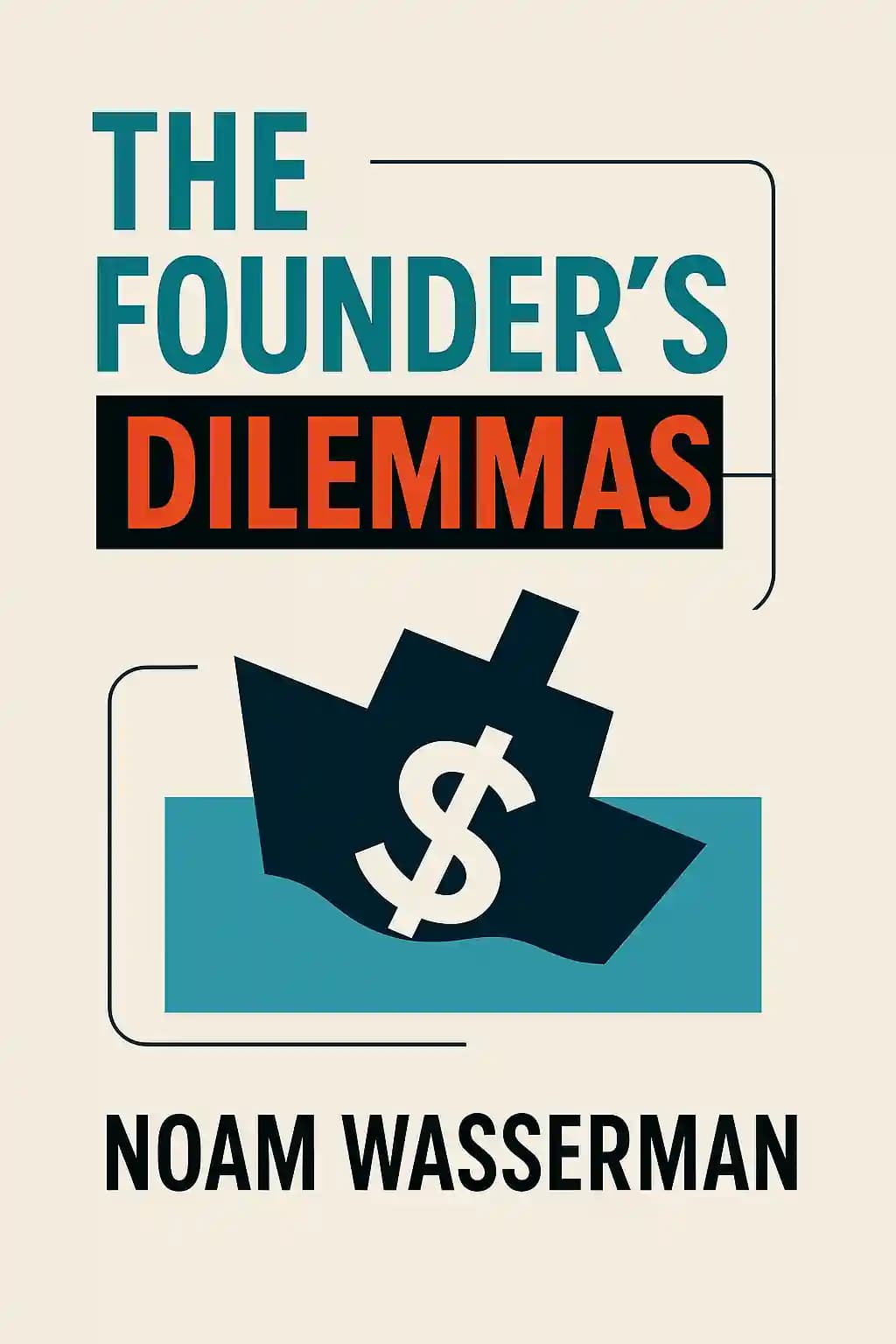
Ever wondered why so many startups fail despite brilliant ideas and passionate founders? The surprising truth is that most casualties come from "friendly fire" - internal conflicts and decisions rather than external market forces. In Noam Wasserman's groundbreaking book, based on a decade of research with nearly 10,000 founders, we discover that 65% of startup failures stem from management team issues. This isn't just another business book - it's been hailed as essential reading by tech titans like Mark Zuckerberg and Reid Hoffman, who wish they'd read it before launching their ventures. Drawing from extensive data and compelling case studies including Twitter's Evan Williams and FeedBurner's Dick Costolo, Wasserman reveals the predictable patterns behind seemingly chaotic entrepreneurial journeys, showing how early decisions create ripple effects that can make or break your startup years later.
Capitolo 2
The Career Dilemma: When to Take the Entrepreneurial Leap
The entrepreneurial journey begins with a deceptively simple question: should I become a founder? While passion drives all entrepreneurs, the decision involves complex calculations about timing, preparation, and personal circumstances. The data shows no perfect "sweet spot" for founding age - technology founders averaged 13.1 years of prior work experience while life sciences founders averaged 15.9 years, with 35% of all founders having worked 20+ years before making the leap.
Family and cultural influences profoundly shape entrepreneurial inclinations. Consider the contrast between Humphrey Chen, whose Taiwanese family viewed entrepreneurship as inferior to professional careers, and Barry Nalls, who grew up immersed in entrepreneurship through his father's gas stations, grandfather's antique business, and uncle's bulldozer company. These early messages often prove more influential than personality traits like risk tolerance.
Motivational patterns also distinguish entrepreneurs from non-entrepreneurs. Data from 27,000 CareerLeader surveys reveals that entrepreneurs prioritize control-related motivations (power, autonomy) and financial gain - precisely opposite to non-entrepreneurs. These motivational patterns remain remarkably stable throughout entrepreneurs' lives, while non-entrepreneurs' motivations shift more over time.
The timing dilemma presents competing considerations. Waiting allows potential founders to build three critical forms of capital: human capital (skills, knowledge, industry expertise), social capital (networks), and financial capital (savings, assets). Barry Nalls leveraged 25 years of telecom experience to build Masergy, knowing exactly what enterprise clients wanted. In contrast, Vivek Khuller's online ticketing venture suffered from his lack of venue industry knowledge: "We were engineers who had never worked in this area... I've never entered Madison Square Garden in my life."
However, waiting too long carries significant risks. Studies show startups survive longest when founded by people with midrange experience (around 25 years), with longer experience actually increasing failure rates. Working longer strengthens "career handcuffs" - psychological attachments to status, "golden handcuffs" of high salaries, and legal constraints like non-compete agreements. Family obligations also tighten as potential founders age, though having a working spouse provides financial security (research shows 70% of high-growth founders were married and 60% had children when starting).
Certain developments can release these handcuffs and trigger founding decisions: employers' slowing growth, changes in company strategy, employment shocks like layoffs, financial windfalls, or family developments like children starting school (which freed Robin Chase to start Zipcar).
When evaluating business ideas, founders must fight against their natural overconfidence. Studies show 95% of entrepreneurs believe their startups have better than 50% chance of succeeding, with one-third believing in 100% success. This optimism is double-edged: it sparks innovation and faster action but leads to unrealistic projections and resource miscalculations. The ideal scenario occurs when career experience, personal circumstances, and market conditions all align favorably - though this perfect alignment rarely happens.
Capitolo 3
The Solo-Founder Paradox: Why Teams Usually Win
After deciding to launch, founders face their first major structural decision: go solo or build a team? The data is striking - in high-potential startups, only 16.1% were solo-founded, with over one-third having two founders and one-quarter having three founders. This pattern exists for good reason.
Some founders choose to go solo when they already possess necessary resources, face little pressure for rapid growth, or desire complete control. Barry Nalls exemplifies the successful solo founder - after 25 years at GTE gaining management experience and industry knowledge, he founded Masergy with confidence in his broad skill set and industry contacts, explaining: "I've always figured things out myself" and "leadership is all about taking in information and making a decision-shared information but not shared decisions."
However, most founders in technology and life sciences choose founding teams because cofounders provide crucial human capital (skills and knowledge), social capital (networks and contacts), and financial capital (money and resources). Tim Westergren exemplifies this approach with Pandora Radio - despite his music expertise, he recognized his lack of technology and business knowledge and refused to proceed until finding cofounders who could fill these gaps.
After deciding to add cofounders, determining the optimal number becomes critical. Each additional cofounder increases coordination costs, communication complexity, and potential role conflicts. As one serial entrepreneur noted, "Complexity increases exponentially with more cofounders." Michael Reich's experience with UpDown illustrates this problem - he added MBA classmates with similar skills to his own, then still needed to bring in a programmer, creating unnecessary role conflicts and equity complications.
Industry and competitive environment significantly influence the solo-versus-team decision. Industries that are highly competitive or favor first movers create a "ticking clock" that increases the need for cofounders. Similarly, complex environments demand larger founding teams because they need to process more information. Research shows larger founding teams have higher organizational growth rates and survival rates in turbulent environments.
The "founder" designation itself can be subjective and symbolic. Some people considered founders join months after inception. One founder-CEO explained he used the "founder" title symbolically for key early functional leaders, even employee number ten, as a way to enhance job offers without giving up scarce equity or cash. However, this practice carries risks when early "jungle stage" employees prove ineffective during later phases, as removing someone with the founder title can deeply impact company culture.
Excessive optimism blinds many founders to their startup's critical needs, making it essential to vigilantly identify gaps in skills, knowledge, and contacts. While immediate needs don't necessarily require cofounders - outsourcing, advisors, or partnerships might suffice - these alternatives often fall short. The decision to bring on cofounders immediately adds complexity and creates future dilemmas across three categories - relationships, roles, and rewards - which form the focus of subsequent chapters.
Capitolo 4
Playing with Fire: The Hidden Dangers of Founding with Friends and Family
Once founders decide to build a team, they face crucial decisions about whom to choose as cofounders. Core founders can find cofounders in three concentric circles: direct contacts (existing relationships from friends to spouses), indirect networking (mutual acquaintances), or impersonal searches (strangers with specific traits). Evan Williams illustrates the range of options and consequences: his first startup with family and friends became "a train wreck management-wise," his second with a girlfriend also failed, leading him to choose a mere acquaintance with relevant experience for his third venture, Odeo.
People naturally exhibit "homophily" - birds of a feather flocking together. Sociologists have shown that small business founding teams disproportionately consist of people with similar gender, race, geographic origins, education, and functional experience. All-male or all-female teams are five times more likely than chance would predict, while ethnically homogeneous teams occur 27-46 times more frequently.
Homogeneity offers important immediate benefits, particularly speed. Finding cofounders similar to yourself is quicker and easier, and developing effective working relationships happens faster when founders share backgrounds and common language. Similar founders can skip part of the learning curve, more easily build trust, and construct clearer organizational identity boundaries.
However, despite the temptation to choose similar cofounders for comfort and ease, homogeneous teams create long-term problems with redundant strengths and missing critical skills. Teams with homogeneous functional experience are actually less stable than heterogeneous ones. To build valuable startups, founders must fight their homophilic tendencies by taking a structured approach to defining needs, assessing gaps, and seeking diverse skills.
While it's relatively easy to assess a potential cofounder's skills and background from their resume, the "soft factors" - risk tolerance, personality, time horizon, commitment level, and value system - are harder to evaluate but equally crucial. These intangibles typically require extensive time to assess, often through frank conversations with previous colleagues and "trying before buying" - working together on preliminary projects before fully committing.
Despite their popularity, founding teams composed of friends and family ("relational teams") face significant hazards. Data shows that 40% of founding teams include cofounders with prior social relationships without professional history, while 17.3% include family members. These teams form due to ease of access, speed of formation, comfort level, and emotional support during stressful startup periods. However, research reveals that prior social relationships actually increase the likelihood of cofounder departure by 28.6% - even higher than teams of strangers. Teams of prior coworkers prove significantly more stable than both social relationships and stranger teams.
The "Playing-with-Fire Gap" represents the distance between potential relationship damage and likelihood of addressing difficult issues. This gap is greatest for cofounders with prior social relationships - they face the most damage if relationships deteriorate yet are least likely to address problems that cause tension. As Chinese entrepreneur Bei Guo observed, "Because they are your most trusted friends, you can be almost 99% open with them. But somehow there is 1% out there you think you will risk hurting them if you say it. It is exactly this 1% that makes all the difference."
Some founding teams take deliberate steps to reduce this gap. Sittercity's Genevieve Thiers and her boyfriend Dan Ratner created a "Geneva Convention" requiring them to write up disagreements and copy the executive team, forcing objective focus on issues rather than each other. They also established firewalls with a "Disaster Plan" specifying Dan would leave if irreconcilable disagreements arose, and delayed his full-time involvement until clearly needed.
Capitolo 5
The Power Struggle: Navigating Titles, Roles, and Decision-Making
Evan Williams's experiences at Blogger and Odeo illustrate the challenges of role definition in startups. At Blogger, despite clear titles, equal decision-making power led to gridlock between Evan and Meg over company direction, ultimately forcing layoffs and Meg's departure. After selling Blogger to Google for $10 million, Evan co-founded Odeo with Noah Glass, establishing clear initial roles but facing another power struggle when Evan committed full-time.
Despite founders often claiming "I don't care about my official title," the jockeying for CEO positions reveals how seriously they take executive titles. Titles carry symbolic significance and translate into real authority, making title negotiations among the toughest early decisions for cofounders. Research shows idea people are significantly more likely to become CEOs (47% versus 12% for non-idea founders) and less likely to receive lower-level titles.
Title assignment is easier when founders have complementary skills, as with Apple's Jobs and Wozniak - one building the product, the other building the company. Founders with similar backgrounds tend to adopt overlapping roles, which can be advantageous during early cash-poor stages requiring flexibility. The Smartix team exemplifies this approach, with three similarly-skilled MBA students working without clear separation of tasks. Conversely, Pandora Radio adopted a clear division of labor, with Jon Kraft (business), Will Glaser (engineering), and Tim Westergren (music industry) each having complete control over their domains.
Founding teams must balance dynamism with clarity when deciding how to make major decisions. Two contrasting approaches emerge: egalitarian (consensus-based) and hierarchical (autocratic). Research suggests dominant CEOs in high-tech environments may be less successful, with one study showing CEO dominance associated with a 19% decrease in firm performance. While consensus-building improves decision quality, it's often too slow for fast-moving startups in "high-velocity" environments. Most veteran entrepreneurs warn against egalitarian approaches, yet most founding teams choose them initially, often necessitating painful transitions to hierarchy as the company grows.
Two-person founding teams face different challenges than trios. Larger teams have more cognitive conflict and communication challenges, but complementary duos with clear domains can align more easily. The Lynx Solutions case illustrates how a trio's dynamics changed when they became a duo. Initially, their "triumvirate" allowed two members to agree while the third would concede. When the remaining duo found decision-making "exhausting," debating endlessly to reach consensus, their constant discord eventually forced one to give the other day-to-day control. As one founder put it, "Two people at the wheel is the worst way to drive. You end up going straight when either a right or a left would be better."
Founders' motivations - whether control-focused or wealth-focused - significantly impact role assignments. A team with two control-motivated founders tends to be unstable, as both will want to be CEO and have final decision-making authority. Blogger's early struggles stemmed from cofounders Evan Williams and Meg Hourihan both wanting control but in different directions. Two wealth-motivated founders typically align better, focusing on arrangements that build the greatest value regardless of control implications, as seen at FeedBurner.
Capitolo 6
The Equity Equation: Splitting Ownership Without Splitting the Team
Splitting ownership in a startup is often more contentious than dividing roles and titles, with potentially more dramatic implications. For many founders, the primary financial motivation is equity upside rather than salary, which is typically lower than what they could earn elsewhere. Unfortunately, many natural inclinations about equity splits prove counterproductive in the long run, even when they initially seem fair and peaceful.
Founders face a critical timing decision: 73% split equity within a month of founding, despite major uncertainties about each founder's potential contributions. Early splits create powerful psychological "anchors" that become difficult to renegotiate, as UpDown's founders discovered. Waiting allows teams to learn whose skills truly contribute most, how well founders work together, and each person's commitment level. However, delaying carries risks too: potential cofounders may be lost without equity offers, and negotiations become more fraught once financing and valuation enter the picture.
While equity splits are ultimately subject to negotiation between founders, four key criteria emerge from research that can help craft sustainable agreements: past contributions, opportunity cost, future contributions, and founder motivations.
Research shows idea people typically receive a statistically significant "idea premium" of 10-15 percentage points more equity than non-idea founders. While some argue "ideas are cheap; execution is dear," many founders view idea contribution as deserving special recognition. Teams that don't award at least a small idea premium risk creating resentment that grows over time, introducing friction within the team.
About 59% of founders contribute some capital to their startups, with most contributing between $1 and $25,000, though 11% contribute over $100,000. Research confirms that greater capital contribution correlates with larger equity stakes. At Ockham, equity was determined solely by capital contribution, with Jim (50%), Mike (30%), and Ken (20%) receiving stakes proportional to their investments.
Founders with high opportunity costs often require greater incentives to join startups. Some founders are unemployed when joining a team, while others hold secure, high-level positions they're reluctant to leave. For the latter group, teams must make the startup opportunity more attractive through senior titles, central roles, or larger equity stakes. At Smartix, Vivek Khuller gave Saurabh Mittal the second-largest equity stake (27% versus Vivek's 35%) primarily to lure him away from two other promising startup opportunities.
Despite the improbability of founders making exactly equal contributions, 33% of teams in the dataset split equity equally. Research by Wasserman and Hellmann explored this phenomenon, examining whether teams with more similar backgrounds and contributions tend toward equal splits. They found evidence for a "threshold of intrateam difference" that separates equal-split from unequal-split teams. When cofounders differ significantly in value contribution, teams engage in equity negotiations despite the tension. Below this threshold, teams often opt for equal splits, avoiding friction that could harm the venture.
Setting early equity splits in stone without allowing for changes is one of founders' biggest mistakes. Founders typically plan for best-case scenarios, assuming their early high commitment levels will persist, no adverse events will change team composition, early-stage tasks reflect future responsibilities, and their skills will remain equally valuable. They overestimate early value creation compared to future contributions, and each founder values their own contributions more than others'.
Dynamic equity agreements can use various approaches like buyout terms and vesting schedules to handle startup uncertainties. Drawing on former Defense Secretary Donald Rumsfeld's famous categorization, these uncertainties can be classified as "knowns" (outcomes already known), "known-unknowns" (anticipated scenarios with uncertain outcomes), and "unknown-unknowns" (complete surprises). These three types of uncertainty can be addressed through terms, contingencies, and trust, respectively.
Vesting is the most common dynamic equity agreement, requiring founders to earn their equity over time or by achieving milestones rather than owning it immediately. This creates "golden handcuffs" that incentivize continued contribution or protect remaining founders if someone leaves. Despite these benefits, founding teams often resist vesting until investors force it upon them, fearing it signals distrust.
Capitolo 7
The Three Rs System: Creating Sustainable Founding Teams
Unlike independent test answers, founding team decisions must align to achieve successful outcomes. Decisions about relationships, roles, and rewards work in concert or against each other in the struggle for growth and control. Misalignment of these Three Rs brings tension at best and team disintegration at worst. There's no universal perfect alignment - what works for one team won't work for another. For instance, Ockham's hierarchical structure (Jim as CEO with 50% equity, Mike as VP with 30%) aligned with their prior boss-subordinate relationship, while UpDown's equal equity split and overlapping roles better suited their team of new acquaintances.
Prior relationships create expectations that influence role structures within startups. Data shows teams must carefully align their relationship types with appropriate role structures to avoid tension. When founding with friends or family, teams are 8% less likely to name a CEO, preferring egalitarian structures that mirror their social peer relationships. Research from Stanford's Project on Emerging Companies found that while 30% of all startups used a "commitment" model emphasizing cultural fit and universal decision buy-in, five-sixths of startups with family/friend partners adopted this approach.
Teams of prior coworkers typically find hierarchical structures more natural, especially when one founder previously supervised the other. Ockham Technologies initially aligned their roles with their prior relationship (Jim as CEO, Mike as VP), but tension arose when Jim included Mike in most decisions, creating misalignment between official roles and actual practice.
Prior relationships strongly influence equity splits. Family relationships tend to raise the threshold for equal splits - teams with family members are more likely to split equity equally regardless of contribution differences. Equity theory explains this by distinguishing between social logic (preserving relationships over maximizing business success) and business logic (prioritizing business success over relationships). Teams operating under social logic prefer equal distribution regardless of contribution differences, while teams under business logic (former coworkers or strangers) prefer equitable distribution proportional to contributions. Research shows teams with prior social relationships are more stable with equal splits, while teams with professional relationships are more stable with equitable splits.
Role structure significantly impacts equity splits. Overlapping, non-distinct roles make it harder to determine individual value contributions, often leading to equal splits. Conversely, clear hierarchical roles typically result in unequal splits, with CEOs receiving a "CEO premium" of 14-20 percentage points more equity. CTOs receive a smaller but significant premium of 5-8 percentage points. However, in 28% of startups, a non-CEO founder holds the largest equity stake, suggesting conscious trade-offs between roles and rewards to align with individual priorities.
Even when teams achieve "Three Rs equilibrium" with aligned relationships, roles, and rewards, three challenges make maintaining this balance difficult. First, communication issues arise as founders avoid discussing sensitive topics - the "elephants in the room" - even when frustrations build. Second, startups constantly face unexpected changes requiring adaptation or pre-established dynamic agreements. Third, inertia from early success can prevent necessary adjustments as the environment evolves. The UpDown team exemplifies these challenges, renegotiating their equity structure three times in one year as Michael's contributions exceeded others' and visa issues affected Georg's participation.
Capitolo 8
Beyond the Founding Team: Building Your Organization and Attracting Capital
Even the most adept founders who have successfully assembled a founding team can find subsequent hiring decisions difficult and dangerous. Founders bring their preferences to these decisions but often fail to appreciate how growth will force them to realign their organizations. Decisions that seem ideal initially can prove disastrous as employees struggle to scale with the maturing startup.
Where startups find their senior executives and whether those hires have strong ties to the founder-CEO significantly impacts the organization. Founder-CEOs are the source of 49% of all C-level and VP-level hires, providing benefits of comfort and coherent organizations. High-potential startups that relied heavily on founders' personal networks received 37% higher valuations than those that barely tapped founders' networks.
While hiring friends and family offers comfort and cultural fit, it creates the same "playing-with-fire" risk seen in founding teams. These relationships complicate difficult business decisions like layoffs or performance management. As Tim Westergren of Pandora discovered, having to choose between friendship and company interests creates "Sophie's Choice" situations with no winning answer.
When deciding whom to hire for new or upgraded positions, founders face two major trade-offs that shift as the startup matures: hiring generalists versus specialists and hiring inexperienced versus experienced people. Early-stage startups typically need flexible generalists who can adapt to changing needs as the business model and product evolve. Dick Costolo of FeedBurner valued the "option value" of being able to move employees between functions - five of their first 20 employees eventually moved into completely different positions. However, as startups resolve uncertainties and formalize processes, specialists become more valuable than generalists.
People from large companies often struggle in startups, bringing habits that prove counterproductive in entrepreneurial settings. Frank Addante hired a VP of sales from Oracle and IBM who "talked a good game" but couldn't create something from nothing: "It's like if you have a crank, he can crank, but he can't actually build the crank." Similarly, Barry Nalls discovered that managers from larger companies often lack individual contributor skills essential in startups: "In an early-stage company, there's no such thing as a manager. Everyone is a contributor, including the CEO!"
Many founders initially self-fund their startups to maintain control and avoid investor management. In 77% of founding teams in the dataset, at least one founder contributed seed capital early on. However, with median monthly burn rates of $75,000 and most startups only having four months of runway, self-funding quickly becomes unsustainable.
When founders take VC money, they sacrifice two major rights: economic ownership and control. With each financing round, founders sell more equity, steadily decreasing their ownership percentage. After the C-round, VCs typically own 53% of a startup (up from 46% after the B-round), while founder and employee ownership plummets from 41% after the A-round to less than 20% after the D-round.
Beyond simple equity percentages, liquidation preferences dramatically affect founder economics, particularly in smaller exits. These provisions dictate that VCs receive their investment back (or a multiple of it) before founders see any proceeds. In 78% of first-round financings, startups agreed to "1x" preferences, meaning investors would receive all proceeds from any exit up to their investment amount. More drastically, 22% of startups accepted even higher multiples, meaning founders would receive nothing unless the company sold for multiple times the invested capital.
Capitolo 9
The Paradox of Success: Why Successful Founders Often Lose Their Jobs
Founder-CEO succession represents one of the most critical points in a startup's life. While some founders like Evan Williams orchestrate their own successions, for many others it comes as a shock. By the third round of financing, over half of startups have replaced their founder-CEOs, with 17% having replaced CEOs multiple times.
Lew Cirne's story illustrates this pattern. Despite methodically preparing for entrepreneurship through roles at Apple and Hummingbird, founding Wily Technology solo, making personal sacrifices for the company, and successfully hitting early milestones, Lew was shocked when investors insisted he step down as CEO during the third financing round. His potential replacement even demanded Lew relinquish his board chairmanship, leaving him with the dilemma of either refusing to hire the professional who could build Wily's value or being completely sidelined from his own creation.
The paradox of entrepreneurial success explains why successful founders like Lew Cirne get fired despite strong performance. Two types of success - product development and fundraising - trigger internal changes that put founders at risk. Quantitative analysis shows that founders' chances of being replaced rise significantly after completing these milestones.
When startups complete product development, they face dramatically different challenges. The organization must add new functions like sales and marketing, requiring the CEO to manage multiple unfamiliar departments. Technical founders often lack the financial sophistication and management skills needed for this stage. Additionally, founders' values can become liabilities - their loyalty to early employees prevents necessary personnel changes, as seen when Mike Brody couldn't replace his underperforming brother as CFO.
Successful fundraising fundamentally shifts power within startups. With each financing round, founders lose board control to outside investors who prioritize shareholder value. These new board members often believe a professional CEO is needed for the next growth stage. For Lew Cirne, the VCs' demand for his replacement coincided with Wily's third financing round. After starting with supportive angel investors, each VC round added board members until they could insist he step down.
As startups celebrate milestones, they rarely realize they're approaching the day their founder-CEO will be replaced. Some founders understand this paradox, creating perverse incentives: "If the company tanks, I'm gone. But if it's a big hit, I'm also gone." Data confirms that founder-CEO departures are most common at very low or very high growth rates, with middling growth offering the best chance of retention.
Unlike large companies where 81% of new CEOs come from inside the organization, startup successors almost always come from outside. This happens because the new CEO typically needs to make major changes to culture, strategy, or team that insiders either cannot do (lacking skills or knowledge) or would not do (due to attachment to the founder's vision).
Founder-CEOs are typically unprepared for the dramatic shift that succession brings. As professional CEO Les Trachtman observed, "The founder-CEO says, 'Okay, I'm ready for this,' but they don't have a clue what it means. They think it's a title change, not the tidal change it really is." Even when founders initiate the succession, transitions can be rocky. At Transcentive, despite Mike Brody supporting Les taking over, Mike struggled to let go of decision-making, and his board position signaled to employees he was still in charge: "It was still, 'Mike, may I?' - which dis-empowered me a bit."
Capitolo 10
The Ultimate Dilemma: Wealth vs. Control
The entrepreneurial journey involves navigating dilemma after dilemma, with decisions that have significant short and long-term consequences. From choosing whether to go solo or build a team, to determining relationships, roles, and rewards for cofounders and hires, to selecting investors - each decision shapes the startup's trajectory. These outcomes reflect a fundamental "wealth versus control" dilemma that underlies all others.
The wealth-versus-control dilemma pits the two most common entrepreneurial motivations against each other. Most founders start with passion and confidence, expecting to both build a valuable startup and run it throughout its life - like Bill Gates or Anita Roddick. However, few can maximize both goals because actions that maximize one inherently hinder the other. Entrepreneurship involves pursuing opportunities "without regard to resources currently controlled," but this creates a fundamental challenge: founders are 60 times more likely to be resource-constrained than to have all necessary resources. Yet fully pursuing opportunities requires human, social, and financial resources. Attracting these resources means giving up valuable assets - specifically economic ownership and decision-making control.
At each decision point, maximizing value tends to threaten the founder's control, and vice versa. This creates an inherent conflict because building value requires attracting value-added players who demand some control. Founders who prioritize control consistently make decisions that maintain their authority - remaining solo founders or choosing non-threatening cofounders, hiring inexperienced people they can direct, self-funding or raising capital only from non-interfering investors, and remaining CEO throughout all stages. Conversely, founders who prioritize wealth consistently make decisions that build value - attracting complementary cofounders, hiring experienced domain experts, raising money from value-adding investors, and stepping aside when someone else could better lead the company's next stage.
Quantitative analyses show that founders who maintain control of both the CEO position and board hold equity stakes only 52% as valuable as those who relinquished both positions. This wealth-versus-control trade-off persists throughout all startup stages. Few founders - especially first-timers - can achieve both maximum control and maximum value creation.
Evan Williams made starkly different choices at his two startups. At Blogger, he consistently made control-oriented decisions: founding with an inexperienced girlfriend, hiring young friends at low salaries, refusing to split equity equally with his cofounder, avoiding professional investors, maintaining an advisory-only board, refusing to relinquish the CEO position (causing his cofounder to leave), and declining acquisition offers that threatened his control. These decisions left him with full control but of a company that sold for far less than its potential warranted.
At Odeo, Evan made wealth-oriented decisions: founding with an experienced business acquaintance who became CEO with the majority of equity, raising $5 million from a venerable VC firm, hiring experienced executives, and accepting a board dominated by investors. When Odeo's prospects dimmed and the team created Twitter, Evan made the unprecedented move of buying out his investors for $3 million to regain control. As Twitter grew explosively, he replaced Jack Dorsey as CEO but eventually recognized his own limitations and hired Dick Costolo, first as COO and later as his successor as CEO.
While luck plays a significant role in achieving both wealth and control, founders can take specific actions to increase their chances of reaching this entrepreneurial ideal. Founders who begin with more resources have higher probability of achieving both wealth and control. Barry Nalls exemplifies how pre-founding preparation can position founders for success. Potential founders should save aggressively, maintaining a low "personal burn rate" even with comfortable corporate salaries to accumulate seed and growth capital. Such founders enjoy greater bargaining power with resource providers.
Serial entrepreneurs often approach the entrepreneurial ideal in later ventures after learning from earlier startups. Data shows they receive larger equity stakes and remain CEOs longer than first-time founders. About 18% take capital from investors who backed their previous startups, allowing them to negotiate terms that preserve more control and ownership.
Is one outcome inherently better than another? For the founder, the answer depends on their core motivations. Wealth-oriented choices aren't better or worse than control-oriented choices - as long as they align with the founder's primary motivation. What's truly problematic is making inconsistent choices or choices that oppose the founder's core motivation.