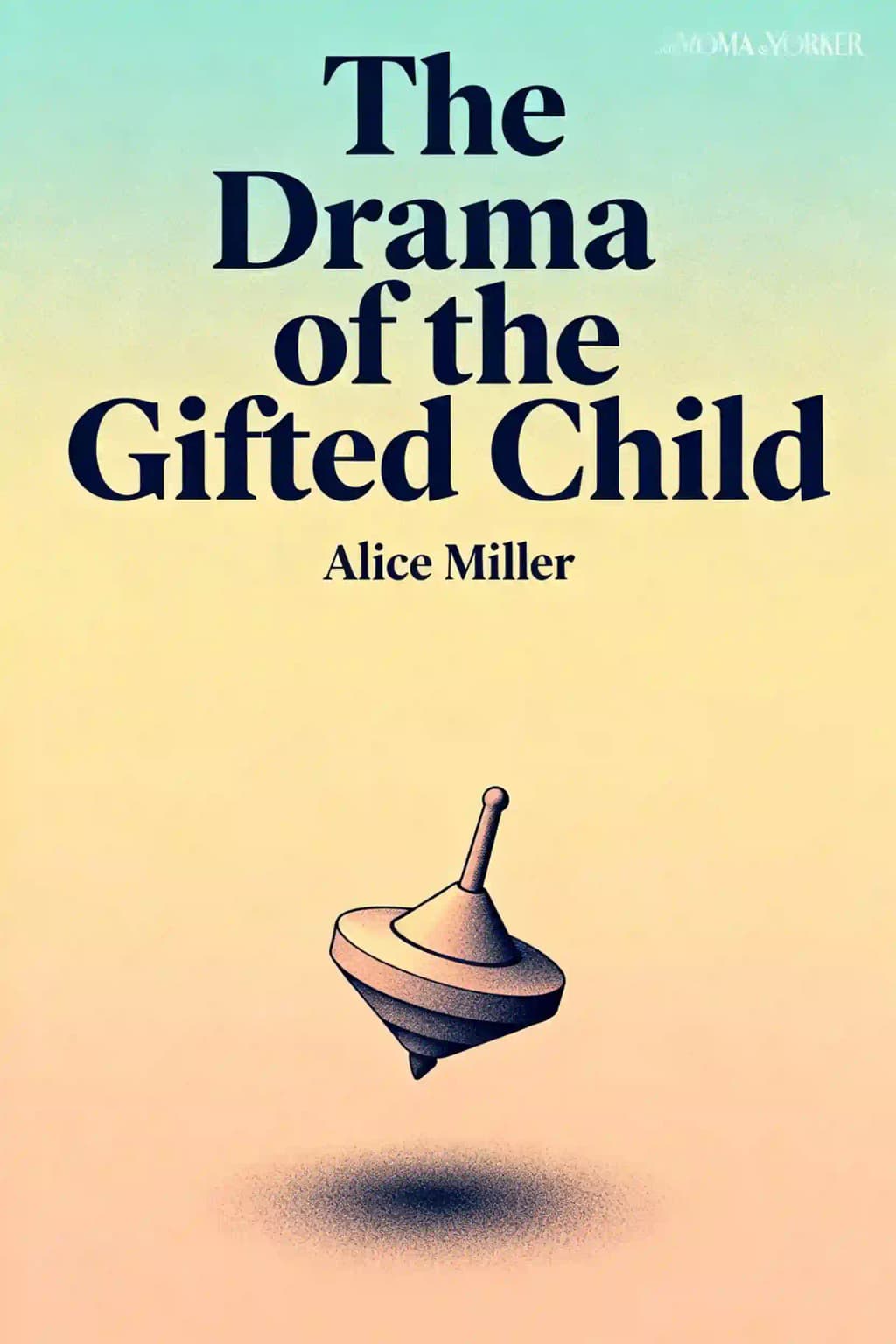
Discover why Alice Miller's groundbreaking exploration of childhood trauma has reshaped psychology since 1979. This international bestseller reveals how "gifted" children sacrifice authenticity to meet parents' needs - a revelation that continues to transform therapy, parenting, and our understanding of generational wounds.
Alice Miller (1923–2010) was a pioneering Swiss-Polish psychologist and psychoanalyst who revolutionized the understanding of childhood trauma through her international bestseller, The Drama of the Gifted Child. Renowned for exposing the lifelong impacts of parental abuse, Miller coined the term "poisonous pedagogy" to describe culturally accepted psychological harm inflicted on children.
A Holocaust survivor who later critiqued Freudian and Jungian theories, she spent two decades practicing psychoanalysis before publishing her seminal work. The Drama of the Gifted Child blends clinical insight with analyses of writers like Kafka and Woolf to trace adult mental health struggles to repressed childhood experiences.
Miller authored multiple influential works, including For Your Own Good and The Body Never Lies, which further explore intergenerational trauma and somatic manifestations of repressed emotions. Her ideas gained global recognition through translations in over 30 languages and the documentary Who’s Afraid of Alice Miller? examining her legacy.
Though controversial for rejecting mainstream psychoanalysis, Miller’s work remains foundational in trauma psychology. The Drama of the Gifted Child has endured as a touchstone text since its 1981 English debut.
The Drama of the Gifted Child by Alice Miller explores how childhood emotional neglect and parental demands shape adult behaviors. It argues that children often suppress their true emotions to meet caregivers’ expectations, leading to repressed trauma, narcissism, or depression in adulthood. Miller critiques traditional psychoanalysis, emphasizing the need to confront childhood truths to achieve emotional healing.
This book is ideal for individuals grappling with unresolved childhood trauma, therapists, or anyone interested in psychology. It’s particularly relevant for those seeking to understand how early emotional suppression impacts relationships, self-esteem, and mental health. Readers of self-help or parenting guides may also gain insights into breaking generational cycles of neglect.
Yes—it’s a seminal work in psychology, translated into 30+ languages, with enduring relevance. Miller’s analysis of parent-child dynamics offers profound insights into adult behaviors, though some critics argue her focus on childhood trauma oversimplifies complex mental health issues. Its blend of clinical observations and accessible prose makes it a cornerstone for trauma-informed discussions.
Key ideas include:
Miller also challenges Freudian theories, advocating for direct engagement with childhood pain rather than repression.
These quotes underscore Miller’s focus on confronting past wounds for healing.
Miller argues narcissism stems from childhood emotional neglect, where children learn to prioritize parental approval over authentic feelings. This creates adults who seek external validation, struggle with empathy, or oscillate between grandiosity and depression—a theme echoed in her analysis of parent-child dynamics.
Critics note Miller’s narrow focus on parental blame, potentially overlooking societal or genetic factors. Others argue her rejection of psychoanalysis oversimplifies therapeutic practices. Despite this, the book remains influential for its pioneering exploration of childhood trauma.
Readers can use Miller’s framework to:
Therapists often integrate her ideas into trauma recovery models.
A Holocaust survivor and former psychoanalyst, Miller’s work reflects her rejection of Freudian denial of parental abuse. Her shift from psychoanalysis to advocating for childhood trauma acknowledgment informs the book’s provocative tone and emphasis on societal accountability.
Pair with Bessel van der Kolk’s The Body Keeps the Score for trauma’s physiological impacts or Judith Herman’s Trauma and Recovery for broader recovery frameworks. These works expand on Miller’s ideas with modern neuroscience and clinical research.
Miller believes repressed memories of emotional neglect fuel adult dysfunction. By revisiting these memories, individuals can reclaim suppressed emotions, break toxic cycles, and achieve authentic self-expression—a process she terms “enlightenment.”
Miller condemns “poisonous pedagogy,” where parents prioritize obedience over emotional validation. She argues this creates adults who distrust their feelings, perpetuate abuse, or develop narcissistic defenses—a critique aligning with modern gentle parenting movements.
Senti il libro attraverso la voce dell'autore
Trasforma la conoscenza in spunti coinvolgenti e ricchi di esempi
Cattura le idee chiave in un lampo per un apprendimento veloce
Goditi il libro in modo divertente e coinvolgente
We enter adulthood carrying invisible chains forged in our earliest years.
Grandiosity defends against depression, while depression shields against the deeper pain of self-loss.
The grandiose person requires constant admiration to survive.
We cannot truly love if forbidden to know our truth.
Depression acts as a reliable indicator of proximity to denied emotions.
Scomponi le idee chiave di The Drama of the Gifted Child in punti facili da capire per comprendere come i team innovativi creano, collaborano e crescono.
Distilla The Drama of the Gifted Child in rapidi promemoria che evidenziano i principi chiave di franchezza, lavoro di squadra e resilienza creativa.

Vivi The Drama of the Gifted Child attraverso narrazioni vivide che trasformano le lezioni di innovazione in momenti che ricorderai e applicherai.
Chiedi qualsiasi cosa, scegli la voce e co-crea spunti che risuonino davvero con te.

Creato da alumni della Columbia University a San Francisco
"Instead of endless scrolling, I just hit play on BeFreed. It saves me so much time."
"I never knew where to start with nonfiction—BeFreed’s book lists turned into podcasts gave me a clear path."
"Perfect balance between learning and entertainment. Finished ‘Thinking, Fast and Slow’ on my commute this week."
"Crazy how much I learned while walking the dog. BeFreed = small habits → big gains."
"Reading used to feel like a chore. Now it’s just part of my lifestyle."
"Feels effortless compared to reading. I’ve finished 6 books this month already."
"BeFreed turned my guilty doomscrolling into something that feels productive and inspiring."
"BeFreed turned my commute into learning time. 20-min podcasts are perfect for finishing books I never had time for."
"BeFreed replaced my podcast queue. Imagine Spotify for books — that’s it. 🙌"
"It is great for me to learn something from the book without reading it."
"The themed book list podcasts help me connect ideas across authors—like a guided audio journey."
"Makes me feel smarter every time before going to work"
Creato da alumni della Columbia University a San Francisco

Ottieni il riassunto di The Drama of the Gifted Child in formato PDF o EPUB gratuito. Stampalo o leggilo offline quando vuoi.
Behind every "gifted child" often lies a profound emotional wound. These sensitive souls-praised for talents and accomplishments since infancy-frequently develop depression and emptiness despite outward success. Their achievements become shields against deeper feelings of anxiety and shame that emerge when their carefully constructed facade falters. What creates this painful paradox? The root lies in early childhood adaptation. When a child's fundamental needs for respect and emotional mirroring must be repressed to preserve parental love, they develop an inability to experience certain feelings consciously. These children master the art of not experiencing emotions because feeling requires someone who accepts them fully. The child becomes the parent's emotional caretaker, available for others' needs while abandoning their authentic self. This leads to sophisticated defense mechanisms and ultimately an "as-if personality" where one reveals only what others expect. As one patient explained: "I lived in a glass house... you cannot conceal anything without giving yourself away, except by hiding it under the ground. And then you cannot see it yourself, either." The tragedy is that these adaptations, while necessary for childhood survival, create an adult who lives perpetually in past dynamics, driven by unconscious memories and repressed feelings.