Capitolo 1
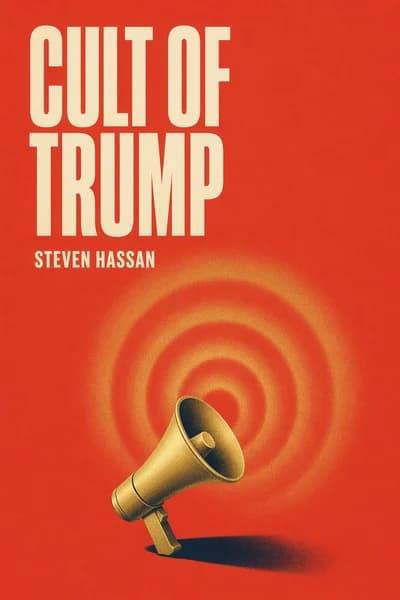
The Cult of Trump: A Warning from the Inside
What if the most powerful person in the world was also a cult leader? Steven Hassan, a former cult member himself, doesn't ask this question lightly. After spending two and a half years in Sun Myung Moon's Unification Church before being deprogrammed by his family, Hassan has devoted over four decades to helping others escape destructive cults. His expertise in mind control techniques led him to an alarming conclusion about Donald Trump's presidency that transcends partisan politics. The book has become required reading in psychology courses examining authoritarian influence, with renowned psychiatrist Judith Herman calling it "an invaluable guide to understanding the Trump phenomenon." Even those skeptical of the "cult" label find Hassan's framework illuminating for understanding Trump's unprecedented hold over his followers and the transformation of previously critical Republicans into fierce defenders.
Capitolo 2
Understanding Cults Beyond Stereotypes
When most people hear the word "cult," they imagine strange religious groups in matching outfits living in compounds. This misunderstanding obscures the reality that most cult members look ordinary, hold regular jobs, and live conventional lives. What defines a destructive cult isn't its beliefs but its methods of recruitment, indoctrination, and control. Throughout Trump's presidency, numerous experts recognized these warning signs. The New York Times published an editorial titled "The Cult of Trump," Senator Bob Corker noted the "cultish" behavior of fellow Republicans, and former White House staffer Omarosa Manigault Newman wrote about escaping "the cult of Trumpworld."
Trump employs the same BITE model (Behavior, Information, Thought, and Emotion control) used by prominent cult leaders. Through social media and constant communication, he creates confusion, distorts reality, and undermines national institutions. By promoting "fake news" narratives and calling journalists "enemies of the people," he effectively closes followers' minds to contradictory evidence.
Robert Jay Lifton, who pioneered the systematic study of authoritarian control through his research on Chinese and Korean political prisoners, identified eight criteria of "thought reform" or brainwashing that parallel Trump's techniques: controlling information environments, claiming special knowledge or power, imposing impossible standards, demanding confession of "sins," presenting ideology as unquestionable truth, using loaded language to stop critical thinking, placing doctrine above personal experience, and determining who deserves to exist.
Most destructive cults revolve around a central figure motivated by power, money, and sex. An estimated 5,000+ such groups operate in America today, influencing millions of people. Their effectiveness stems from sophisticated psychological techniques refined through decades of research, including government programs like MK-ULTRA and studies by Milgram and Zimbardo demonstrating how easily people submit to authority and adopt social roles.
What truly distinguishes healthy influence from destructive cults isn't ideology but behavioral patterns. Unlike Bruce Springsteen fans who can freely criticize or leave without consequences, destructive cults use deception in recruiting and control information to prevent questioning. They typically feature a pyramid structure with an authoritarian leader demanding absolute loyalty, surrounded by inner circle members and various tiers of followers-a structure that applies perfectly to Trump's organization as both businessman and president.
Capitolo 3
The Making of Trump: A Perfect Storm of Influences
Trump's development follows patterns seen in other cult leaders, including cold/absent mothers, authoritarian fathers, childhood behavioral issues, and exposure to authoritarian figures. His mother Mary, though impeccably dressed, was notably absent in Donald's childhood-his friends rarely saw her interact with him. This maternal absence likely impacted Trump's emotional development, as mother-child bonding establishes trust, security, and empathy.
Fred Trump, tough and demanding, became Donald's primary influence, hammering into him that "You are a killer... You are a king" and "Most people are weaklings." By his own admission, Trump was a difficult, aggressive child who once punched a music teacher and was frequently in detention. His initials "DT" became shorthand for punishment among classmates, with one describing him as a "loudmouth bully" who would "pummel" other boys.
A pivotal influence came from Norman Vincent Peale, pastor of Marble Collegiate Church where the Trumps attended weekly. Nicknamed "God's salesman," Peale transformed Christianity into a prosperity gospel where material success signaled divine blessing and failure indicated sin. His bestseller "The Power of Positive Thinking" promoted techniques that banished doubt but also eliminated critical thinking, encouraging magical thinking where strong desire could manifest reality. Though theological critics accused Peale of making religion self-centered rather than God-centered, Trump adored him, claiming Peale "thought I was the greatest student of all time."
After discovering his son's knife collection, Fred Trump enrolled thirteen-year-old Donald in New York Military Academy, a boarding school far from home-what biographer Michael D'Antonio called "a profound rejection." There Trump encountered Colonel Theodore Dobias, a tough WWII veteran who "had a tendency to go for the jugular if he smelled weakness." Trump quickly learned to project strength to earn respect.
Perhaps most significantly, Trump's relationship with Roy Cohn proved transformative. Meeting at Le Club, Cohn advised an aggressive stance against racial discrimination charges: "Tell them to go to hell and fight the thing in court." Beyond legal counsel, Cohn became Trump's mentor, teaching him ruthless negotiation tactics and the "never defend, always attack" philosophy similar to Scientology's L. Ron Hubbard.
After bankruptcies and scandals in the early 1990s, Trump reinvented himself through television. Producer Mark Burnett cast Trump as the star of The Apprentice, seeing in him the "feral charisma" needed for a corporate reality competition. Though Trump was considered a "D-lister" at the time, the show's supervising editor Jonathon Braun admitted, "We knew Trump was a fake... but we made him out to be the most important person in the world." The gamble paid off spectacularly, with the show making hundreds of millions while rehabilitating Trump's image as a "Master of the Universe."
Capitolo 4
Inside the Mind of a Malignant Narcissist
In April 2017, concerned psychiatrists and mental health professionals gathered at Yale School of Medicine to discuss President Trump's mental health. Feeling a professional duty to warn the public, they published their findings in "The Dangerous Case of Donald Trump," edited by forensic psychiatrist Bandy X. Lee. While avoiding formal diagnosis, they identified disturbing psychological patterns: narcissistic tendencies, impulsivity, delusions, paranoia, xenophobia, misogyny, inability to acknowledge errors, pathological lying, and extreme hedonism.
Some may ask if all presidents are narcissists, as the office requires confidence and self-assurance. Indeed, a certain "grandiose narcissism" has been measured in past presidents, with Lyndon Johnson ranking highest. But narcissism becomes pathological when a person becomes addicted to feeling special at any cost. Even more dangerous is "malignant narcissism," which combines narcissism with antisocial behavior, sadism, and paranoia-a pattern seen in destructive cult leaders like Moon, Hubbard, Jones, and others.
Erich Fromm coined the term "malignant narcissism" in 1964 to describe what he considered the most severe mental sickness, representing the "quintessence of evil" due to the lack of empathy and morality. People with this condition display grandiose self-centered behavior, fantasies of power and success, need for praise, sense of entitlement, and lack of empathy that leads them to exploit others without remorse.
Trump consistently exaggerates his talents and achievements, claiming unmatched expertise in everything from ISIS to taxes, infrastructure to nuclear issues, often punctuating statements with "Believe me" and using hypnotic repetition to convince his audience. He spins self-glorifying fantasies about his power, wealth, intelligence and looks to feel special and cope with stress. In his book "Think Big," he dedicates an entire chapter to revenge, advising: "If they screw you, screw them back 10 times as hard."
Malignant narcissists exhibit sadism as aggressive self-affirmation and a defense mechanism, driven by revenge desires. They destroy, dehumanize, and symbolically castrate others, unable to tolerate criticism. Trump weaponizes the legal system like Scientology's L. Ron Hubbard, who explicitly stated lawsuits should "harass and discourage rather than win." Trump surpasses most individuals in litigation volume, having been involved in over 3,500 lawsuits, initiating more than half himself.
Perhaps most dangerous is the paranoia that psychiatrist Otto Kernberg identifies as the root cause of malignant narcissists' self-inflation-they project unresolved hatred onto others they then persecute. Trump obsesses over perceived enemies-mainstream media, Democrats, globalists, the "deep state," immigrants, Muslims, and critics. Former aide Cliff Sims reveals Trump summoned him to compile an "enemies list" of untrustworthy staffers within his own administration. "If it had been a horror movie," Sims wrote, "this would have been the moment when everyone suddenly realizes the call is coming from inside the house."
Capitolo 5
America's Vulnerability to Manipulation
America has become increasingly susceptible to manipulation, with Trump transforming the Republican Party into its opposite-abandoning fiscal conservatism, overlooking presidential lies, and tolerating the denigration of respected figures like John McCain. This vulnerability stems from a perfect storm: information overload, rapid social change, economic hardship, and institutional breakdown. The Great Recession left many Americans feeling betrayed by government, religion, science, and business, while celebrity culture fills the cultural void.
The concept of human rationality began unraveling with Freud's theories about unconscious urges and impulses that can erupt under certain conditions. Freud's nephew, Edward Bernays, pioneered psychological manipulation in public relations, developing "the engineering of consent" to shape public opinion. His approach to selling products by appealing to emotions rather than necessity created modern consumerism, defining an American ideology equating success with material possessions.
Government-funded social psychology research revealed how profoundly our thoughts and behaviors can be influenced by others. Solomon Asch's 1951 conformity experiments showed that 75% of participants would conform to an obviously incorrect group consensus at least once. Stanley Milgram's 1961 obedience experiments demonstrated that ordinary Americans would administer what they believed were painful electric shocks to others when instructed by authority figures. In Zimbardo's Stanford Prison Experiment, randomly assigned "guards" became sadistic toward "prisoners" within days, showing how quickly people adopt roles and how situations override individual values.
Edgar Schein's 1961 book "Coercive Persuasion" described psychological change as a three-step process based on Kurt Lewin's model: unfreezing (breaking down identity), changing (indoctrination), and refreezing (reinforcing the new identity). This framework helps explain how Americans have fallen under Trump's influence through systematic psychological manipulation.
The unfreezing phase undermines a person's sense of reality by disorienting them physically and mentally. Trump masters this by making contradictory statements about the same issue while maintaining an assured tone that leaves listeners unable to process the inconsistencies. The changing phase creates a new identity through formal indoctrination (rallies, meetings) and informal reinforcement (social media, videos). In the refreezing phase, the new identity is solidified through continued reinforcement, with followers conditioned to emulate their leader in all aspects.
The average American, bombarded with thousands of ads daily and suffering from information overload and shortened attention spans, becomes susceptible to manipulation. Critical thinking becomes nearly impossible with 40% of Americans sleep-deprived, getting less than seven hours nightly. Meanwhile, technology companies foster device addiction, with the average American spending eleven hours daily looking at screens, creating a perfect storm for undue influence.
Capitolo 6
Trump's Arsenal of Persuasion Techniques
In summer 2015, Dilbert cartoonist Scott Adams predicted Trump had a 98% chance of becoming president, citing Trump's superior powers of persuasion despite polls favoring Clinton. Adams, a self-proclaimed trained hypnotist, recognized Trump's media savvy, reality TV experience, and business background as persuasive advantages. Trump has mastered sophisticated techniques for the digital age, strategically using hyperbole-what he calls "truthful hyperbole" in The Art of the Deal-to capture attention and emotions, manipulating both media and minds.
The human brain functions like a sophisticated biocomputer, filtering information to focus on what's important. Our unconscious mind manages bodily functions and shapes our conscious thoughts through stored beliefs, judgments, and behaviors. Trump masterfully manipulates attention and imagination through vivid imagery and hyperbole, as seen in his inauguration speech describing "American carnage" and promising safety. His memorable insults like "Lyin' Ted" create mental images that can be triggered repeatedly.
Trump employs numerous psychological techniques to maintain influence. Anchoring uses sensory cues-like red MAGA hats-to trigger associated thoughts or feelings. Framing sets psychological context for experiences, as when Trump deflected Megyn Kelly's debate question about his derogatory comments toward women by interjecting "Only Rosie O'Donnell," drawing laughter and defusing criticism. His simple yet effective campaign narrative-"America was once great. America is no longer great. I will make America great again"-won him the presidency when Hillary Clinton offered no compelling counter-narrative.
Confusion techniques exploit our limited cognitive capacity by overwhelming the conscious mind with incongruous information. When someone confidently lies while their body language suggests truthfulness, people often enter mild trances to resolve the conflict, becoming more susceptible to false beliefs. Trump excels at "the big lie" technique-making outrageous false claims so extreme people assume they must be true.
Pattern interruption violates norms or social scripts, creating disorientation. Trump's presidency is defined by such disruptions-using politically incorrect language, lying openly, tweeting at unusual hours, and abandoning political decorum. Double binds force compliance while creating an illusion of choice, leaving people confused and vulnerable. Trump masterfully uses double binds to control situations, as when he taunted Jeb Bush about his "low energy"-leaving Bush in a catch-22 where either responding aggressively or backing down would validate Trump's frame.
Fear, our most basic survival emotion, serves as Trump's primary tool for maintaining power. As Eric Hoffer noted in "The True Believer," mass movements need a devil more than a god. Trump consistently creates fear of "others" and catastrophic consequences should he lose power. He portrays America as perpetually under siege from invading caravans and internal enemies like the media. This scapegoating mirrors tactics used by cult leaders-Hubbard blamed psychiatrists, Moon blamed communists, Hitler blamed Jews.
Capitolo 7
The Media Ecosystem That Enables Trump
Trump's presidency has been characterized by an unprecedented symbiotic relationship with media, particularly Fox News. His tweets often mirror Fox content, creating what The New York Times called "a public mind meld" between the president and the network. While presidents have historically used media platforms to communicate with the public, Trump's approach differs in its partisan nature-speaking primarily to his base rather than the whole nation.
Government media manipulation has a long history in America. During World War I, President Wilson created the Committee on Public Information, which shaped press coverage while suppressing opposition newspapers. With radio's rise in the 1920s, FDR used "fireside chats" to reassure Americans during crises, while Father Charles Coughlin exploited the medium to broadcast anti-Semitic conspiracy theories to 30 million listeners.
As radio grew popular in the 1930s, the government established the FCC to regulate broadcasting. The 1949 Fairness Doctrine required stations to present "varying and conflicting views" on controversial issues. Despite implementation challenges, this maintained a fragile balance in media until 1987, when President Reagan vetoed Congress's attempt to codify it and directed the FCC to abolish it entirely, spawning a new generation of partisan right-wing radio personalities.
With the Fairness Doctrine revoked, AM radio transformed from public interest broadcasting to profit-driven talk radio. Rush Limbaugh emerged as the modern-day Coughlin, launching his nationally syndicated show in 1988 that became enormously influential. His "brilliantly effective" strategy labeled mainstream media as "biased," creating a loyal audience hungry for "unbiased" conservative content.
Roger Ailes, who began as Nixon's media consultant in 1967, understood television's emotional power, recognizing that "Television rarely tells the whole story" but could effectively trigger emotions with sound bites. After helping both Reagan and Bush win elections, Ailes partnered with Rupert Murdoch in 1996 to create Fox News. The network employed tactics like fearmongering, confusion, blame, and division to cultivate a conservative audience.
Harvard scholars analyzing millions of news stories found right-wing media uniquely prone to promoting disinformation, conspiracy theories, and extremist content. Unlike mainstream media's commitment to journalistic standards with error detection and correction mechanisms, the right-wing ecosystem lacks this self-correcting function, creating what researchers call a "propaganda feedback loop" where uncorrected falsehoods persist and circulate between outlets like InfoWars, Breitbart, and Fox News.
Fox News has abandoned journalistic principles since Roger Ailes' 2016 departure. Once canceling Sean Hannity's Tea Party rally appearance to protect "journalistic integrity," by 2018 Hannity appeared on stage at Trump rallies. The network dropped its "fair and balanced" motto in 2016, becoming what critics call "Trump TV" with a "revolving door" relationship with the White House.
Capitolo 8
The Network of Influencers Behind Trump
Trump's cabinet picks revealed a pattern of appointing individuals hostile to the very agencies they would lead-from Rex Tillerson with no government experience but Russian ties, to climate-change denier Scott Pruitt for the EPA. This strategy of delegitimization echoes tactics developed by Christian right strategists Paul Weyrich and William Lind, who advocated collapsing enemies from within by disrupting their mental, emotional, and moral foundations through propaganda, confusion, and fearmongering.
Trump systematically attacked government legitimacy throughout his campaign, portraying Washington as a corrupt "global power structure" with Clinton at its center. His unprecedented refusal to commit to accepting election results if he lost directly undermined democracy itself. This approach mirrors strategies outlined in Weyrich and Lind's "The New Conservatism," which advocated fourth-generation warfare (4GW) to collapse perceived enemies from within.
Russia's delegitimization campaign against American democracy was unprecedented in scope and sophistication. They deployed thousands of cyberterrorism agents targeting Americans with tailored misinformation, creating fake social media accounts and groups to spread confusion and division. Their tactics mirrored cult mind control techniques: deception, confusion with alternative facts, blame, division, loaded language, and fearmongering.
Trump's relationship with Russia began in 1987 when the Soviet ambassador invited him to Moscow during a KGB recruitment period, where he was placed under surveillance. Shortly after returning, Trump took out newspaper ads criticizing American foreign policy, particularly regarding NATO-foreshadowing his later presidential positions. In the early 1990s, when Trump faced bankruptcy and massive debt, Russian oligarchs provided financial rescue through real estate partnerships and condo purchases.
Many of Trump's presidential policy decisions appear to advance Russian objectives: weakening NATO, slashing the State Department budget, loosening ties with allies, and diminishing America's global power and prestige. At the 2018 Helsinki summit, Trump sided with Putin over American intelligence agencies regarding election interference, even as Putin acknowledged wanting Trump elected.
The Christian right has mythologized Trump as divinely chosen, with leaders like Lance Wallnau comparing him to the Persian king Cyrus-an unwitting vessel for God's work. This movement isn't monolithic but comprises conservative Protestant evangelicals and Catholics united by opposition to abortion, homosexuality, and scientific advances, with a goal of establishing a theocratic nation under the banner of "religious freedom."
Powerful networks like the Fellowship (also known as "The Family"), the New Apostolic Reformation, and Opus Dei work secretly to influence politicians and business leaders. The Family operates secretively from buildings like the C Street House on Capitol Hill, cultivating powerful figures across party lines. Their philosophy reimagines Jesus as a strongman focused on power rather than love or mercy, with leaders admiring the control exhibited by authoritarian figures like Hitler, Stalin, and Mao, though condemning their evil. The group's ultimate goal is "a ruling class of Christ-committed men" in "a voluntary dictatorship of the divine."
Capitolo 9
Breaking Free from Mind Control
When former Trump attorney Michael Cohen testified before Congress in 2019, he appeared bewildered by his own actions, saying he had been "mesmerized" by Trump into doing things he knew were wrong-a realization similar to what many cult survivors experience upon leaving high-demand groups. Breaking free from undue influence requires recognizing the false leadership and confronting the devastating reality of one's misplaced devotion.
Since we all believe we control our own thoughts while being constantly influenced by external forces, Hassan offers a five-step process to determine if one is under undue influence:
1. Reality test: Disconnect from reinforcing influences like social media, get adequate sleep, exercise, and reconnect with your authentic self.
2. Educate yourself: Study social psychology, mind control models, propaganda techniques, and logical fallacies.
3. Listen to critics: Seek credentialed experts with differing viewpoints, examine factual evidence, and read diverse sources.
4. Self-reflect: Consider your beliefs before encountering Trump and examine how your perception was shaped by media, religious figures, or social networks. Question whether you would knowingly follow someone who demonstrably lies, and whether your fears are rational.
To help someone trapped in the Cult of Trump, start with knowledge-step into their media world to understand their perspective, though in limited doses to maintain objectivity. Remember that beneath the cult identity, their authentic self remains. Avoid win-lose arguments. Instead, ask thoughtful questions like "How did you come to feel strongly about Trump?" and listen patiently. Build rapport and trust, find common ground, and reject name-calling and ad hominem attacks.
Former Trump supporter David Weissman describes how comedian Sarah Silverman's respectful engagement on Twitter transformed his political views. Their months-long dialogue about immigration, gun reform, and abortion led him to discover reliable sources that debunked conservative media claims. When he began questioning Trump publicly, he was hacked and shunned by supporters-typical cult treatment of defectors.
One powerful remedy for blind faith is seeing the world through different perspectives. Begin by asking your loved one to teach you how to see Trump through their eyes-have them coach you until you can accurately represent their viewpoint. Then invite them to reciprocate by stepping into your shoes. This role-switching exercise creates space for genuine understanding.
Trump's true believers inhabit a frightening world filled with migrant invaders, Muslim terrorists, the deep state, and liberal elites supposedly bent on destroying America. This fearmongering and phobia indoctrination serves as Trump's primary tool for rallying his base. Phobias differ from legitimate fears-they persist irrationally, detached from actual danger. In destructive cults, deliberately implanted phobias become the most powerful technique for maintaining dependence and obedience.
Capitolo 10
Safeguarding Democracy's Future
The chapter opens with the haunting reminder of Jim Jones and the Jonestown massacre where 912 people died, including over 300 children. A sign above Jones's stage read "Those who do not remember the past are condemned to repeat it"-a chilling warning about the dangers of mind control. The parallels between this historical tragedy and today's digital age are disturbing, as undue influence can now reach people anywhere, anytime, radicalizing individuals through online communities and media.
Our democracy needs safeguards against psychologically unstable leaders. With the executive branch concentrated in a single person, it's imperative that the president be of sound mind. Hassan suggests requiring presidential candidates to undergo full neuropsychiatric evaluations by a bipartisan committee to establish mental competence, with routine follow-ups after taking office.
Our legal system needs an updated definition of undue influence that incorporates scientific advances in understanding how the mind works. Currently, destructive cults often escape accountability for violating members' rights, especially if they have religious designation. Santa Clara University law professor Alan Scheflin has proposed a Social Influence Model framework for evaluating undue influence in courts, examining the influencer, the influencee, and the methods used.
Freedom of religion is the "first freedom" in the Constitution, protecting our right to think freely without civic disadvantage. However, Christian right factions have interpreted religious freedom to mean they may violate constitutional principles if aligned with their theocratic beliefs. Through initiatives like Project Blitz, which Trump has supported, they're pushing legislation allowing discrimination against LGBTQ people and religious minorities.
Most mental health professionals remain unaware of the DSM category for brainwashing and mind control, leaving them ill-equipped to identify or treat patients suffering from cult involvement. Hassan advocates for developing curricula on undue influence and mind control to be incorporated into all mental health training programs.
Social media platforms like Facebook and Twitter have been weaponized by foreign actors to influence American elections. Hassan calls for ethical standards in technology, praising steps like YouTube's algorithm changes to reduce "borderline content" and Facebook's ban on white nationalism content. He suggests using the BITE model when designing algorithms to detect coercive influence and ensuring compassion is incorporated into AI development.
Trump's increasingly unbalanced behavior is cause for alarm. His paranoia and vengeful nature are dangerous traits in a president. The parallels between Trump and Jim Jones are disturbing. Jones was also a malignant narcissist with paranoia who ultimately orchestrated the deaths of 917 followers when he felt betrayed. Experts from the World Mental Health Coalition have expressed grave concerns about Trump's fitness for leadership.
If Trump loses in 2020, he might claim the election was rigged and incite his followers to action. The dangers of mind control are as real today as they were forty years ago in Jonestown. While love and truth can overcome fear and mind control, we ignore history's lessons at our peril.