Capitolo 1
America's Paradox: Natural Rights in a Progressive Age
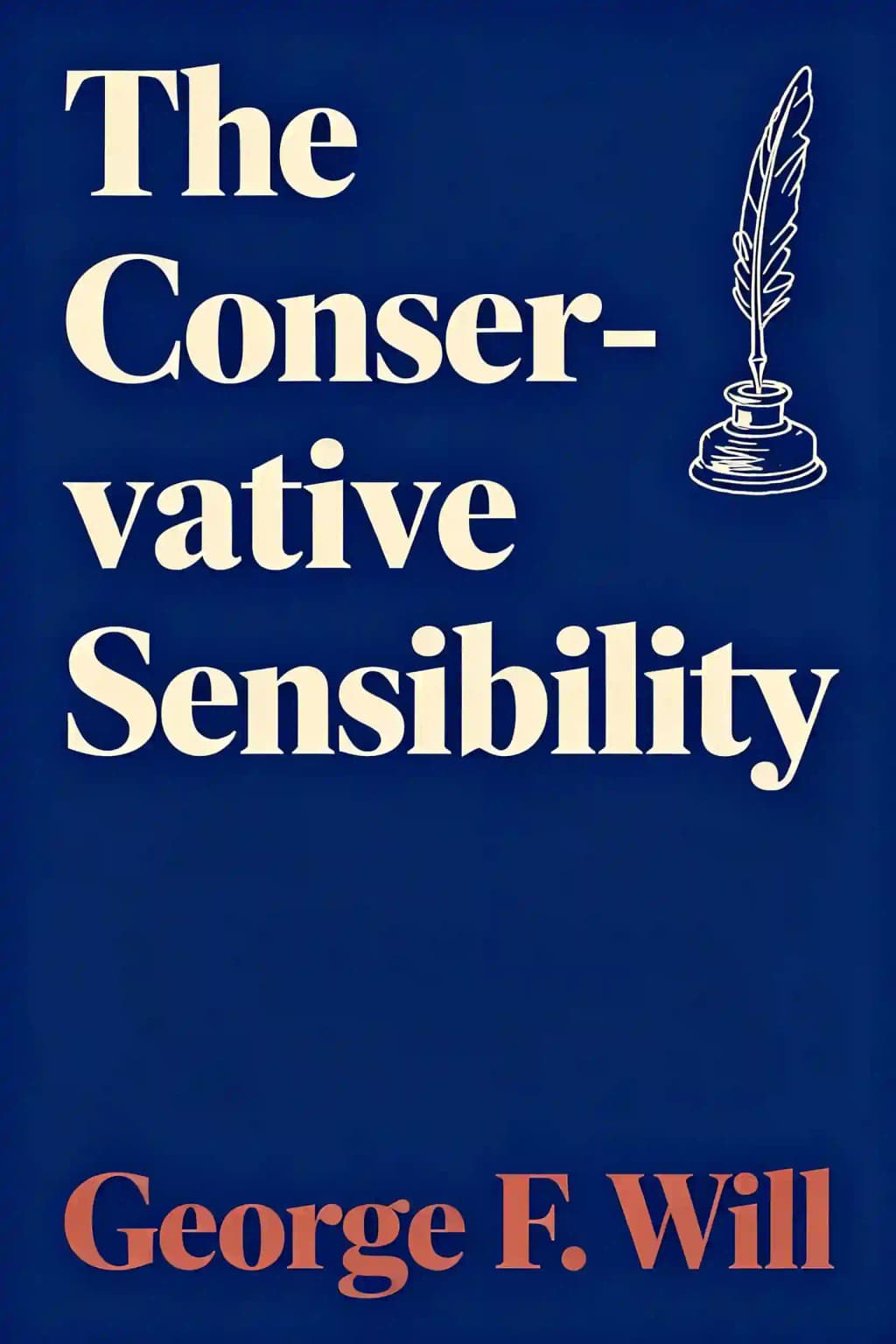
The Conservative Sensibility arrives at a pivotal moment in American history. As the nation approaches its quarter-millennium, George F. Will offers a profound meditation on the intellectual foundations of American conservatism. This book has become required reading among political philosophers, with figures ranging from Barack Obama to Justice Neil Gorsuch citing its insights. Will's analysis resonates particularly with those seeking to understand America's current political polarization, as he traces our contemporary divisions to a century-old philosophical battle between the Founders' vision of natural rights and the Progressives' vision of an evolving Constitution.
Unlike many conservative manifestos, Will's work transcends partisan talking points, instead excavating the Republic's intellectual foundations to reveal something both beautiful and practical. His Harvard-educated perspective brings remarkable clarity to complex ideas, making this book accessible to readers across the political spectrum. As America wrestles with questions about its identity and future, Will's exploration of the "conservative sensibility" offers a timely reminder of what the nation was designed to conserve.
Capitolo 2
The Battle Between Madison and Wilson
The American Revolution's fate hinged on contingency and individual agency rather than historicism's autonomous processes. The Battle of Princeton in 1777, though lasting just forty-five minutes, proved one of history's most consequential conflicts. When American troops initially panicked before British bayonets, Washington's personal bravery reversed their retreat. His charge shattered Britain's aura of invincibility and halted American defeatism. Present that day were Washington and John Marshall-the two men most important in making the infant republic into a nation.
This revolutionary spirit established a distinctly American conservatism unlike European varieties. While European conservatism defended throne-and-altar traditions, American conservatism sought to conserve institutions promoting social dynamism and mobility. This fundamental difference explains why American exceptionalism connects so deeply to conservative principles-Americans were born free from feudal structures, had a revolution setting people free to pursue happiness as they choose, and created a Constitution limiting what government may do to them.
Today's political arguments reflect a century-old debate between Madisonians and Wilsonians. The Madisonian persuasion holds that rights are natural, discernible by reason, and pre-exist collective human will, making limited government natural. The Wilsonian persuasion rejects this philosophy, embracing flux and malleability, making the social context a political choice. This conflict grows more intense as both sides sharpen their fundamental differences.
The stakes are immense: if rights are natural, they exist beyond majority rule. As Justice Jackson famously declared in the 1943 West Virginia v. Barnette decision: "Fundamental rights may not be submitted to vote; they depend on the outcome of no elections." This principle-that certain rights lie beyond majority rule-forms the cornerstone of American conservatism properly understood.
Capitolo 3
Natural Rights and the Founders' Vision
The Founders believed in a fixed human nature and natural rights discernible through reason. Lincoln acknowledged this in 1842, calling human nature "God's decree" that "never can be reversed." President Coolidge, commemorating the Declaration's 150th anniversary, reaffirmed these "old theories and principles" as "sound," noting that America represented a "new civilization" with greater regard for individual rights.
Locke's assertion that "men may chuse different things, and yet all chuse right" launched classical liberalism by acknowledging the legitimacy of diverse human tastes. This pluralism, alongside Hobbes's demotion of politics from sacred to utilitarian, established the foundation for modern governance-not to make men virtuous but to provide security so individuals could pursue their own conceptions of happiness.
The Founders designed a system accommodating human defectiveness without requiring constant public-spiritedness. Unlike progressives who view human nature as malleable, the Founders saw it as a source of normative guidance. They understood natural rights as inalienable and universal-the foundation of democratic equality and limited government. Government's purpose wasn't imposing opinions about happiness but securing pre-existing rights.
Madison's revolution in democratic theory overturned the pessimistic consensus that democracy could only work in small, homogeneous societies. His solution to preventing tyranny of the majority was counterintuitive: cultivate factions. In an "extensive republic," the sheer scale ensures majorities remain unstable coalitions of minorities. As he explained in Federalist 10, "Extend the sphere, and you take in a greater variety of parties and interests; you make it less probable that a majority of the whole will have a common motive to invade the rights of other citizens."
The Constitution follows logically from the Declaration, with democracy serving as the means to secure liberty, not as an end itself. The Founders embraced democracy firmly but without sentimentality, understanding its susceptibility to degeneracy. Their constitutional architecture reflected what Martin Diamond called "the American people's sensible self-doubt."
Capitolo 4
The Progressive Challenge
The progressives launched a fundamental challenge to the Founders' natural rights philosophy, seeking to replace limited government with an expansive state guided by expert administration. Woodrow Wilson rejected the Founders' anxieties about government being inherently dangerous, especially when wielded by majorities. In 1879, he ridiculed those who denounce "the tyranny of partisan majorities" yet praise "true representative government" as "laughably inconsistent." He believed government was not evil but "the indispensable organ of society."
Wilson's vision required "wresting the Constitution to strange and as yet unimagined uses," later softened to requiring "a nice adjustment" determined by "the exigencies and new aspects of life itself." He saw the state as "an instrumentality for quickening" both collective and individual development, with no clear limits on its authority.
In his 1887 essay "Socialism and Democracy," Wilson argued that "all idea of a limitation of public authority by individual rights be put out of view" and "no line can be drawn between private and public affairs which the State may not cross at will." He maintained that "the difference between democracy and socialism is not an essential difference, but only a practical difference," both resting on "the absolute right of the community to determine its own destiny."
Wilson's democratic theory subordinated individual rights to collective rights. He admired socialism as a "revolt from selfish, misguided individualism" attempting to bring individuals "into complete harmony with society." He considered the Constitution's system of checks and balances a "radical defect" that "parcels out power and confuses responsibility," believing the Framers would admit "the only fruit of dividing power had been to make it irresponsible."
Roosevelt's San Francisco Commonwealth Club speech revealed his vision of a transformed America requiring strong government. Most radically, Roosevelt reinterpreted the Declaration of Independence as a "contract" where "rulers were accorded power" in exchange for certain rights, with statesmanship involving "the re-definition of these rights in terms of a changing and growing social order." This fundamentally reversed the Founders' understanding that rights precede government.
From the Founding until the 1930s, America operated on the premise that government's function was to provide ordered liberty for the pursuit of happiness, not happiness itself. The New Deal fundamentally changed this relationship, creating a sanguine estimation of central government competence that has grown steadily more ambitious without making Americans more content with their government.
Capitolo 5
The Administrative State and Constitutional Disequilibrium
The modern presidency has become "a pernicious conflation" of executive function with "semi-sacerdotal" spiritual leadership, catering to citizens seeking from politics "excitements, satisfactions, and consolations that politics should not try to supply." Despite early American aversion to monarchy, the presidency evolved to fulfill the need for "a visible point serving as a common centre in the government."
The transformation began with technological changes. Theodore Roosevelt became the first filmed by movie cameras and to use the office as a "bully pulpit." The evolution continued with FDR mastering radio to bypass Congress and journalists, speaking directly to Americans in their living rooms with artificial intimacy: "My friends" and "Tell me your troubles."
Woodrow Wilson transformed presidential communication, arguing presidents should engage in "interpretation" of the people's hearts. Modern transportation and communication technologies enabled presidents to be omnipresent, evolving into today's concept of president as "tribune of the people" and "molder of the public mind." This contradicts the Constitution's remarkably limited presidential role, centered on the Take Care Clause: "take care that the laws be faithfully executed."
Eight decades after FDR called for a "temporary departure from the normal balance" between executive and legislative authority in his first inaugural address, this departure has become permanent. Barack Obama, who campaigned in 2008 promising to reverse executive overreach, instead declared he would not wait for Congress to "help" him.
Madison foresaw this development in 1791, warning that as the federal government assumed powers belonging to state and local governments, the federal legislature would become overwhelmed and forced to transfer many functions to the executive branch. The administrative state began with the Interstate Commerce Commission in 1887 and has grown exponentially-in 2016, Congress passed 2,966 pages of laws while federal agencies produced 97,110 pages of regulations.
This accumulation of legislative, executive, and judicial powers in the same hands fulfills Madison's definition of tyranny in Federalist 47. While Chief Justice Marshall declared it "emphatically the province and duty of the Judicial Department to say what the law is," today's administrative state has upended this principle.
Capitolo 6
Judicial Engagement and Natural Rights
The judicial branch must become more energetic in defending the separation of powers that serves liberty. The Constitution continues what the Declaration began, embedding the doctrine of natural rights at the center of national identity.
The Declaration of Independence was not specifically "democratic" but contingently implies democracy as the form of government most likely to secure natural rights. As Leon Kass notes, any government is legitimate if it secures natural rights and rules by consent of the governed.
The Constitution's essential drama derives from the tension between individual natural rights and the community's constructed right to make laws through majority rule. The Declaration is chronologically and logically prior to the Constitution, setting the framework for reading it and serving as its conscience. As Timothy Sandefur writes, "Liberty is the goal at which democracy aims, not the other way around."
After Washington and Lincoln, John Marshall stands as America's third most important figure. This self-taught lawyer from humble origins embedded constitutional reasoning at the core of American governance during his thirty-four years as Chief Justice. The path to judicial review began with the Magna Carta's incremental expansion of liberty, but America revolutionized rights theory by establishing that people who are born free create government to secure pre-existing natural rights, rather than receiving rights granted from above.
The paradox of American governance lies in our profound skepticism of government power alongside our reliance on a government institution-the Supreme Court-to elaborate and apply our political philosophy. Constitutional lawyers function as our practitioners of political philosophy, interpreting the Declaration of Independence and the Constitution that provides institutional architecture for its precepts.
The great divide in America today exists between those who believe "first come rights and then comes government" (the Republican Constitution view) and those who believe "first comes government and then come rights" (the Democratic Constitution view). This distinction reflects competing understandings of "We the People"-either as individuals possessing natural rights or as a collective entity whose majority will should prevail.
Capitolo 7
Markets, Knowledge, and Human Flourishing
Political economy is properly the study of how production and exchange are shaped by customs, laws, and governments. A mature capitalist economy is not spontaneous but a complex government construct requiring laws that guarantee transparency and reliable information. After World War II, leaders like Kennedy and Nixon expressed supreme confidence in their ability to "manage" the economy, only to be humbled by phenomena like stagflation.
Hayek's seminal 1945 essay explained why central economic planning fails: necessary knowledge exists only in "dispersed bits" among countless individuals, not in any centralized form. Markets function as marvels that coordinate actions through price signals, allowing responses to scarcity without anyone needing to understand the entire system. As Hayek noted, "The more civilized we become, the more relatively ignorant must each individual be of the facts on which the working of civilization depends."
The conservative sensibility delights in market society's spontaneous order and surprising innovations, while progressives yearn for predictability and control. Intellectuals' disdain for capitalism stems partly from resentment that markets function effectively without their guidance. This ingratitude ignores how the "vulgar" commercial class makes the intellectual class possible-as economist George Stigler noted, "we professors are much more beholden to Henry Ford than to the foundation which bears his name."
Modern government faces a fundamental contradiction: it must promote economic growth to fund its expanding promises while simultaneously imposing regulatory and redistributive burdens that impede that very growth. This creates what Daniel Bell called "the cultural contradictions of capitalism"-capitalism requires virtues like thrift, industriousness and deferred gratification, yet its success produces abundance, leisure and appetite emancipation that undermine these same virtues.
Would you trade your middle-class life today for John D. Rockefeller's billion-dollar fortune in 1916? Don Boudreaux of George Mason University suggests you'd be foolish to accept. Despite palatial homes and private islands, you'd suffer primitive healthcare, limited entertainment, and technological deprivation. You'd have no antibiotics, modern dentistry, reliable birth control, or treatments for depression, influenza, or countless other ailments.
Capitolo 8
Culture and Opportunity
The American creed holds that all individuals possess equal freedom and the right to exercise it, with government instituted to protect this liberty. In an open society, people with equal rights inevitably develop unequal conditions due to differences in aptitudes, abilities, and circumstances.
Will critiques conservatives' facile distinction between supporting "equality of opportunity" while opposing "equality of condition." This formulation, he argues, ignores how deeply opportunities are shaped by existing conditions. While equality of outcomes remains neither possible nor desirable, equality of opportunity proves far more elusive than conservatives comfortably acknowledge.
Lincoln spoke of lifting "weights" from all men's shoulders to give them "equal chance." Lyndon Johnson expanded this thinking in his landmark 1965 Howard University speech, arguing "freedom is not enough"-one cannot merely bring formerly chained people to a starting line and call the race fair. The government itself had closed opportunity gates through policies like FHA "redlining," which explicitly steered mortgages away from Black neighborhoods and buyers.
In 1966, sociologist James Coleman delivered findings so "seismic" that the Johnson administration tried burying them by releasing the report on July Fourth weekend. Coleman discovered that schools were "remarkably similar" in their impact on student achievement when accounting for socioeconomic background. The crucial predictor of school performance wasn't funding or resources, but the quality of families from which students came.
The verbal environment of early childhood creates profound inequalities before formal education begins. Children from poor families hear about 600 words per hour, working-class children 1,200, and professional-class children 2,100. By age three, poor children have heard 30 million fewer words than their professional-class peers. This verbal deficit creates an "early catastrophe" where learning trajectories diverge radically in the first three years of life.
America has made remarkable progress reducing racial barriers, but the Great Society's anti-poverty efforts have created a "tangle of pathologies." While material poverty has declined dramatically, this progress has been accompanied by family disintegration, welfare dependency, and "flight from work."
Most alarming is the "quiet catastrophe"-a smaller percentage of prime-working-age men are employed today than during the Great Depression. This retreat from work is largely voluntary, with millions choosing economic inactivity financed by government benefits and family support. America now ranks second-to-last among affluent nations in male workforce participation despite having neither a weaker economy nor more generous welfare than other developed countries.
Capitolo 9
Education and Cultural Inheritance
America must re-establish its national character to ensure "We the People" denotes something real. Though the Declaration claimed "one people," Americans were diverse in faith, language and local attachments. Democracy requires a demos-a shared identity built through education and civic liturgies that nourish collective memory.
Woodrow Wilson understood education as a conserving enterprise making young people artificially "old" through seasoned ideas, preventing society from "becoming infantile in every generation." The Founders aimed not for perfection but for happiness, believing moral truths could be apprehended by ordinary minds unclouded by passion.
History-deprivation was once a control mechanism of American slavery, preventing enslaved people from developing pride, solidarity, and a sense of potential by disconnecting them from their past. Today, America inflicts this same deprivation on itself through presentism-judging historical figures by contemporary standards. This practice combines ignorance with arrogance, allowing people to flatter themselves as morally superior to figures like Washington or Lincoln without making the imaginative leap to understand earlier generations' struggles with reconciling moral principles and inherited institutions.
Educators should conserve, enlarge and transmit the ideas and virtues on which a society based on persuasion and consent depends. Instead, postmodernism-Nietzsche's claim that "there are not facts, only interpretations"-has seeped into academia and society like a slow toxin. But facts do exist, and ignorance of them proves embarrassing, as when students cheered Franco's fascists in a documentary because they were labeled "rebels."
Multiculturalism as policy rather than fact has become an ideology claiming all standards for judging cultures are culture-bound, making it wrong to "privilege" Western culture. This attacks individualism by defining people as mere manifestations of groups rather than self-defining participants in a free society. The resulting intellectual gerrymandering carves curricula into protected enclaves based on the insulting assumption that people have only derivative identities stemming from victim group membership.
Capitolo 10
America's Foreign Policy Dilemma
Woodrow Wilson's sleepless night in Paris during the 1919 peace conference reveals the hubris of American idealism in foreign affairs. While Europe's leaders were focused on ending a devastating war, Wilson was preoccupied with details as minute as "the composition of the railway police in Shantung." Wilson's belief that America was uniquely "disinterested and trusted" contrasted sharply with European realism.
The clash between American idealism and European realism continues to shape foreign policy. America's character as "less a place than an idea" means its foreign policy will always have "an indelible color of idealism." However, conservatism must leaven this with "an unsentimental, almost bleak realism" about human nature-which is "desirous and competitive, hence anxious, and hence given to conflict."
Our history is littered with shattered illusions about war's end. In 1862, photographers captured Civil War dead at Antietam, yet graphic journalism didn't prevent future conflicts. In 1910, economist Norman Angell's bestseller "The Grand Illusion" wrongly predicted nations would find war unprofitable. Jefferson's attempt to use trade embargoes instead of military force proved that "the ledger book was no match for human atavism."
America's commercial republic naturally approaches international relations through business-like reasoning and legal negotiation, but this often fails against "animal spirits, national atavisms, and ideological frenzies." America's unique founding created a distinctive approach to foreign policy. John Quincy Adams articulated this in 1821: "She goes not abroad in search of monsters to destroy... She is the well-wisher to the freedom and independence of all. She is the champion and vindicator only of her own."
Vietnam was "the professors' war"-too clever by half with "carefully calibrated violence" sending "signals" to an uncomprehending enemy. The phrase "the best and the brightest" has become sarcastic shorthand for elite failure. Vietnam exemplified America's tragic tendency toward mutual incomprehension in foreign affairs-from refugees mistaking cheese for soap to McNamara's mangled Vietnamese pronunciation to Westmoreland's cultural tone-deafness.
Capitolo 11
A Conservative Sensibility Without Theism
If God is uninterested in humanity's affairs, He becomes politically irrelevant. Religion becomes problematic when divine revelation enters, with God actively intervening and providing behavioral strictures. Biblical religion defends individual dignity linked to moral agency, and should therefore be wary of government untethered from securing natural rights.
Tocqueville warned of a "milder" democratic despotism that would "degrade men without tormenting them," treating citizens like children while providing for all their needs and "gradually robbing a man of all the uses of himself." Religious institutions struggle to flourish under government that presumes to satisfy every human need, while secularists must consider whether limited government can endure without religion's role in civil society.
The Founders' deistic view saw God as like "a rich aunt in Australia-benevolent, distant, and infrequently heard from." This deity, having wound up the universe, has no continuing interest in human affairs and makes no interventions. If religion should console and enjoin as well as explain, deism barely qualifies as religion.
The Founders typically discussed religion in terms of temporal utility rather than timeless truths. Franklin became "a thorough Deist" who considered belief in a creator and immortality "the essentials of every religion." Washington employed his "famous gift of silence" about religion, refused to kneel in prayer, avoided church on communion Sundays, and died without ministers or prayers present.
Darwin's theory of natural selection severed the intellectual anchor rope of natural theology by providing an explanation for nature's orderliness without requiring divine intention. Like mathematician Laplace who told Napoleon "I have no need of that hypothesis" when asked about God's absence from his celestial mechanics, Darwin displaced the hypothesis that anchored natural theology.
There exists a conservative sensibility that finds flux exhilarating rather than depressing. This secular conservative aesthetic finds beauty in Darwin's worldview of creative contingencies, tracing to Lucretius' poem "On the Nature of Things." This vision of atoms, void and constant motion creates a world "not rendered insignificant but made more beautiful by its transience."
Capitolo 12
Returning to First Principles
Conservatives today harbor radical worries about America's government and culture. While progressives focus on distributive justice, conservatives question the post-New Deal state's power, seeing a connection between government overreach and cultural decay.
The conservative mission is to convince people that government promises are unsustainable and that modern government has become a deforming force corrupting the country's character. As Reagan noted, "We asked things of government that government was not equipped to give." Government grows through interest group bargaining, with none willing to disarm in the scramble for benefits.
Americans' trust in government has plummeted from 77 percent in 1964 to just 20 percent in 2017, coinciding with government's expansion through ambitious distributive justice programs. Despite Clinton's 1997 proclamation that "the fight over government's role" was ending, this argument-as old as Plato's Republic-continues unabated.
Conservatives must build a society nurturing self-sufficient individuals against the pull of urbanization and statism toward dependency. The federal government has been emancipated from constitutional circumscription, teaching Americans to expect Washington to address every problem and satisfy every want. Reviving states' rights-and responsibilities-would be an act of fidelity to the Founders, moving politics to the periphery of American life as Jefferson intended.
F. Scott Fitzgerald's conclusion to The Great Gatsby captures America's melancholy relationship with its past. The novel ends with Nick Carraway imagining Dutch sailors seeing the "fresh, green breast of the new world" with wonder, then reflecting on Gatsby's pursuit of the green light at Daisy's dock-a dream already behind him. "So we beat on, boats against the current, borne back ceaselessly into the past." The American Founding was a luminous moment that turned world history, translating ideas into constitutional institutions. The challenge now is whether we can get back not to original conditions but to original premises, living by the exacting principles of our Founding.