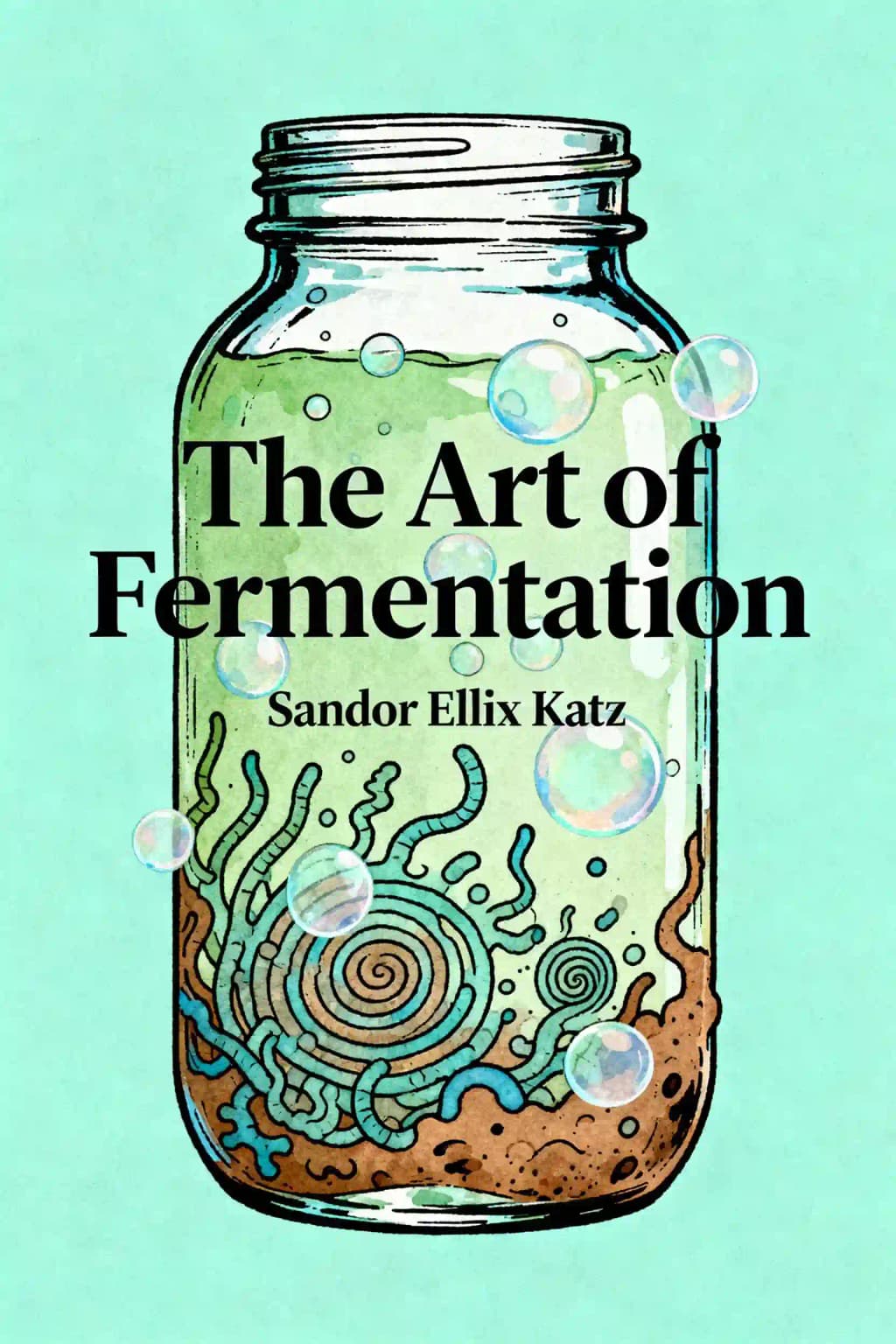
Discover the revolution that's transformed kitchens worldwide. Sandor Katz's James Beard Award-winning bible - endorsed by Michael Pollan as a declaration of independence from industrial food systems - has made fermentation accessible to over 250,000 readers. Ready to join the microbial rebellion?
Sandor Ellix Katz, author of The Art of Fermentation, is a James Beard Award-winning fermentation revivalist and a leading voice in DIY food preservation and microbial ecology. A New York City native and Brown University graduate, Katz’s expertise stems from decades of hands-on experimentation with fermented foods like sauerkraut, kombucha, and koji, driven by his passions for nutrition, gardening, and sustainable living. His work bridges food science and cultural tradition, emphasizing fermentation’s role in health and community resilience.
Katz’s influential Wild Fermentation (2003) sparked a global fermentation revival, followed by Fermentation as Metaphor (2020), which explores the philosophical and ecological dimensions of microbial processes. A sought-after educator, he has taught workshops in over 20 countries and been featured in The New York Times, NPR, and international documentaries. Residing in rural Tennessee, Katz is an advocate for queer and AIDS communities, crediting fermented foods as integral to his health journey.
The Art of Fermentation, hailed as the “fermentation bible,” has been translated into 12 languages and remains a cornerstone text in culinary schools and sustainability programs worldwide.
The Art of Fermentation is a comprehensive guide to home fermentation, blending practical techniques with cultural and scientific insights. It covers fermenting vegetables, dairy, grains, meats, and beverages like kombucha and mead, while emphasizing fermentation’s role in food preservation, health, and global traditions. The book balances beginner-friendly instructions with advanced concepts, making it a foundational resource for DIY enthusiasts.
This book is ideal for cooks, homesteaders, gardeners, and food lovers interested in preserving harvests, exploring probiotics, or reconnecting with ancestral food practices. It caters to novices (with troubleshooting tips) and experienced fermenters seeking deeper knowledge of microbial processes, safety parameters, and global fermentation traditions.
Yes—it’s a James Beard Award-winning New York Times bestseller praised as “the bible for the D.I.Y set.” Beyond recipes, it explores fermentation’s cultural roots, health benefits, and ecological impact, making it a timeless reference for both practical use and philosophical exploration.
Katz details methods for sauerkraut, kimchi, kefir, tempeh, sourdough, alcoholic beverages (mead, cider), and cured meats. He emphasizes flexibility, encouraging experimentation with wild fermentation (relying on ambient microbes) and controlled environments. Safety guidelines, container choices, and troubleshooting common issues (e.g., mold) are thoroughly addressed.
The book links fermentation to enhanced nutrition (e.g., increased vitamins), gut health, and immune support. Katz shares personal anecdotes about using fermented foods to manage health challenges, alongside scientific explanations of probiotics and bioactive compounds.
Katz examines fermentation’s role in human evolution, from preserving food scarcity to shaping regional cuisines. Case studies include Korean kimchi, Eastern European kvass, and Japanese koji, highlighting how microbial practices define cultural identities and sustainability.
While not a conventional recipe book, it offers flexible frameworks (e.g., salt ratios for kraut, fermentation timelines) rather than strict steps. This approach honors fermentation’s historical spontaneity and empowers readers to adapt techniques to local ingredients.
Some readers find its lack of step-by-step recipes challenging for beginners. Others note its dense scientific sections, though these are balanced by Katz’s accessible storytelling. Despite this, it remains the most authoritative work on fermentation theory and practice.
The Art of Fermentation expands on Katz’s earlier work Wild Fermentation with deeper scientific analysis, broader global examples, and advanced techniques (e.g., meat curing, mold cultivation). It’s more encyclopedic, whereas Wild Fermentation focuses on simple starter projects.
Yes. Katz discusses scaling homemade ferments, regulatory considerations, and market trends. He encourages small-batch production aligned with local food movements, citing examples like farmstead cheesemaking and kombucha startups.
As interest in probiotics, sustainability, and artisanal food grows, the book offers timeless wisdom for reducing food waste, enhancing nutrition, and reviving microbial diversity—key themes in today’s climate-conscious, health-focused culture.
Senti il libro attraverso la voce dell'autore
Trasforma la conoscenza in spunti coinvolgenti e ricchi di esempi
Cattura le idee chiave in un lampo per un apprendimento veloce
Goditi il libro in modo divertente e coinvolgente
Fermentation is a process of transformation.
We are essentially composite organisms.
Fermenting your own food is a political act.
The fundamental problem with this approach is that most bacteria protect us.
Scomponi le idee chiave di The Art of Fermentation in punti facili da capire per comprendere come i team innovativi creano, collaborano e crescono.
Vivi The Art of Fermentation attraverso narrazioni vivide che trasformano le lezioni di innovazione in momenti che ricorderai e applicherai.
Chiedi qualsiasi cosa, scegli il tuo stile di apprendimento e co-crea intuizioni che risuonano davvero con te.

Creato da alumni della Columbia University a San Francisco
"Instead of endless scrolling, I just hit play on BeFreed. It saves me so much time."
"I never knew where to start with nonfiction—BeFreed’s book lists turned into podcasts gave me a clear path."
"Perfect balance between learning and entertainment. Finished ‘Thinking, Fast and Slow’ on my commute this week."
"Crazy how much I learned while walking the dog. BeFreed = small habits → big gains."
"Reading used to feel like a chore. Now it’s just part of my lifestyle."
"Feels effortless compared to reading. I’ve finished 6 books this month already."
"BeFreed turned my guilty doomscrolling into something that feels productive and inspiring."
"BeFreed turned my commute into learning time. 20-min podcasts are perfect for finishing books I never had time for."
"BeFreed replaced my podcast queue. Imagine Spotify for books — that’s it. 🙌"
"It is great for me to learn something from the book without reading it."
"The themed book list podcasts help me connect ideas across authors—like a guided audio journey."
"Makes me feel smarter every time before going to work"
Creato da alumni della Columbia University a San Francisco

Ottieni il riassunto di The Art of Fermentation in formato PDF o EPUB gratuito. Stampalo o leggilo offline quando vuoi.
Imagine a world where your kitchen counter becomes a laboratory of transformation, where ordinary cabbage metamorphoses into tangy sauerkraut, and sweet tea evolves into effervescent kombucha. This is the world Sandor Katz invites us into-one where we partner with invisible allies that have shaped human civilization since its dawn. Fermentation isn't just an ancient food preservation technique; it's a profound act of cultural reclamation in an era dominated by processed foods and disconnection from traditional foodways. As we face growing concerns about industrial food systems, fermentation offers a revolutionary path back to food sovereignty. The microbes that transform our food represent our most ancient ancestors-the first life forms that emerged when Earth lacked sufficient oxygen. Through these microscopic partners, we can rediscover our place in the grand web of life and reclaim control of our food, health, and cultural heritage.
Our bodies host bacterial populations that outnumber our own cells by more than 10 to 1, with approximately 100 trillion bacteria residing in our intestines alone. These bacteria aren't passive hitchhikers-they break down otherwise indigestible nutrients, produce essential vitamins, defend against pathogens, and even modulate gene expression related to immune function. We are, in essence, composite organisms-walking ecosystems rather than isolated individuals. This understanding transforms how we think about food. The Japanese, for instance, possess specific seaweed-digesting enzymes acquired from marine bacteria not found in North American gut microbiomes-a testament to how our diet shapes our metabolic capabilities through the microbes we consume. Modern hyper-hygienic, processed foods deprive us of these environmental reservoirs of microbial genes that allow adaptation through lateral transfer. By consuming bacteria-rich living foods, we build genetic reservoirs inside our intestines that enhance our metabolic capabilities and strengthen our immune systems.
Fermentation creates compelling, complex flavors that form the backbone of gourmet cuisine worldwide. From olives cured in brine to the vast array of cheeses whose varieties stem from different bacteria and fungi, from sourdough breads to prized meats like salamis and prosciutto-fermentation enhances our culinary experiences in countless ways. The process fundamentally involves manipulating environmental conditions to encourage beneficial organisms while discouraging harmful ones. The profound connection between microbial cultures and human culture is no coincidence; both represent communities perpetuating themselves through time. Fermented foods appear in every culinary tradition worldwide. Immigrants crossing continents and oceans have carried their sourdoughs and fermentation starters with them as tangible embodiments of culture, deeply embedded in human desires and cravings. Alcohol, in particular, has shaped human cultural development for at least 9,000 years, functioning as a holy sacrament in both indigenous traditions and major world religions, connecting humans with gods and ancestors across cultures.
Though historically valued primarily for food preservation, fermentation offers considerable health benefits now confirmed by modern science. The process pre-digests food through bacterial and fungal enzymatic action, breaking down organic compounds into more accessible forms. Through this microbial digestion, minerals become more bioavailable and difficult-to-digest compounds are broken down. Fermentation often increases levels of B vitamins and creates unique micronutrients absent in raw ingredients. Japanese natto, for example, contains nattokinase, an enzyme with potent fibrinolytic activity beneficial for cardiovascular health and potentially helpful with Alzheimer's disease. In cabbage fermentation, compounds break down into isothiocyanates and indole-3-carbinol, which have cancer-preventive properties. Fermentation can also remove various toxic compounds from foods, sometimes transforming anti-nutrients into nutrients. High-cyanide cassava tubers are detoxified through fermentation, while the process also reduces naturally occurring nitrates and oxalic acid in vegetables and can biodegrade certain pesticide residues.
The basic technique for fermenting vegetables follows one fundamental principle: keeping vegetables submerged under liquid creates a selective environment where oxygen-dependent organisms cannot grow, encouraging beneficial acidifying bacteria. The simple "Chop, Salt, Pack, Wait" process underlies most vegetable fermentation traditions. While salt isn't absolutely required, it significantly improves taste, texture, and preservation potential by pulling water from vegetables, keeping them crisp, creating a selective environment favoring lactic acid bacteria, and extending preservation by slowing fermentation. For sour tonic beverages like kombucha or water kefir, you'll need starter cultures that are self-perpetuating. Some starters like ginger bug can be easily created at home by mixing grated ginger, sugar, and water, then stirring frequently and adding more ginger and sugar daily until vigorously bubbly. Others require obtaining SCOBY (symbiotic community of bacteria and yeast) cultures from enthusiasts or commercial sources. These cultures grow abundantly with use, making them easy to share and spread.
Grains and starchy tubers form humanity's most basic daily staples, but their dense, dry qualities make them difficult to digest without fermentation. They contain "anti-nutrients" like phytic acid that bind essential minerals and inhibit absorption. Fermentation transforms these compounds, neutralizing their harmful effects and increasing nutrient bioavailability. The simplest grain fermentation method is soaking, which activates both the dormant seed and its surface microbes. Water revives bacteria and fungi on grain surfaces, initiating fermentation while the grain begins its germination process. Milk fermentation follows similar principles of transformation. Throughout history, most people consumed milk primarily in fermented forms which stabilized the highly perishable substance. As lactic acid bacteria digest lactose, they create acid that causes casein proteins to separate and rebond into a continuous meshwork, transforming liquid milk into a fragile solid that separates into curds and whey. From yogurt and kefir to countless regional cheese varieties, fermentation creates dairy products that are more digestible, nutritious, and longer-lasting than fresh milk.
We must reclaim our food. Today's supermarket shelves showcase products of a globalized system built on proprietary genetics, synthetic chemicals, monocultures, long-distance transportation, factory processing, wasteful packaging, and energy-intensive refrigeration. This system destroys the earth, our health, economic vitality, and robs us of dignity by breeding dependency. Start by fermenting something-anything. Make sauerkraut in your kitchen, brew kombucha on your counter, or culture yogurt in your oven with the light on. Each jar of bubbling vegetables or tangy sourdough connects you to ancestors who developed these techniques over millennia. Through these living foods, build relationships with local farmers, share cultures with neighbors, and rediscover the joy of creating rather than merely consuming. By engaging life forces through practices like fermentation, we consciously cultivate a web of relationships that extends beyond our individual bodies. We practice cultural revival and reconnect with our context in the living world. In a time of growing disconnection, fermenting foods offers a tangible way to reclaim our heritage, improve our health, and participate in a quiet revolution-one jar, one loaf, one culture at a time.