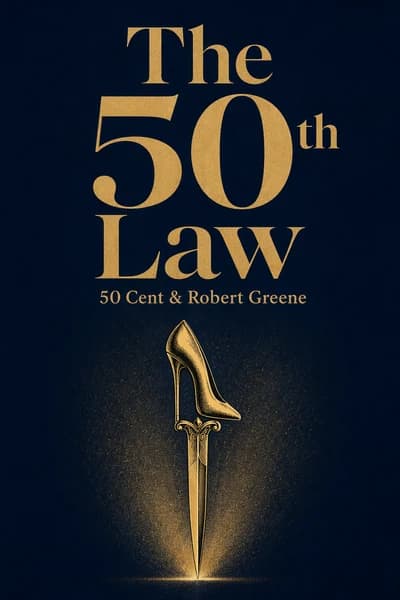
The 50th law
Panoramica di The 50th law
In "The 50th Law," hip-hop icon 50 Cent and bestseller Robert Greene blend street wisdom with philosophy, revealing how fearlessness transforms adversity into opportunity. What makes billionaires and celebrities embrace this unconventional guide? The answer lies in mastering fear itself.
Temi chiave in The 50th law
- radical realism
- calculated risk-taking
- strategic self-reliance
- street-smart pragmatism
- psychological fearlessness
Citazioni da The 50th law
Your fears are a prison limiting your potential.
The greatest danger is a soft mind and dull eye.
Dependency is a prison we easily enter but cannot leave.
Move higher up the food chain, eliminating dependencies.
Every negative situation contains potential for something positive.
Personaggi di The 50th law
- 50 CentHip-hop artist and entrepreneur (Curtis Jackson)
- Robert GreeneAuthor and strategist who co-wrote the book
- TruthAn older hustler who mentored Curtis Jackson
- Rubin "Hurricane" CarterBoxer used as a case study in self-reliance
Sull'autore
Sull'autore di The 50th law
Curtis "50 Cent" Jackson and Robert Greene are the collaborative authors of The 50th Law, a New York Times bestselling book blending strategy, self-help, and philosophy.
Jackson, a Grammy-nominated rapper and entrepreneur, rose to fame with his multi-platinum album Get Rich or Die Tryin'. He leveraged his street-smart background into successful ventures like G-Unit Records and a historic stake in Vitamin Water.
Greene, renowned for his expertise in power dynamics and human behavior, is the bestselling author of The 48 Laws of Power and The Art of Seduction, works celebrated for their historical insights into strategy and influence.
Their partnership merges Jackson’s real-world resilience with Greene’s scholarly analysis, framing fearlessness as the cornerstone of success. Greene’s prior books, required reading in industries from tech to finance, have sold millions globally, while Jackson’s story has been featured in Forbes, Bloomberg, and his semi-autobiographical film Get Rich or Die Tryin’.
The 50th Law has been translated into over 20 languages and remains a staple in entrepreneurial and personal development circles.
Scarica il riassunto di The 50th law
Ottieni il riassunto di The 50th law in formato PDF o EPUB gratuito. Stampalo o leggilo offline quando vuoi.
FAQ su questo libro
The 50th Law by 50 Cent and Robert Greene advocates for fearlessness as the ultimate tool for success, blending street wisdom with historical strategy. The book outlines 10 principles—such as intense realism, self-reliance, and confronting mortality—to overcome societal anxieties and gain power. Using 50 Cent’s journey from hustler to mogul, it emphasizes adaptability, audacity, and leveraging harsh realities to thrive.
Entrepreneurs, leaders, and individuals seeking to overcome self-doubt or societal constraints will benefit most. Its lessons on resilience and self-reliance resonate with those navigating competitive environments, from startups to creative ventures. Fans of Robert Greene’s 48 Laws of Power or 50 Cent’s rags-to-riches story will find it particularly compelling.
Yes—it offers actionable frameworks for transforming fear into strategic advantage. The blend of 50 Cent’s gritty anecdotes (e.g., surviving shootings, building empires) and Greene’s philosophical insights creates a unique guide for modern hustlers. Critics praise its unflinching focus on self-ownership, though some note its aggressive tone.
Key ideas include:
- Intense Realism: See the world without illusions to exploit opportunities.
- Self-Reliance: Avoid dependency by building independent ventures.
- The Sublime: Confront mortality to fuel urgency.
- Fluidity: Adapt rapidly to changing circumstances.
The book frames fear as a prison and fearlessness as liberation.
Fearlessness isn’t recklessness—it’s a calculated embrace of risk and reality. The authors argue that societal anxiety stems from avoiding harsh truths (e.g., mortality, competition). By accepting these realities, you gain clarity to act boldly. 50 Cent’s mantra—“I fear mediocrity more than failure”—exemplifies this mindset.
The “Hustler’s Eye” refers to hyper-awareness of opportunities and threats. 50 Cent honed this by observing drug dealers’ survival tactics, learning to distrust surface appearances and anticipate shifts in power. Greene ties this to historical figures like Machiavelli, who advised rulers to “see things as they are, not as they ought to be”.
The book warns against relying on employers or systems: “When you work for others, you’re at their mercy.” Instead, build “little empires” (side ventures) to retain autonomy. 50 Cent exemplifies this by transitioning from bagging drugs to producing crack independently, ensuring control over his income.
Chapter 10 argues that confronting death—the “sublime”—fuels urgency and purpose. 50 Cent’s near-fatal shooting taught him to act decisively, while Greene cites Stoic philosophy: accepting mortality frees you from trivial fears. The lesson: “Live with the intensity of someone who knows time is limited”.
Both emphasize strategic ruthlessness, but The 50th Law focuses on internal mindset (fearlessness) rather than external tactics. It blends Greene’s historical analysis with 50 Cent’s modern hustle, making it more narrative-driven. Critics note it’s less cynical than 48 Laws, advocating authenticity alongside ambition.
Some argue its glorification of hustling oversimplifies systemic barriers. Others find the fusion of 50 Cent’s street stories with Greene’s academic tone jarring. However, supporters counter that its raw practicality resonates in competitive fields like entrepreneurship.
The book’s “fluid” mindset teaches adaptability—e.g., 50 Cent pivoting from drugs to music after realizing rap’s scalability. Greene advises “moving up the food chain” by seeking higher leverage roles. For career changers, this means prioritizing autonomy and skill diversification over stability.
- “Your fears are a prison that confines you within a limited range of action.”
- “The ultimate power is to be completely yourself.”
- “There are no Alps for a fearless mind.” (Paraphrasing Machiavelli)
These emphasize rejecting conformity and societal anxiety.
In an era of AI disruption and gig economies, its lessons on self-reliance and adaptability remain critical. The rise of solo entrepreneurship and remote work aligns with its “little empires” philosophy, making it a manual for navigating uncertainty.