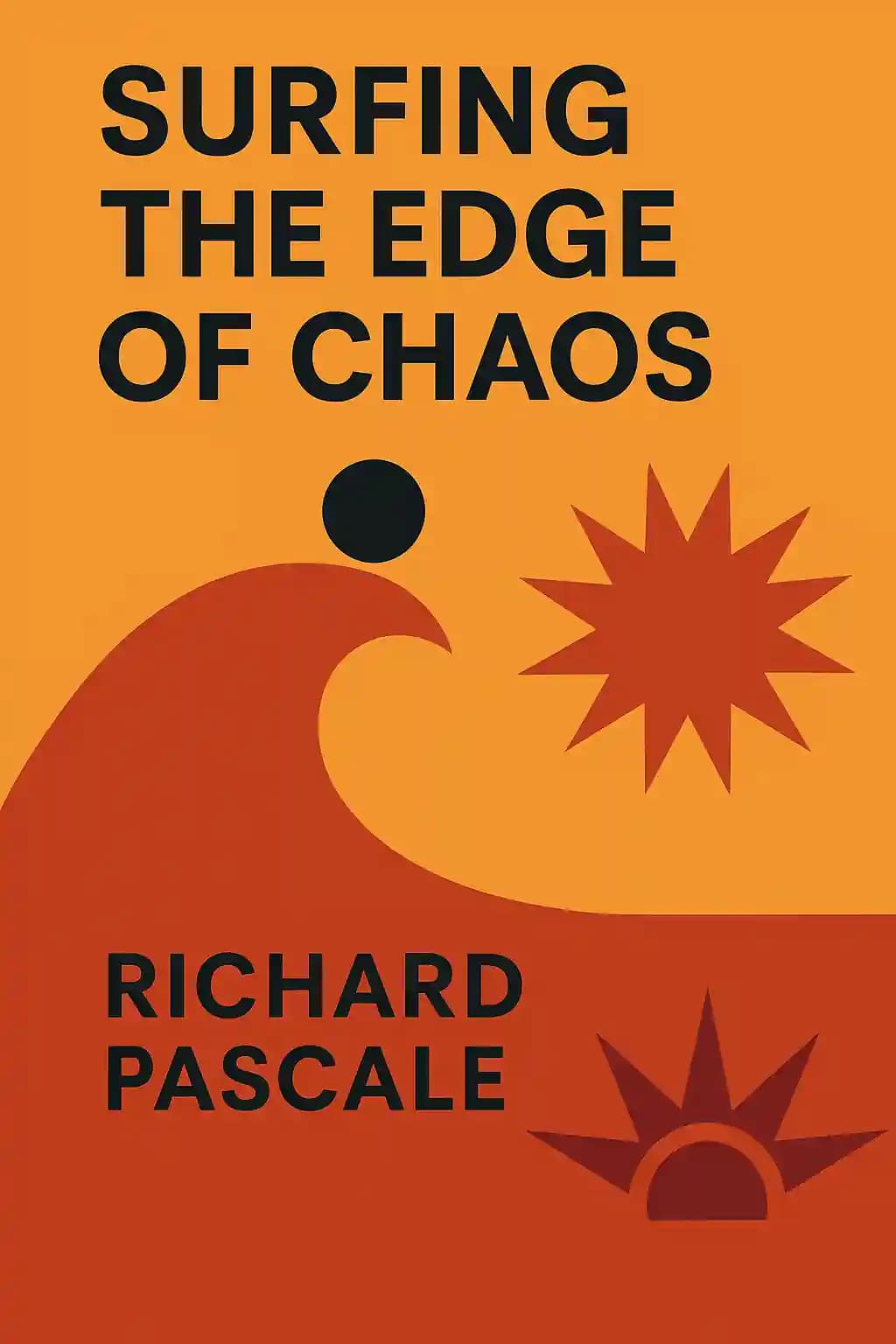
In "Surfing the Edge of Chaos," Pascale reveals how successful organizations thrive by embracing nature's principles rather than fighting them. NASA's adaptive leadership model draws from these concepts. Can your business evolve or will it become extinct in today's unpredictable landscape?
Richard Tanner Pascale, Linda Gioja, and Mark Milleman are the authors of Surfing the Edge of Chaos and pioneering thinkers in organizational strategy and complexity science.
Pascale (1938–2024), a Harvard MBA and Stanford Business School faculty member for two decades, was hailed by The Economist as one of the "leading management gurus of the past 50 years." His expertise in blending biological systems theory with business innovation stems from consulting Fortune 100 companies and his role as an Oxford Saïd Business School Associate Fellow. Co-author Mark Millemann contributed his systems-thinking acumen, while Linda Gioja brought fresh perspectives to their exploration of chaos theory’s applications to leadership.
Pascale’s seminal works, including The Art of Japanese Management (a foundational text on 1980s corporate strategy) and Managing on the Edge, established his reputation for challenging conventional management practices. Surfing the Edge of Chaos builds on his legacy, offering frameworks for thriving in volatile markets. Translated into multiple languages, the book remains a staple in business curricula and executive training programs worldwide.
Surfing the Edge of Chaos explores how businesses can thrive in turbulent environments by applying principles from complexity science. The book argues that organizations must balance structure and flexibility, operating at the "edge of chaos" to foster innovation and adaptability. Using case studies from companies like Monsanto and British Petroleum, it provides frameworks for managing change in dynamic markets.
This book is ideal for leaders, managers, and entrepreneurs navigating organizational transformation. It’s also valuable for students of management science seeking insights into complexity theory and real-world applications. Readers interested in systemic change, innovation strategies, or corporate resilience will find actionable guidance.
Yes, the book remains relevant for its pioneering synthesis of biological systems and business strategy. It offers timeless principles for adaptive leadership, supported by case studies and quotes from industry leaders like Warren Bennis. Its focus on balancing stability and agility makes it essential for modern organizational challenges.
The book was co-authored by Richard Tanner Pascale, a renowned management theorist and Stanford professor; Mark Millemann, a complexity science expert; and Linda Gioja, a consultant specializing in organizational change. Pascale, hailed by The Economist as a top management guru, also wrote The Art of Japanese Management.
The "edge of chaos" refers to a state where systems maintain enough structure to function cohesively but enough flexibility to evolve. In business, this means encouraging experimentation while preserving core stability—a concept illustrated through examples like BP’s adaptive response to market shifts.
The authors analyze companies like Monsanto and British Petroleum, showcasing how they embraced complexity principles to navigate disruption. For instance, BP’s decentralized approach during the 1990s oil crises exemplifies "self-organization," a key theme in the book.
Unlike The Art of Japanese Management (focused on static strategies), this book addresses dynamic, unpredictable markets. It builds on Pascale’s Managing on the Edge by integrating complexity science and biological metaphors, offering a more fluid framework for change.
As businesses face AI disruption, climate challenges, and geopolitical shifts, the book’s emphasis on adaptability remains critical. Its principles help organizations respond to hyper-turbulent environments, making it a staple for modern leadership and innovation strategies.
Leaders learn to foster environments where creativity and structure coexist. By embracing uncertainty and decentralizing authority, they can drive resilience—a approach endorsed by thought leaders like Gary Hamel, who called the book an “action plan” for revitalizing organizations.
Senti il libro attraverso la voce dell'autore
Trasforma la conoscenza in spunti coinvolgenti e ricchi di esempi
Cattura le idee chiave in un lampo per un apprendimento veloce
Goditi il libro in modo divertente e coinvolgente
Equilibrium precedes death, making systems less responsive to change.
Living things move toward the edge of chaos when threatened.
Equilibrium often disguises itself as advantage.
Diversity provides crucial protection against threats.
Corporate “fringes” generate the most innovative ideas.
Scomponi le idee chiave di Surfing the Edge of Chaos in punti facili da capire per comprendere come i team innovativi creano, collaborano e crescono.
Vivi Surfing the Edge of Chaos attraverso narrazioni vivide che trasformano le lezioni di innovazione in momenti che ricorderai e applicherai.
Chiedi qualsiasi cosa, scegli il tuo stile di apprendimento e co-crea intuizioni che risuonano davvero con te.

Creato da alumni della Columbia University a San Francisco
"Instead of endless scrolling, I just hit play on BeFreed. It saves me so much time."
"I never knew where to start with nonfiction—BeFreed’s book lists turned into podcasts gave me a clear path."
"Perfect balance between learning and entertainment. Finished ‘Thinking, Fast and Slow’ on my commute this week."
"Crazy how much I learned while walking the dog. BeFreed = small habits → big gains."
"Reading used to feel like a chore. Now it’s just part of my lifestyle."
"Feels effortless compared to reading. I’ve finished 6 books this month already."
"BeFreed turned my guilty doomscrolling into something that feels productive and inspiring."
"BeFreed turned my commute into learning time. 20-min podcasts are perfect for finishing books I never had time for."
"BeFreed replaced my podcast queue. Imagine Spotify for books — that’s it. 🙌"
"It is great for me to learn something from the book without reading it."
"The themed book list podcasts help me connect ideas across authors—like a guided audio journey."
"Makes me feel smarter every time before going to work"
Creato da alumni della Columbia University a San Francisco

Ottieni il riassunto di Surfing the Edge of Chaos in formato PDF o EPUB gratuito. Stampalo o leggilo offline quando vuoi.
What if everything you learned about managing organizations is fundamentally wrong? Picture the dodo bird-flightless, defenseless, and perfectly adapted to an island paradise without predators. Then humans arrived, and within decades, the species vanished. Now consider IBM's strategic planners in the 1980s, who accurately predicted the shift to personal computers and open architecture. They saw the future clearly, yet their organization changed nothing. Instead, executives simply raised mainframe prices to cover declining margins, watching their empire crumble in slow motion. This isn't a story about ignorance-it's about something far more dangerous: organizational equilibrium masquerading as strength. The most haunting question in business isn't whether you can see threats coming. It's whether you can respond when everything in your culture screams to maintain the status quo. Fortune 500 companies show declining survival rates: 10% attrition from 1976-1985, jumping to 30% from 1986-1990, and 36% from 1991-1996. Most likely saw competitive threats coming but couldn't translate awareness into action.
For centuries, we've managed organizations like Newtonian machines-predictable, linear, controllable. But a scientific revolution is rewriting these rules, drawing wisdom from living systems. Nature doesn't optimize for control; it optimizes for adaptation through innovate, proliferate, aggregate. Microsoft Windows dominated through rapid reproduction and strategic aggregation, not superior engineering. Termites, each following simple rules, collectively build twelve-foot architectural marvels with regulated climates, housing millions without central planners. Cemex and British Telecom saved millions using ant-foraging algorithms for fleet management. Organizations are complex adaptive systems-networks of independent agents constantly refining models through learning. Four principles govern them: equilibrium precedes death, threatened systems move toward chaos's edge, components self-organize into emergent forms, and you cannot direct them linearly-only disturb them toward desired outcomes. Yet equilibrium disguises itself as strength. Yellowstone spent a century extinguishing fires, creating artificial stability that allowed deadfall to accumulate. When drought arrived in 1988, this equilibrium fueled North America's largest fire. "In Search of Excellence" celebrated forty-three companies with perfect organizational fit. Within five years, half struggled. Australia's biodiversity offers a haunting parallel: after 40 million years of isolation, unique species evolved without defenses. European-introduced animals eliminated 80% of Australia's biodiversity within 200 years. Nature solved this through sexual reproduction, maximizing diversity through random chromosome combinations. When bubonic plague returned to Europe after initially decimating 30% of the population, subsequent waves claimed fewer victims because sexual reproduction had distributed protective antibodies. Diversity isn't nice to have-it's survival insurance.
In 1995, Sears achieved the greatest shareholder value appreciation among Fortune 500 companies, reversing four decades of decline. Chairman Arthur Martinez added $2 billion in market share, yet implemented almost nothing new strategically. His predecessor Ed Brennan had sold the Sears Tower, launched Brand Central, created the Discover Card, and cut 48,000 jobs - but failed completely. The difference wasn't strategy - it was understanding equilibrium. Brennan's recentralization created "drive-by merchandising," where headquarters claimed to know local markets better than store managers. Martinez deployed multiple disruptions: mandating 20% external hires for managerial roles, "zero-basing" the top 150 jobs, replacing five of eight executives, and demanding accountability. He told his top fifty executives, "Yesterday's peacock is tomorrow's feather duster." The Phoenix team launched thousands of Town Hall meetings using "learning maps" - six-foot-wide visual devices showing competitive evolution from 1950s Main Street through 1980s category killers. Nearly two-thirds of 300,000 employees participated, generating half a million suggestions that added 9% to sales and doubled store profitability. Yet Martinez's lieutenants never embraced employee mobilization, issuing cost-cutting edicts that destroyed newfound commitment - a reminder that breaking equilibrium is only the beginning.
The South American fire ant arrived in America before World War II and spread across 260 million acres despite eradication efforts. Under extreme threat, colonies evolved a remarkable adaptation: permanent multiple-queen colonies with up to 300 queens simultaneously laying eggs. These super-colonies reach extraordinary densities - 400 mounds per acre instead of 40, containing 22.6 million ants per acre. Workers arrive at food sources in twenty seconds versus two minutes. The ants found the edge of chaos - that permeable, intermediate condition where order and disorder flow - and thrived there. Intel's Andy Grove understood this instinctively, guiding Intel through major transitions: from semiconductors to memory chips, from DRAMs to microprocessors when Asian competition destroyed their market, and through the controversial Pentium branding strategy. His approach involved two phases: first allowing chaos to reign through experimentation, then guiding the organization through "the Valley of Death" - the disruptive but necessary transition before emerging with clarity. Three concepts from complexity science help navigate this edge: attractors that orient systems in particular directions, amplifying and damping feedback that accelerates or slows change, and fitness landscapes that map competitive advantage. Strange attractors emerge from interactions between organisms and environments - the land mine treaty arose from convergence of global communications, human empathy, mine-detecting technology, and international cooperation. Fitness landscapes come in three types: gradual like northern France, rugged like Nepal, or random like the moon's meteor-shaped surface. When threatened species like the North American coyote are driven from habitats, they descend the fitness landscape toward chaos, adapting to new environments that may ultimately prove superior - as with coyotes now thriving in Malibu and Beverly Hills.
How do 20,000 bees maintain hive temperature within one degree year-round? No central planner coordinates this-just simple rules creating sophisticated collective behavior. This is self-organization, and it's everywhere. Dental plaque bacteria signal each other to form structures a thousand times more antibiotic-resistant than individual cells. Tupperware built a $2 billion business through self-employed dealers recruiting hosts-networks bound by social capital and incentives. Visa captured half the credit card market through decentralized structure with no hierarchy. Alcoholics Anonymous created a simple 12-step process with no hierarchy, paid staff, or endowment-DNA that now powers hundreds of organizations engaging over thirty million people globally. Yet self-organization requires boundaries. Mao's vague Cultural Revolution directives without constraints led to chaos. Conversely, excessive control throttles it-"participative management" initiatives often seek superficial buy-in while limiting genuine contributions. Productive self-organization needs clear boundaries and genuine autonomy.
Ranchers spent $3 billion over a century trying to eliminate coyotes. The result? Coyotes expanded from eleven western states to all forty-nine continental states, growing 20 percent larger and smarter. Federal Express faced similar resistance when algorithms optimized pilot scheduling-pilots formed a union and demanded the system's abandonment. Living systems cannot be directed but can be gently guided through architectural design that provides structural integrity while remaining intentionally incomplete, allowing people to infuse their values over time. Because practical knowledge is socially acquired, influencing the social system efficiently alters the knowledge system. The central premise: adults act their way into new thinking rather than think their way into new acting. You cannot design transformation from scratch-you must disturb the existing system enough to allow new possibilities to emerge. Prairie restoration teaches this lesson. Success came from introducing fire as a destabilizing force that allowed remaining prairie members to quicken the system's reassembly. British Petroleum's Exploration unit used the Seven-S Framework to examine gaps between strategy and reality-a gap so intimidating it generated productive disequilibrium. Participants recognized dysfunctional structure, incompatible systems, "warring tribes" culture, and mediocre skills. This juxtaposition catalyzed transformation.
Nature's deepest lesson: vitality comes from perpetual motion at chaos's edge, not stability. The disciplines sustaining organizational vitality-infusing understanding of success drivers, insisting on straight talk, managing from the future, rewarding inventive accountability, learning from mistakes, fostering relentless discomfort, and cultivating reciprocity-aren't management techniques but fractal-like routines that help organizations sustain disequilibrium. Southwest Airlines embodies this paradox, treating employees as knowledge workers while encouraging playfulness-flight attendants pop out of overhead bins and sing safety announcements-yet maintaining costs 25% below industry standard. They screen 150,000 applications yearly to hire 5,000 people, putting employees first, customers second, shareholders third. This reciprocity enables distributed intelligence to unite for common good. Your organization isn't a machine to optimize-it's a living system to nurture. Stop trying to control it. Start learning to dance with it. In a world where equilibrium precedes death, the only sustainable competitive advantage is the capacity to keep moving, keep adapting, keep living at the edge where order meets chaos.