Capitolo 1
The Divine Symphony: Thomas Aquinas' Theological Masterpiece
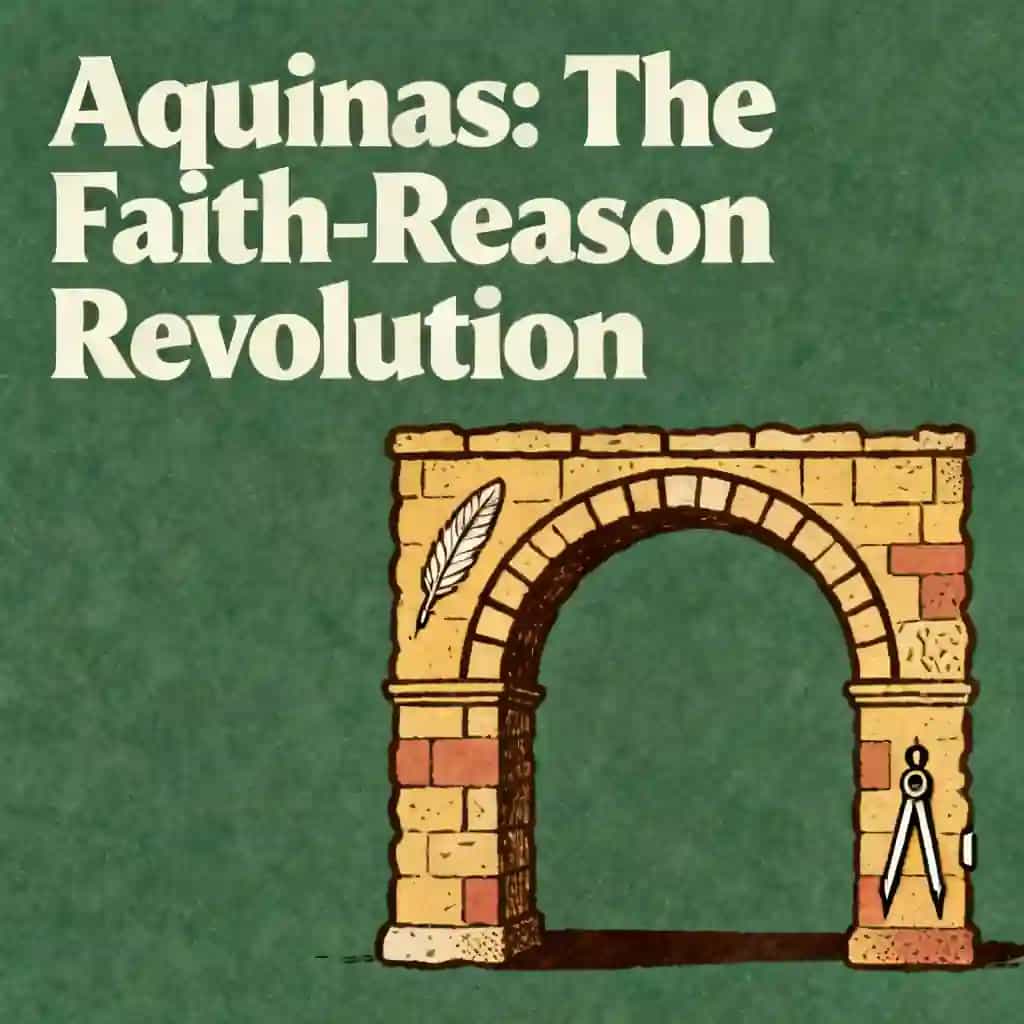
Have you ever wondered what happens when one of history's most brilliant minds turns his attention to the deepest questions of existence? Thomas Aquinas' Summa Theologica represents perhaps the most ambitious intellectual project ever undertaken by a single human being. Completed between 1265 and 1274, this monumental work has influenced everyone from Pope Francis to Justice Antonin Scalia. Even secular philosophers like Bertrand Russell acknowledged its formidable intellectual architecture. What's remarkable is how this 13th-century text continues to shape modern thought-Catholic universities still use it as a foundational text, and its methodical approach to reasoning influences fields far beyond theology. The work's enduring power lies in its systematic attempt to harmonize faith and reason, a project that remains relevant in our increasingly fragmented intellectual landscape.
Capitolo 2
The Architecture of Divine Wisdom: Understanding God's Nature
Aquinas begins his theological journey with a profound exploration of God's existence and nature. Rather than starting with blind faith, he employs rational arguments that even non-believers might find compelling. His famous "Five Ways" demonstrate God's existence through observation of the natural world-not through scriptural authority alone.
"Nothing can move itself without being moved by another," Aquinas reasons in his first argument. Consider how this chain of causation must eventually lead to an "Unmoved Mover"-something that causes movement without itself being moved. Similarly, when we observe the world's intricate order, we must acknowledge an intelligent designer. As Aquinas puts it, "Things that lack intelligence, such as natural bodies, act for an end... therefore some intelligent being exists by whom all natural things are directed to their end."
What's revolutionary about this approach is how Aquinas refuses to separate faith from reason. Unlike many religious thinkers who view rational inquiry as threatening to faith, Aquinas sees reason as a divine gift that complements revelation. He writes, "Grace does not destroy nature but perfects it." This principle undergirds his entire theological system.
When discussing God's attributes, Aquinas employs what scholars call the "via negativa"-defining God by what He is not. God is not limited by time (eternal), not composed of parts (simple), not changeable (immutable). This approach acknowledges human language's limitations when describing the divine. Think about it: how can finite human concepts fully capture an infinite being?
Aquinas also explores how we can meaningfully speak about God despite these limitations. When we say "God is good," we're using analogical language-neither purely literal nor purely metaphorical. Divine goodness is the perfect form of what we experience as goodness in creation, though infinitely greater. This nuanced understanding of religious language offers a middle path between naive literalism and complete skepticism about God-talk.
Capitolo 3
The Human Person: Body and Soul United
Aquinas' anthropology-his understanding of human nature-represents one of his most enduring contributions. Against the Platonic and Augustinian traditions that viewed the body as a prison for the soul, Aquinas insists that humans are fundamentally psychosomatic unities-body and soul together form one complete substance.
"The soul is the form of the body," he writes, drawing on Aristotle. This means the soul isn't a ghost inhabiting a machine but the organizing principle that makes a body human. When you recognize your friend across the street, it's not just your soul recognizing their soul-it's you, a unified being, recognizing another unified being.
This has profound implications. For Aquinas, embodiment isn't a punishment or temporary condition but essential to human nature. Our physical senses aren't obstacles to knowledge but gateways to it: "Nothing is in the intellect that was not first in the senses." Even our highest intellectual activities begin with sensory experience.
Consider how this contrasts with both ancient dualism and modern materialism. Unlike Plato, who saw the body as a tomb for the soul, Aquinas celebrates embodiment. Unlike modern materialists who reduce consciousness to brain activity, he maintains that intellectual operations transcend matter. The human person emerges as neither a disembodied spirit nor a sophisticated machine, but a unique kind of being straddling material and spiritual realms.
This balanced anthropology extends to Aquinas' understanding of human knowledge. We aren't born with innate ideas, nor are we blank slates. Rather, we have natural capacities that develop through interaction with the world. Knowledge begins with sensation but doesn't end there-the active intellect abstracts universal concepts from particular experiences. When you understand "triangle," you grasp something that transcends any particular triangle you've seen.
Capitolo 4
The Moral Journey: Virtue and the Path to Happiness
What constitutes human flourishing? For Aquinas, happiness (beatitudo) isn't merely a subjective feeling but objective fulfillment of our nature. "The ultimate end of human life is happiness," he writes, but true happiness consists in knowing and loving God-the infinite good that alone can satisfy our unlimited desire for goodness.
Aquinas' ethical framework integrates Aristotelian virtue ethics with Christian theology. Virtues are habitual dispositions that perfect human powers. The cardinal virtues-prudence, justice, fortitude, and temperance-perfect natural human capacities, while the theological virtues-faith, hope, and charity-are divinely infused to direct us toward supernatural happiness.
Consider prudence, which Aquinas calls "right reason applied to action." Unlike mere cleverness, prudence involves discerning the true good and appropriate means to achieve it. A prudent person doesn't just calculate consequences but recognizes what truly fulfills human nature. Justice gives others their due, fortitude enables perseverance through difficulties, and temperance moderates physical pleasures according to reason.
What makes Aquinas' moral theory so compelling is its integration of multiple ethical perspectives. It incorporates virtue ethics' focus on character, natural law's emphasis on rational principles, and divine command theory's recognition of God's authority-all without reducing ethics to any single dimension.
His treatment of natural law deserves special attention. Natural law isn't arbitrary divine command but the rational creature's participation in eternal law. Its first principle-"Good is to be done and pursued, and evil avoided"-serves as the foundation for more specific moral precepts. This approach allows Aquinas to explain both moral universals and legitimate cultural variations in ethics.
Capitolo 5
Law and Society: Ordering the Common Good
Aquinas' political philosophy represents a sophisticated attempt to balance individual rights with community needs, offering a framework that remains remarkably relevant to contemporary political challenges. Law, properly understood, is "an ordinance of reason for the common good, promulgated by one who has care of the community." This definition contains four essential elements: rationality (law must be based on reason, not arbitrary will), common good orientation (law serves collective welfare), legitimate authority (law must come from recognized leadership), and promulgation (law must be publicly declared and knowable).
Human law derives its binding force from natural law - the universal moral principles accessible to human reason. When lawmakers enact legislation contrary to natural law, they create what Aquinas calls "perversions of law" that lack moral authority. "An unjust law is no law at all," he famously states, anticipating civil disobedience traditions by centuries. This principle influenced figures from Martin Luther King Jr. to modern human rights advocates, providing philosophical groundwork for resistance to unjust regimes.
Yet Aquinas is no revolutionary. He believes political authority is necessary for social order and human flourishing, arguing that even imperfect governments are preferable to anarchy. The purpose of government isn't to control citizens but to create conditions where virtue can flourish. "The proper effect of law is to lead its subjects to their proper virtue," he writes. Good laws make good citizens not through coercion but by creating an environment conducive to moral development - through education, incentives for good behavior, and removal of obstacles to virtue.
His understanding of justice distinguishes between commutative justice (governing exchanges between individuals) and distributive justice (allocating common goods proportionally). Commutative justice ensures fairness in private transactions, contracts, and remedies for wrongs. Distributive justice addresses broader social questions: how should society's benefits and burdens be shared? This nuanced approach recognizes that justice requires both fair exchanges and equitable distribution according to merit and need. For example, while everyone deserves basic necessities, positions of authority should be allocated based on capability and virtue.
Aquinas' political vision transcends modern categories of "liberal" and "conservative." He defends private property as necessary for social peace and efficient resource management while insisting that ownership carries social obligations - the wealthy have duties to assist the poor. He affirms legitimate political authority while establishing moral limits on government power, arguing that rulers must serve the common good rather than personal interests. His theory of mixed government, combining elements of monarchy, aristocracy, and democracy, influenced later constitutional thinking. This balanced approach continues to inspire political thinkers across the ideological spectrum, from Catholic social teaching to secular political philosophy.
In practical terms, Aquinas addresses specific questions of governance: taxation (justified when serving common good), resistance to tyranny (permissible under certain conditions), and international relations (emphasizing peace and justice between nations). His framework provides guidance for evaluating modern political challenges, from economic inequality to environmental stewardship.
Capitolo 6
The Sacramental Universe: Grace Perfecting Nature
For Aquinas, the material world isn't an obstacle to spiritual life but a medium through which divine grace operates. This sacramental vision reaches its apex in his theology of the seven sacraments-visible signs that truly effect what they signify.
"A sacrament is a sign of a sacred thing insofar as it sanctifies men," Aquinas writes. Unlike mere symbols that point to absent realities, sacraments make present what they represent. In baptism, water doesn't just symbolize spiritual cleansing-it actually effects it. In the Eucharist, bread and wine become Christ's body and blood not just symbolically but substantially.
This understanding depends on Aquinas' Aristotelian metaphysics, particularly the distinction between substance and accidents. In transubstantiation, the bread's substance changes while its accidents (appearance, taste, etc.) remain. Modern minds might find this difficult, but Aquinas' point is profound: material reality can mediate divine presence without being obliterated by it.
The sacramental principle extends beyond formal sacraments to Aquinas' entire worldview. Created things aren't obstacles to God but revelations of divine goodness. "From the greatness and beauty of created things comes a corresponding perception of their Creator," he writes, echoing the Book of Wisdom. This sacramental vision inspired Catholic art, architecture, and literature for centuries.
Aquinas' understanding of grace similarly balances divine initiative with human freedom. Grace isn't opposed to nature but perfects it from within. God's grace operates not by overriding human freedom but by elevating it to participate in divine life. As he famously puts it, "Grace does not destroy nature but perfects it."
Capitolo 7
The Harmony of Faith and Reason: Theological Method
Perhaps Aquinas' most enduring contribution is his theological method - the systematic and rigorous way he approaches questions of faith and philosophy. Each article in the Summa Theologica follows a precise dialectical structure: a question is posed, objections are stated with their full force, an authoritative counter-position (sed contra) is cited, Aquinas presents his detailed response (respondeo), and finally he methodically answers each objection individually.
This method demonstrates remarkable intellectual honesty and academic rigor. Aquinas presents the strongest possible arguments against his position before responding, often articulating his opponents' views more clearly than they themselves did. He engages opposing viewpoints with genuine respect and careful attention, rather than creating straw men or dismissing them outright. Even when citing authorities like Augustine or Aristotle, he subjects their claims to rational scrutiny and isn't afraid to respectfully disagree when necessary.
Consider his treatment of whether God exists (Summa I, Q.2). He first presents powerful objections: the problem of evil in the world, the apparent sufficiency of natural causes to explain phenomena, and the seeming absence of divine intervention. Only after acknowledging these serious challenges does he develop his famous "Five Ways" - the quinque viae - demonstrating God's existence through natural reason. This approach models intellectual humility and thoroughness, recognizing that faith seeks understanding through honest engagement with difficulties rather than avoiding them.
Aquinas' method also demonstrates his fundamental conviction that faith and reason are complementary paths to truth, not contradictory forces. He carefully distinguishes different types of knowledge: revealed truths like the Trinity exceed reason's natural grasp but don't contradict it; purely natural knowledge like mathematical or scientific truths are fully accessible to reason without need for revelation; and between these extremes lie truths like God's existence that can be known both by revelation and rational demonstration. This nuanced categorization helps clarify the relationship between natural and revealed theology.
This balanced approach offers a sophisticated alternative to both fideism (rejecting reason in favor of blind faith) and rationalism (accepting only what human reason can definitively prove). For Aquinas, faith and reason are like two wings on which the human spirit rises to contemplation of truth - each insufficient alone but powerful together. His method demonstrates practically how these two modes of knowing can work in harmony while respecting their distinct natures and limitations. This synthesis continues to influence theological and philosophical methodology today, offering a model for rigorous intellectual engagement that maintains both rational integrity and religious conviction.
Capitolo 8
Theological Virtues: Faith, Hope, and Charity
The theological virtues - faith, hope, and charity - occupy a central and distinctive position in Aquinas' moral theology. Unlike natural virtues that perfect inherent human capacities through practice and habit, theological virtues are directly infused by divine grace to orient human beings toward supernatural happiness. These virtues are supernatural in both their origin and their object, transcending what human nature can achieve through its own powers.
Faith represents intellectual assent to divine truth based on God's authority rather than human reasoning. It's neither blind credulity nor mere opinion, but rather a unique form of knowledge with its own particular certainty. "Faith is the substance of things hoped for, the evidence of things not seen," Aquinas quotes from Hebrews, emphasizing that faith provides a special kind of evidence. While natural reason proceeds from visible effects to causes, faith begins with divine revelation and moves toward understanding. This faith-based knowledge carries its own certainty - not through empirical demonstration or logical proof, but through trust in God's perfect truthfulness and wisdom.
Hope directs human desire toward eternal happiness with confident expectation while maintaining proper balance. It steers between two dangerous extremes: presumption, which expects salvation without appropriate effort or cooperation with grace, and despair, which considers salvation impossible despite God's mercy. Hope combines realistic recognition of human weakness and limitation with profound trust in divine mercy and power. It sustains the soul through difficulties by focusing on the ultimate good that God promises.
Charity - the love of God and neighbor - stands as the greatest of all virtues, serving as the "form" or animating principle that gives life and proper direction to all other virtues. Without charity, other virtues may produce externally good actions but cannot lead to ultimate happiness or union with God. "If I speak in human and angelic tongues but do not have love, I am a resounding gong," Aquinas quotes from Paul's First Letter to the Corinthians, emphasizing charity's essential role. This virtue transforms human love by participation in divine love itself, enabling genuine self-giving and universal benevolence.
These three virtues work together to transform the human person from within, each perfecting a different aspect of human nature. Faith illuminates the intellect with divine truth, providing supernatural knowledge of God's nature and plan. Hope elevates natural desire toward eternal goods, strengthening the will to persist in seeking its ultimate end. Charity conforms the human will to divine love, enabling authentic love of both God and neighbor. Together, they initiate participation in divine life - a participation that begins imperfectly in this life but will reach its perfect fulfillment in the beatific vision, where faith gives way to sight, hope to possession, and charity alone remains, perfectly fulfilled.
Capitolo 9
The Ultimate End: Contemplating Divine Truth
Aquinas' entire theological system culminates in the beatific vision - direct intellectual contemplation of God's essence. This ultimate human fulfillment transcends both faith and reason as we currently experience them, representing the pinnacle of human potential and spiritual achievement. The concept builds upon both Aristotelian philosophy and Christian revelation, synthesizing rational inquiry with divine truth.
"The ultimate happiness of man consists in the contemplation of truth," Aquinas writes, "for this operation is specific to man and is shared with no other animals." This uniquely human capacity for intellectual contemplation distinguishes us from all other creatures and points to our supernatural destiny. Yet complete happiness requires seeing God's essence, which exceeds natural human capacity. Only through divine grace can the human intellect be elevated to see God "face to face" - a transformation that surpasses our natural powers while fulfilling their deepest orientation.
This vision satisfies every human desire in a comprehensive way. The intellect finds perfect truth, eliminating all doubt and uncertainty. The will rests in perfect goodness, experiencing complete moral fulfillment. Human nature attains its ultimate fulfillment, reaching the end for which it was created. "This is eternal life," Aquinas quotes Jesus, "that they may know you, the only true God." This knowledge is not merely abstract or theoretical but deeply personal and transformative.
What's remarkable about this vision is how it integrates intellectual and affective dimensions of human experience. Unlike mystical traditions that abandon intellect for ecstatic union, Aquinas maintains that knowing and loving God are inseparable in perfect happiness. The beatific vision is simultaneously perfect knowledge and perfect love - a complete engagement of both mind and heart. This integration reflects Aquinas' broader understanding of human nature as a unity of rational and emotional capacities.
This final end gives meaning to the entire moral and spiritual journey, illuminating the purpose of all human striving. Virtues shape character for this ultimate encounter; laws guide behavior toward this supreme good; sacraments provide grace for this supernatural destiny. The Summa's structure reflects this journey: beginning with God as First Cause, proceeding through creation and human life, and culminating in return to God as Final End. Every element of Aquinas' thought - philosophical, theological, and moral - finds its coherence in this ultimate vision of divine truth.
The beatific vision also explains why no earthly good can provide complete satisfaction. Material prosperity, sensual pleasure, political power, and even natural knowledge - while good in themselves - cannot fulfill humanity's deepest longings. Only the infinite truth and goodness of God can satisfy the human heart's infinite capacity for knowledge and love.
Capitolo 10
The Enduring Legacy: Why Aquinas Still Matters
Eight centuries after Aquinas wrote, his thought remains astonishingly relevant. In an age of intellectual fragmentation, his comprehensive synthesis offers a model of integrated thinking that bridges multiple disciplines - from metaphysics and ethics to politics and psychology. When faith and reason are often portrayed as enemies, his harmonization of these domains provides a middle path between fundamentalism and skepticism, demonstrating how religious belief can coexist with rigorous rational inquiry.
His natural law theory continues to influence legal philosophy, offering a framework for universal human rights that doesn't depend on religious authority alone. This approach has shaped modern human rights declarations and constitutional law across multiple nations. His conception of natural law - grounded in human nature and discoverable through reason - provides a basis for cross-cultural moral dialogue in our diverse global society. For instance, his arguments about human dignity and the common good remain central to debates about social justice, environmental ethics, and bioethics.
His virtue ethics provides an alternative to both rigid rule-following and moral relativism. Rather than focusing solely on rules or consequences, Aquinas emphasizes character development and practical wisdom. This approach has experienced a renaissance in contemporary moral philosophy, influencing fields from business ethics to education. His detailed analysis of virtues like prudence, justice, courage, and temperance offers practical guidance for moral development that resonates with modern psychological insights about habit formation and character building.
His political philosophy balances individual rights with community needs in ways that transcend partisan divisions. Aquinas's concept of the common good - which respects individual dignity while recognizing our social nature - offers valuable insights for current debates about democracy, economic justice, and social responsibility. His thoughts on just war theory, property rights, and the limits of political authority remain relevant to contemporary international relations and political theory.
Perhaps most importantly, Aquinas demonstrates that faith can engage intellectual challenges without fear or compromise. His willingness to incorporate Aristotelian philosophy - considered dangerous by many of his contemporaries - shows that religious tradition can grow through dialogue with other perspectives. This intellectual courage provides a model for addressing contemporary challenges between science and religion, secular and sacred worldviews.
The Summa Theologica stands as one of humanity's greatest intellectual achievements - a cathedral of thought that invites us to explore the deepest questions of existence. Its systematic approach to knowledge integration, careful consideration of opposing viewpoints, and commitment to rational argumentation provide methodological tools valuable for any serious inquiry. Whether or not we share Aquinas' Catholic faith, his methodical pursuit of wisdom offers a model for anyone seeking to integrate knowledge into a coherent vision of reality. In our fragmented intellectual landscape, his synthesis reminds us that the human mind is capable of finding unity amid diversity, harmony amid apparent contradiction, and truth through careful reasoning and open dialogue.