Masaaki Imai's "Strategic KAIZENTM" revolutionizes operational excellence through Flow, Synchronization, and Leveling. The culmination of his 40-year continuous improvement journey has transformed global industries from Toyota to tech giants. What competitive edge could you gain from the man who redefined business efficiency worldwide?
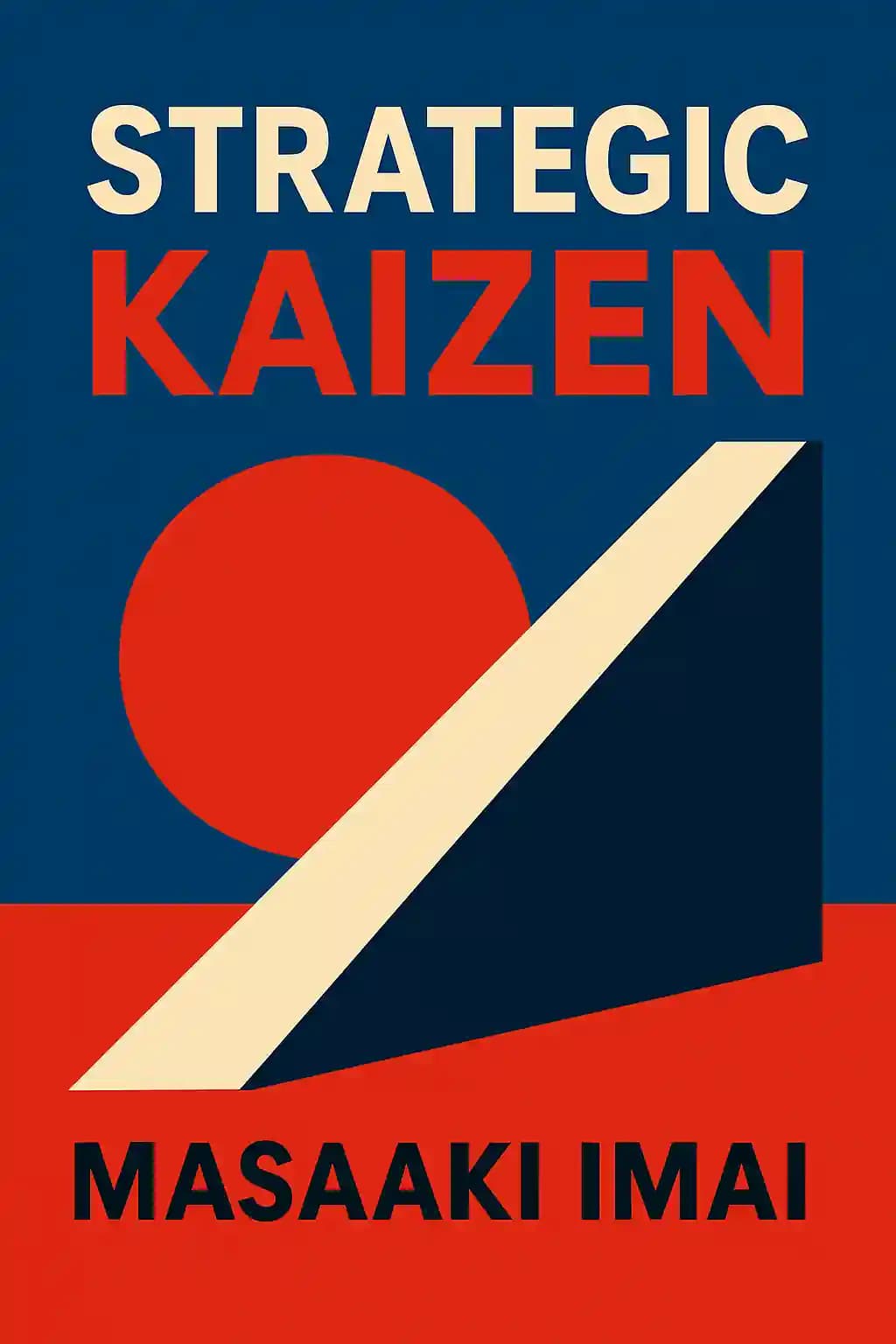
Masaaki Imai, author of Strategic Kaizen: Using Lean, Daily Management, and Toyota Production System Practices to Achieve Operational Excellence, is a globally recognized pioneer of continuous improvement methodologies. A Japanese management consultant and founder of the Kaizen Institute (1985), Imai revolutionized organizational efficiency through his development of the Kaizen philosophy, emphasizing low-cost, incremental process optimization.
His 1986 bestseller Kaizen: The Key to Japan’s Competitive Success introduced Lean Manufacturing principles to Western audiences, selling over 300,000 copies across 16 languages. His follow-up Gemba Kaizen (1997) further codified workplace-centric improvement strategies, now standard in industries worldwide.
Imai’s expertise stems from six decades advising Fortune 500 companies and institutions like Harvard Business School, where his frameworks influenced Lean adopters like Danaher Corporation. Through his institute, operating in 30+ countries, he trains leaders in blending Toyota Production System principles with cultural adaptation. Strategic Kaizen (2021) expands his legacy by integrating daily management systems with strategic objectives. Translated into 10+ languages, his works remain required reading in operational excellence programs globally.
Strategic Kaizen outlines a methodology for aligning continuous improvement (Kaizen) with long-term business strategy. It introduces Flow, Synchronization, and Leveling (FSL) as core pillars to eliminate waste, optimize resources, and enhance operational efficiency. The book emphasizes shifting from short-term fixes to systemic, sustainable improvements backed by case studies from Toyota and other lean enterprises.
This book is ideal for CEOs, operational managers, Lean practitioners, and professionals seeking to integrate Kaizen into strategic planning. It’s particularly valuable for manufacturing leaders but also offers insights for service industries aiming to reduce costs while improving quality and customer satisfaction.
Yes—it’s a critical resource for understanding how to operationalize Kaizen strategically. While some readers note its manufacturing-heavy examples, the principles apply broadly. The book’s focus on minimal resource investment for maximum output makes it a standout guide for achieving sustainable growth.
Traditional Kaizen focuses on incremental, bottom-up improvements, while Strategic Kaizen integrates these efforts with top-down organizational goals. It emphasizes systemic change over isolated fixes, using metrics to align daily tasks with broader business objectives.
These tools help bridge tactical improvements and strategic vision.
Some critics argue the book overlaps with Imai’s earlier works, offering limited new insights for Kaizen veterans. Others desire more non-manufacturing examples. However, its strategic focus and practical frameworks counterbalance these concerns.
These underscore the book’s emphasis on efficiency and cultural transformation.
Unlike Six Sigma’s defect-focused approach or TQM’s quality benchmarks, Strategic Kaizen prioritizes resource efficiency and strategic alignment. It complements these methodologies by embedding continuous improvement into daily operations rather than treating it as a standalone initiative.
Organizations report sustained cost reductions, faster response times, higher employee engagement, and improved customer satisfaction. Toyota’s success with these principles highlights their potential for decades-long competitiveness.
Yes. While manufacturing examples dominate, the FSL framework and waste-reduction principles adapt to healthcare, IT, and logistics. For instance, synchronizing workflows in hospitals or leveling project pipelines in tech teams can yield similar efficiency gains.
Senti il libro attraverso la voce dell'autore
Trasforma la conoscenza in spunti coinvolgenti e ricchi di esempi
Cattura le idee chiave in un lampo per un apprendimento veloce
Goditi il libro in modo divertente e coinvolgente
Traditional companies operate with maximum resources to produce minimum outputs.
Traditional companies cling to outdated myths like 'cheaper by the dozen'.
Lean operations treat flow as sacred.
Scomponi le idee chiave di Strategic Kaizen in punti facili da capire per comprendere come i team innovativi creano, collaborano e crescono.
Vivi Strategic Kaizen attraverso narrazioni vivide che trasformano le lezioni di innovazione in momenti che ricorderai e applicherai.
Chiedi qualsiasi cosa, scegli il tuo stile di apprendimento e co-crea intuizioni che risuonano davvero con te.

Creato da alumni della Columbia University a San Francisco
"Instead of endless scrolling, I just hit play on BeFreed. It saves me so much time."
"I never knew where to start with nonfiction—BeFreed’s book lists turned into podcasts gave me a clear path."
"Perfect balance between learning and entertainment. Finished ‘Thinking, Fast and Slow’ on my commute this week."
"Crazy how much I learned while walking the dog. BeFreed = small habits → big gains."
"Reading used to feel like a chore. Now it’s just part of my lifestyle."
"Feels effortless compared to reading. I’ve finished 6 books this month already."
"BeFreed turned my guilty doomscrolling into something that feels productive and inspiring."
"BeFreed turned my commute into learning time. 20-min podcasts are perfect for finishing books I never had time for."
"BeFreed replaced my podcast queue. Imagine Spotify for books — that’s it. 🙌"
"It is great for me to learn something from the book without reading it."
"The themed book list podcasts help me connect ideas across authors—like a guided audio journey."
"Makes me feel smarter every time before going to work"
Creato da alumni della Columbia University a San Francisco

Ottieni il riassunto di Strategic Kaizen in formato PDF o EPUB gratuito. Stampalo o leggilo offline quando vuoi.
Have you ever wondered why some companies consistently outperform their competitors despite similar resources? The answer lies in a concept so fundamental yet overlooked by 99% of businesses worldwide. In "Strategic Kaizen," management guru Masaaki Imai reveals the secret behind Toyota's legendary success-the pursuit of flow, synchronization, and leveling (FSL). This revolutionary approach transforms how businesses operate, creating extraordinary results with ordinary resources. Warren Buffett reportedly keeps Imai's work on his nightstand, while companies from Apple to Amazon have incorporated these principles. At its core lies a deceptively simple idea: business excellence comes not from maximizing resources but from optimizing flow-the smooth, continuous movement of materials, information, and processes throughout an organization.
Today's business landscape divides between traditional companies (99%) and lean companies (1%). Traditional businesses maximize resources for minimum outputs, while lean companies achieve maximum outputs with minimum resources - explaining why most businesses struggle despite technological advances. Traditional companies follow outdated myths like "cheaper by the dozen" and rely on unreliable forecasts, creating excessive inventory and waste. This means warehouses filled with unsold products while new batches are produced based on optimistic projections, tying up capital, increasing storage costs, and causing obsolescence. This approach creates four fatal flaws: excessive resource consumption, quality issues from operational variation, market inflexibility, and disconnects between siloed departments. Few companies adopt lean approaches despite their proven superiority because governance structures prioritize short-term financial results over operational excellence. Quarterly earnings pressures and stock-based compensation discourage investments in transformations that might temporarily affect profits. Without criteria to assess operational status beyond financial reporting, executives lack incentives to pursue strategies that would create sustainable value.
The Toyota Production System emerged from postwar necessity. When Kiichiro Toyoda founded Toyota Motor Corporation, he boldly declared: "We must catch up with the US auto industry in three years. Otherwise, we shall not survive." Taiichi Ohno, a machining department manager, tackled this challenge head-on. Hearing American productivity was nine times higher than Japan's, he refused to accept this as an inherent difference. His first innovation was assigning multiple machines to single operators, arranging equipment to minimize movement. Japan's 1950 recession forced layoffs at Toyota, strengthening Ohno's resolve to improve productivity while reducing inventory. When Korean War military orders arrived, bank agreements prevented rehiring workers, compelling Ohno to dramatically increase per-capita output with fewer people. Ohno's most profound insight came from American supermarkets, where merchandise is replenished exactly as sold. He implemented this concept between processes, creating a pull system where upstream production matched downstream consumption. This "supermarket approach" evolved into kanban cards, standard work, leveling, and intelligent automation-the foundational elements of the Toyota Production System.
Flow represents the fundamental difference between lean and traditional operations. Lean treats flow as sacred, while traditional operations disrupt it pursuing volume. In lean production, any flow disruption signals a problem requiring immediate attention and systematic problem-solving. Flow minimizes resources by eliminating unnecessary movement and waiting time, removes waste (muda), unevenness (mura), and overburden (muri). Standardized work stabilizes quality by making abnormalities visible. Crucially, flow transforms organizational culture by fostering attention to detail and self-discipline. Creating smooth flow requires connecting all processes from raw materials to final assembly. Equipment must follow processing order, often in U-shaped cells minimizing transport distance. Batch sizes should be progressively reduced toward one-piece flow, work-in-process inventory minimized, and consistent takt time (production rhythm) maintained throughout. One-piece flow represents the ultimate lean expression, where a single work piece moves through sequential processes without delay. This requires equipment with built-in quality checks that automatically stop when abnormalities occur - automation with a human touch that frees operators from constant monitoring and allows them to handle multiple processes efficiently.
Flow, synchronization, and leveling (FSL) form the hidden secrets of lean strategy. While companies track financial performance, they often lack systems to measure operational excellence, causing them to neglect crucial operational indicators. Synchronization (doukika) serves two functions: aligning production with customer orders across processes and harmonizing operational time between processes - ensuring both market alignment and internal efficiency. When Ohno became director of Toyota's assembly plant in 1962, he noticed lighter components were processed early in the month with reasonable workloads, while heavier units later caused excessive overtime. This observation led to leveling (heijunka) - distributing work evenly throughout the month. Ohno's philosophy was straightforward: "The easiest and most efficient production is to make the same product in the same number and in the same manner every day." This principle challenged traditional batch-and-queue thinking, requiring minimal batch sizes and synchronized processing times. The FSL Assessment provides a framework for evaluating lean implementation, examining leadership engagement, culture, technical capabilities, and operational systems before focusing on specific tools and techniques.
Consider KOA Industry, a traditional electronic components maker facing crisis when the yen's appreciation devastated profits. Under 29-year-old President Koichi Mukaiyama, they launched a comprehensive production system with three-year goals. Their transformation began with a "shock remedy" that became legendary in Japanese manufacturing. Management gathered all sales branch inventories in the corporate gymnasium, revealing most items were unsellable due to obsolescence or damage. By implementing flow concepts and streamlining distribution, delivery lead time dropped from 4-5 days to under two days, enabling a 30% reduction in sales personnel while creating more time for customer visits. At Yokomori Manufacturing Company, consultant Kenji Takahashi found metal parts haphazardly piled throughout the facility. Time-motion studies revealed 70% of operators' time was wasted moving materials between workstations. Despite these inefficiencies, the company president planned to invest in an expensive automatic warehouse system. Takahashi systematically transformed Yokomori over 15 years by implementing production leveling and flow principles. The results were dramatic: eliminated line imbalances, reduced distribution costs, and significant improvements in quality metrics and delivery reliability. The company also experienced unexpected benefits including reduced overtime, improved worker morale, and enhanced customer satisfaction.
Transforming to lean thinking demands sustained commitment. Most Western executives lack operational experience, often choosing financial restructuring over operational improvements when facing challenges. Successfully implementing lean strategy requires: CEO and board commitment to long-term thinking; both top-down and bottom-up implementation; companywide adoption starting with workplace assessment; a senior manager tracking FSL activities and reporting to the CEO; and monthly FSL assessment. As Taiichi Ohno noted: "Let the flow manage the processes, and do not let management interfere with the flow." This reveals that smooth flow triggered by customer orders is the essence of the Toyota Production System. The lean approach naturally reduces costs, stabilizes quality, and delivers ecological benefits through reduced waste. Organizations must overcome key shortcomings: prioritizing short-term gains, favoring financial over operational restructuring, undervaluing workplace management, maintaining inflexible practices, and treating business as merely monetary. By embracing flow as your strategic foundation, you can build a sustainable organization that delights customers while creating long-term excellence. The question isn't whether you can afford to implement these principles - it's whether you can afford not to.