Capitolo 1
The Courage to Finish What Matters Most
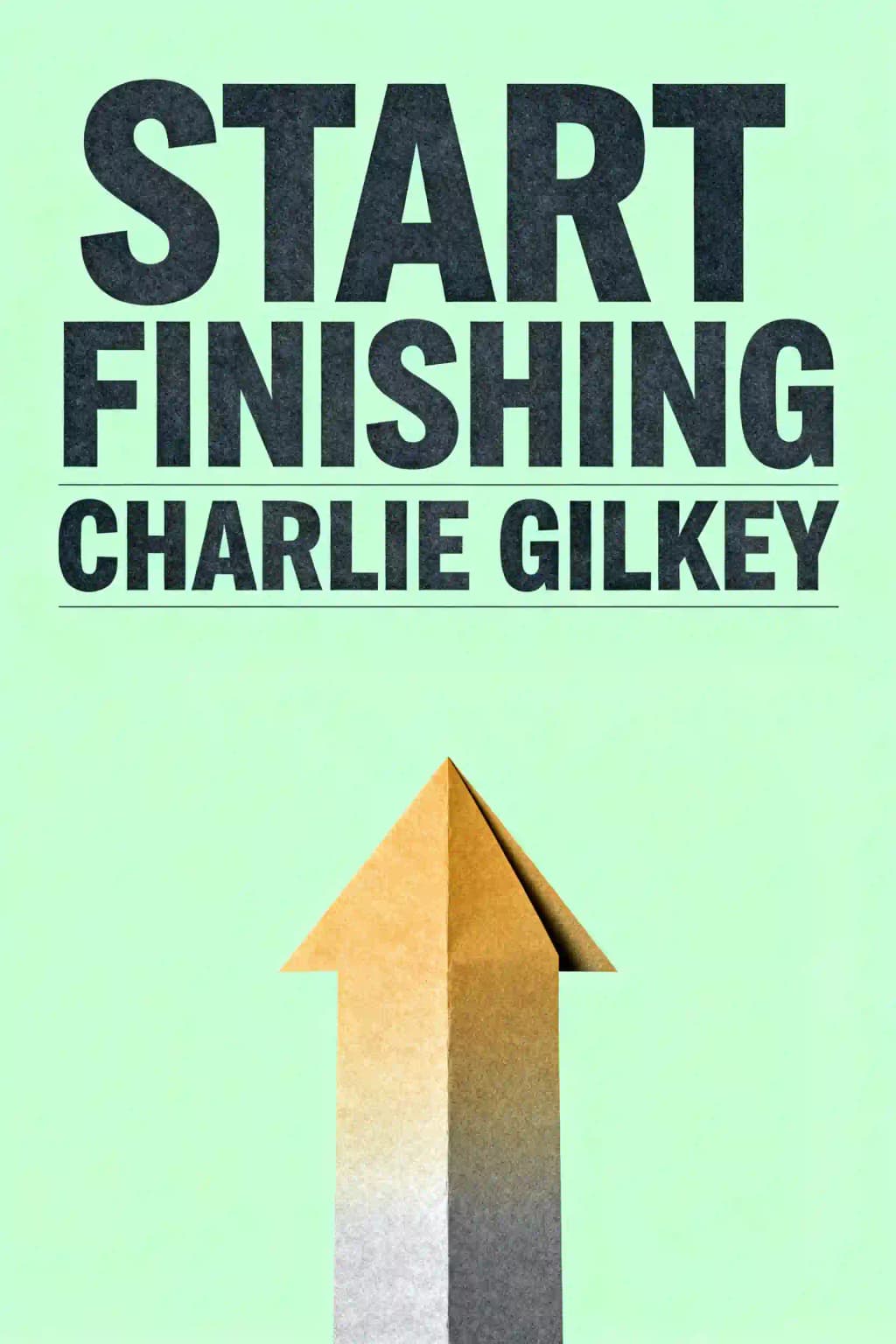
In a world where attention spans are shrinking and distractions are multiplying, Charlie Gilkey's "Start Finishing" arrives as a revolutionary manifesto for creators and doers. This isn't just another productivity book-it's a comprehensive philosophy for bringing your most meaningful work into existence. Since its 2019 publication, the book has become a cornerstone text for creative professionals, entrepreneurs, and anyone with important projects perpetually stuck in the "someday" category. Beloved by thought leaders like Seth Godin and Daniel Pink, Gilkey's approach resonates particularly with multi-passionate individuals who struggle to complete their most meaningful work. What makes this book stand out is Gilkey's unique background-combining philosophical rigor (he's a former PhD candidate) with practical military experience (as an Army veteran who served in Iraq). This unusual combination allows him to address both the existential questions of meaningful work and the tactical challenges of execution. Whether you're writing a novel, launching a business, or pursuing any project that matters deeply to you, "Start Finishing" offers the roadmap to transform your brilliant ideas into completed realities.
Capitolo 2
The Someday Trap and the Sacred Nature of Your Best Work
Most of us live with a painful gap between what truly matters to us and how we actually spend our time. Our brilliant ideas remain buried under busywork, responsibilities, and fatigue-waiting for a "someday" that never arrives on its own. We don't lack ideas; we lack finished projects. The challenge isn't starting more things but finishing what matters.
This disconnect creates what Gilkey calls "creative constipation"-a toxic buildup of unexpressed ideas and inspirations. Like physical constipation, this condition makes us irritable and resentful, particularly toward those who are doing their best work. Our emotional range narrows as negative feelings amplify while positive peaks diminish. When creative energy lacks constructive outlets, it often manifests destructively-through retail therapy, emotional eating, or even blowing up our lives in midlife crises.
What exactly constitutes our "best work"? It's not just any project, but work that's uniquely ours, serves both ourselves and others, and requires us to truly show up despite uncertainty. This work isn't necessarily easy, often requiring us to blaze our own trail beyond what books or others can teach us. Your best work is sacred-something that makes you come alive and feels like something you get to do rather than have to do.
Importantly, your best work may not be your full-time job. It could be raising children, volunteering in your community, or pursuing a passionate hobby. This removes the excuse that your day job prevents you from doing what matters most. We live in a project world where everything changes every 3-5 years. Projects serve as mirrors reflecting our inner world and bridges to the future we want to create.
For those with scattered interests, Gilkey offers reassurance: embrace your "ands" rather than limiting yourself to one domain. You can be a writer and a programmer and a parent and a musician-just recognize that each requires upkeep through projects. The key is not trying to do everything simultaneously but making conscious choices about which projects deserve your focus right now.
Capitolo 3
Bridging the Air Sandwich: From Vision to Daily Reality
Why is there such a persistent gap between our big-picture aspirations and day-to-day reality? Gilkey describes this as an "air sandwich"-our vision and big goals forming the top slice of bread, our daily reality forming the bottom slice, with a vast empty space between them.
This gap contains five interconnected challenges. First, competing priorities pull us in different directions, creating constant tension between work, family, health, and personal projects. Second, head trash-the self-limiting stories we tell ourselves-undermines our confidence and motivation. Third, we lack realistic plans that break down ambitious goals into doable steps. Fourth, we perceive resource shortages, believing we need more money, time, or connections than we actually do. Finally, poor team alignment means the important people in our lives aren't supporting our efforts.
These challenges work together in complex ways. For example, believing you're "not the planning type" (head trash) prevents you from creating realistic plans, which leads to not seeing available resources or enlisting help from others. The solution isn't addressing these challenges one by one but understanding how they interconnect.
To bridge this air sandwich, we need five keys that function like Aristotelian virtues-finding the middle path between excess and deficiency:
Intention gives direction to our work by clarifying why we're doing something and what we want to achieve. Without clear intentions, our actions feel random and meaningless.
Awareness helps us recognize our best work conditions, energy patterns, and emotional responses. By paying attention to when we feel lit up versus stifled, we can identify what truly constitutes our best work.
Boundaries create space both for something (positive boundaries) and from something (negative boundaries). Without establishing boundaries for your best work and from distractions, your important work will always be displaced.
Courage is more essential than talent for finishing what matters. While we often associate courage with heroic acts, everyday courage manifests in choosing our best work, having difficult conversations, sharing our work, and persisting through stuck phases.
Discipline channels our energy into purposeful action rather than letting it dissipate. Though many creatives resist discipline, it's what transforms talent into achievement. Discipline creates freedom by establishing habits that eliminate decision fatigue.
These keys work together to address different obstacles in the air sandwich. For example, aligning competing priorities requires awareness to clarify what matters most, discipline to maintain focus on priorities, and boundaries to protect against other people's priorities encroaching on our own.
Capitolo 4
Confronting the Paradox: Why We Avoid Our Most Important Work
We all want to do our best work yet often avoid it-a paradox stemming from our complex inner landscapes. While we're busy with daily activities, we frequently circle around our most meaningful work without making real progress, spending hours researching and procrastinating rather than moving forward.
This phenomenon, which Gilkey calls "thrashing," is the emotional flailing and metawork we do when avoiding full commitment to our best work. The more an idea matters to us, the more we'll thrash, precisely because its success or failure feels deeply important. Some people thrash before starting ("Who am I to do this?"), others thrash mid-project ("Is anyone going to care if I finish this?"), at the end ("Is this good enough?"), or throughout every stage.
When projects enter a void-where progress seems impossible-we're tempted to switch to "easier" ideas, but this just creates the same thrashing pattern without the satisfaction of completing what truly matters. Thrashing isn't a sign you're on the wrong path; it signals you're doing work that matters and requires you to show up powerfully.
Your best work will involve dragons-challenges that stand in your way-but humans are natural dragon slayers. We've survived for hundreds of thousands of years using creativity, grit, and cooperation. Despite being physically weaker than other predators, we've become the apex species through our ingenuity and resilience. Dragons aren't a signal you're on the wrong road; they indicate you're on the right one.
Failure is inevitable when doing your best work. If you're not occasionally failing, you're not truly showing up. But failure isn't a character flaw-it's a sign that something was out of alignment. Maybe you charged ahead alone instead of asking for help, overcommitted, put the wrong people on your team, or needed more skill development.
Time's finite nature creates displacement-the reality that every action we choose displaces countless others we could have done. This tension emerges from being unlimited sentience trapped in limited bodies. We must use displacement strategically to start finishing our best work rather than running from it.
To make headway with your best work, you must fight the natural inclination to work on everything in your idea closet and instead decide to let some ideas go completely-even if it means feeling the sting of remorse and regret. The best way to finish something is often to drop it midstream, freeing up the emotional and creative energy tied to it.
Capitolo 5
Transforming Ideas into Actionable Projects
Converting your idea into a goal gives you a clear destination rather than leaving you swimming endlessly in possibilities. The SMART framework Gilkey recommends for creative people is: Simple (clear without requiring explanation), Meaningful (connected to what matters to you), Actionable (clear next steps you can take), Realistic (achievable with available resources), and Trackable (measurable progress).
While making SMART goals may feel unnatural at first for creative people, it becomes second nature with practice. The process is straightforward: start by adding a verb that captures completion, add a realistic timeframe (doubled from your initial estimate), check it against reality, and ensure it remains simple with a clear formula like "Complete (Verb) (Idea) by (Date)."
When planning projects, we should focus on success rather than failure, but we must also understand that success comes in three distinct levels. Small Success is the minimum required to pass-not particularly pride-inducing but still worth celebrating. Moderate Success exceeds minimum requirements and can be achieved through your own efforts and resources. Epic Success greatly exceeds requirements and requires building a team to help you get there.
The key insight is matching your level of success with your level of effort and commitment-many of us want epic success with small-success effort, which creates anxiety and overwhelm. By intentionally choosing which level matters most for different areas of your life, you can align your expectations with reality.
If a goal lacks a date, it's destined for Someday/Maybe Land. Undated items have no commitment power and get naturally triaged out of our focus. Dating items forces us to confront displacement-the reality that our time and attention are finite. While we typically focus on completion dates, start dates can be equally powerful for commitment.
Your success pack is the group of people who will help push your best-work project to completion. Think of them as your Avengers or Fellowship of the Ring. You need 3-5 people from each of four categories: Guides (experienced mentors who provide wisdom), Peers (colleagues at your level who provide feedback), Supporters (people who actively help with your work), and Beneficiaries (specific people who will benefit from your completed project).
Having 12-20 people in your corner counteracts the outsized attention we give to naysayers. The key is not just building your success pack but actively using it through regular communication and accountability. Remember that if you don't finish your work, your specific beneficiaries will be worse off-a powerful motivator when things get tough.
Capitolo 6
Creating Time and Space for Your Most Important Work
You'll never find time for your best work-you must make it. The challenge is that time is conceptually slippery, and most ways we think about it don't work for us. We need to rethink time using spatial metaphors that help us prioritize our work more effectively.
We don't work on projects; we work on chunks of projects linked together in sequence. Chunking splits projects into coherent, doable parts; linking joins chunks together; and sequencing arranges them in logical order. The most effective time chunks are fifteen-minute tasks and two-hour blocks, which better match our natural attention cycles than standard time divisions.
The project pyramid shows how bigger projects contain smaller ones in a hierarchical structure. A year-long project typically contains quarterly chunks, which contain monthly chunks, which contain weekly chunks, which contain two-hour blocks, which contain fifteen-minute tasks. Even in a simple model, one annual project would spawn 1,920 tasks-equivalent to three full work months dedicated solely to that project. This explains why people who start the year with seven major goals are unlikely to succeed.
The Five Projects Rule states you shouldn't have more than five active projects per timescale. Research shows most people won't complete more than five projects per timescale anyway, with three being optimal for creative/professional work to leave bandwidth for personal projects. This rule helps constrain commitments and enables quick planning-when planning weekly, focus only on your five weekly projects, which should be chunks of your monthly projects.
To make space for your best work, convert your weekly schedule into coherent blocks. Four basic blocks form the foundation: focus blocks (90-120 minutes of high-level creative work), social blocks (90-120 minutes for real-time interaction), admin blocks (30-60 minutes for supporting tasks), and recovery blocks (variable-length recharging activities).
Focus blocks are the fuel for your best work-without them, you won't finish meaningful projects. Most people can effectively use only three focus blocks per day due to distractions and energy limitations. You need at least three focus blocks per week dedicated to your best-work project to maintain momentum and avoid demotivation. With fewer than three blocks, you risk a "thrash crash" where frustration from lack of progress kills your project.
Social blocks are dedicated to real-time interaction with others. While focus blocks create something, social blocks connect with someone. People often discount social blocks as "not getting anything done," but connecting with friends, family, colleagues, and your success pack is inherently valuable.
Admin blocks contain supporting work that isn't your best work but enables it-email, calls, filing, organizing, bookkeeping, and similar tasks. Without dedicated admin blocks, these tasks trickle in continuously, preventing you from ever getting to your best work.
Recovery blocks recharge the energy depleted by focus, social, and admin blocks. We must be intentional about recovery precisely because we overvalue output. Plan approximately one recovery block for every two focus or social blocks.
Capitolo 7
Building Your Project Roadmap with Strategic Planning
Rather than making your project unnecessarily difficult, build it around your strengths to find flow more easily. Your GATES (Genius, Affinities, Talents, Expertise, and Strengths) provide a framework for leveraging your natural advantages. When listing your GATES, don't limit yourself to professional skills-include personal abilities like curating music, organizing data, or throwing parties.
While some projects need only time and energy, most require money too. Even when money isn't required, it usually makes projects easier or quicker. Think of budgeting as creating a positive boundary rather than a restrictive one-it's about finding the best ways to use resources to complete your project.
Goals and deadlines are just tools, but your actual capacity is what truly matters. If you consistently complete four units of creative work regardless of whether you set goals for six or ten units, those four units represent your true capacity. Building from capacity rather than deadlines means carrying fewer projects but actually finishing them, resulting in less frustration and fewer project collisions.
Relay time is the waiting period that occurs whenever a project changes hands. Projects resemble relay races where each person runs at full speed, but one bad handoff or one person sandbagging can slow everything down. To minimize relay time, be specific with requests (avoid vague questions like "Thoughts?"), consider collaborators' schedules and preferences, and plan for strategic handoffs.
Building a project road map requires embracing iteration and messiness. The process involves several steps: Start by listing all top-of-mind chunks of your project using universal action words. Next, examine how your chunks relate to each other and sort them into a natural hierarchy. Then, sequence your chunks based on how the verbs naturally relate-you can't publish without creating and editing, and you typically can't create without planning and researching.
After creating your sequence, clump smaller chunks into larger, linked units-the opposite of chunking. The project pyramid provides a default structure for clumping. Finally, overlay your chunks on a timeline, selecting a time perspective that matches your project's scope. When roadmapping this way, you can easily adjust larger chunks if circumstances change-simply move the affected legs of the project rather than changing numerous individual tasks.
True commitment means assigning specific times-like Wednesday at 10:00 or during Wednesday's focus block. Don't schedule creative projects too far in advance, as you'll likely need adjustments, but don't skip advance planning either or you'll never complete the project. Remember, plans aren't straitjackets but roadmaps to help drive your project to completion.
Capitolo 8
Overcoming Resistance and Building Daily Momentum
Just as engineers must account for drag affecting fast-moving vehicles, you must anticipate the forces that will push against your project's momentum. While various factors create drag, people-especially you-tend to be the dominant sources of resistance to your own progress.
As you begin doing your best work, you may unconsciously start applying the brakes due to internalized stories about success requiring sacrifice. These no-win scenarios typically fall into three patterns: The Success Will Wreck My Relationships tale (fearing success will harm connections with others), The Success Versus Virtue myth (believing achievement requires compromising integrity), and The What If I Can't Do It Again? trap.
Many of us fear that excelling will damage our relationships, having witnessed or experienced the fallout when someone's success created envy or resentment. This scenario encodes the belief that "if I win, I hurt someone." Untangling this requires addressing shared expectations in relationships, recognizing when others don't want us to grow due to their own insecurities, and refusing to be merely supporting characters in others' stories.
Mediocrity appears safe-you avoid both failure's embarrassment and success's complications. By staying average, you dodge the dragons of both failure and success. But while mediocrity feels safe in the short term-keep your head down, check the box, avoid heat today-it's devastating for long-term thriving. Nothing memorable comes from playing it safe. No cultural change emerges from avoiding risk. We can't thrive in mediocrity any more than fish can thrive in shallow puddles.
Our projects don't exist in isolation but alongside other people's priorities (OPP). Unlike competing priorities (which are our own), OPP are external demands we accommodate or accept. Several rules govern OPP: longer projects attract more OPP; more important projects face more OPP; OPP never disappears completely; unclear personal priorities invite more OPP; and the more you accommodate OPP, the more you'll face.
If your success pack propels your project forward, derailers and naysayers are the headwinds working against you. Derailers often don't realize they're derailing you-they believe they're helping. To manage them, confirm they want your success, clearly request the specific type of feedback you need, give them three strikes before changing strategy, be strategic about when you engage with them, and if all else fails, do your project covertly.
Like the scorpion who stings the frog because "it's in my nature," naysayers will naysay. Many naysayers are just projections-"ghost naysayers" we create in our minds. For real naysayers: don't engage with them, stop trying to win their approval, connect with a supporter when tempted to engage a naysayer, and even if they stop criticizing, don't assume they've joined your success pack.
A project premortem identifies potential failure points before they occur. Known challenges don't tank projects-surprises and "willful insanity" do. Conduct your premortem from a grounded, resilient perspective by asking questions about potential obstacles and your readiness to overcome them.
Capitolo 9
Creating Sustainable Progress Through Effective Habits
Momentum planning is the continual process of making and adjusting plans across all time perspectives. When reality defies your plans, the only sensible choice is to adjust them. Counter-intuitively, better planners review and adjust their plans more frequently, not less.
Your physical environment dramatically impacts your ability to do your best work. Just as Tony Stark's lab was custom-built to capture his ideas with minimal friction, your workspace should be optimized for your specific needs. Consider factors like sound, smell, sunlight, clothing, clutter/organization, space, and music. What works is highly individual-some people need absolute quiet while others thrive with background noise; some need pristine organization while others work better with creative clutter.
Two strategies can dramatically improve your work efficiency. Batching involves doing similar kinds of work in a continuous time block, minimizing the cognitive cost of context switching. Stacking means doing dissimilar tasks that use different mental or physical resources simultaneously-like doing laundry while listening to an audiobook or holding a meeting while hiking.
Those tasks you dread most-your "frogs"-should be tackled early and consistently. Mark Twain advised: "If you know you have to swallow a frog, swallow it first thing in the morning. If there are two frogs, swallow the big one first." The longer a dreaded task sits, the more psychological weight it gains, even though the actual work required remains constant.
Strategic timing is often more important than task selection. Rather than focusing solely on what needs to be done, consider when it's best to do it. Your chronotype-whether you're an early bird (lark), night owl, or afternoon person (emu)-should dictate your most productive hours. Despite cultural pressure toward early rising, your natural rhythm rarely changes.
Different days suit different types of work. Schedule your most demanding tasks-deep work requiring decisions and analysis-on days when you have the most creative energy (often Mondays and Tuesdays). Batch collaborative work and follow-ups midweek when more people are engaged. Reserve Thursdays and Fridays for lighter social meetings and weekly reviews.
The best time to create a plan is whenever you realize you don't have one-don't wait for the start of a new day, week, or month to get organized. For regular momentum planning: do daily planning either the night before or first thing in the morning before checking email (15 minutes); weekly planning on Sunday night or Monday morning (30 minutes); monthly planning the weekend before the month starts; quarterly planning the week before the quarter starts; and annual planning the month before the year begins.
The 5/10/15 split combines the Five Projects Rule with daily momentum planning: focus on your five projects, spend 10 minutes each morning checking in, and 15 minutes each evening checking out. This system addresses our two common challenges: getting a strong start and properly disengaging at day's end.
Capitolo 10
Finishing Strong and Celebrating Your Achievement
Our big-picture thriving emerges from accumulating purposeful, productive days. While we focus on finishing projects, what truly matters is progress-you'll never be "finished" with your best work as each completed project leads to new ones.
Celebrating small wins shifts your mindset from "that happened" to "I made that happen," removing appeals to mystery, luck, or chance. When you track and acknowledge your daily progress, you can easily see what led to bigger wins because you've been documenting the journey all along.
Habits and routines function as defaults-automatic behaviors that lower cognitive load by eliminating countless daily microdecisions. While we naturally create defaults, they typically center on comfort and pleasure rather than productivity. The key is creating intentional defaults that work for us.
The practice of leaving "bread crumbs"-clear notes about where to pick up next-bridges the gap between work sessions. This requires both leaving enough time at the end of a focus block to document your progress and recognizing that your current momentum won't automatically carry forward.
Unplanned diversions from work come in two forms: interruptions (external diversions like phone calls or people entering your workspace) and distractions (internal diversions you allow yourself, like checking email or social media). The key to managing both is identifying and altering their entry points before they occur.
Even with perfect planning, projects inevitably get stuck in three distinct patterns: cascades (when one delayed project causes others to back up), logjams (when multiple projects compete for the same limited focus blocks), and tarpits (projects that not only get stuck but become increasingly difficult to restart the longer they remain inactive).
The final stretch of a project-the "red zone"-is often the hardest part of finishing. Like in football where the offense struggles in the last twenty yards, creative projects face concentrated resistance near the end. The defense (head trash, competing priorities, poor team alignment) locks down, while we battle fatigue and overthinking.
Victory laps aren't just optional celebrations-they're essential rituals that honor both your achievement and the community that supported you. While we readily celebrate weddings, graduations, and other clear achievements, we often hesitate to celebrate our creative accomplishments, feeling it's braggy or self-centered.
Jumping immediately from one project to another is like running a second marathon right after finishing the first-it leads to burnout and injury. The more a project matters to you, the greater your need for downtime and transition afterward. When you finish a project, you release the energy that was tied up in it, creating an energetic void that can feel simultaneously disorienting, uplifting, and anticlimactic.
After-action reviews (AARs) transform project experiences into valuable lessons that improve future work. For your projects, conduct an AAR by writing down answers to key questions rather than just mentally reviewing them. This documentation allows you to reference actual lessons learned rather than relying on faulty memory.
Completing your best work represents the culmination of overcoming dragons, handling frogs, assembling teams, navigating logjams, negotiating with derailers, and tussling with inner demons. Your project has literally changed reality-creating conditions that wouldn't exist had you not done it when, how, and with whom you did it. Every best-work project leaves your fingerprints on the universe.
While we often believe completing significant projects will fundamentally change our lives, the Buddhist wisdom reminds us: "Before enlightenment: chop wood, carry water. After enlightenment: chop wood, carry water." Success doesn't change the fundamentals-before success, start finishing; after success, start finishing. Days spent doing your best work compound to create a thriving life.