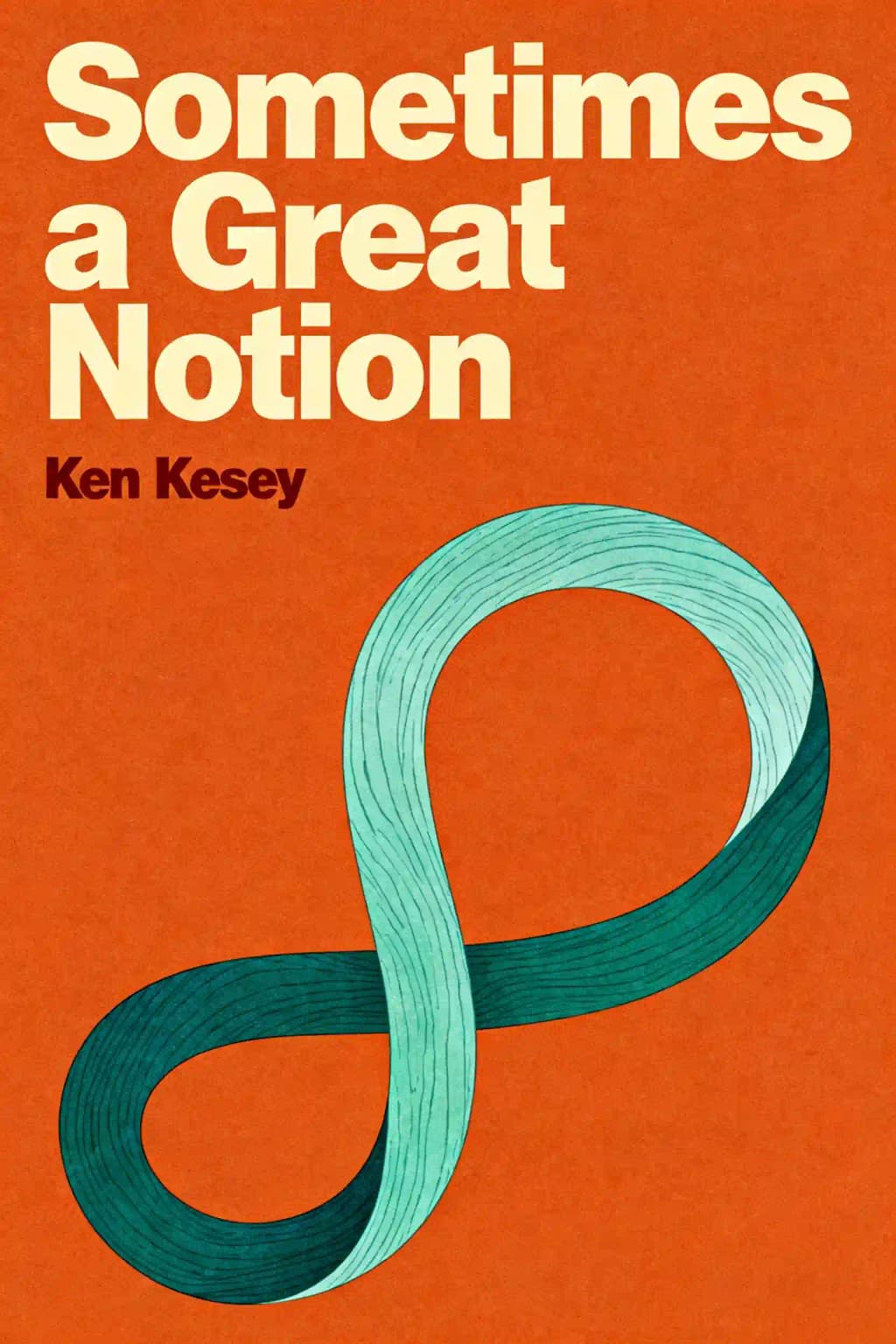
Kesey's epic saga of Oregon loggers - dubbed "this region's Moby Dick" - revolutionized American literature with its Shakespearean themes and innovative narrative technique. The heavyweight champion of Northwest novels maintains a stunning 4.26 Goodreads rating after inspiring generations of writers.
Kenneth Elton Kesey (1935–2001) is the author of Sometimes a Great Notion and one of America's most influential countercultural novelists.
Published in 1964, this sprawling family saga about Oregon loggers explores themes of individualism, loyalty, and rebellion against societal expectations—subjects that defined Kesey's literary vision. A Stanford-educated writer who volunteered for government psychedelic experiments, Kesey drew on his Pacific Northwest roots and Beat Generation influences to craft richly textured narratives.
His debut novel, One Flew Over the Cuckoo's Nest, became an instant bestseller in 1962 and was adapted into an Academy Award-winning film that swept all five major categories in 1975. Though many critics consider Sometimes a Great Notion his masterpiece, Kesey's legacy extends beyond fiction: he led the Merry Pranksters, mentored the Grateful Dead, and bridged the Beat movement with 1960s counterculture.
Sometimes a Great Notion is an epic novel by Ken Kesey that chronicles the life of an Oregon logging family and their conflicts with their community and each other. Published in 1964, the book explores themes of individualism versus society, family loyalty, and the rugged independence of Pacific Northwest loggers. Kesey crafted this ambitious narrative to capture the complexities of family dynamics and the clash between personal freedom and collective responsibility in rural Oregon.
Ken Kesey wrote Sometimes a Great Notion in 1964 as his second novel following the success of One Flew Over the Cuckoo's Nest. Kesey regarded Sometimes a Great Notion as his magnum opus, aspiring to create a modernist saga comparable to William Faulkner's Yoknapatawpha works. The novel solidified Kesey's reputation as a major American author and demonstrated his literary ambition beyond his debut success, though it polarized critics upon release.
Sometimes a Great Notion appeals to readers who appreciate literary fiction with complex narrative structures and deep character exploration. Fans of William Faulkner, family sagas, and stories about American individualism will find value in Ken Kesey's ambitious work. The book particularly resonates with those interested in Pacific Northwest culture, labor history, and novels that examine the tension between personal autonomy and community obligations.
Sometimes a Great Notion is worth reading for those seeking challenging, literary fiction that rewards patience and attention. Ken Kesey considered it his finest achievement, crafting an epic that explores profound themes about family, independence, and society. While the novel was a commercial success and garnered critical acclaim, it polarized some readers with its complex structure and demanding prose. The book remains a significant work in American literature for its ambitious scope and psychological depth.
Sometimes a Great Notion explores the central theme of individualism versus collective society, mirroring the concerns Kesey examined in One Flew Over the Cuckoo's Nest. The novel delves into family loyalty, stubbornness, and the consequences of refusing to compromise with community expectations. Additional themes include the conflict between tradition and change, masculine identity in working-class culture, and the environmental relationship between humans and the Oregon wilderness.
Sometimes a Great Notion differs significantly from One Flew Over the Cuckoo's Nest in scope and ambition, with Ken Kesey crafting a sprawling family epic rather than a focused institutional critique. While both novels explore themes of individual rebellion against societal forces, Sometimes a Great Notion employs a more complex narrative structure and multiple perspectives. Kesey considered Sometimes a Great Notion his superior work and magnum opus, though One Flew Over the Cuckoo's Nest achieved greater popular recognition and cultural impact.
Ken Kesey regarded Sometimes a Great Notion as his magnum opus because it represented his most ambitious literary achievement, aspiring to the modernist grandeur of William Faulkner's epic sagas. The novel allowed Kesey to explore complex narrative techniques, multiple viewpoints, and deeper psychological terrain than his debut. The book's sprawling scope and its intimate portrayal of Oregon logging culture reflected Kesey's own roots and demonstrated his full range as a serious literary artist beyond countercultural icon.
Sometimes a Great Notion is set in rural Oregon, detailing the life and struggles of a logging family in the rugged Pacific Northwest. Ken Kesey drew from his own Oregon upbringing, having grown up in Springfield and graduated from the University of Oregon. The novel captures the landscape, culture, and working-class ethos of Oregon's logging communities, grounding the story in the specific geography and social dynamics of the Willamette Valley region where Kesey spent his formative years.
Ken Kesey employs a complex, modernist writing style in Sometimes a Great Notion, using multiple perspectives and stream-of-consciousness techniques inspired by William Faulkner. The novel features shifting viewpoints, non-linear chronology, and experimental narrative structures that challenge readers. Kesey developed this sophisticated approach during his time in Wallace Stegner's creative writing program at Stanford University, where he studied with distinguished mentors including Malcolm Cowley and Richard Scowcroft.
Sometimes a Great Notion polarized critics and readers upon its 1964 release due to its demanding complexity and ambitious scope. Some critics found the novel's intricate narrative structure and multiple viewpoints difficult to follow, making it less accessible than Ken Kesey's debut work. Despite being a commercial success, the book faced criticism for its challenging prose style and sprawling length, which some readers found overwhelming compared to the tighter focus of One Flew Over the Cuckoo's Nest.
Sometimes a Great Notion provides an authentic portrayal of Oregon logging culture, drawing from Ken Kesey's deep knowledge of his home state's working-class communities. The novel captures the rugged independence, physical labor, and tight-knit social dynamics of Pacific Northwest logging families. Kesey's Oregon roots—growing up in Springfield and graduating from the University of Oregon—gave him intimate understanding of the regional culture, values, and conflicts that shape the book's authentic depiction of logger life.
Senti il libro attraverso la voce dell'autore
Trasforma la conoscenza in spunti coinvolgenti e ricchi di esempi
Cattura le idee chiave in un lampo per un apprendimento veloce
Goditi il libro in modo divertente e coinvolgente
NEVER GIVE A INCH!
This is Kesey's monster statement.
Their individualism comes at a terrible cost.
They've finally reached the Pacific.
Sometimes a Great Notion isn't just another novel...
Scomponi le idee chiave di Sometimes a great notion in punti facili da capire per comprendere come i team innovativi creano, collaborano e crescono.
Distilla Sometimes a great notion in rapidi promemoria che evidenziano i principi chiave di franchezza, lavoro di squadra e resilienza creativa.

Vivi Sometimes a great notion attraverso narrazioni vivide che trasformano le lezioni di innovazione in momenti che ricorderai e applicherai.
Chiedi qualsiasi cosa, scegli la voce e co-crea spunti che risuonino davvero con te.

Creato da alumni della Columbia University a San Francisco
"Instead of endless scrolling, I just hit play on BeFreed. It saves me so much time."
"I never knew where to start with nonfiction—BeFreed’s book lists turned into podcasts gave me a clear path."
"Perfect balance between learning and entertainment. Finished ‘Thinking, Fast and Slow’ on my commute this week."
"Crazy how much I learned while walking the dog. BeFreed = small habits → big gains."
"Reading used to feel like a chore. Now it’s just part of my lifestyle."
"Feels effortless compared to reading. I’ve finished 6 books this month already."
"BeFreed turned my guilty doomscrolling into something that feels productive and inspiring."
"BeFreed turned my commute into learning time. 20-min podcasts are perfect for finishing books I never had time for."
"BeFreed replaced my podcast queue. Imagine Spotify for books — that’s it. 🙌"
"It is great for me to learn something from the book without reading it."
"The themed book list podcasts help me connect ideas across authors—like a guided audio journey."
"Makes me feel smarter every time before going to work"
Creato da alumni della Columbia University a San Francisco

Ottieni il riassunto di Sometimes a great notion in formato PDF o EPUB gratuito. Stampalo o leggilo offline quando vuoi.
In the rain-soaked Oregon Coastal Range, the Stamper house stands as a monument to defiance. Unlike every other structure that respectfully retreats from the Wakonda Auga River's hungry waters, this two-story home juts defiantly into the current, reinforced with logs, cables, and cement bags-a physical manifestation of the family motto painted above their door: "NEVER GIVE A INCH!" This defiance extends beyond architecture to the novel's central conflict. While the entire logging community of Wakonda has gone on strike against the powerful Wakonda Pacific company, the Stampers continue operating their independent logging business, honoring their contract rather than joining the union walkout. The town's hatred culminates in the novel's opening image: a severed arm hanging from the Stamper house, middle finger extended toward the gathered union men across the river-a gesture that encapsulates the Stampers' brutal individualism that refuses to bend to community pressure.