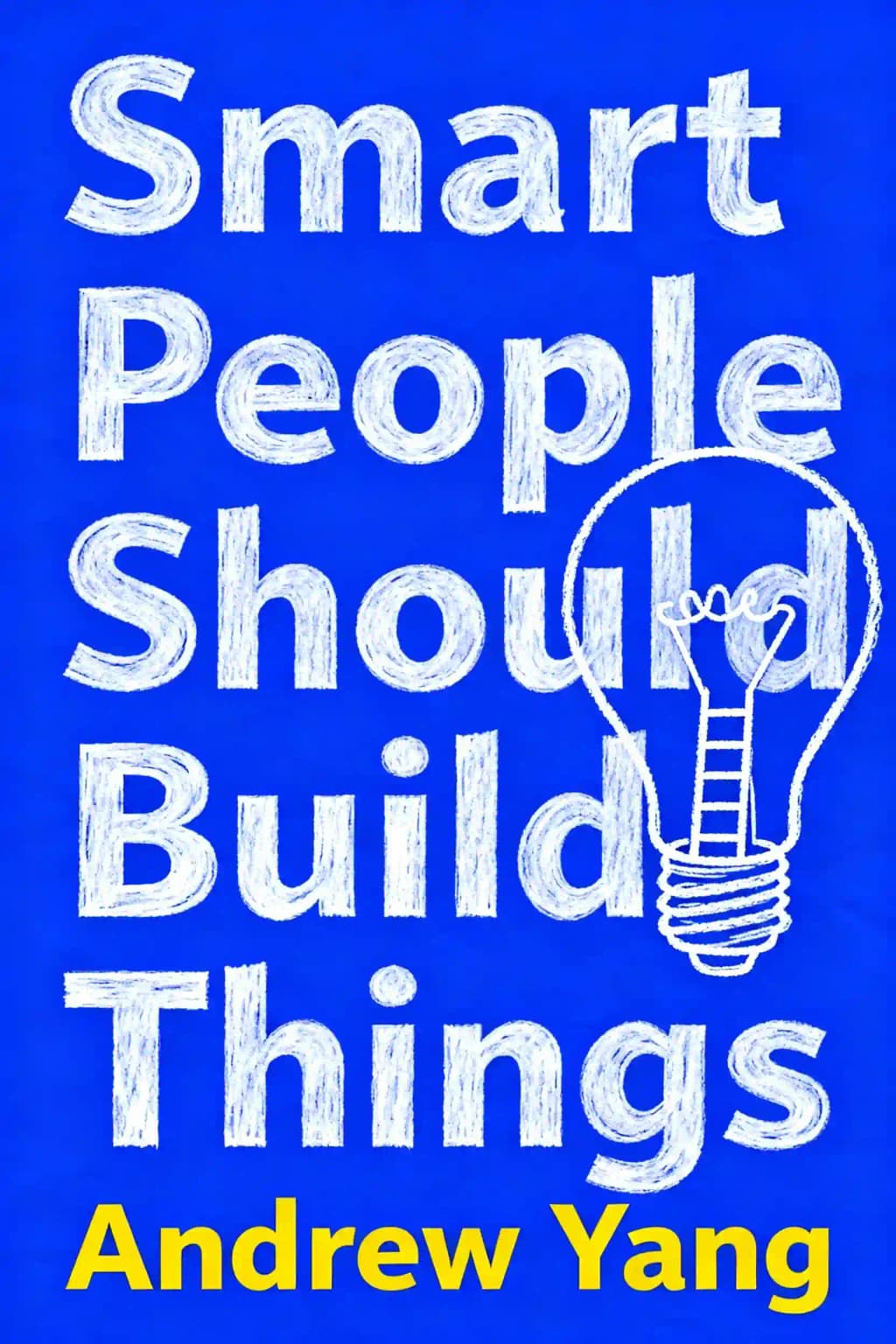
Andrew Yang challenges America's talent pipeline, arguing elite graduates should build startups, not join finance or consulting. Named a White House "Champion of Change," Yang's manifesto reveals why entrepreneurship - not traditional careers - drives economic growth and creates meaningful innovation.
Andrew Yang is an entrepreneur, policy advocate, and the author of Smart People Should Build Things, a book focused on economic revitalization through entrepreneurship. His work is deeply rooted in the idea of redirecting talent toward innovation, particularly in cities facing economic challenges. This theme is central to his book and reflects his broader mission.
Yang is a graduate of Columbia Law School and the founder of Venture for America, a nonprofit organization that trained thousands of entrepreneurs and created jobs across the United States. His impactful work with Venture for America earned him recognition as a White House Champion of Change under President Obama, highlighting his significant contributions to fostering entrepreneurship and economic growth.
Beyond Smart People Should Build Things, Yang is also the bestselling author of The War on Normal People, which brought the concept of universal basic income into the mainstream, and Forward, which outlines a plan for comprehensive systemic reform. As a 2020 Democratic presidential candidate and a CNN political commentator, he effectively combines economic theory with practical, grassroots advocacy.
Yang's ideas have been widely disseminated through various platforms, including TEDx, The Joe Rogan Experience, and The New York Times, further amplifying his influence and reach. Smart People Should Build Things encapsulates Yang's enduring commitment to empowering startups as drivers of opportunity, solidifying his standing as a pragmatic and innovative voice in the realm of economic development.
Smart People Should Build Things argues that America’s top talent is misallocated toward stagnant industries like finance and law instead of entrepreneurship. Andrew Yang advocates redirecting ambitious graduates to build startups, revive emerging cities, and create jobs, drawing from his journey from lawyer to entrepreneur and founding Venture for America, a nonprofit placing graduates in startups.
Aspiring entrepreneurs, recent graduates, and professionals in traditional careers (e.g., consulting, law) seeking purpose-driven work will benefit. Yang targets those feeling trapped by “golden handcuffs” and cities like Detroit or Baltimore needing entrepreneurial talent to drive economic growth.
Yes—Yang blends personal anecdotes, startup lessons, and policy ideas into a compelling case for entrepreneurship as a force for economic revitalization. Critics praise its mix of memoir and practical guidance, though some note it promotes Yang’s Venture for America.
Yang defines “building things” as creating scalable businesses, products, or services that address societal challenges (e.g., education, energy). This contrasts with roles in finance or law, which he argues are less impactful on job creation and innovation.
Venture for America (VFA) is Yang’s nonprofit that places top graduates in startups for two years, providing mentorship and training. Aimed at job creation and entrepreneurial skill-building, VFA targets cities like New Orleans and Detroit to foster economic renewal.
Yes—Yang urges readers to avoid “status-driven” careers and instead pursue startups for fulfillment. He shares lessons on fundraising, team-building, and resilience, emphasizing that entrepreneurial paths offer personal growth despite risks.
Some argue the book overly promotes Venture for America without sufficient data on its long-term impact. Others note Yang’s focus on elite graduates may overlook broader systemic barriers to entrepreneurship.
Yang critiques America’s fixation on prestigious degrees and safe career paths, calling it a cultural failure. He champions a shift toward valuing risk-taking, creativity, and community impact through entrepreneurship.
Yes—Yang disputes the myth of innate entrepreneurial genius. He argues skills like resilience, resourcefulness, and teamwork can be cultivated through hands-on experience and mentorship, as seen in VFA’s model.
Yang shares his own startup failures to underscore the importance of perseverance. He details challenges like securing funding and finding product-market fit, framing setbacks as critical learning opportunities.
Senti il libro attraverso la voce dell'autore
Trasforma la conoscenza in spunti coinvolgenti e ricchi di esempi
Cattura le idee chiave in un lampo per un apprendimento veloce
Goditi il libro in modo divertente e coinvolgente
Our smartest graduates aren't building things anymore.
The financial industry's recruiting pitch is particularly effective.
Professional training fundamentally rewires your brain.
Organizations give rise to organizations like themselves.
Scomponi le idee chiave di Smart People Should Build Things in punti facili da capire per comprendere come i team innovativi creano, collaborano e crescono.
Distilla Smart People Should Build Things in rapidi promemoria che evidenziano i principi chiave di franchezza, lavoro di squadra e resilienza creativa.

Vivi Smart People Should Build Things attraverso narrazioni vivide che trasformano le lezioni di innovazione in momenti che ricorderai e applicherai.
Chiedi qualsiasi cosa, scegli la voce e co-crea spunti che risuonino davvero con te.

Creato da alumni della Columbia University a San Francisco
"Instead of endless scrolling, I just hit play on BeFreed. It saves me so much time."
"I never knew where to start with nonfiction—BeFreed’s book lists turned into podcasts gave me a clear path."
"Perfect balance between learning and entertainment. Finished ‘Thinking, Fast and Slow’ on my commute this week."
"Crazy how much I learned while walking the dog. BeFreed = small habits → big gains."
"Reading used to feel like a chore. Now it’s just part of my lifestyle."
"Feels effortless compared to reading. I’ve finished 6 books this month already."
"BeFreed turned my guilty doomscrolling into something that feels productive and inspiring."
"BeFreed turned my commute into learning time. 20-min podcasts are perfect for finishing books I never had time for."
"BeFreed replaced my podcast queue. Imagine Spotify for books — that’s it. 🙌"
"It is great for me to learn something from the book without reading it."
"The themed book list podcasts help me connect ideas across authors—like a guided audio journey."
"Makes me feel smarter every time before going to work"
Creato da alumni della Columbia University a San Francisco

Ottieni il riassunto di Smart People Should Build Things in formato PDF o EPUB gratuito. Stampalo o leggilo offline quando vuoi.
Every spring, America's elite universities witness a peculiar ritual. Brilliant students who once dreamed of curing diseases, revolutionizing education, or building revolutionary technologies line up in business casual attire, clutching polished resumes, waiting to interview with Goldman Sachs and McKinsey. The numbers are staggering: 29% of Harvard graduates funnel into finance or consulting, while another 37% pursue law or medical school. Meanwhile, the small companies that could drive real innovation struggle to attract even a single top graduate. Something has gone profoundly wrong with how we deploy our brightest minds-and it's costing us far more than we realize. Why do our smartest graduates abandon their ambitious dreams for spreadsheets and PowerPoint decks? The answer lies in a recruitment machine so sophisticated it makes college admissions look amateur. Investment banks and consulting firms invest millions creating what feels like a natural next step-structured interviews, clear deadlines, defined benchmarks. For students who've spent their lives mastering formal processes, it's irresistible. Dylan Matthews, a 2012 Harvard graduate, captures this perfectly: "Applying to Wall Street is much closer to college applications than applying anywhere else. Harvard students are really good at formal processes like that, and less good at sorting through thousands of job listings from companies whose reputations they don't know." These firms begin courting sophomores through networking events and summer internships, offering something intoxicating: $100,000+ salaries, signing bonuses, prestige, and the promise that "you can do anything after two years here." Meanwhile, a promising startup in Detroit can't compete. No campus presence, no structured training program, no brand recognition. They might offer exciting work and equity, but to a 22-year-old with $100,000 in student debt, that sounds like risk. The consulting firm sounds like security.