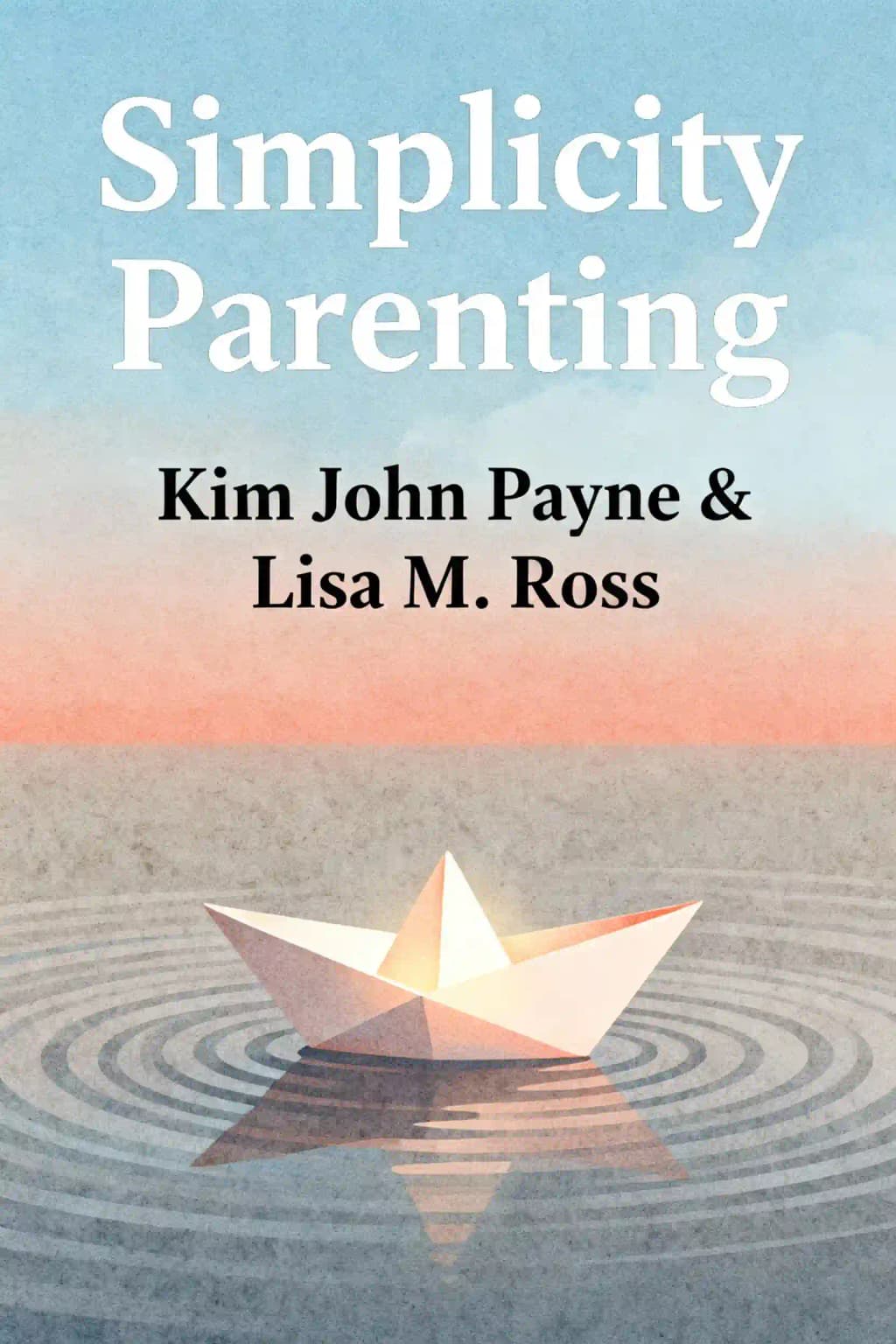
In "Simplicity Parenting," Kim John Payne reveals how decluttering your child's world creates calmer, happier kids. Endorsed by parenting expert Sarah Moore, this 2009 game-changer asks: What if your child's behavioral issues stem from too much stuff and overscheduled lives?
Kim John Payne, M.Ed., co-author of Simplicity Parenting: Using the Extraordinary Power of Less to Raise Calmer, Happier, and More Secure Kids, is a renowned family consultant and educator with over two decades of experience in child development and family counseling.
A leading voice in holistic parenting, Payne has served as a school counselor, private family therapist, and director of the Waldorf Collaborative Counseling Program at Antioch University New England. His work on attention disorders and sensory simplification has influenced educational frameworks globally, including partnerships with the Alliance for Childhood.
Lisa M. Ross, a seasoned writer and former literary agent, brings her expertise in family dynamics and communication to the book’s accessible, actionable guidance. Together, they address modern challenges like screen time and hyperparenting, advocating for rhythmic routines and clutter-free environments to foster emotional resilience.
The revised edition of their seminal work, updated to address social media and boundary-setting, remains a trusted resource for parents worldwide, endorsed by educators and professionals for its transformative approach to nurturing childhood.
Simplicity Parenting offers a blueprint to reduce childhood overwhelm by simplifying environments, routines, and parental pressures. Kim John Payne advocates decluttering toys, establishing predictable rhythms, limiting adult-world stressors, and fostering imaginative play to nurture calmer, happier kids. The book’s four pillars—environment, rhythm, schedules, and filtering adult concerns—aim to create sanctuary-like homes.
Parents feeling overwhelmed by modern parenting’s demands, caregivers of anxious or overstimulated children, and families seeking calmer home dynamics. It’s ideal for those drawn to minimalist lifestyles or wanting to prioritize meaningful connections over material excess.
Yes—readers praise its actionable advice for reducing family stress. Reviewers note improved child behavior post-decluttering and calmer routines. Critics argue it may feel restrictive, but Payne emphasizes flexibility, urging families to adapt principles to their needs.
Payne advises keeping toys that inspire open-ended play (e.g., blocks, art supplies) and removing “fixed” toys with limited uses (e.g., single-purpose gadgets). He argues fewer choices deepen focus and creativity, letting children “pour their imagination” into play.
Ask: “Does this item let my child’s imagination flow, or does it dictate how they play?” Toys that only require button-pushing or have overly detailed designs are prioritized for removal, while open-ended tools are retained.
While not anti-technology, Payne urges strict limits on screens to prevent sensory overload. He links excessive screen exposure to reduced attention spans and recommends replacing digital entertainment with hands-on play and family interaction.
This involves creating serene spaces with natural light, muted colors, and minimal synthetic scents. Reducing visual/auditory chaos helps children focus, self-regulate, and engage deeply with activities.
Yes—principles adapt to any age. For teens, Payne suggests collaborative decluttering, co-designing routines, and discussing media boundaries. The focus shifts to fostering autonomy within simplified frameworks.
Some argue its emphasis on reduction overlooks socioeconomic diversity (e.g., limited budgets for toy rotations). Others note it requires significant parental effort to maintain rhythms. Supporters counter that small, incremental changes yield impactful results.
Both prioritize intentionality, but Payne focuses on childhood development rather than spatial aesthetics. While Kondō asks “Does this spark joy?”, Payne asks “Does this spark imagination?”—targeting kids’ creative needs over adult preferences.
As digital saturation grows, families increasingly seek ways to combat attention fragmentation. Payne’s strategies for tech moderation, mental space creation, and connection align with contemporary minimalist and mindfulness movements.
Senti il libro attraverso la voce dell'autore
Trasforma la conoscenza in spunti coinvolgenti e ricchi di esempi
Cattura le idee chiave in un lampo per un apprendimento veloce
Goditi il libro in modo divertente e coinvolgente
Our children are drowning in stuff, choices, information, and speed.
These typical children were exhibiting what Payne calls Cumulative Stress Reaction.
These children were suffering from what he terms 'the undeclared war on childhood'.
Parents might notice phases: first, the buildup of tension, then the peak of emotional distress.
The threshold to a child's room often reveals an otherworldly space.
Scomponi le idee chiave di Simplicity Parenting in punti facili da capire per comprendere come i team innovativi creano, collaborano e crescono.
Vivi Simplicity Parenting attraverso narrazioni vivide che trasformano le lezioni di innovazione in momenti che ricorderai e applicherai.
Chiedi qualsiasi cosa, scegli il tuo stile di apprendimento e co-crea intuizioni che risuonano davvero con te.

Creato da alumni della Columbia University a San Francisco
"Instead of endless scrolling, I just hit play on BeFreed. It saves me so much time."
"I never knew where to start with nonfiction—BeFreed’s book lists turned into podcasts gave me a clear path."
"Perfect balance between learning and entertainment. Finished ‘Thinking, Fast and Slow’ on my commute this week."
"Crazy how much I learned while walking the dog. BeFreed = small habits → big gains."
"Reading used to feel like a chore. Now it’s just part of my lifestyle."
"Feels effortless compared to reading. I’ve finished 6 books this month already."
"BeFreed turned my guilty doomscrolling into something that feels productive and inspiring."
"BeFreed turned my commute into learning time. 20-min podcasts are perfect for finishing books I never had time for."
"BeFreed replaced my podcast queue. Imagine Spotify for books — that’s it. 🙌"
"It is great for me to learn something from the book without reading it."
"The themed book list podcasts help me connect ideas across authors—like a guided audio journey."
"Makes me feel smarter every time before going to work"
Creato da alumni della Columbia University a San Francisco

Ottieni il riassunto di Simplicity Parenting in formato PDF o EPUB gratuito. Stampalo o leggilo offline quando vuoi.
What if the anxiety, sleeplessness, and explosive behavior we see in our children aren't signs of deficiency-but of overload? A family therapist working in refugee camps noticed something unsettling: children from comfortable suburban homes were showing the same symptoms as war-traumatized refugees. Same treatment plans. Same behavioral patterns. Same stress markers. These weren't kids fleeing violence or famine. They had loving parents, safe homes, full pantries. Yet they were exhibiting what clinicians call Cumulative Stress Reaction-a condition eerily similar to PTSD, but caused not by a single trauma, but by the relentless accumulation of small, unrelenting pressures. The culprit? Four pillars of "too much" quietly dismantling childhood: too much stuff, too many choices, too much information, and too fast a pace. When families began systematically reducing these elements-cutting toys, screen time, activities, and adult information by half-something remarkable happened. Within four months, 68% of clinically struggling children returned to normal functioning. No medication. Just space to breathe. Their academic performance jumped nearly 37%. This wasn't about adding enrichment or therapeutic intervention. It was about subtraction-clearing away the noise so childhood could unfold as it's meant to.
We instinctively recognize physical illness-fever, cough, pallor. But children also experience "soul fevers," emotional states where they're overwhelmed and disconnected. An introverted child withdraws while lashing out; an extroverted one becomes uncharacteristically aggressive. A cheerful child suddenly refuses favorite activities. Minor disappointments trigger hour-long meltdowns. The response mirrors treating physical illness-stop everything and create space for recovery. Most children reset their emotional equilibrium with two or three quiet days filled with simple pleasures: painting, baking cookies together, reading beloved books, building with their hands. Nature provides particularly powerful medicine. Studies show hospital patients with tree views recover faster, and time outdoors shifts children from fight-or-flight responses to higher cognitive functioning. Like physical fevers, soul fevers have their own lifespan that can't be rushed. By simplifying during these times, we create a loving container for recovery. They emerge stronger, having learned that difficult feelings pass and that their parents understand their emotional needs as deeply as their physical ones.
Today's average child receives seventy toys annually, transforming treasures into clutter. Advertisers claim more toys spark imagination, but excess actually fragments attention and derails natural focus. The key distinction: toys that invite imagination versus those that are "fixed." A wooden block becomes a phone, car, or building. A plastic movie character can only be itself. Architect Simon Nicholson's "Theory of Loose Parts" explains that creativity relates directly to movable, transformable elements. When simplifying, gather all toys into one mountain, then reduce dramatically-halved, then halved again. Remove broken items, developmentally inappropriate toys, anything that "does too much" mechanically, high-stimulation toys with flashing lights, and pressure purchases. Create a "lending library" where one toy must be put away for each new one entering rotation. The guideline: how many toys can your child put away independently in five minutes? Children need sensory experiences with natural materials, real tools providing genuine involvement, and make-believe play developing critical cognitive skills. Most importantly, they need experiences, not entertainment-exploring their environments, engaging with earth, water, fire, and air, developing purpose through meaningful activities alongside adults.
Children crave rhythm from their first heartbeat in the womb. Consistent patterns teach them things disappear and reappear, building security. When six-year-old Justin refused to leave bed due to erratic schedules, his parents introduced nightly previews and visual markers. Rhythm establishes gentle authority - "This is what we do" communicates safety while reducing constant discipline. Start small, creating islands of consistency that build "relational credits" sustaining connections through difficult times. Family dinners correlate with better academics, healthier eating, and reduced depression and substance abuse. The journey toward sleep begins at wake-up, with "pressure valves" throughout the day releasing emotional steam. Most children aged two to six need eleven hours nightly; each hour missed reduces attention span by 25%. Bedtime stories serve as powerful pressure valves, allowing children to process emotions through mythical adventures.
Children today have twelve hours less free time per week than a generation ago. Like sustainable farming requiring crop rotation, childhood needs balance between three essential elements: the "fallow field" of leisure and rest, the "legume crop" of deep creative play when children lose themselves in flow, and the "crop field" of structured activities. Boredom isn't a problem to solve-it's the precursor to creativity. When children claim they're bored, they're crossing the bridge from "doing nothing" to deep creative play. Instead of rescuing them, respond flatly: "Something to do is right around the corner." One mother discovered that alternating arousing and calming days helped prevent meltdowns-after stimulating activities, she intentionally inserted quiet breaks. Creating "moments of Sabbath"-no phones during dinner, no email after a certain hour-restores balance. These pauses serve as punctuation in the run-on sentence of life. When we reduce overscheduling, we make room for anticipation's powerful gift: a child who looks forward to an event brings imagination to it, creating mental pictures and layering meaning before it even happens.
One mother described motherhood as "worry"-a feeling her own mother, who raised eight children, never experienced. Today's fears eclipse our hopes. Imagine a houseguest monopolizing your children's attention for hours daily, sharing inappropriate content, and dominating meals. That houseguest is your television-a black hole consuming family time. For young children, eliminating screens allows neural development to proceed uninterrupted. During the first three years, when a baby's brain forms quadrillions of connections, parents provide essential security and filtering. Children with secure attachments experience less stress, regulate emotions better, and learn more effectively. Despite child abductions remaining statistically unchanged for twenty years, media sensationalism has amplified parental fears. Parents who constantly consume alarming media "nurse" on anxiety, polluting family well-being and teaching children to see danger before possibility. Parents often drown children in constant commentary, filling space with words rather than truly noticing. The Threefold Filter-asking if what we're about to say is true, kind, and necessary-provides a framework for conscious speech. When parents say less, children listen more.
Contrary to our culture's equation of choice with freedom, too many options overwhelm children. When choices are reduced, pressure lifts, allowing children to discover what truly speaks to them. As the noise of popular culture and consumerism diminishes, families tune into their own values, creating a stable center for consistent discipline and clearer direction. In a world constantly telling us children need more - more stimulation, activities, stuff - perhaps the most radical parenting act is creating space for less. Less noise so they hear their own thoughts. Less rushing so they move at childhood's natural pace. Less anxiety so they build genuine confidence. When you simplify children's lives, they reconnect you with your less stressed, more carefree self. The gift of simplicity isn't just what we give our children - it's what they give back, reminding us that the richest childhood isn't built from abundance but from presence, rhythm, and breathing room to simply be.