Capitolo 1
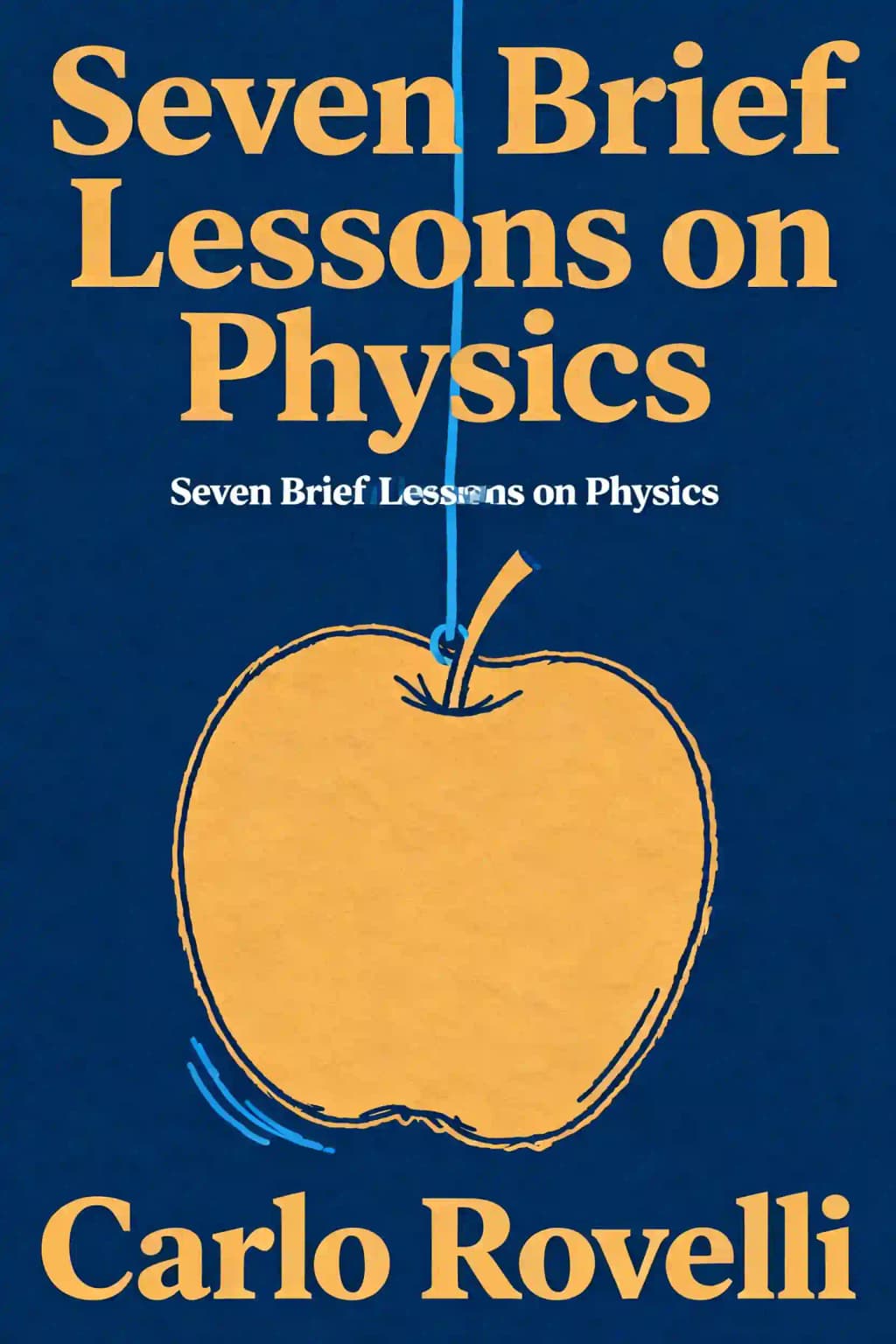
The Universe in Seven Steps: Rovelli's Journey Through Modern Physics
Physics can feel intimidating-a realm of complex equations and abstract concepts far removed from daily life. Yet Carlo Rovelli's masterpiece has accomplished something remarkable: making the most revolutionary ideas in modern physics not just accessible but genuinely thrilling. This slim volume has become a global phenomenon, translated into 41 languages and selling over a million copies worldwide. Even celebrities like Benedict Cumberbatch and Emma Watson have praised its ability to make complex physics feel poetic and profound. What makes this book extraordinary is Rovelli's unique background-he's not just a theoretical physicist at the forefront of quantum gravity research, but also deeply versed in philosophy and literature. This rare combination allows him to bridge the gap between scientific precision and humanistic wonder, showing us that physics isn't just about understanding particles and forces-it's about understanding our place in the cosmos.
Capitolo 2
Einstein's Masterpiece: Space That Bends and Time That Flows
Albert Einstein's general theory of relativity stands as perhaps the most beautiful scientific theory ever conceived. After his groundbreaking papers on special relativity in 1905, Einstein spent a decade in intense intellectual labor, wrestling with a fundamental insight that would transform our understanding of gravity. The result wasn't just a new theory-it was a complete reimagining of space and time.
The theory's central revelation is both simple and profound: gravity isn't a force that spreads through space-gravity is space itself. Matter causes space to curve around it, like a bowling ball placed on a trampoline. This curvature explains why planets orbit stars and why light bends around massive objects. Even more astonishing, time itself warps in the presence of matter, flowing more quickly at higher altitudes where gravity's pull is weaker. This isn't mere speculation-atomic clocks placed at different heights actually measure this difference.
What makes Einstein's theory so remarkable is its extraordinary predictive power. It anticipated black holes-regions where space curves so dramatically that nothing, not even light, can escape. It predicted the expansion of the universe and the existence of gravitational waves-ripples in the fabric of spacetime that were finally detected in 2015, a century after Einstein proposed them. All this complexity emerges from a single, elegant equation: Ra - 12Rga = Ta.
Consider how revolutionary this concept is: the space between objects isn't empty nothingness but a dynamic, malleable fabric that can stretch, compress, and ripple like water. When massive objects move, they create gravitational waves that propagate outward at the speed of light, carrying energy across the cosmos. These aren't abstract mathematical constructs but real physical phenomena that shape everything from the orbits of planets to the evolution of galaxies.
Einstein's theory represents science at its most beautiful-a perfect marriage of mathematical elegance and explanatory power that fundamentally changed our understanding of reality. It shows us that the universe is far stranger and more interconnected than our everyday experience suggests, yet comprehensible through the language of mathematics.
Capitolo 3
The Quantum World: Where Reality Gets Weird
If general relativity represents physics at its most elegant and comprehensible, quantum mechanics stands as its mysterious, enigmatic counterpart. Unlike Einstein's theory-a compact gem conceived by a single brilliant mind-quantum mechanics emerged messily, through the collective efforts of dozens of physicists grappling with increasingly bizarre experimental results.
The quantum revolution began in 1900 when Max Planck reluctantly introduced the idea that energy might come in discrete packets called "quanta" rather than continuous flows. This seemingly minor mathematical trick to solve a specific problem would ultimately upend physics. Einstein expanded this concept in 1905, showing that light itself consists of particles-photons-rather than continuous waves. This was just the beginning of the strangeness.
Niels Bohr soon discovered that electrons don't orbit atomic nuclei like planets around the sun. Instead, they occupy specific energy levels and can "jump" between them by absorbing or emitting photons-without existing in the space between. Werner Heisenberg later formalized this into a mathematical framework that produced startlingly accurate predictions while defying common sense: electrons don't have definite positions between measurements; they exist as probability waves that "collapse" into particles only when observed.
Consider what this means: the fundamental particles making up reality don't have definite properties until they interact with something else. An electron isn't somewhere specific until we look for it. Its position, speed, and other properties exist only as probabilities until measurement forces the system to "choose" a specific state. Even more bizarrely, these measurements appear fundamentally random-not just unpredictable because of our ignorance, but genuinely indeterminate at the most fundamental level.
Einstein himself found these ideas deeply troubling, famously declaring that "God does not play dice with the universe." He engaged in years of intellectual sparring with Bohr, proposing thought experiments designed to reveal contradictions in quantum theory. Yet every experimental test has confirmed quantum mechanics' predictions with astonishing precision.
A century later, quantum mechanics powers our modern world-from computers and lasers to MRI machines and GPS systems-yet remains profoundly mysterious. Perhaps its greatest lesson is that reality itself may be fundamentally about interaction rather than independent existence. Things don't simply "exist"-they exist in relation to other things, materializing their properties only through interaction. This suggests a deeply interconnected universe where nothing is truly separate from anything else.
Capitolo 4
Our Cosmic Home: From Earth-Centered Universe to Cosmic Web
Our understanding of the cosmos represents humanity's longest intellectual journey-a series of revolutionary expansions in perspective that have repeatedly demoted our apparent significance while revealing a universe of breathtaking grandeur.
For millennia, humans perceived a simple cosmos: Earth below, sky above. This intuitive model gave way when Greek thinker Anaximander boldly proposed Earth suspended freely in space, with sky extending in all directions. Later, Parmenides and Aristotle established the spherical nature of both Earth and the celestial realm, creating the geocentric model that dominated Western thought for nearly two thousand years.
The Copernican revolution of the 16th century displaced Earth from the center, revealing our planet as just one of several orbiting the sun. This cosmic demotion continued as improved instruments revealed our solar system to be merely one among countless others in a galaxy containing a hundred billion stars. By the 1930s, astronomers realized our Milky Way itself is just one galaxy among billions, scattered across an expanding cosmos stretching beyond our most powerful telescopes.
Modern observations have revealed a universe of almost incomprehensible scale-containing perhaps two trillion galaxies, each with hundreds of billions of stars and planets. Recent calculations suggest the observable universe might contain as many as 10^24 planets similar to Earth. Yet this vast expanse isn't static-it's dynamic and evolving, with space itself expanding like the surface of an inflating balloon.
Our current understanding suggests this entire cosmos emerged from an extraordinarily hot, dense state approximately 13.8 billion years ago, expanding and cooling to form the structures we observe today. Space itself stretches between galaxies, carrying them apart like raisins in rising dough. This expansion appears to be accelerating due to a mysterious "dark energy" that comprises roughly 68% of the universe's content.
What's particularly striking is how this scientific narrative parallels ancient intuitions. Many creation myths describe the universe emerging from primordial chaos or nothingness-not unlike the quantum fluctuations that may have triggered the Big Bang. The Buddhist concept of "dependent origination"-where nothing exists independently but only through relationships with other things-resonates with modern cosmology's picture of a universe where space, time, and matter are dynamically intertwined.
Each expansion of our cosmic perspective has required abandoning comfortable certainties. Yet each has revealed a universe more magnificent than we had imagined-a cosmos where atoms in our bodies were forged in ancient stars, connecting us intimately to the cosmic story.
Capitolo 5
The Building Blocks: Elementary Particles and Fields
If the cosmos represents the largest scale of physical reality, elementary particles represent the smallest. These fundamental building blocks compose everything we see and touch, yet they bear little resemblance to our intuitive notion of "things."
The journey to understand matter's basic components began with atoms-once thought indivisible but later revealed to contain electrons orbiting nuclei made of protons and neutrons. Deeper investigation showed these protons and neutrons themselves contain even smaller particles called quarks, whimsically named by physicist Murray Gell-Mann after a nonsensical word from James Joyce's "Finnegans Wake." These quarks are bound together by force-carrying particles aptly named "gluons."
Our current understanding, formalized in the Standard Model of particle physics, identifies just a handful of truly elementary particles: six types of quarks, six types of leptons (including electrons and neutrinos), four force carriers (photons, gluons, W and Z bosons), and the Higgs boson discovered in 2013. These particles function like a cosmic alphabet-a limited set of characters that, through various combinations, spell out the entire story of material reality.
Yet quantum mechanics reveals these aren't solid, pebble-like entities. Rather, they're excitations of underlying quantum fields that permeate all space-ripples or wavelets that appear and disappear according to quantum laws. Even empty space contains a constant swarming of "virtual particles" that briefly pop into existence before vanishing again. This quantum world bears little resemblance to Newton's mechanical universe of solid objects following precise trajectories-it's a continuous, restless dance of things coming into existence and disappearing, a world of happenings rather than things.
Consider an electron: rather than a tiny sphere with fixed properties, it's better understood as a localized vibration in an electron field that extends throughout the universe. When this vibration interacts with other fields, it manifests the properties we associate with electrons. Between interactions, it exists only as a cloud of probabilities.
Despite its remarkable success, the Standard Model remains unsatisfying to many physicists. Unlike the elegant simplicity of general relativity, it feels piecemeal-a collection of particles and forces with seemingly arbitrary properties. It requires mathematical tricks like "renormalization" to make predictions, and it fails to explain phenomena like dark matter or incorporate gravity. Alternative theories like string theory have been proposed but remain unconfirmed by experiment.
Yet for all its inelegance, the Standard Model works remarkably well at describing our world-a handful of elementary particles vibrating between existence and non-existence, combining like letters to tell the immense history of galaxies, stars, mountains, and smiling faces.
Capitolo 6
The Quantum Nature of Space: Loops and Networks
At the frontier of modern physics lies a profound paradox: our two most successful theories-general relativity and quantum mechanics-contradict each other while both working extraordinarily well in their domains. General relativity describes a smooth, continuous space-time curved by matter and energy, while quantum mechanics portrays a world of discrete energy packets and probabilistic behavior. This contradiction isn't merely an academic puzzle-it suggests our understanding of reality remains fundamentally incomplete.
Resolving this contradiction is the challenge of "quantum gravity," pursued by theoretical physicists worldwide. Such contradictions have historically led to revolutionary advances in physics, as when Newton combined Galileo's and Kepler's insights, or when Einstein resolved conflicts between electromagnetism and mechanics with special relativity.
One promising approach is "loop quantum gravity," which suggests that space itself isn't continuous but composed of extremely minute "atoms of space" or "loops"-discrete units a billion billion times smaller than atomic nuclei. These quanta form a network of relations weaving the texture of space like rings in chain mail. This isn't merely saying space contains discrete elements-these quanta are space itself. The smooth, continuous space we perceive emerges from this underlying granular structure, just as a sandy beach appears smooth from a distance despite consisting of countless individual grains.
Even more radically, the theory eliminates the concept of elementary "time" flowing independently. Change remains ubiquitous, but elementary processes can't be ordered in a common succession of instants. Each process dances to its own rhythm, with time emerging from relationships between quantum events. The familiar world of continuous space and flowing time is merely a blurred vision of this swarming of elementary processes, just as a calm Alpine lake consists of myriads of water molecules in rapid motion.
This quantum view of spacetime suggests reality is fundamentally relational-things don't exist in space and time; they exist in relation to one another, creating the fabric of spacetime through their interactions. Space isn't a container for matter but emerges from the relationships between quantum entities.
If confirmed, this would represent a profound shift in our understanding of reality's foundation. Just as quantum mechanics revealed matter to be fundamentally different from our everyday perception, quantum gravity suggests space and time themselves may be emergent properties arising from deeper quantum processes. The solid ground beneath our feet, the vast distances between galaxies, and the steady flow of time might all be macroscopic approximations of a reality far stranger than we can intuitively grasp.
Capitolo 7
Time's Arrow: Heat, Probability, and Black Holes
Why does time flow in only one direction? This seemingly simple question leads to profound insights about reality's nature. The investigation began with heat-that everyday phenomenon that always flows from hot objects to cold ones, never the reverse. In the 19th century, James Maxwell and Ludwig Boltzmann discovered that heat isn't a fluid but rather the motion of atoms-hot substances contain atoms moving more quickly than cold ones.
This elegant insight opened profound questions about time's directionality. Most physical laws work equally well forward or backward-a frictionless pendulum could swing forever without distinguishing past from future. Yet heat-producing processes create an unmistakable arrow of time. Drop an egg, and it shatters; we never see shattered eggs spontaneously reassembling themselves.
Boltzmann's revolutionary answer was surprisingly simple: it happens by sheer probability. Heat flows from hot to cold objects not by absolute law but with overwhelming statistical likelihood, as fast-moving atoms tend to distribute their energy through collisions. The probability that all the molecules in a room would spontaneously move to one corner is mathematically possible but vanishingly unlikely-comparable to shuffling a deck of cards and having them arrange perfectly by suit and number.
This introduction of probability into physics' foundation was initially ridiculed, contributing to Boltzmann's suicide in 1906, before gaining universal acceptance. Unlike quantum probability (which appears fundamental to reality), thermodynamic probability stems from our practical inability to track billions of particles simultaneously. We can measure a balloon's shape, volume, and temperature without knowing each molecule's exact position-but this limitation means we can only predict the probability of various behaviors when the balloon is released.
This statistical approach reveals something profound: probability doesn't govern matter itself but rather the limited set of properties through which we interact with objects. The flow of time as we experience it may be intimately connected to this statistical nature of thermodynamics-to our inability to perceive reality's finest details.
A tantalizing clue toward solving this puzzle comes from Stephen Hawking's discovery that black holes emit heat. Though too faint to observe in actual black holes, this quantum effect on a gravitational object involves all three pillars of physics: quantum mechanics, general relativity, and thermodynamics. The heat of black holes is like the Rosetta Stone of physics-written in three languages still awaiting complete decipherment.
Einstein himself noted that our notion of "now" flowing from past to future finds no correspondence in physics. As he wrote after his friend Michele Besso's death: "Michele has left this strange world a little before me. This means nothing. People like us, who believe in physics, know that the distinction made between past, present and future is nothing more than a persistent, stubborn illusion."
Our vivid experience of time's passage likely emerges from the connection between time and heat-from our limited ability to register reality's fine details. For a hypothetical all-knowing being, the universe might appear as a single block of past, present, and future. Our perception of time flowing may be the signature of our particular perspective on a reality far more complex than we can directly perceive.
Capitolo 8
Cosmic Perspective: Finding Meaning in a Universe of Particles
After journeying through curved spacetime, quantum fields, and the birth of the cosmos, we return to a fundamental question: what are we in this world of ephemeral quanta and probability waves? If we consist only of particles following physical laws, where does our sense of individual existence come from? What meaning can our values, dreams, and emotions have in this boundless universe?
We occupy a unique position in the cosmos-we are both the observers who create the collective image of reality and an integral part of the world we perceive. Made of the same atoms exchanged between pine trees and stars, we've learned that we're only a small part of the universe. We once believed ourselves central to everything, but discovered we're merely descendants of the same ancestors as butterflies and larches.
Our bodies are assemblages of particles that have existed since the Big Bang, temporarily organized into the pattern we call "human." The carbon in our cells was forged in ancient stars that exploded billions of years ago. The water in our bodies has cycled through countless organisms before becoming part of us. We aren't separate from nature-we are nature in one of its innumerable expressions.
What about consciousness and free will? Our freedom doesn't mean our behavior isn't determined by natural laws, but rather that it's determined by those laws acting in our extraordinarily complex brains. There is no "I" separate from "the neurons in my brain"-they are the same thing. An individual is a complex, tightly integrated process. Our sensation of internal liberty comes from the fact that our self-image is much cruder than the detailed complexity happening within us.
Consider the numbers: we have a hundred billion neurons in our brains-as many as stars in a galaxy-with an astronomical number of potential combinations. The "I" who decides is formed from reflections upon itself, through self-representations in the world. This doesn't diminish the reality of our experience-it enriches it by connecting it to the broader tapestry of existence.
Our moral values and emotions are no less real for being part of nature or shaped by evolution-they are more valuable because they are real. They are the complex reality of which we are made. Love, curiosity, wonder-these aren't illusions but emergent properties of our particular organization of matter, no less significant for having physical explanations.
We are a naturally curious species, the only one left of the genus Homo. One hundred thousand years ago we left Africa, driven by this curiosity. This same drive to understand has led us from primitive mythologies to quantum mechanics and relativity-yet still, we stand before mysteries. As Lucretius wrote, "we are all born from the same celestial seed." Our knowledge continues to grow, and on the frontiers of what we know, in contact with the ocean of the unknown, shines the mystery and beauty of the world.
Capitolo 9
The Dance of Knowledge and Mystery: Physics as a Human Adventure
Physics isn't merely a collection of facts about particles and forces-it's a profound human adventure, a centuries-long conversation between curious minds and a mysterious universe. What makes Rovelli's approach so compelling is his recognition that science doesn't diminish wonder-it deepens it.
The journey of modern physics reveals a pattern: each breakthrough doesn't just answer questions but opens new ones, often more profound than those we started with. Einstein's relativity solved problems with Newtonian mechanics but created new puzzles about the nature of space and time. Quantum mechanics resolved contradictions in atomic physics but introduced deeper questions about reality and observation. This isn't failure but the signature of genuine progress-each layer of understanding peeled away reveals further mysteries beneath.
This perspective offers a powerful antidote to both scientific arrogance and anti-scientific skepticism. The greatest physicists-from Einstein and Bohr to Feynman and Hawking-have combined technical mastery with profound humility before nature's mysteries. As Feynman famously noted, "The first principle is that you must not fool yourself-and you are the easiest person to fool."
Physics teaches us that reality is far stranger than common sense suggests. Space curves. Time dilates. Particles exist as probability waves until observed. Empty space teems with virtual particles popping in and out of existence. These aren't mystical speculations but conclusions drawn from rigorous experiment and mathematics. The universe doesn't conform to our intuitions-our intuitions must expand to accommodate the universe.
Perhaps most importantly, physics reveals our deep connection to the cosmos. The hydrogen in our bodies formed in the Big Bang. The carbon, oxygen, and other elements were forged in stellar furnaces and scattered by supernovae explosions. The atoms in your left hand might have come from a different star than those in your right. We aren't visitors to the universe-we are the universe becoming conscious of itself.
This cosmic perspective doesn't diminish human significance but transforms it. We matter not because we're at the center of creation or separate from nature, but because we're the part of nature capable of understanding nature. Through science, art, and philosophy, we give voice to a universe that would otherwise remain mute to its own magnificence.
As we face global challenges requiring scientific literacy and collective action, Rovelli's approach offers a vital reminder: physics isn't just for physicists. Its insights belong to all humanity-a testament to what human curiosity, collaboration, and creativity can achieve. The universe revealed by modern physics isn't cold and mechanical but vibrant, interconnected, and filled with possibility-a universe worthy of both scientific investigation and poetic celebration.