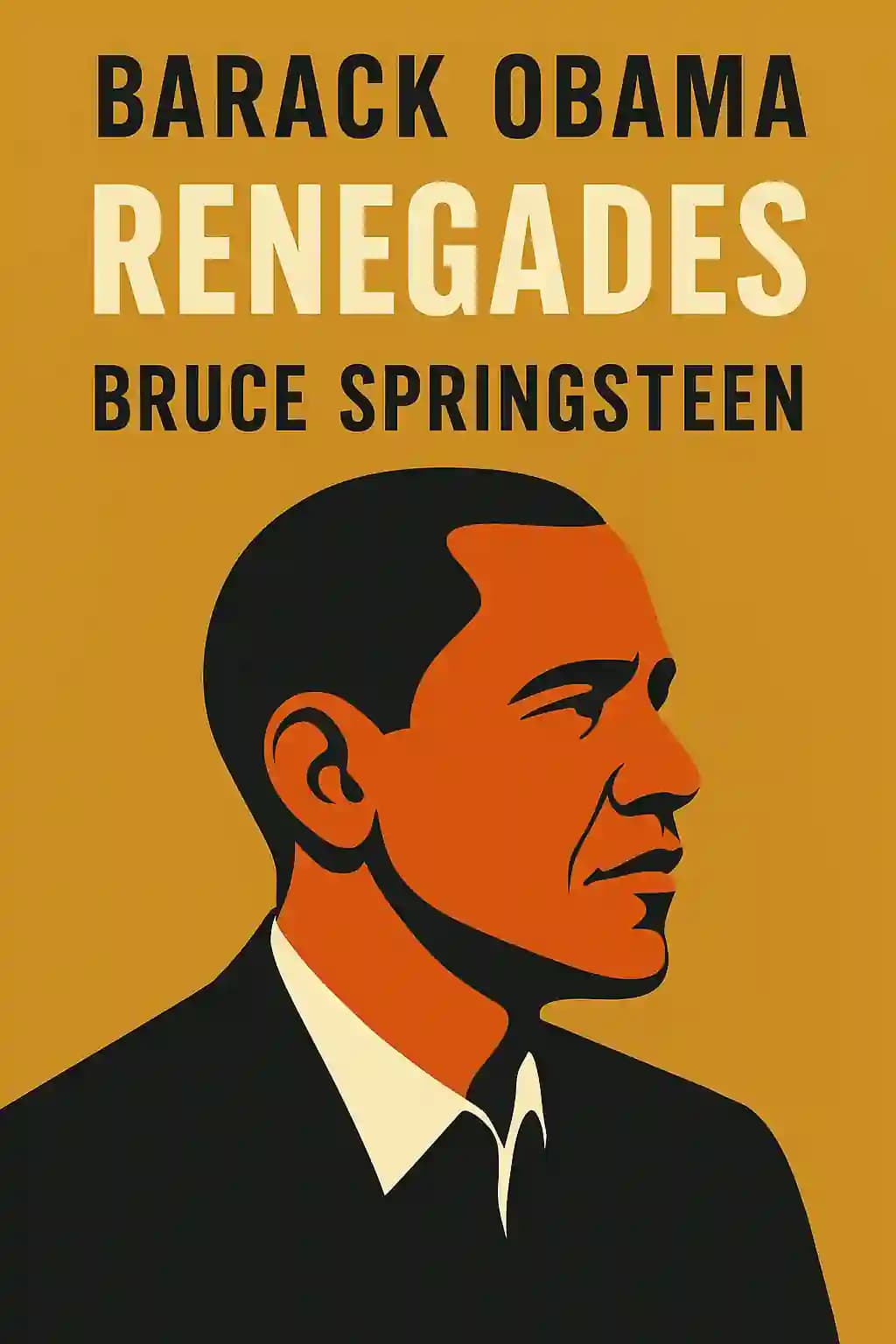
Two American icons - Obama and Springsteen - reveal their personal journeys through race, masculinity, and the American dream in this visually stunning dialogue. What happens when a President and a rockstar share their vulnerabilities? Michelle Obama says her husband learned plenty.
Barack Obama, the 44th President of the United States and bestselling author of A Promised Land, teams with Bruce Springsteen, the iconic singer-songwriter known as “The Boss,” in Renegades: Born in the USA.
This collaborative work blends memoir, social commentary, and cultural history, exploring themes of race, fatherhood, and the complexities of American identity through candid conversations originally featured on their chart-topping Spotify podcast. Obama’s political leadership and Springsteen’s five-decade music career – including seminal albums like Born to Run – inform their examination of national unity and personal resilience.
The book expands their dialogue with rare photographs, annotated speeches, and handwritten lyrics, offering an intimate portrait of their parallel journeys as cultural storytellers. Springsteen’s 2016 memoir Born to Run and Obama’s presidential writings established both as chroniclers of the American experience, while their Renegades podcast became one of Spotify’s most-streamed series globally.
Published by Crown in 2021, the illustrated hardback became a New York Times bestseller, translating their raw podcast chemistry into a visceral exploration of hope amid societal divides.
Renegades: Born in the USA captures candid conversations between Barack Obama and Bruce Springsteen, exploring themes like race, fatherhood, American identity, and the challenges of bridging political divides. Blending personal anecdotes, historical reflections, and cultural analysis, the book features photos, annotated speeches, and handwritten lyrics to illustrate their shared vision of a more unified America.
Fans of Obama’s political insights or Springsteen’s music, as well as readers interested in American culture, will find value. The book appeals to those seeking dialogue on societal issues like racial justice, masculinity, and the evolving American Dream, enriched by the duo’s contrasting perspectives.
Yes, for its rare blend of personal storytelling and cultural commentary. The book offers intimate reflections from two iconic figures, paired with visual artifacts like historical photos and Springsteen’s lyric drafts, making it a compelling read for those invested in America’s past and future.
Key themes include the pursuit of the American Dream, racial inequality, fatherhood, and resilience. Obama and Springsteen dissect how societal divisions emerge and emphasize storytelling as a tool for unity, weaving in references to historical figures like Harriet Tubman and musical influences.
Both acknowledge its fragility—Obama frames it as an ongoing struggle for equity, while Springsteen romanticizes its promise through working-class narratives. They agree that reclaiming this ideal requires confronting systemic barriers and fostering collective hope.
Obama reflects on his biracial upbringing and political journey, while Springsteen discusses his working-class roots and artistic evolution. Both open up about fatherhood, marital challenges, and the emotional toll of public life, humanizing their iconic personas.
The book features rare photos from their personal archives, Obama’s annotated speeches (like his Selma anniversary address), Springsteen’s handwritten lyrics, and historical documents. These visuals contextualize their dialogue and enrich the narrative.
Obama’s political pragmatism contrasts with Springsteen’s artistic idealism, yet their shared outsider perspectives—Obama as a Black man in politics, Springsteen as a blue-collar poet—create mutual respect. This dynamic fuels nuanced discussions on identity and belonging.
Some critics argue the book prioritizes nostalgic optimism over concrete policy solutions. Others note its conversational tone may lack depth for readers seeking rigorous analysis of America’s systemic issues.
The dialogues confront polarization, racial injustice, and economic inequality. Obama and Springsteen advocate for empathy, shared narratives, and civic engagement as antidotes to division, reflecting on 2020’s upheavals.
Notable lines include Obama’s “America isn’t a zero-sum game” and Springsteen’s “The country we carry in our hearts is waiting.” These underscore their belief in collective progress and cultural storytelling.
Unlike Obama’s memoirs (A Promised Land) or Springsteen’s autobiography (Born to Run), Renegades emphasizes collaboration. It blends political and artistic lenses, offering a unique hybrid of memoir and cultural critique.
Senti il libro attraverso la voce dell'autore
Trasforma la conoscenza in spunti coinvolgenti e ricchi di esempi
Cattura le idee chiave in un lampo per un apprendimento veloce
Goditi il libro in modo divertente e coinvolgente
America is a place “for all the outsiders and all the misfits” trying to make something from nothing.
Music serves as both cultural unifier and mirror reflecting social fault lines.
“Life among musicians is good,” Springsteen noted.
The local bar scene and the boardwalk became his classroom.
Scomponi le idee chiave di Renegades in punti facili da capire per comprendere come i team innovativi creano, collaborano e crescono.
Vivi Renegades attraverso narrazioni vivide che trasformano le lezioni di innovazione in momenti che ricorderai e applicherai.
Chiedi qualsiasi cosa, scegli il tuo stile di apprendimento e co-crea intuizioni che risuonano davvero con te.

Creato da alumni della Columbia University a San Francisco
"Instead of endless scrolling, I just hit play on BeFreed. It saves me so much time."
"I never knew where to start with nonfiction—BeFreed’s book lists turned into podcasts gave me a clear path."
"Perfect balance between learning and entertainment. Finished ‘Thinking, Fast and Slow’ on my commute this week."
"Crazy how much I learned while walking the dog. BeFreed = small habits → big gains."
"Reading used to feel like a chore. Now it’s just part of my lifestyle."
"Feels effortless compared to reading. I’ve finished 6 books this month already."
"BeFreed turned my guilty doomscrolling into something that feels productive and inspiring."
"BeFreed turned my commute into learning time. 20-min podcasts are perfect for finishing books I never had time for."
"BeFreed replaced my podcast queue. Imagine Spotify for books — that’s it. 🙌"
"It is great for me to learn something from the book without reading it."
"The themed book list podcasts help me connect ideas across authors—like a guided audio journey."
"Makes me feel smarter every time before going to work"
Creato da alumni della Columbia University a San Francisco

Ottieni il riassunto di Renegades in formato PDF o EPUB gratuito. Stampalo o leggilo offline quando vuoi.
In the summer of 2020, as pandemic fears and political divisions tore through America, two men from vastly different worlds sat down in a New Jersey farmhouse surrounded by guitars and recording equipment. Barack Obama-raised in Hawaii by a white mother, Harvard Law graduate, first Black president-faced Bruce Springsteen-working-class white rock star from Freehold, New Jersey. Their unlikely friendship had begun years earlier when Springsteen performed at Obama's campaign events, but deepened through conversations about their parallel journeys searching for America's soul and their own identities within it. "I'm a high school graduate from Freehold who plays guitar," Springsteen initially wondered. "What's wrong with this picture?" Yet their podcast "Renegades" quickly resonated with an America desperate for authentic dialogue across divides. What makes their connection so compelling isn't just their celebrity status, but how these two men from such different backgrounds discovered they'd been asking the same essential questions all along: What does it mean to be American? What obligations do we have to one another? And how do we become the people we hope to be?
Both men's childhoods were defined by feeling like outsiders. Obama faced subtle racism growing up mixed-race in Hawaii - exemplified when a tennis coach suggested he might "rub off on the chart and make it dirty." Basketball became his sanctuary where skill trumped skin color. His mother nurtured his Black identity through stories of figures like Muhammad Ali and Martin Luther King Jr., teaching him about the fortifying nature of Black American struggles. Springsteen's alienation stemmed from a working-class home dominated by his father Douglas - an enigmatic man prone to disappearing and sitting alone in darkness. Music became Bruce's salvation, with the local bar scene and boardwalk serving as his classroom for transforming personal pain into universal stories. Despite their different paths, both developed similar views on American identity. Obama sees America as defined not by appearance but by "fidelity to a creed" - a place for outsiders and misfits building something from nothing. Springsteen's music echoes this, giving voice to working-class struggles while examining the gap between American ideals and reality.
Obama sees America's exceptionalism in its unique blend of people from every race, religion, and culture worldwide. This diversity finds powerful expression through American music - where African rhythms merge with Irish ballads to create jazz, blues, country, and rock. Music serves both to unite and highlight our divisions. Springsteen's musical evolution embodies this American synthesis. Starting with Top 40 and his mother's doo-wop and R&B, he expanded to Dylan, Woody Guthrie, and country music, seeking broader musical perspectives. In these traditions, he discovered not just stories of hardship but "transcendence and actionable solutions" - music that empowered rather than resigned listeners. The misunderstanding of "Born in the U.S.A." as purely patriotic rather than a critique of Vietnam veterans' treatment reveals music's complex relationship with national identity. Obama's White House concerts deliberately crossed genres, pairing country with gospel, R&B with rock. During rehearsals, Obama witnessed moments of genuine collaboration, like Mick Jagger working with young blues guitarist Gary Clark Jr. "Life among musicians is good," Springsteen observed, prompting Obama's response: "It'd be good if politics was like this."
Obama describes his approach to racial healing as balancing ideals with reality - bridging America as it is with how we mythologize it. He favors hopeful narratives while acknowledging structural injustices. The conversation explores how activists and politicians serve complementary roles - prophetic voices call out injustice while political leaders forge practical solutions, similar to how King's moral vision complemented Johnson's pragmatism during civil rights reforms. Springsteen shares how his song "American Skin (41 Shots)," written after Amadou Diallo's death by police, faced police union boycotts despite being a meditation on tragedy - illustrating art's unique ability to facilitate difficult racial discussions. When Springsteen expresses shock at recent white nationalist demonstrations, Obama contextualizes such backlash through historical examples from Reconstruction to Civil Rights. Despite setbacks, they see humanity's trajectory as ultimately upward, though with many detours.
Both men grew up in modest but stable families during a time when American society was less stratified. Despite social barriers, upward mobility was achievable through unions and government support, with hard work providing both financial security and dignity. They point to the Reagan era as when American values shifted toward materialism. Springsteen's album Nebraska captured the era's "dread," while Obama witnessed Wall Street's "greed is good" culture emerge. This shift paralleled manufacturing's decline, weakened unions, and exploding CEO compensation - from 30 to 300 times average worker pay. Their personal choices reflected different priorities than wealth accumulation. Obama's path to community organizing stemmed from his mother's influence and his recognition of racial inequities, while Springsteen grappled with sudden success after years of poverty. Both struggled to maintain authenticity as their fortunes grew. Springsteen's "Used Cars" exemplifies this tension, expressing through art the complex emotions about class that often elude political discussion.
Traditional masculine ideals - emphasizing toughness, emotional suppression, and defining success through possessions rather than care - contribute to broader societal problems. Both men's views on masculinity were shaped by complicated relationships with absent fathers: Springsteen's father Douglas was secretive and would disappear without explanation, while Obama's father left when he was young, appearing only once more in his childhood. Their evolution toward healthier masculinity was shaped by the strong women in their lives. Their partners - Michelle and Patti - challenged them, grounded them, and helped them become better versions of themselves. These relationships ultimately led to what they consider their greatest gift: fatherhood. Parenthood transformed both men. Springsteen had a breakthrough when he realized he'd taught his son Evan to suppress emotional needs, prompting him to apologize and consciously choose presence and connection. Obama prioritized family dinner at 6:30 every night despite presidential demands, calling these moments his "lifeline" amid chaos.
As their conversations conclude, Obama and Springsteen reflect on America's promise while acknowledging its flaws. Despite media cynicism that profits from division, they believe most Americans seek a unifying national story - one of a just country where everyone belongs. Their optimism isn't naive. Both have witnessed America's failures yet maintain what they call a tough hope - a belief in possibility grounded in honest assessment. As Obama notes: "You can't get to where you want to go if you don't know where you are." They find hope in younger generations who embrace a unifying American story while rejecting discrimination. Obama sees their role as keeping "the lantern lit" for these emerging leaders. Springsteen's "The Rising," written after 9/11, embodies this resilience, acknowledging pain while pointing toward renewal. Their friendship exemplifies the America they envision: diverse individuals finding common purpose while honoring unique journeys. Their conversations remind us that America's story continues to unfold, with each person shaping its next chapter. As Obama said at Selma: "The single most powerful word in our democracy is the word 'We.'"


