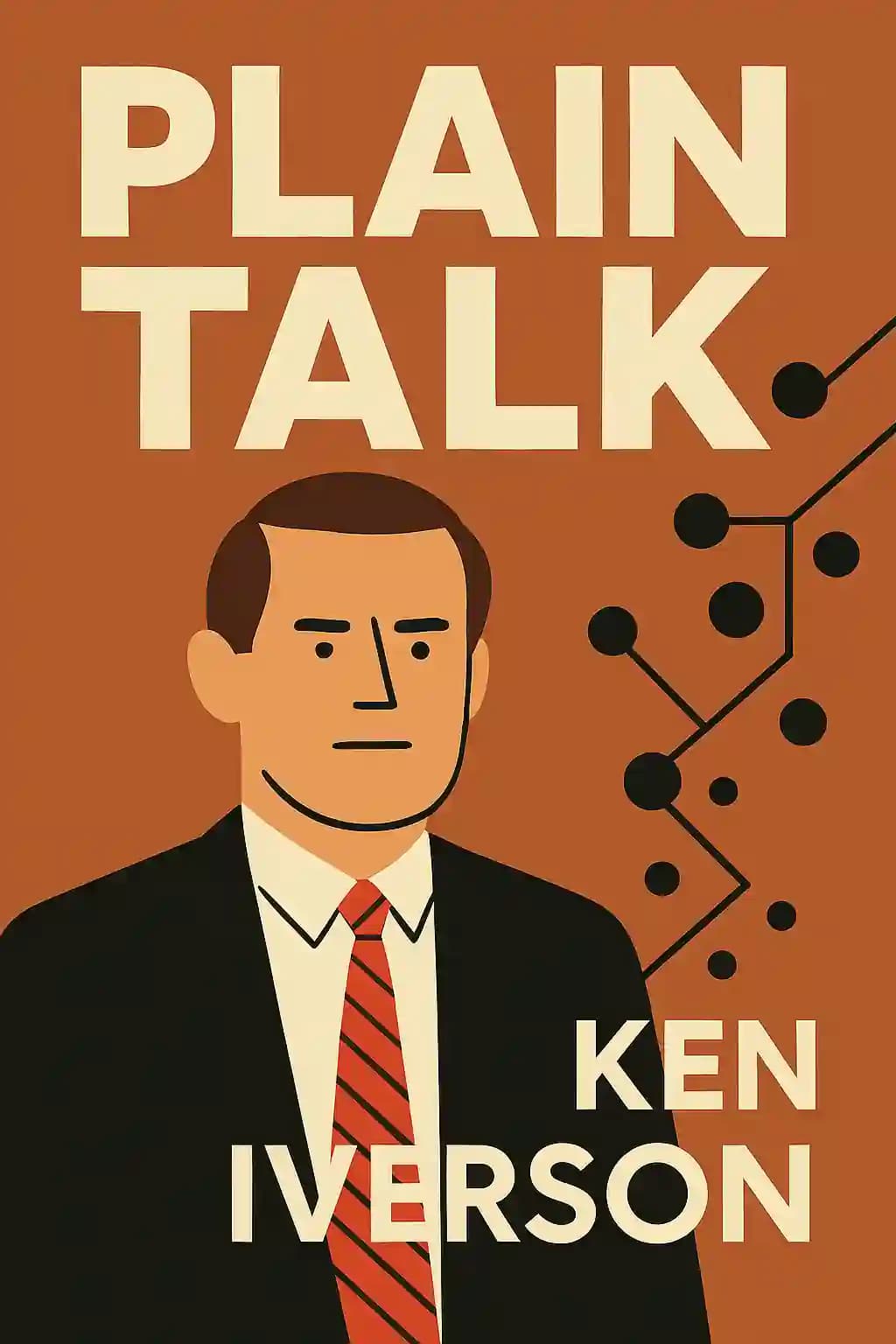
Plain talk
lessons from a business maverick
Panoramica di Plain talk
Plain Talk reveals how Ken Iverson transformed Nucor from bankruptcy to America's third-largest steelmaker using radical transparency and "painsharing" instead of layoffs. Peter Kaufman calls it essential reading on company culture, where Iverson's secret formula was "70% culture, 30% technology."
Temi chiave in Plain talk
- radical decentralization
- incentive based compensation
- shared sacrifice leadership
- employee partnership models
- no-layoff policies
Citazioni da Plain talk
Trust your instincts.
We choose investors over speculators.
Cost-cutting alone never justifies reorganization.
I worry when sparks don't fly.
Personaggi di Plain talk
- Ken IversonAuthor and former CEO of Nucor Corporation
- Hamilton LottGeneral manager of the Vulcraft Division
- Joe RutkowskiNucor manager who discussed division autonomy
Sull'autore
Sull'autore di Plain talk
Ken Iverson, born Kenneth Eugene Iverson (1920–2004), was a pioneering Canadian computer scientist and Turing Award laureate best known for revolutionizing programming languages with his creation of APL. His work, including Plain Talk by Ken Iverson, reflects his lifelong commitment to simplifying complex computational concepts through innovative notation and systems design.
A Harvard-trained mathematician and former IBM Fellow, Iverson’s groundbreaking book A Programming Language (1962) formalized APL’s syntax, which became foundational in computer science education and systems engineering. His ideas influenced IBM’s OS/360 operating system and earned him the prestigious ACM A.M. Turing Award in 1979.
Iverson’s legacy extends to academic frameworks like Mathematics and Programming, used in universities to teach algorithmic thinking. Known for blending theoretical rigor with practical application, his APL language remains a touchstone in data analysis and software development. A Programming Language has been cited in over 5,000 technical papers, cementing Iverson’s status as a visionary in computational problem-solving.
Scarica il riassunto di Plain talk
Ottieni il riassunto di Plain talk in formato PDF o EPUB gratuito. Stampalo o leggilo offline quando vuoi.
FAQ su questo libro
Plain Talk outlines Ken Iverson’s leadership philosophy for building high-performing organizations through trust, transparency, and decentralized decision-making. It emphasizes eliminating bureaucracy, fostering open communication, and empowering employees to drive innovation. Drawing from Iverson’s experience as CEO of Nucor Steel, the book demonstrates how flat hierarchies and shared accountability can transform corporate culture and resilience.
This book is ideal for business leaders, managers, and HR professionals seeking to cultivate agile, trust-driven workplaces. Entrepreneurs launching startups will find actionable strategies for scaling efficiently, while executives in traditional industries can learn to decentralize authority and prioritize employee empowerment. It’s particularly relevant for those navigating organizational change or economic uncertainty.
Yes—readers praise Plain Talk for its practical, jargon-free advice on leadership and organizational design. Reviewers highlight its real-world examples, like Nucor’s success during crises, though some note that its straightforward principles may seem intuitive to seasoned leaders. The book’s emphasis on transparency and anti-bureaucracy remains widely applicable.
Iverson advocates four core ideas:
- Trust-driven collaboration: Leaders must prioritize open dialogue and active listening.
- Economic pain-sharing: Protect frontline workers during downturns through executive pay cuts.
- Decentralized authority: Empower employees to make decisions without hierarchical bottlenecks.
- Learning from failure: Treat risks as opportunities for collective growth rather than blame.
The concept encourages large companies to maintain startup-like agility by minimizing bureaucracy and preserving direct communication channels. Iverson argues that “smallness” fosters innovation, accountability, and rapid adaptation—traits he embedded at Nucor through lean teams and cross-functional collaboration.
During crises, plain sharing refers to equitable sacrifice across an organization. At Nucor, executives took up to 70% pay cuts to avoid layoffs, reinforcing unity and trust. This approach contrasts with traditional top-down cost-cutting and aligns incentives between leadership and staff.
Under Iverson, Nucor adopted a flat structure where frontline workers influenced strategic decisions. The company eliminated executive perks, tied pay to performance, and prioritized open-floor communication. These practices helped Nucor outperform competitors during industry downturns and innovate in steel production.
Iverson frames risk as essential for growth, advocating calculated experiments where failures become team learning opportunities. He discouraged punitive measures for honest mistakes, instead fostering a culture where employees felt safe proposing unconventional solutions.
Some reviewers argue that Iverson’s methods oversimplify complex leadership challenges, particularly in highly regulated industries. Others note that Nucor’s unique context (private ownership, steel industry) may limit the universality of its lessons. However, most agree the core principles remain adaptable.
Its emphasis on flat hierarchies, employee autonomy, and adaptive leadership aligns with contemporary trends like remote work and agile methodologies. The book’s anti-bureaucracy stance resonates in industries disrupted by startups and AI-driven efficiency demands.
Unlike theoretical frameworks (e.g., Atomic Habits), Plain Talk offers concrete operational tactics from a CEO’s lived experience. It diverges from top-down models by prioritizing grassroots innovation over rigid planning—a contrast to conventional management guides.
Key lines include:
- “Trust isn’t earned through speeches—it’s built through shared sacrifice.”
- “Bureaucracy is the enemy of progress; empower those closest to the problem.”
- “A leader’s pay cut today secures their team’s loyalty tomorrow.”