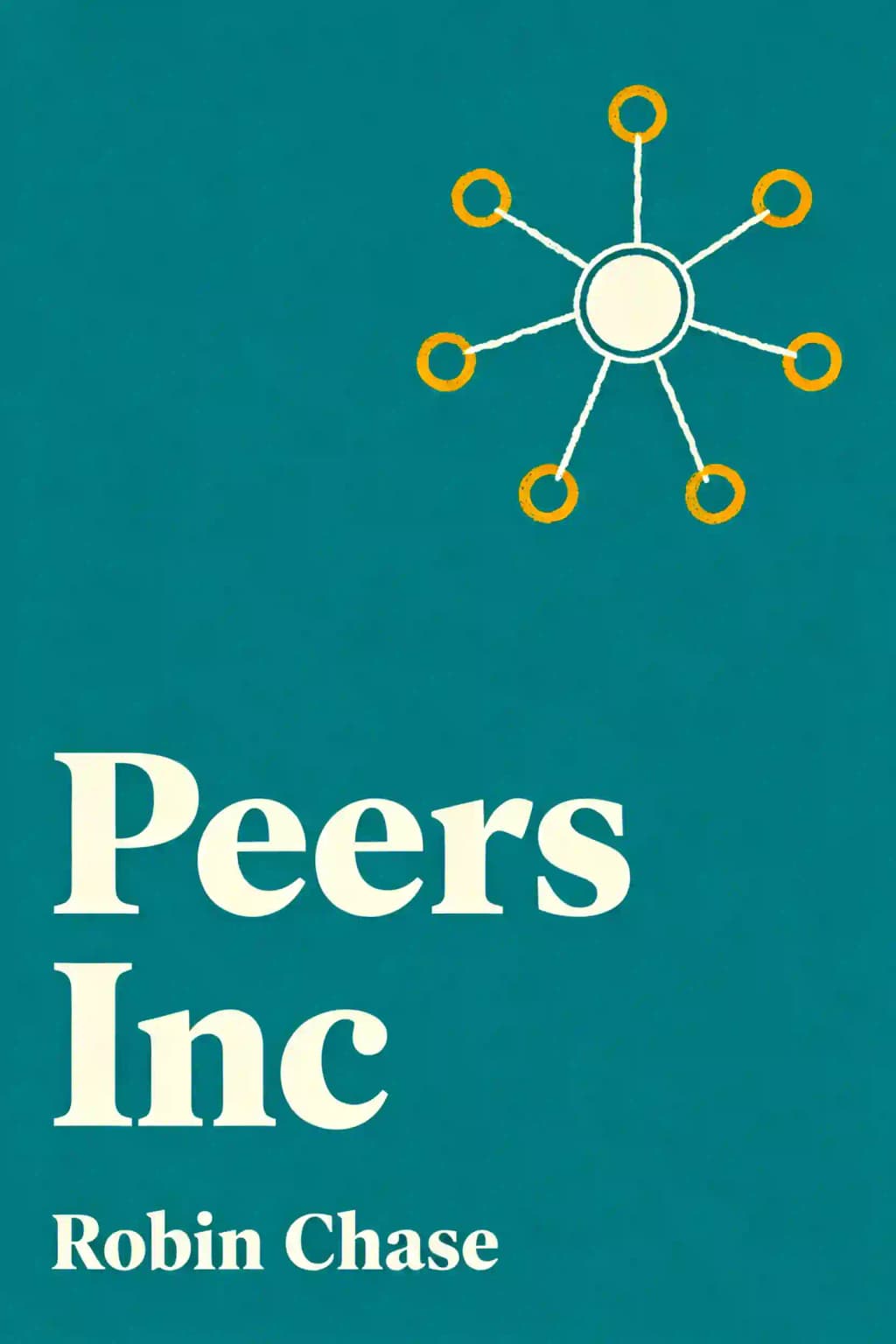
Robin Chase's "Peers Inc" reveals how collaborative platforms are revolutionizing capitalism. Time's "100 Most Influential People" honoree and Zipcar founder offers a blueprint for harnessing excess capacity to combat climate change. Could this "first great book about the sharing economy" redefine abundance in our resource-limited world?
Robin Chase, author of Peers Inc: How People and Platforms Are Inventing the Collaborative Economy and Reinventing Capitalism, is a pioneering transportation entrepreneur and sharing economy innovator. Best known as co-founder and former CEO of Zipcar, the world’s largest carsharing network, Chase has shaped modern urban mobility through ventures like Buzzcar, GoLoco, and Veniam, a vehicle data-transmission company. Her book explores how collaborative business models unlock innovation and sustainability, drawing from her firsthand experience disrupting traditional industries.
Chase’s expertise is recognized globally. TIME named her among its 100 Most Influential People, and she serves on boards for the World Resources Institute and Dutch multinational DSM’s Sustainability Advisory Board.
A frequent speaker featured in The New York Times, NPR, and TED-style forums, she blends practical insights from leading tech-driven companies with visionary advocacy for equitable cities. Peers Inc has become a seminal text on platform economies, cited by policymakers and Fortune 500 leaders alike. Chase holds degrees from Wellesley College and MIT, with an honorary doctorate from the Illinois Institute of Technology.
Peers Inc explores the collaborative economy model where corporations ("Inc") provide platforms to harness individuals ("Peers") and excess resources. Robin Chase, Zipcar's co-founder, argues this synergy drives innovation, scalability, and efficiency, using examples like Airbnb and Zipcar. The book outlines building blocks (excess capacity, platforms, peer participation) and stages of development, showing how this model reshapes capitalism and addresses global challenges like climate change.
Entrepreneurs, business leaders, and policymakers interested in the sharing economy, collaborative innovation, or sustainable business models will find this book valuable. It’s also relevant for readers exploring how platforms like Uber or Airbnb disrupt industries, and those seeking strategies to leverage underutilized resources for economic and environmental impact.
Yes, for its actionable insights into the collaborative economy’s mechanics and real-world examples. Chase blends theory with her Zipcar experience, though some critiques note uneven pacing. The book remains essential for understanding platform-based business models and their societal implications, particularly for sustainability and income inequality.
By optimizing existing resources (reducing waste) and accelerating innovation through collaboration. Chase argues that platforms enabling car-sharing or renewable energy networks can scale solutions faster than traditional models, cutting emissions while maintaining economic growth.
Traditional models focus on owning resources and centralized control. Peers Inc prioritizes shared assets, decentralized innovation, and peer contributions, enabling faster scalability, lower costs, and adaptability. For example, Zipcar’s car-sharing reduces ownership needs while expanding access.
Without equitable influence, platforms risk exploiting peers (e.g., Uber drivers lacking benefits). Chase emphasizes that long-term viability requires fair profit-sharing, decision-making, and protections to sustain trust and participation.
Critics highlight risks like worker exploitation, regulatory gaps, and monopolistic tendencies. For instance, Uber’s treatment of drivers underscores how power imbalances can emerge. Chase acknowledges these challenges but argues proactive policies can mitigate them.
Zipcar’s success demonstrated how a platform could transform car ownership by leveraging excess vehicles and peer participation. Chase uses this case to illustrate scalable resource-sharing, iterative learning, and the balance between corporate infrastructure and user-driven innovation.
Yes, by integrating platforms to unlock underused assets (e.g., manufacturing tools, data) and inviting peer innovation. Chase suggests this helps legacy firms stay competitive, though transitioning requires cultural shifts and embracing openness.
As remote work, AI, and sustainability priorities grow, collaborative models remain vital. The book’s principles apply to emerging trends like decentralised tech (Web3) and circular economies, making it a blueprint for resilient, adaptive businesses.
Senti il libro attraverso la voce dell'autore
Trasforma la conoscenza in spunti coinvolgenti e ricchi di esempi
Cattura le idee chiave in un lampo per un apprendimento veloce
Goditi il libro in modo divertente e coinvolgente
Sharing, not owning, creates the greatest value.
Americans want ownership, not access.
The path forward isn't producing more but organizing differently.
We live amid abundance.
Platforms connect and empower peers.
Scomponi le idee chiave di Peers Inc in punti facili da capire per comprendere come i team innovativi creano, collaborano e crescono.
Vivi Peers Inc attraverso narrazioni vivide che trasformano le lezioni di innovazione in momenti che ricorderai e applicherai.
Chiedi qualsiasi cosa, scegli il tuo stile di apprendimento e co-crea intuizioni che risuonano davvero con te.

Creato da alumni della Columbia University a San Francisco
"Instead of endless scrolling, I just hit play on BeFreed. It saves me so much time."
"I never knew where to start with nonfiction—BeFreed’s book lists turned into podcasts gave me a clear path."
"Perfect balance between learning and entertainment. Finished ‘Thinking, Fast and Slow’ on my commute this week."
"Crazy how much I learned while walking the dog. BeFreed = small habits → big gains."
"Reading used to feel like a chore. Now it’s just part of my lifestyle."
"Feels effortless compared to reading. I’ve finished 6 books this month already."
"BeFreed turned my guilty doomscrolling into something that feels productive and inspiring."
"BeFreed turned my commute into learning time. 20-min podcasts are perfect for finishing books I never had time for."
"BeFreed replaced my podcast queue. Imagine Spotify for books — that’s it. 🙌"
"It is great for me to learn something from the book without reading it."
"The themed book list podcasts help me connect ideas across authors—like a guided audio journey."
"Makes me feel smarter every time before going to work"
Creato da alumni della Columbia University a San Francisco

Ottieni il riassunto di Peers Inc in formato PDF o EPUB gratuito. Stampalo o leggilo offline quando vuoi.
What if I told you that the average car sits unused 95% of its life, costing its owner thousands annually while gathering dust? In 1999, a Cambridge mother of three named Robin Chase faced a daily frustration: her husband took their only car to work, leaving her stranded. When a friend mentioned European car-sharing programs, something clicked. Within months, Chase launched Zipcar with just $50,000, one lime-green Volkswagen Beetle nicknamed "Betsy," and a revolutionary insight-what if we stopped owning and started sharing? The concept seemed absurd to investors. Americans love ownership, they insisted. People can't be trusted with shared property. The technology is too complex. Yet Chase persisted, driven by three radical beliefs: people would share when economics made sense, technology could make sharing effortless, and humans could be trusted. When the company nearly collapsed three days before launch over a $7,000 security deposit, an angel investor wired $25,000 overnight after meeting Chase at a party. Today, Zipcar's model has spawned a global revolution-Airbnb controls more rooms than the world's largest hotel chains without owning property, Uber transformed transportation without vehicles, and entire industries are being reimagined around a simple question: why own when you can share?
Every solo driver carries three empty seats-millions of vacant spaces moving in parallel. Frederic Mazzella discovered this Christmas 2003, stranded in Paris. His solution, BlaBlaCar, now moves over 2 million Europeans monthly by filling those seats, surpassing Eurostar's ridership. This excess capacity surrounds us. Your car sits idle 23 hours daily. School parking lots empty on weekends. Bogota's Ciclovia converts 75 miles of roads into recreational space weekly, serving 2 million people at sixteen cents per person. When Apple opened the iPhone to outside developers, the App Store exploded to over 1.2 million apps. We live amid abundance disguised as scarcity. Progress isn't producing more-it's organizing differently. ReCAPTCHA repurposes human verification tests to digitize books with 99.1% accuracy. Waze harvests previously wasted navigation data. The challenge isn't resources but imagination: seeing the wealth already present and building systems to unlock it.
Nick Grossman owned an underused car in Brooklyn but couldn't launch his own car-sharing service - he lacked insurance, billing systems, and credibility to attract strangers. This gap between individual capacity and collective utility is where platforms shine. They create "architecture of participation" - systems that organize and simplify involvement. Nearly a million Zipcar members share 15,000 cars because the platform handles complexity: insurance, apps, hardware, billing. What individuals can't accomplish alone, platforms make effortless. Platforms unlock value by slicing assets into consumable pieces (Zipcar turns ownership into half-hour increments), aggregating individual capacity into reliable networks (Airbnb combines spare rooms into a global hotel alternative), or opening resources for creative reuse. When Washington DC made city data accessible through Apps for Democracy, developers created 47 applications in 30 days - work that would've cost $2.2 million if contracted traditionally. The most powerful platforms are paradoxically the simplest. Complex platforms like Airbnb require extensive information and limit innovation. Wide-open platforms like GitHub, Google Docs, and the Internet itself are delightfully simple and adaptable to countless uses.
While traditional organizations crave standardization, there are always more smart people outside your organization than inside. The Internet makes it simple to find, organize, and pay for individual contributions, transforming human diversity from a management headache into society's greatest asset. Apple's App Store unleashed millions of creators. YouTube revealed unexpected talent - philosophical cats, mathematical animations, creators who never imagined themselves as entertainers. Sophia Amoruso went from security guard to CEO of $100 million NastyGal by leveraging eBay and social media. NASA discovered this advantage through platforms like InnoCentive, receiving thousands of solutions from over 20 countries. Aerospace physicists solved polymer challenges that stumped R&D labs. Non-biologists created genomic algorithms 100 times faster than existing solutions. Jake Zien, 18, earned $660,000 inventing a flexible power strip through Quirky. Freelancers prioritize flexibility: 68% seek extra income, 42% want schedule control. As Airbnb's Joe Gebbia notes, the real surprise is "the freedom and joy people feel in their economic empowerment." This autonomy transforms work from obligation into opportunity.
Excess capacity, platforms, and diverse peers create three "miracles" that violate fundamental business laws. First is exponential growth without proportional investment. Airbnb matched Intercontinental Hotel Group's 645,000 rooms in four years without constructing a single property-a feat that took traditional chains decades. BlaBlaCar transported 2 million people monthly within 10 years, equivalent to 5,000 high-speed trains, without laying tracks. Second is exponential learning. Duolingo reached 50 million users learning 15 languages within three years-more than the entire U.S. public school system. By conducting hundreds of simultaneous experiments, they determine optimal teaching methods in 48 hours, reducing language acquisition from 130 classroom hours to just 34. Third is perfect matching-finding exactly the right person with the right knowledge at precisely the right moment. HelpAround connects diabetics sharing critical medical supplies during emergencies. When Michael Brown was killed in Ferguson, @FeministaJones organized nationwide protests within three days. Each of us now accesses the collective mind of humanity.
Building successful platforms requires navigating what Jane Jacobs called the "intricate ballet" of participation-a delicate power balance between platform creators and peers. Get it wrong, and the platform either never launches or collapses under its own success. Successful platforms typically progress through four phases. First, the **controlled kernel** requires strong founder control. Linux's Linus Torvalds maintained tight control over code commits despite thousands of contributors. As TopCoder's Jack Hughes noted, "You ultimately need a dictator to insist that anyone can participate." Next, the **"everybody welcome" phase** scales participation. BlaBlaCar introduced online ratings in 2008, addressing trust issues and exploding from 60,000 members to 10 million by 2013. As platforms mature, **power players emerge** who master the system, sometimes threatening smaller peers. Lending Club and Prosper evolved from true peer-to-peer marketplaces to facilitating most loans through institutional lenders-70-80% by 2014. The final phase is **achieving power equilibrium**-a dynamic state where neither platform nor peers dominate. Strategies include permitting data portability, advocating for peers through dedicated staff, and giving peers communication channels to organize.
Climate change demands platform innovation's speed and scale. The World Bank projects a 4C global temperature increase by 2100 even if countries meet emissions promises-a shift comparable to the Ice Age-to-present transition, compressed into decades. This could trigger mass extinction of one-third to one-half of Earth's species. Behavioral changes can happen instantly. London and Stockholm's congestion fees cut traffic 25% overnight. Transportation generates 22% of U.S. CO2 emissions, but smartphone platforms make shared mobility more convenient than ownership. Millennials reduced car miles 23% between 2001-2009. Electric power generates 35% of U.S. emissions. SolarCity exemplifies platform solutions by handling design, financing, permits, installation, and maintenance-leveraging unused rooftops and consumers' electric bills. Etsy proves sustainability and profitability coexist: after becoming a B Corp in 2012, they increased female managers from 15% to 40%, reduced electricity use 19%, and grew sales 50% to $1.35 billion. The challenge to brilliant minds: tackle decarbonization instead of making people click ads. The platform revolution offers humanity a lifeline-the cars exist, the rooms exist, the knowledge exists. We needed courage to share, technology to connect, and wisdom to trust strangers. The question isn't whether this transformation will happen, but whether you'll help build it.