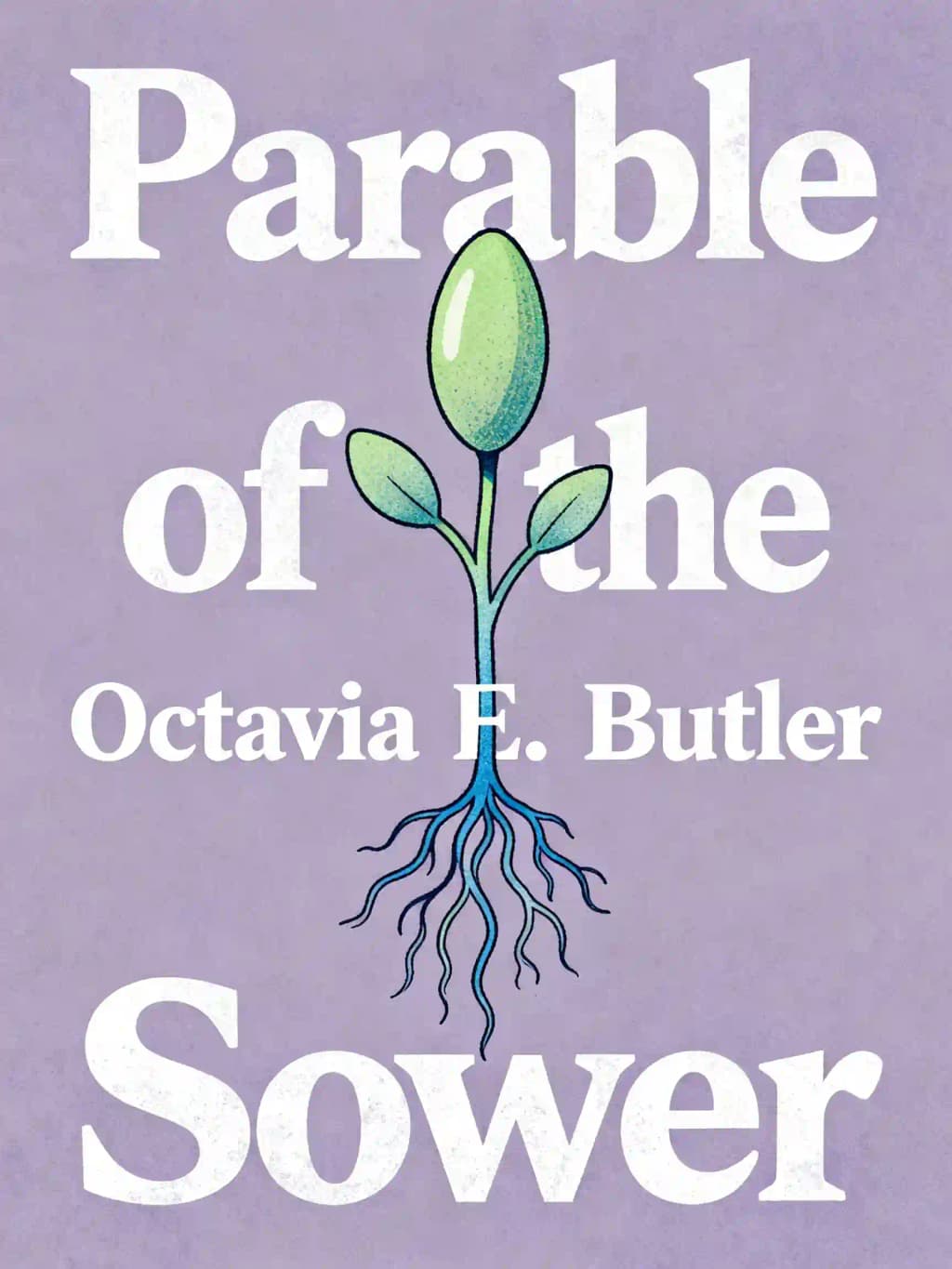
Parable of the Sower
Panoramica di Parable of the Sower
In Butler's eerily prescient 1993 dystopia set in 2024, a hyperempathic teenager navigates societal collapse. Finally hitting NYT bestsellers in 2020, this haunting vision of climate crisis and inequality asks: how will you survive when everything you know crumbles?

Temi chiave in Parable of the Sower
- societal collapse
- hyperempathy syndrome
- climate crisis survival
- earthseed philosophy
- community resilience
Citazioni da Parable of the Sower
All that you touch You Change. All that you Change Changes you. The only lasting truth Is Change. God Is Change.
In order to rise From its own ashes A phoenix First Must Burn.
God is Change.
God exists to be shaped.
The Destiny of Earthseed is to take root among the stars.
Personaggi di Parable of the Sower
- Lauren OlaminaProtagonist with hyperempathy and founder of Earthseed
- Lauren's fatherBaptist minister and community leader in Robledo
- Christopher DonnerPresidential candidate promising to restore order
- Amy DunnYoung child who accidentally starts a garage fire
Sull'autore
Sull'autore di Parable of the Sower
Octavia Estelle Butler (1947–2006), author of Parable of the Sower, was a groundbreaking Hugo and Nebula Award-winning science fiction pioneer, celebrated for weaving African American perspectives into speculative narratives. A MacArthur Fellow—the first sci-fi writer to receive the "genius grant"—Butler explored themes of dystopian collapse, resilience, and societal rebirth through her work, drawing from her experiences growing up in segregated Pasadena and her studies during the Black Power movement.
Parable of the Sower (1993), her seminal climate-fiction novel, examines themes of community survival and incremental hope amid environmental and economic collapse, reflecting Butler’s lifelong engagement with systemic inequality. Her other influential works include Kindred (1979), a time-travel exploration of slavery, and the Patternist series, which established her early career.
Butler’s prescient storytelling, particularly her Earthseed philosophy in the Parable duology, continues to resonate in academic and Afrofuturist circles. Translated into over 20 languages, her works remain staples in literature curricula and have seen renewed relevance for their unflinching analysis of climate crises and corporate dystopia.
Scarica il riassunto di Parable of the Sower
Ottieni il riassunto di Parable of the Sower in formato PDF o EPUB gratuito. Stampalo o leggilo offline quando vuoi.
FAQ su questo libro
Parable of the Sower (1993) is a dystopian novel set in a near-future 2024 America collapsing due to climate disasters, wealth inequality, and societal chaos. It follows Lauren Olamina, a young Black woman with hyperempathy syndrome, as she flees her destroyed community and founds "Earthseed," a belief system centering adaptability and interstellar human survival. Themes include resilience, communal rebirth, and the power of proactive change.
Fans of dystopian fiction (e.g., The Handmaid’s Tale) and readers exploring climate fiction, social justice, or Afrofuturism will find this novel compelling. It’s also relevant for those interested in philosophical frameworks for societal transformation, as Earthseed’s teachings blend pragmatism with spiritual growth.
Yes—Butler’s prescient exploration of climate collapse, inequality, and community-building resonates deeply in 2025. While some critics note its bleak tone, the novel’s emphasis on resilience and collective action offers actionable insights for navigating crises.
Key themes include:
- Adaptation: Surviving requires embracing change, illustrated by Lauren’s mantra, “God is Change”
- Empathy: Lauren’s hyperempathy symbolizes both vulnerability and ethical responsibility
- Rebirth: Communities rebuild through shared purpose, symbolized by acorns growing into oaks
Earthseed is Lauren’s belief system, framing change as divine and humanity’s destiny as interstellar colonization. Its core tenet—“God is Change”—urges proactive adaptation rather than passive acceptance of suffering.
Butler critiques climate denial, corporate greed, and systemic inequality. The walled community of Robledo mirrors modern gated suburbs, while privatized cities like Olivar highlight exploitative capitalism.
Lauren’s hyperempathy—a genetic condition causing her to feel others’ pain and joy—reflects the dual burdens of marginalized groups: deep emotional labor paired with societal exploitation.
Butler uses biblical parables (e.g., Noah’s Ark) to parallel Lauren’s journey, framing societal collapse as both destruction and opportunity for ethical renewal.
Lauren’s group establishes “Acorn,” a farming commune, and plants oak trees to symbolize rebirth. The closing Bible parable underscores the need to nurture hope in “good ground”.
Its depiction of climate migration, corporate exploitation, and grassroots organizing mirrors 2025 challenges, making it a vital read for activists and futurists.
Some reviewers argue the novel’s unrelenting grimness overshadows its hopeful themes, while others find Earthseed’s philosophy underdeveloped.
Unlike passive protagonists in classics like 1984, Lauren actively builds alternatives, blending survivalist pragmatism with visionary idealism. This makes the story uniquely actionable.
- “God is Change”: Earthseed’s central doctrine
- “All that you touch, you Change”: Highlights humanity’s agency
- “The only lasting truth is Change”: Rejects rigid ideologies