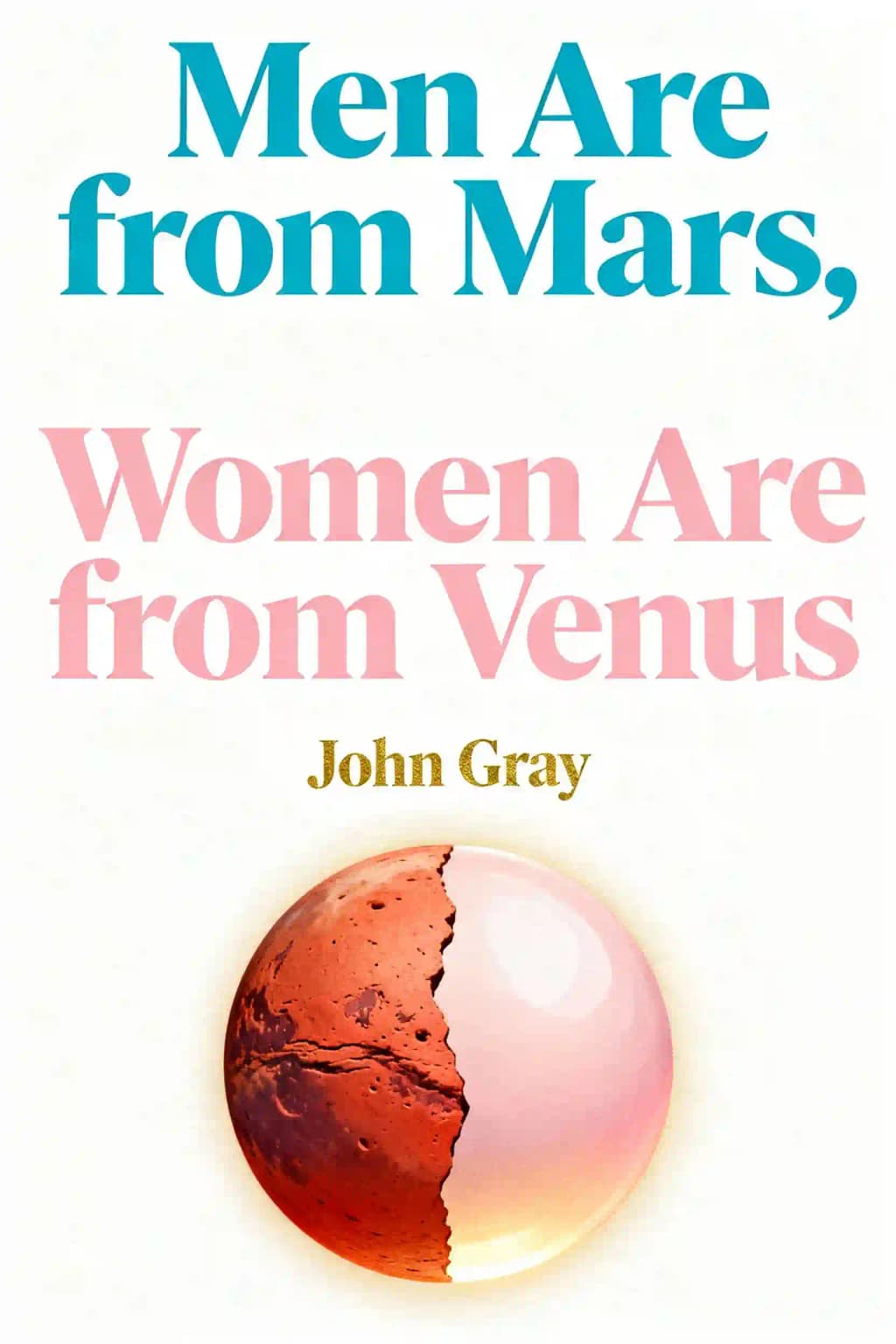
Men Are from Mars, Women Are from Venus
Panoramica di Men Are from Mars, Women Are from Venus
Discover why 15 million readers found their relationship salvation in this 1992 phenomenon. The Mars-Venus metaphor revolutionized how we understand gender communication, spending 121 weeks as a bestseller while sparking debates about whether it brilliantly clarifies or harmfully stereotypes our differences.

Temi chiave in Men Are from Mars, Women Are from Venus
- gendered communication styles
- emotional processing differences
- conflict resolution strategies
- unsolicited advice dynamics
- stress management behaviors
Citazioni da Men Are from Mars, Women Are from Venus
When a man can listen to a woman's feelings without getting angry and frustrated, he gives her a wonderful gift.
Not being needed is a slow death for him.
Love frees him from self-gratification alone, energizing him with higher purpose.
The solution isn't changing our inherent natures but understanding our differences.
Personaggi di Men Are from Mars, Women Are from Venus
- John GrayAuthor and relationship counselor
- Bonnie GrayJohn Gray's wife
- RobertCase study example of a man processing stress
Sull'autore
Sull'autore di Men Are from Mars, Women Are from Venus
John Gray, American author of the groundbreaking relationship guide Men Are from Mars, Women Are from Venus, is a bestselling self-help expert and communication strategist renowned for decoding gender dynamics.
A former transcendental meditation devotee and disciple of Maharishi Mahesh Yogi, Gray blends spiritual insights with practical psychology in his work. His 1992 literary phenomenon popularized the concept of inherent psychological differences between men and women, framed through the iconic interplanetary metaphor.
Trained as a relationship counselor, Gray honed his methods through workshops and earlier books like What You Feel You Can Heal and Men, Women, and Relationships. A frequent Oprah guest and TED Talk contributor, his work gained mainstream traction through ABC specials and a Mattel board game adaptation. Men Are from Mars remains a cultural touchstone, with over 15 million copies sold globally and translations in 40+ languages.
Scarica il riassunto di Men Are from Mars, Women Are from Venus
Ottieni il riassunto di Men Are from Mars, Women Are from Venus in formato PDF o EPUB gratuito. Stampalo o leggilo offline quando vuoi.
FAQ su questo libro
Men Are from Mars, Women Are from Venus explores gender differences in communication and relationships through the metaphor of men (Martians) and women (Venusians) originating from distinct planets. John Gray argues misunderstandings arise because men prioritize autonomy and problem-solving, while women value emotional connection. The book offers strategies to bridge these gaps, such as recognizing men’s need for "cave time" and women’s desire for empathetic listening.
Couples seeking to improve communication, individuals struggling with relationship conflicts, or anyone interested in psychology-based gender dynamics. While criticized for heteronormative assumptions, its practical advice resonates with those navigating traditional male-female partnerships.
Yes, for its historical impact (over 15 million copies sold) and accessible frameworks, though readers should contextualize its 1992 publication date. Critics note oversimplified stereotypes, but its core message—prioritizing empathy for inherent differences—remains relevant.
- The Cave: Men retreat to process stress independently
- Rubber Band Theory: Men cycle between intimacy and autonomy
- Wave Dynamics: Women’s emotional states fluctuate like waves
- Scorekeeping: Women value small, consistent gestures over grand displays
Gray suggests men communicate to solve problems (“report talk”), while women use conversation to connect (“rapport talk”). For example, a wife venting about work seeks empathy, not solutions—a mismatch that sparks conflict if unaddressed.
Critics argue it reinforces gender stereotypes, neglects LGBTQ+ relationships, and oversimplifies complex dynamics. The 2020s cultural shift toward fluid gender roles further challenges its binary Martian/Venusian framework.
Both focus on understanding partners’ needs, but Gray emphasizes gender differences, while Gary Chapman’s Love Languages centers on individualized expressions of affection. Gray’s approach is more prescriptive about male-female behavior.
- “Men are like rubber bands—they pull away but inevitably return”
- “Women are like waves—their self-esteem rises and falls”
- “When Venusians are upset, they need to talk; Martians need to retreat”
Yes. Gray’s insights apply to professional settings: recognizing colleagues’ communication styles (solution-focused vs. collaborative) can reduce misunderstandings. However, avoid rigid gender assumptions in modern, diverse teams.
The Mars/Venus allegory symbolizes innate differences, while amnesia represents society’s failure to acknowledge these divergences. Gray also uses “caves” (male solitude) and “wells” (female emotional depth) as spatial metaphors.
Gray advises:
- Men: Listen without fixing.
- Women: Avoid overwhelming partners with unsolicited advice.
- Both: Use “I feel” statements instead of blame
Despite dated elements, its humor, relatable anecdotes, and actionable tips sustain relevance. Modern adaptations, like stage shows blending Gray’s theories with comedy, keep it in pop culture.
A revised edition could address nonbinary relationships, digital communication challenges (texting, social media), and post-#MeToo dynamics while retaining its core empathy-focused message.