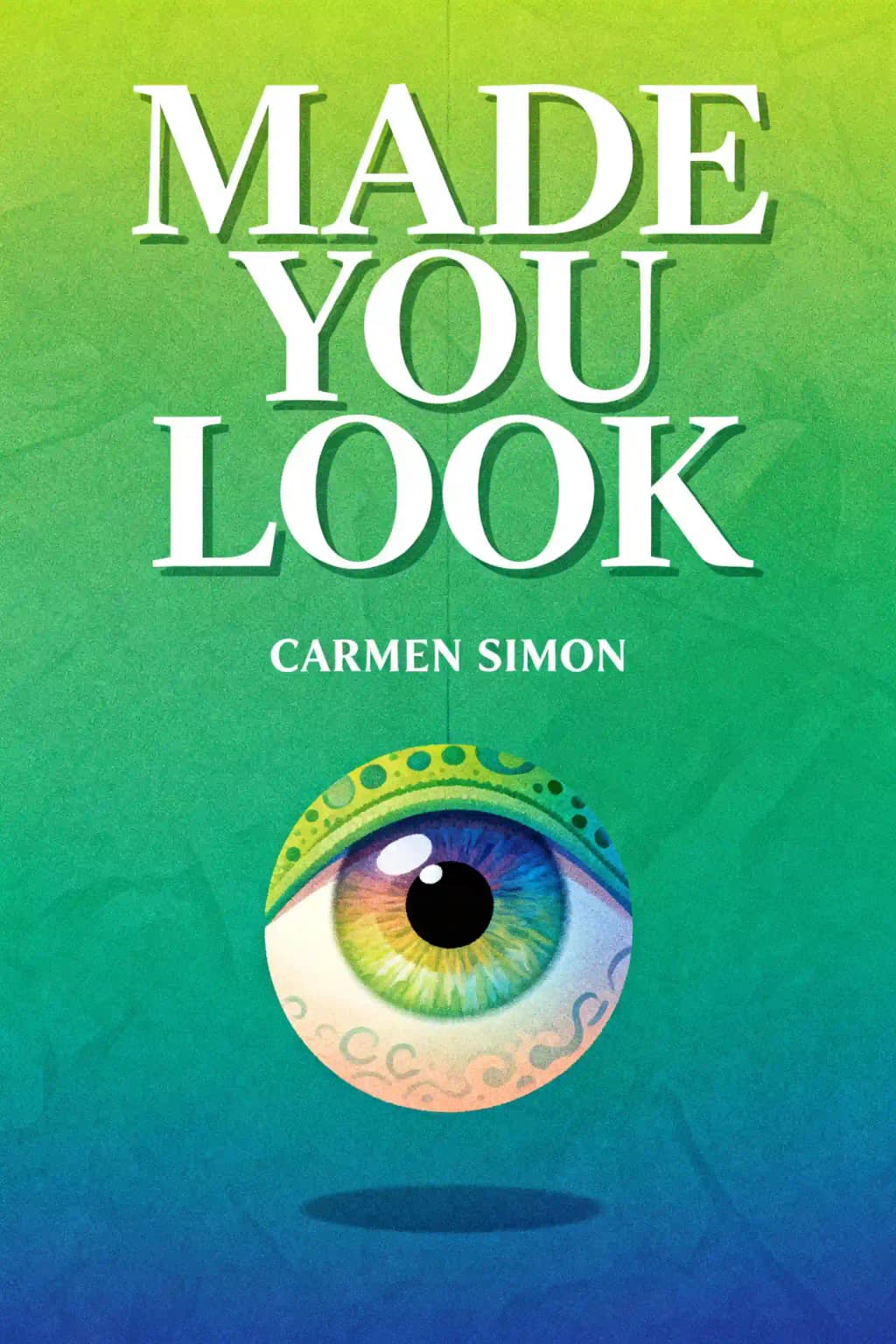
Made You Look
How to Use Brain Science to Attract Attention and Persuade an Audience
Panoramica di Made You Look
In "Made You Look," neuroscientist Carmen Simon reveals how brain science can transform your ability to capture attention. Using EEG technology and a four-part framework, she teaches what truly makes people look - and remember. Ever wonder why some presentations stick while others fade?

Temi chiave in Made You Look
- attention economy
- neuroscience of persuasion
- cognitive priming
- embodied cognition
- visual storytelling science
Citazioni da Made You Look
Attention is the ultimate currency.
Our brains are naturally selective.
Movement has been the driving force behind brain development.
Surprise is particularly effective.
Most business content fails at priming.
Personaggi di Made You Look
- Carmen SimonCognitive neuroscientist and author of the book
Sull'autore
Sull'autore di Made You Look
Dr. Carmen Simon, cognitive neuroscientist and bestselling author of Made You Look: A Scientific Guide to Creating Persuasive Content, combines brain science with practical marketing strategies in this visual guide to cutting through information overload. A dual doctorate holder in cognitive psychology and instructional technology, she founded Memzy to help corporations craft messages that embed in memory and drive decisions. Simon teaches brain science courses at Stanford University and serves as Chief Science Officer at Corporate Visions, where her neuromarketing research shapes Fortune 500 communication strategies.
Her previous work, Impossible to Ignore: Creating Memorable Content to Influence Decisions, became an international persuasion playbook acclaimed by Forbes and Fast Company. Known for blending rigorous neuroscience with actionable frameworks, Simon keynotes globally for organizations seeking science-backed methods to sustain audience attention.
Made You Look distills her 15+ years of research into vivid infographics and case studies, with techniques adopted by brands like Microsoft and Cisco. The book’s full-color visual format reflects her signature approach—using unexpected contrasts to make complex concepts stick.
Scarica il riassunto di Made You Look
Ottieni il riassunto di Made You Look in formato PDF o EPUB gratuito. Stampalo o leggilo offline quando vuoi.
FAQ su questo libro
Made You Look by Carmen Simon is a neuroscience-backed guide to capturing attention and influencing decisions through persuasive communication. It introduces a four-part framework: automatic triggers (using sensory stimuli), guided action (directing focus to rewards), introspection (aligning with internal motivations), and visual search (external reward cues). The book combines biometric research and practical strategies for marketers, presenters, and business leaders.
This book is ideal for marketers, sales professionals, corporate trainers, and business leaders seeking science-based methods to enhance engagement. It’s particularly valuable for those designing presentations, ads, or training materials, as Simon’s insights apply to virtual and in-person communication.
Yes, Made You Look offers actionable strategies grounded in biometric studies, such as eye-tracking and brain synchronization research. Simon’s findings—like the statistic that 40% of presentation content goes unnoticed—provide concrete ways to optimize messaging, making it a valuable resource for improving audience retention and decision-making.
- Automatic triggers: Use color, contrast, or motion to grab attention.
- Guided action: Prompt audiences to focus on rewarding outcomes.
- Introspection: Align content with viewers’ internal values.
- Visual search: Design external cues that match audience goals.
Simon’s research reveals that 40% of content is missed in both virtual and face-to-face presentations. She recommends incorporating movement (e.g., whiteboard drawings) to synchronize audience brains, enhancing collaboration and retention. Static slides are less effective at sustaining attention.
Simon employs biometric sensors, eye-tracking technology, and neuroimaging to study attention patterns. Her experiments measure where audiences look, how long they focus, and which stimuli create lasting memories, providing empirical support for her framework.
Movement (e.g., animated visuals or live sketching) triggers brain synchronization, which improves shared attention and collaboration. This contrasts with static slides, which often fail to sustain engagement. Simon links this finding to increased audience recall and decision-making.
The book ties attention to memory formation, arguing that stimuli activating the brain’s reward system (e.g., personalized content) are more likely to be remembered. Effective attention capture directly influences purchasing and behavioral decisions.
While not explicitly critiqued in sources, potential limitations include the reliance on lab-based biometric studies, which may not fully replicate real-world distractions. Readers might also seek more industry-specific examples beyond the generalized framework.
Unlike traditional marketing books, Simon’s work focuses on neuroscience and biometric data rather than anecdotal strategies. It emphasizes the science of attention over broad messaging tactics, offering tools validated by eye-tracking and brain activity studies.
Yes. The book’s guidelines—such as using motion-rich visuals and aligning content with learners’ intrinsic rewards—can make training videos and materials more engaging. Simon’s research shows these methods boost information retention and application.
While direct quotes aren’t provided in sources, Simon emphasizes: “Attention precedes memory, and memory precedes decisions.” This underscores her thesis that capturing focus is the first step to influencing behavior.