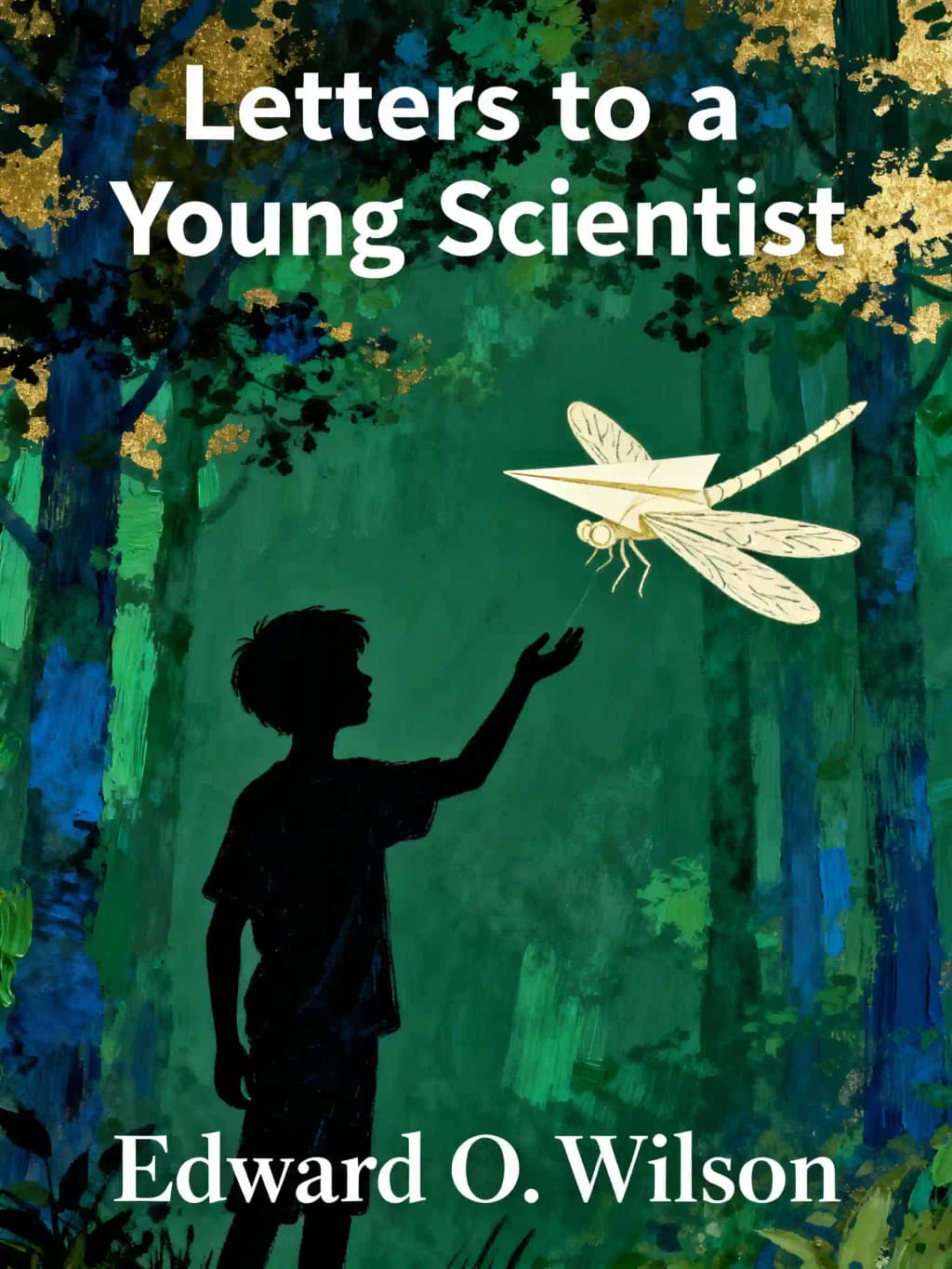
Two-time Pulitzer winner Edward O. Wilson's masterclass for aspiring scientists distills 50 years of Harvard wisdom into 21 letters. Discover why this legendary biologist believes passion trumps genius - advice that's reshaping how we approach scientific breakthroughs and environmental challenges.
Edward O. Wilson (1929–2021) was a Pulitzer Prize-winning biologist and naturalist, and the author of Letters to a Young Scientist, a mentorship-driven guide to scientific curiosity and discovery. For four decades, he was a professor at Harvard University.
Wilson pioneered groundbreaking work in sociobiology, biodiversity, and conservation, themes central to this book. His expertise stemmed from decades of field research on ants, detailed in Pulitzer-winning works like On Human Nature and The Ants (co-authored with Bert Hölldobler), as well as influential titles such as Sociobiology: The New Synthesis and Consilience.
Known for blending rigorous science with lyrical prose, Wilson’s writings bridge biology, philosophy, and environmental advocacy. Letters to a Young Scientist distills his six-decade career into practical wisdom for aspiring researchers, emphasizing observation and interdisciplinary thinking.
His works have been translated into over 30 languages, and he received more than 150 international awards, including the U.S. National Medal of Science. Wilson’s legacy as a "Darwin’s natural heir" (per The Guardian) continues to shape global conservation efforts and scientific education.
Letters to a Young Scientist by Edward O. Wilson is a mentorship-driven guide offering wisdom to aspiring scientists. Drawing on 60+ years of experience, Wilson blends personal anecdotes, ethical principles, and practical advice to emphasize curiosity, perseverance, and the creative process in science. Key themes include overcoming fear of failure, balancing passion with rigor, and addressing global challenges like climate change and biodiversity loss.
Aspiring scientists, educators, and science enthusiasts will find this book invaluable. Wilson’s insights are tailored for students navigating early career decisions, professionals seeking ethical guidance, and readers passionate about scientific discovery. Its accessible style also appeals to non-scientists interested in how scientific minds approach problem-solving and innovation.
Yes—it’s a timeless resource for anyone pursuing science. Wilson’s blend of autobiographical storytelling, actionable advice, and optimism about science’s role in solving global crises makes it both inspirational and practical. Critics praise its “contagious awe for the natural world” and relevance to modern challenges like sustainability and technological advancement.
Wilson champions imagination and trial-and-error as core to scientific breakthroughs. He encourages:
The book stresses:
Wilson tackles hurdles like:
Yes—he reassures readers that math proficiency isn’t a barrier. Wilson advocates:
The book connects scientific curiosity to urgent issues:
He emphasizes teamwork as essential for modern science, advising:
Some note the “letters” format feels less personal than Rilke’s inspiration (Letters to a Young Poet). However, most praise its actionable insights and ability to demystify science careers. Critics highlight its enduring relevance despite being published in 2013.
Key metaphors include:
He validates alternative paths, including:
Senti il libro attraverso la voce dell'autore
Trasforma la conoscenza in spunti coinvolgenti e ricchi di esempi
Cattura le idee chiave in un lampo per un apprendimento veloce
Goditi il libro in modo divertente e coinvolgente
Look for one sparsely inhabited.
Deep ignorance, properly handled, becomes superb opportunity.
The right question is intellectually superior to finding the right answer.
Science is a culture of illuminations dedicated to acquiring factual knowledge.
Scomponi le idee chiave di Letters to a Young Scientist in punti facili da capire per comprendere come i team innovativi creano, collaborano e crescono.
Distilla Letters to a Young Scientist in rapidi promemoria che evidenziano i principi chiave di franchezza, lavoro di squadra e resilienza creativa.

Vivi Letters to a Young Scientist attraverso narrazioni vivide che trasformano le lezioni di innovazione in momenti che ricorderai e applicherai.
Chiedi qualsiasi cosa, scegli la voce e co-crea spunti che risuonino davvero con te.

Creato da alumni della Columbia University a San Francisco
"Instead of endless scrolling, I just hit play on BeFreed. It saves me so much time."
"I never knew where to start with nonfiction—BeFreed’s book lists turned into podcasts gave me a clear path."
"Perfect balance between learning and entertainment. Finished ‘Thinking, Fast and Slow’ on my commute this week."
"Crazy how much I learned while walking the dog. BeFreed = small habits → big gains."
"Reading used to feel like a chore. Now it’s just part of my lifestyle."
"Feels effortless compared to reading. I’ve finished 6 books this month already."
"BeFreed turned my guilty doomscrolling into something that feels productive and inspiring."
"BeFreed turned my commute into learning time. 20-min podcasts are perfect for finishing books I never had time for."
"BeFreed replaced my podcast queue. Imagine Spotify for books — that’s it. 🙌"
"It is great for me to learn something from the book without reading it."
"The themed book list podcasts help me connect ideas across authors—like a guided audio journey."
"Makes me feel smarter every time before going to work"
Creato da alumni della Columbia University a San Francisco

Ottieni il riassunto di Letters to a Young Scientist in formato PDF o EPUB gratuito. Stampalo o leggilo offline quando vuoi.
Picture a fourteen-year-old boy in wartime Alabama, completely oblivious to global events while wading through swamps collecting insects. That summer of 1943, I became the nature counselor at Boy Scout Camp Pushmataha despite being woefully underprepared. My solution? Snakes. I organized the entire camp into a snake-hunting brigade, capturing specimens and identifying them for gathered scouts. Though briefly interrupted when a pygmy rattlesnake bit my finger, I finished the season as one of the most popular counselors. This wasn't just a summer job - it was the beginning of a lifelong passion that would eventually lead to groundbreaking discoveries about ants, sociobiology, and biodiversity. Edward O. Wilson's journey from curious boy to two-time Pulitzer Prize winner offers a roadmap for anyone with scientific curiosity, regardless of background or mathematical aptitude.