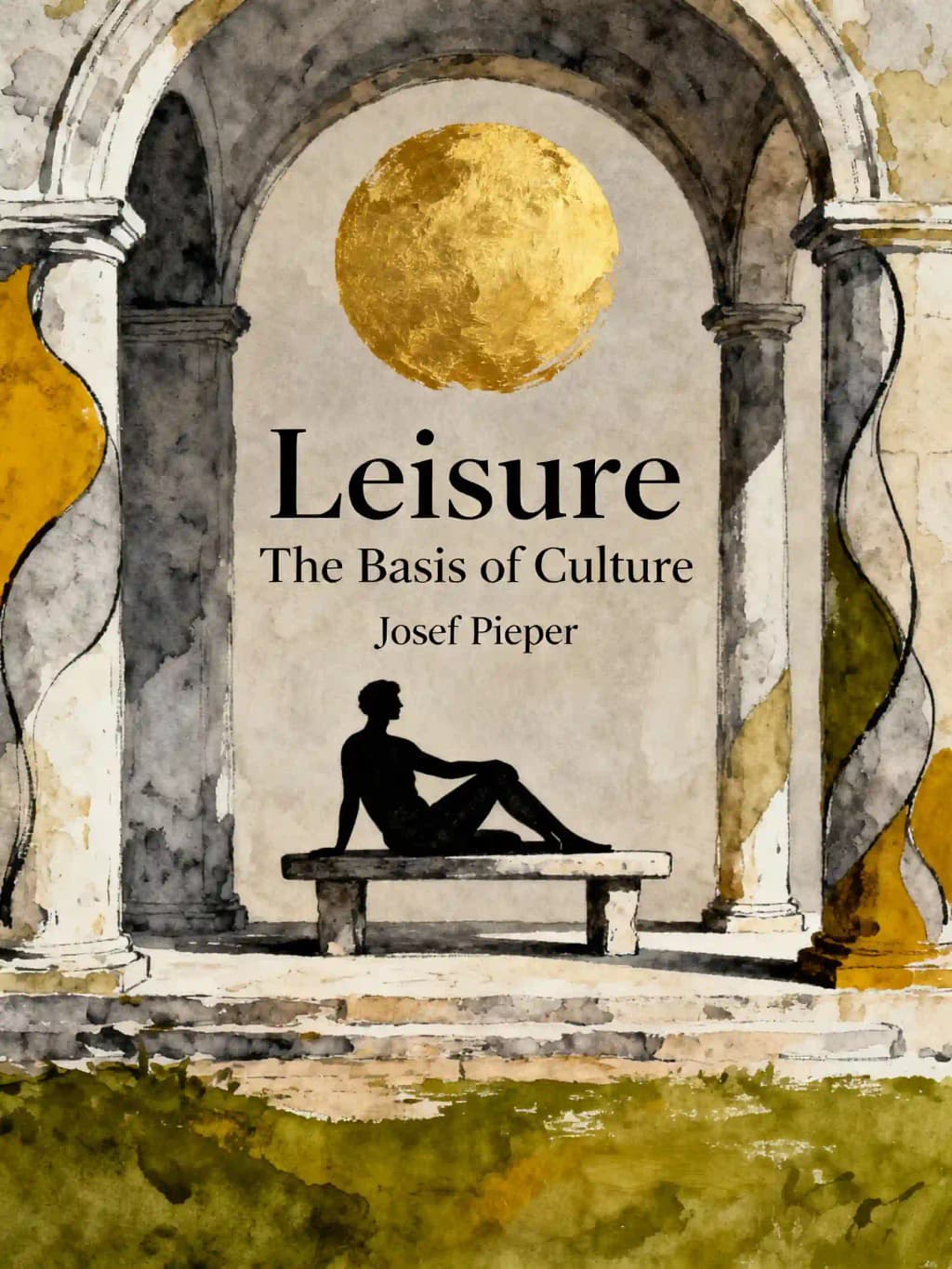
Leisure
The Basis of Culture
Panoramica di Leisure
In a world obsessed with productivity, Pieper's philosophical masterpiece challenges our work-centric culture. Endorsed by T.S. Eliot, this 1947 gem argues that true leisure - not mere idleness - is essential for cultural survival and human freedom. What if our busyness is destroying civilization?
Temi chiave in Leisure
- total work culture
- contemplative receptivity
- utility vs leisure
- intellectual labor
- metaphysics of culture
Citazioni da Leisure
Leisure is not the same as idleness.
Leisure is the disposition of receptive understanding, of contemplative beholding, and immersion in the real.
Leisure is the basis of culture.
Leisure, then, is a condition of the soul.
We've completely inverted this relationship, embracing the maxim 'one lives to work' instead.
Personaggi di Leisure
- Josef PieperAuthor and philosopher who wrote the book
- Thomas AquinasMedieval theologian cited on virtue and vision
- AntisthenesThinker who proposed effort as a measure of value
Sull'autore
Sull'autore di Leisure
Josef Pieper (1904–1997), author of Leisure: The Basis of Culture, was a preeminent German Catholic philosopher and leading scholar of Thomistic thought. A professor at the University of Münster for over two decades, Pieper revitalized interest in Thomas Aquinas’s philosophy, blending classical wisdom with modern existential questions.
His work explores themes of virtue, contemplation, and the spiritual foundations of culture, rooted in his deep engagement with theology and medieval philosophy. Beyond Leisure, Pieper’s influential works include The Four Cardinal Virtues and Guide to Thomas Aquinas, which distill Aquinas’s ethics and metaphysics into accessible prose.
His autobiography, No One Could Have Known, recounts his intellectual journey amid the upheavals of Nazi Germany and postwar Europe. A recipient of the Balzan Prize for Philosophy, Pieper’s writings have shaped academic and theological discourse worldwide.
Leisure: The Basis of Culture remains a cornerstone of philosophical literature, celebrated for its critique of modern productivity and its defense of contemplation as the heart of human dignity. Translated into multiple languages, it continues to inspire debates on ethics, culture, and the meaning of work.
Scarica il riassunto di Leisure
Ottieni il riassunto di Leisure in formato PDF o EPUB gratuito. Stampalo o leggilo offline quando vuoi.
FAQ su questo libro
Leisure: The Basis of Culture critiques modern society’s obsession with productivity, arguing true leisure—rooted in contemplation, worship, and celebration—is essential for cultural renewal. Josef Pieper contrasts ancient views of leisure as a divine-oriented activity with modern distortions that reduce it to mere idleness or work recovery. The book calls for reclaiming leisure’s role in fostering human flourishing and intellectual freedom.
This book is ideal for philosophy enthusiasts, theology students, and anyone exploring work-life balance. It appeals to readers interested in Thomistic philosophy, Catholic thought, or critiques of capitalist work ethics. Academics and cultural critics will also find value in Pieper’s analysis of leisure’s societal impact.
Yes, for its timeless critique of "total work" culture and insights into spiritual fulfillment. While dense, Pieper’s arguments—like linking leisure to divine worship—offer profound reflections for personal and societal renewal. Readers praise its depth but recommend supplemental lectures for clarity.
Pieper defines leisure as an “attitude of mind and condition of the soul” focused on contemplation, worship, and intellectual pursuits. It transcends passive rest, emphasizing active engagement with truth, beauty, and community celebration—a stark contrast to modern “hustle culture”.
Leisure is not opposed to work but elevates it by providing purpose beyond productivity. Pieper argues work should serve leisure’s higher goals—cultivating wisdom and connection to the divine—rather than becoming an end in itself.
Leisure, for Pieper, finds its ultimate expression in divine worship, particularly through religious festivals and sacraments. These acts of communal celebration align human activity with eternal truths, countering materialism and fostering cultural cohesion.
Critics note its dense philosophical language and narrow focus on Western/Christian frameworks. Some argue Pieper idealizes pre-modern societies and underaddresses structural barriers to leisure in industrialized economies.
Unlike self-help’s focus on productivity hacks, Pieper frames leisure as resistance to utilitarian thinking. True leisure, he argues, requires embracing “non-activity” for spiritual and intellectual growth—a counterpoint to today’s optimized “self-care” trends.
Philosophy represents leisure’s highest form, as it pursues truth for its own sake. Pieper sees philosophical contemplation as a liberating act that defies commodification, enabling humans to transcend transactional mindsets.
Prioritize contemplative practices like reading, art, or prayer; reclaim Sundays for non-commercial activities; and cultivate mindfulness in daily routines. These steps counter burnout by recentering life on meaning over output.
The title underscores Pieper’s thesis: cultures thrive when rooted in leisure’s contemplative spirit. Without it, societies become mechanized, reducing humans to laborers devoid of transcendent purpose.
It aligns with Pieper’s Thomistic explorations in The Four Cardinal Virtues and Faith, Hope, Love, emphasizing harmony between human activity and divine order. His later works expand on these themes within ethical and theological contexts.