In a world where AI threatens jobs, Geoff Colvin reveals why deeply human skills - empathy, creativity, storytelling - are becoming invaluable. Leadership expert Kevin Eikenberry called it an "emotional roller coaster" that proves relationships, not knowledge, will define future success.
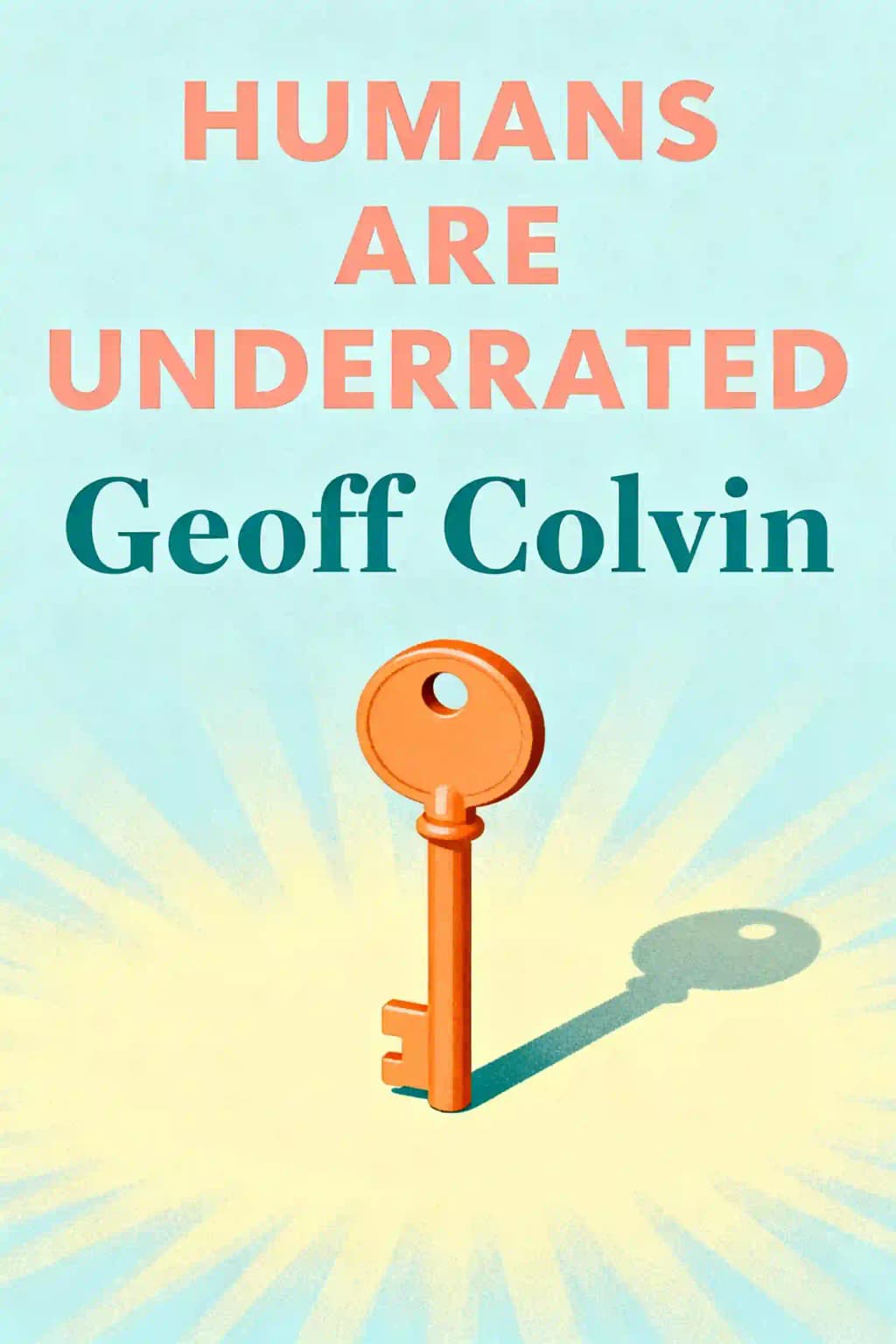
Geoff Colvin, senior editor-at-large for Fortune and bestselling author of Humans Are Underrated: What High Achievers Know That Brilliant Machines Never Will, is a leading voice on leadership and human performance in the age of technological disruption.
Drawing on decades of experience at Fortune, where he analyzes global business trends and interviews top executives, Colvin’s work explores how professionals and organizations can thrive by cultivating uniquely human skills like creativity, empathy, and collaboration. A sought-after commentator, he reaches millions weekly through CBS Radio broadcasts and has appeared on Today, Good Morning America, and PBS’s Nightly Business Report.
Colvin’s previous books include Talent Is Overrated, which revolutionized understanding of elite performance, and The Upside of the Downturn, named “Best Management Book of the Year” by Strategy + Business. His insights are informed by Harvard and NYU education, corporate advisory roles, and moderation of elite forums like the Fortune Global Summit. Translated into over a dozen languages, Humans Are Underrated builds on his legacy of research-backed strategies for navigating rapid change.
Humans Are Underrated explores how human skills like empathy, collaboration, and storytelling will remain irreplaceable despite advancing technology. Geoff Colvin argues that as machines surpass humans in technical tasks, socially driven abilities become critical for career success and organizational resilience. The book combines research and case studies to show how cultivating these "human-centric" skills offers a competitive edge in a tech-dominated future.
This book is ideal for professionals fearing job automation, leaders navigating workplace changes, and anyone interested in future-proofing their skills. It’s also valuable for educators and HR teams designing training programs focused on emotional intelligence, creativity, and teamwork—areas where humans excel over machines.
Yes, particularly for readers seeking actionable strategies to thrive alongside AI. Colvin’s blend of data, interviews, and clear frameworks makes it a practical guide for adapting to technological disruption. Critics praise its optimism about human potential, though some argue it underplays systemic challenges like workforce retraining.
Key concepts include:
While Talent Is Overrated debunks innate genius, emphasizing deliberate practice, Humans Are Underrated shifts focus to uniquely human traits machines can’t replicate. Both books stress skill development but target different facets of success—technical mastery vs. social and creative intelligence.
The book advises readers to pivot toward roles requiring emotional intelligence, complex problem-solving, and team leadership—skills resistant to automation. For example, Colvin highlights healthcare and education as sectors where human interaction remains central.
Some argue Colvin underestimates the scale of workforce disruption caused by AI and automation. Critics also note that systemic issues (e.g., access to training) aren’t fully addressed, risking a gap between theory and practical implementation.
As AI tools like ChatGPT and robotics advance, Colvin’s insights on human-machine collaboration are increasingly urgent. The book’s emphasis on creativity, ethical judgment, and interpersonal skills aligns with growing demand for roles like AI trainers and ethics officers.
Colvin cites research showing women often outperform men in social and emotional skills, positioning them strongly for leadership in collaborative environments. However, he cautions against stereotyping, noting these skills can be learned by anyone.
Though not directly from this book, Colvin’s earlier themes of adaptation (e.g., The Upside of the Downturn) mirror the “new cheese” metaphor—embracing change rather than clinging to outdated models. In Humans Are Underrated, this translates to innovating with human-centric strategies.
Yes, Colvin analyzes organizations like the U.S. Army and healthcare providers that prioritize teamwork and empathy. For example, he details how Mayo Clinic’s collaborative culture improves patient outcomes, illustrating the tangible value of human skills.
While Atomic Habits focuses on individual behavior change, Colvin’s work emphasizes collective human strengths. Both advocate skill development but target different scales: personal habits vs. organizational and societal adaptability.
Senti il libro attraverso la voce dell'autore
Trasforma la conoscenza in spunti coinvolgenti e ricchi di esempi
Cattura le idee chiave in un lampo per un apprendimento veloce
Goditi il libro in modo divertente e coinvolgente
College is no longer the automatic ticket to success.
Very little, other than 'enjoy.'
We are fundamentally social creatures.
Humans Are Underrated has become required reading.
Our most deeply human capabilities are becoming our most economically valuable assets.
Scomponi le idee chiave di Humans are Underrated in punti facili da capire per comprendere come i team innovativi creano, collaborano e crescono.
Distilla Humans are Underrated in rapidi promemoria che evidenziano i principi chiave di franchezza, lavoro di squadra e resilienza creativa.

Vivi Humans are Underrated attraverso narrazioni vivide che trasformano le lezioni di innovazione in momenti che ricorderai e applicherai.
Chiedi qualsiasi cosa, scegli la voce e co-crea spunti che risuonino davvero con te.

Creato da alumni della Columbia University a San Francisco
"Instead of endless scrolling, I just hit play on BeFreed. It saves me so much time."
"I never knew where to start with nonfiction—BeFreed’s book lists turned into podcasts gave me a clear path."
"Perfect balance between learning and entertainment. Finished ‘Thinking, Fast and Slow’ on my commute this week."
"Crazy how much I learned while walking the dog. BeFreed = small habits → big gains."
"Reading used to feel like a chore. Now it’s just part of my lifestyle."
"Feels effortless compared to reading. I’ve finished 6 books this month already."
"BeFreed turned my guilty doomscrolling into something that feels productive and inspiring."
"BeFreed turned my commute into learning time. 20-min podcasts are perfect for finishing books I never had time for."
"BeFreed replaced my podcast queue. Imagine Spotify for books — that’s it. 🙌"
"It is great for me to learn something from the book without reading it."
"The themed book list podcasts help me connect ideas across authors—like a guided audio journey."
"Makes me feel smarter every time before going to work"
Creato da alumni della Columbia University a San Francisco

Ottieni il riassunto di Humans are Underrated in formato PDF o EPUB gratuito. Stampalo o leggilo offline quando vuoi.
IBM's Watson didn't just win at Jeopardy!-it demolished human champions, processing complex wordplay and accessing vast knowledge without breaking a sweat. But here's the unsettling part: this wasn't just a game show stunt. It was a preview of an economy that increasingly provides what people want using more machines and fewer people. Yet here's the paradox that changes everything: just as computers master tasks we thought uniquely human, our most deeply human capabilities-empathy, collaboration, storytelling-are becoming our most valuable economic assets. The question isn't whether machines will take our jobs. It's whether we'll reclaim the human skills we've been letting atrophy.