Capitolo 1
Unlocking Your Mind's Limitless Potential
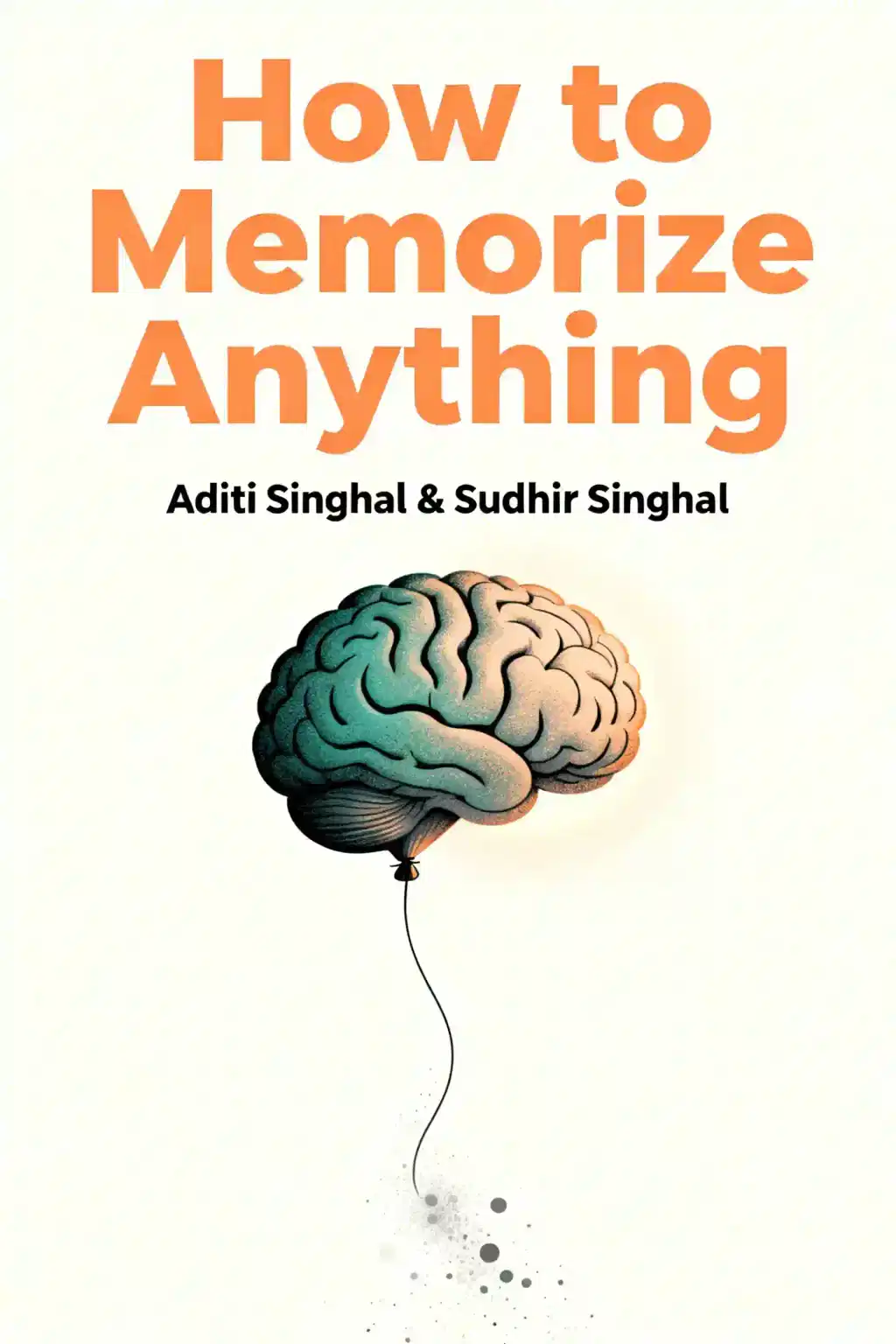
Have you ever wondered why some people seem to remember everything effortlessly while you struggle to recall what you had for breakfast yesterday? What if I told you that memory isn't a gift bestowed upon the lucky few, but rather a skill that anyone can master with the right techniques? "How to Memorize Anything" by Aditi Singhal and Sudhir Singhal has become a phenomenon in educational circles, with memory champions and everyday people alike transforming their cognitive abilities through its methods. The book has gained a cult following among students preparing for competitive exams, with many crediting their academic success to these techniques. Even celebrities like Aamir Khan have publicly praised memory training methods similar to those in the book. The Guinness World Record-holding authors don't just teach theory-they've proven these methods work by helping their five-year-old son become the youngest Indian to memorize the complete periodic table. Ready to discover how your brain can perform feats you never thought possible?
Capitolo 2
The Untapped Power of Your Memory
Your brain is an astonishing organ with capabilities far beyond what most people realize. With approximately 100 billion neurons forming over a trillion connections, your brain has a storage capacity of roughly 2.5 petabytes-enough to store 3 million hours of TV shows. That's 300 years of continuous viewing! This vast capacity extends to all types of information, from complex mathematical formulas to intricate visual details of past experiences. Despite this remarkable potential, most people utilize less than 10% of their memory capacity in daily life.
Several myths about memory persist that limit our expectations. Many believe memory can become "full," but the truth is memory functions more like a muscle that grows stronger with use. Just as weightlifters can progressively lift heavier weights, memory champions demonstrate that regular practice leads to exponential improvements in recall ability. Another common misconception is that memory deteriorates with age. While neurons do deplete as we age, we can develop new brain cells throughout life by exercising our mental faculties. Studies of Buddhist monks who practice intensive meditation show enhanced brain plasticity well into their 80s. In fact, an elderly person using proper memory techniques can outperform an untrained 20-year-old in recall tests.
Memory pills and supplements provide limited benefits by supporting brain health, but they won't significantly improve memory without proper techniques. While omega-3 fatty acids and antioxidants support brain function, the key to exceptional memory lies in training, not supplementation. All humans have similar brain "hardware"-differences in memory performance come from utilization levels, not inherent capacity. Memory isn't fixed at birth; it can be trained and developed like any other skill, as demonstrated by ordinary people who become memory champions through dedicated practice.
Memory formation involves three main stages: Registration (taking in information through our senses), Retention (storing information), and Recollection (retrieving information when needed). This process resembles a computer's input, storage, and output functions. Registration requires alert sense organs and complete attention; otherwise, information won't be properly recorded. This explains why we "lose" keys when distracted-we never registered where we put them in the first place. Studies show that people who practice mindfulness techniques can improve their registration ability by up to 50%.
For stronger memories, we need to engage all five senses and create associations with existing memories. The more sensory channels we activate, the stronger the memory becomes. For instance, when learning a new name, seeing the person's face (visual), hearing their name (auditory), and shaking their hand (tactile) creates a more robust memory trace. Retention involves properly organizing stored information, just as we organize household items in their appropriate places. The ancient Greeks used the "Method of Loci" technique, mentally placing memories in specific locations within a familiar building, achieving remarkable recall accuracy.
By understanding these fundamental processes and implementing proven memory techniques, we can begin to harness our brain's true potential. Regular practice of memory exercises, combined with proper attention and association strategies, can transform our ability to remember virtually anything, from complex academic material to everyday tasks. The key lies not in having a "good memory," but in developing good memory habits and techniques.
Capitolo 3
The Three Pillars of Exceptional Memory
The foundation of all memory improvement rests on three natural factors: attention, interest, and emotions. These elements determine both what we remember and how well we remember it.
Attention acts as a spotlight that allows the brain to focus on specific information while filtering out distractions. Without focused attention, information our senses receive may not register at all-mere repetition without attention creates no new neural pathways. As William James noted, attention is "taking possession by the mind" of one thought among many possibilities. Our perception of reality directly connects to where we focus our attention; what we ignore fades into insignificance regardless of its importance.
Interest dramatically affects what we remember. When we lack interest in information-like half-heartedly listening to a shopping list-we struggle to recall even basic details. This explains why students forget lectures, husbands miss what their wives say, and children ignore parental instructions. Conversely, we effortlessly maintain attention on subjects that genuinely interest us, like watching favorite movies or chatting on smartphones regardless of surrounding distractions. Importantly, interest can be deliberately generated by connecting information to personal benefits or using creative visualization techniques.
Emotions function as memory's glue. When emotionally connected to information-whether through positive or negative feelings-we remember it more vividly and for longer periods. This explains why cricket fans watch matches with greater attention when their favorite team is playing, or why we clearly remember startling incidents but forget routine mornings. Movies demonstrate this principle perfectly-we remember films from years ago because we emotionally connected with the characters.
To improve concentration, meditation serves as effective "attention training," scientifically proven to enhance focus in as little as eight weeks of daily practice. By actively engaging your mind on relevant thoughts while filtering out distractions, meditation strengthens attention like a muscle.
Remember your AIM-Attention, Interest, and Meditation-as these fundamentals determine both the content and quality of what you retain. Without them, even the most sophisticated memory techniques will fail to deliver results.
Capitolo 4
The Language Your Brain Understands
Memory isn't innately "good" or "poor"-it's simply trained or untrained. With proper techniques, anyone can develop an exceptional memory for almost anything. Most people struggle to memorize even a simple 15-item list in sequence, typically recalling only the first few items (primacy effect) or the last ones (recency effect), becoming confused in the middle. This phenomenon, known as the serial position effect, demonstrates how untrained memory typically works. However, this limitation can be overcome through understanding and working with your brain's natural information processing systems.
Information must be processed in a language the brain understands. While computers store data in binary language (ones and zeros), our brains process input through the five senses, with visual and spatial information being particularly powerful. The fundamental laws of memory can be summarized as AIR: Association (connect new information with existing knowledge), Imagination (create vivid mental pictures), and Ridiculous Thinking (make associations unusual or exaggerated). These three principles work together to create strong, lasting memories.
Association works like stringing pearls on a necklace-when information is connected, it stays organized and accessible. Our brain naturally stores information in connected pairs; we can only memorize random data by relating it to something meaningful. For example, when learning a new person's name like "Baker," connecting it to either the profession or imagining them baking bread creates an immediate association. This explains why we can easily recall connected items in a memorized list without going through the entire sequence, much like how you can jump to any point in a familiar song without starting from the beginning.
Visualization powerfully enhances association because the optic nerve contains over one million fibers, while the auditory nerve has only about fifty thousand. Seeing something once equals hearing it twenty times because visual nerves connect to the brain more strongly than auditory ones. This explains why we remember faces but forget names-we see faces but only hear names. Our brain naturally stores memories as images, which is why converting information into vivid mental pictures creates longer-lasting memories. For instance, to remember the name "River," visualizing someone swimming in a flowing river creates a stronger memory than simply hearing the name.
Our minds are naturally drawn to and retain what's unusual, odd, funny, or extraordinary. The more bizarre or ridiculous the mental image, the more memorable it becomes. This is why we remember unusual events from our childhood but forget routine days. For example, visualizing an ant talking on a mobile phone while riding a tiny motorcycle, or an elephant delicately painting a self-portrait while wearing a beret and smoking a pipe - these absurd scenarios create strong neural connections that make information stick. The more outrageous and detailed the image, the more effectively it serves as a memory anchor.
By applying these three principles together-Association, Imagination, and Ridiculous thinking-you create a powerful system for registering and recalling any information with ease, speed, and accuracy. This isn't a trick or shortcut; it's working with your brain's natural processes rather than against them. When you combine all three elements, like imagining a baker throwing cakes at passing cars while riding a giant rolling pin, you create memories that are nearly impossible to forget.
Capitolo 5
Building Memory Chains and Personal Nicknames
The Chain Method connects unrelated items by creating effective links between pairs of words. When you think of one item, the next immediately comes to mind. This versatile method has no limits-students have memorized over 500 words in sequence after hearing them just once.
To memorize a shopping list using the chain method, create vivid mental connections between consecutive items. For example, imagine yourself holding a giant toothbrush with shampoo instead of toothpaste, then it rains biscuits, forcing you to run to a tomato field where you find Reebok sports shoes. Each item links naturally to the next through bizarre, memorable imagery.
Rather than relying on written to-do lists that can be misplaced, spend a few minutes to memorize your daily tasks using the chain method. For a Saturday schedule including lawn tennis, car washing, bank visits, and other errands, create a story linking each activity: playing tennis at your club, then washing your mud-covered car, driving it into the bank where people attack you with haircuts, leading you to buy medicines from your dentist who uses stationery items as dental tools. These absurd connections make your schedule unforgettable.
While the Chain Method works well for familiar words, the Personal Nick Name (PNN) method tackles unfamiliar terms by creating personal, memorable associations. When encountering abstract words like country names or technical terms, break them into familiar-sounding components to create mental images.
For example, to remember Bulgaria's capital Sofia, visualize a "Bull" (from Bulgaria) lying on a "Sofa" (from Sofia). Similarly, Barbados with capital Bridgetown can be remembered by picturing "Barbie dolls" living in a "town on a bridge." For Australia-Canberra, visualize an "Ostrich" (Australia) taking photos with a "Camera" (Canberra).
The PNN method transforms language learning by converting foreign or difficult words into visualizable forms through personal nicknames. By associating these nicknames with meanings through vivid, often ridiculous imagery, vocabulary retention becomes dramatically more effective. This technique works equally well for foreign languages (converting "Cara" to "car" to remember the Spanish word for "face"), challenging English vocabulary (breaking "Obliterate" into "mob+literate"), and complex scientific terminology.
Capitolo 6
Mastering Names, Faces, and Locations
Remembering people's names is one of the most valuable social skills, as a person's name is their most prized possession. While most people easily remember faces (images being naturally memorable), names often slip away, causing embarrassment and potentially offending others. Those who remember names develop better personal relationships and gain advantages in professional settings.
The key to remembering names involves five critical steps: First, pay complete attention when hearing a name-asking for repetition or spelling if needed, and making a positive remark about the name to create initial engagement. Second, create a mental picture of the name, either using its inherent meaning (like "Kamal" meaning lotus), associating it with a famous namesake, or breaking unfamiliar names into familiar components using the Personal Nick Name method (like "Amolika" becoming "Amul butter + lick"). Third, identify a distinctive facial feature that stands out. Fourth, create a vivid, even outlandish association between the name-image and the facial feature. Finally, repeat the person's name throughout your conversation and when saying goodbye, then review all new names at day's end.
The Hide-and-Seek Method (also known as loci method, journey method, or Roman room method) involves mentally "hiding" information at specific locations along a familiar route and then "seeking" it during recall. Dating back over 2,000 years to Roman orators, this method works for memorizing speech points, checklists, shopping lists, and other sequential information.
For example, to memorize a speech on "Qualities of a Good Leader," first identify familiar locations in sequence (like items in your drawing room: lamp shade, sofa, window, etc.) and then associate each quality with a location through vivid visualization. During the speech, mentally walk through your room to recall each point confidently.
When creating hide-and-seek memory locations: (1) Choose familiar locations like your room or regular routes; (2) Select distinct items as stops to avoid confusion (not two similar chairs); (3) Arrange stops in a consistent sequence to prevent missing information.
The Hide-and-Seek method offers two key advantages: first, it provides unlimited memorization capacity through creating new hiding places wherever you go; second, even if you forget one stop, you can continue recalling from the next location without disrupting the sequence. This reliability makes it the preferred technique of memory champions worldwide.
Capitolo 7
Memory Tools for Every Situation
Mnemonics are learning techniques that enhance memory retention. Derived from the Greek word "mnemonikos" (meaning "of memory"), they represent "artificial memory" that must be trained, unlike natural memory that everyone uses automatically. Research shows students who regularly use mnemonics demonstrate significant improvement in test scores.
Seven forms of mnemonics can transform hard-to-remember information into easily recalled formats:
Rhyme mnemonics transform information into memorable poems. Examples include "In fourteen-hundred ninety-two, Columbus sailed the ocean blue" and verses for remembering days in each month.
Acronyms create new words from the first letters of a list, like VIBGYOR for rainbow colors or AIR for the memory laws (Association, Imagination, Ridiculous thinking).
Acrostics create meaningful sentences using the first letters of terms to memorize, particularly useful for remembering items in sequence. Unlike acronyms that form single words, acrostics create entire phrases like "My Very Educated Mother Just Served Us Noodles" for planets.
Setting information to music dramatically enhances recall-a principle widely used in advertising. From childhood ABC songs to commercial jingles like Honda's "Dekho dekhe yeh zamana" or McDonald's "I'm loving it," musical associations create powerful memory hooks.
The Number Phrase Technique converts hard-to-visualize numbers into memorable word phrases. Each digit corresponds to a word with that many letters-for example, house number 134 becomes "I Say Open."
Image mnemonics leverage our mind's natural ability to remember visuals. This technique involves forming mental images and making associations between them. The Chain method, PNN and Hide-and-Seek techniques learned earlier are all forms of image mnemonics.
Spelling mnemonics help master English's tricky spelling patterns through various approaches. For confusing homophones like "principal/principle," remember that a principal is your "pal" while a principle is a "rule."
The Peg System creates mental "hooks" to hang information on by connecting new information to well-established knowledge like numbers or the alphabet. Since numbers are abstract and difficult to visualize, we convert them into concrete images through various methods. The Number Rhyme Method assigns memorable rhyming images to numbers (one=sun, two=shoe, three=tree) to help remember lists in exact order.
Capitolo 8
Mastering Numbers and Creating Mind Maps
Numbers pervade our daily lives through bank accounts, passwords, addresses, and countless other data points. While smartphones can store this information, mentally mastering numbers gives us impressive capabilities, like delivering sales presentations without notes or recalling scientific constants instantly.
The Phonetic Peg System teaches a new "language" for memorizing numbers by assigning specific consonant sounds to each digit from 0-9. This allows us to convert abstract, difficult-to-visualize numbers into concrete, memorable words. The system assigns specific consonant sounds to each digit: 1=t/d, 2=n, 3=m, 4=r, 5=L, 6=j/ch/sh/g(soft), 7=k/g(hard), 8=f/v, 9=p/b, and 0=s/z. Vowels and soft consonants like w, h, y carry no numerical value and can be added freely to form words.
Once you've mastered the phonetic codes, you can transform any number into memorable words by replacing digits with their corresponding consonant sounds and adding vowels as needed. For example, 32 becomes "m" (3) + "n" (2), which can form words like "moon," "man," or "menu."
The phonetic system eliminates confusion between similar numbers by converting them into distinct words. For instance, you might confuse house numbers like 124 and 142, but when 124 becomes "donor" (d-n-r) and 142 becomes "train" (t-r-n), they're unmistakably different.
To memorize a phone number like 9810120337, break it into pairs (98/10/12/03/37) and convert each pair to a word using phonetic codes. For example, these could become "best friend dosa den sumo mike." Create a story connecting these words with the person whose number you're memorizing.
Mind maps harness the brain's natural tendency to think in pictures and associations rather than linear text. This powerful tool combines three key memory components: association, imagination, and pictorial representation. Invented by Tony Buzan, mind maps are radial diagrams that start with a central idea and branch outward with key words and images, mimicking how our brains naturally work.
To create an effective mind map: 1) Use landscape-oriented blank paper; 2) Start at the center with a colorful image of your main subject; 3) Add curved main branches with key words and images for major topics; 4) Create sub-branches for details; 5) Use curved rather than straight lines; 6) Incorporate colors throughout; 7) Write clearly in print using only one word per line; 8) Use arrows to connect related ideas across different branches.
Mind maps outperform linear note-taking because they provide both overview and detail simultaneously on a single page. The combination of words, images and colors engages both left and right brain thinking, making information more memorable. They mirror how our brains naturally think-through associations rather than linear sequences-allowing for faster idea generation and exploration of creative pathways.
Capitolo 9
Cultivating Concentration and Brain Health
Concentration is focusing your mind on one thought or task while excluding others. Like sunlight passing through a convex lens gains burning power through concentration at one point, our minds achieve remarkable results when focused. To improve concentration, eight key approaches are recommended: concentration exercises, observation skills development, proper nutrition, lifestyle management, avoiding multitasking, clear goal setting, letting go of unwanted memories, and meditation.
To sharpen concentration, incorporate variety into daily routines by doing something different each day-shop at new stores, take alternate routes home, or try unfamiliar activities. Challenge your brain by using your non-dominant hand for simple tasks, spelling words backward, counting specific words in text, performing mental calculations, and recalling objects from memory.
Observation is fundamental to memory-without attention and focus, we cannot truly observe, and without observation, we cannot remember. Most people merely see without observing, like glancing at a watch countless times without knowing if it has digits or Roman numerals. True observation happens when the brain actively interprets what the eyes see.
Though the brain is just 2% of our body weight, it consumes 20% of our oxygen and 25% of our energy. Glucose fuels the brain-without sufficient supply, concentration suffers and short-term memory falters. Brain-boosting foods include whole grains (release glucose, provide zinc and B vitamins), walnuts (rich in vitamin E, reduce Alzheimer's risk), tomatoes (contain lycopene that prevents free radical damage), and leafy greens (full of antioxidants that increase mental clarity). Staying hydrated is crucial-water provides the electrical energy needed for all brain functions.
Quality sleep is crucial for brain function, learning, and memory formation. During sleep, your brain remains active with increased oxygen consumption as it reorganizes information and forms memories from the day. Maintaining a regular sleep pattern is essential-most healthy adults need about 8 hours of sleep.
Multitasking significantly reduces productivity and impairs memory. Research from the University of Michigan found that participants writing a report while checking email took 50% longer than those handling tasks separately. Stanford research even showed that chronic multitaskers perform worse at multitasking than those who focus on one task at a time.
Meditation, essentially "attention training," improves focus by reducing sensory information processed by the thalamus (our sensory gatekeeper). Scientific studies show meditation increases cortical thickness and gray matter-areas linked to memory, attention, decision-making and learning. Even meditating once weekly for four years shows measurable brain improvements.
By implementing these practices, you create the optimal conditions for your memory techniques to flourish, transforming not just your ability to remember, but your overall cognitive performance in every aspect of life.