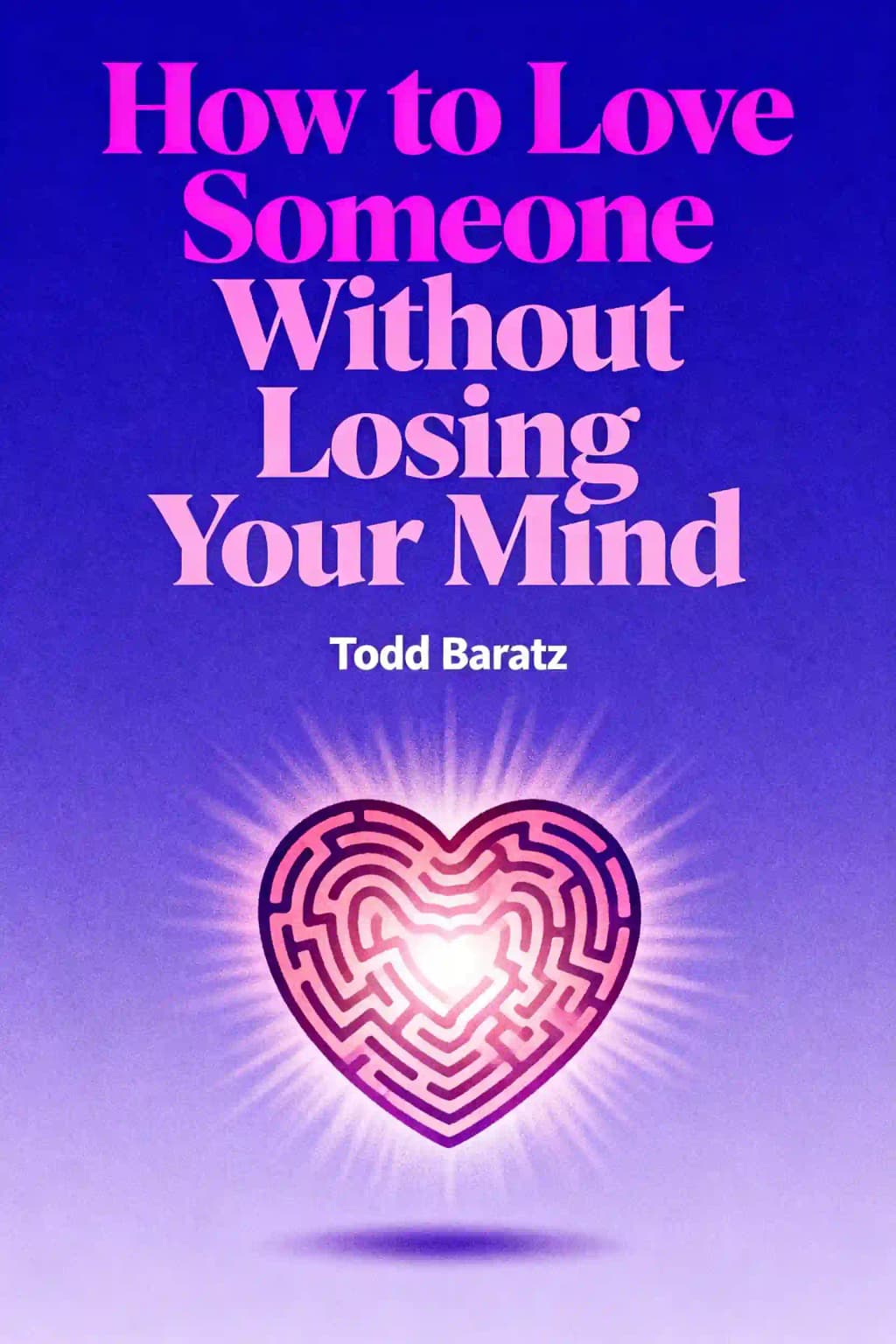
Therapist Todd Baratz dismantles fairy-tale love myths in this witty, practical guide praised by experts like Wednesday Martin and Terrence Real. What if maintaining your identity is the real secret to intimacy? Discover why this book has become therapy's most recommended relationship manual.
Todd Baratz, author of How to Love Someone Without Losing Your Mind, is a licensed mental health counselor and certified sex therapist renowned for his candid approach to relationships and emotional wellness. An alumnus of New York University's Gallatin School, Baratz blends interdisciplinary studies in psychology and philosophy with over 15 years of clinical experience.
His work focuses on dismantling toxic relationship patterns through self-awareness and practical strategies, themes central to his critically acclaimed book. He amplifies his insights through the OurDiagnonsense podcast—rated 4.5 stars across 43 episodes—and the Unfiltered Real Talk newsletter, which boasts over 11,000 subscribers.
Baratz’s viral YourDiagnonsense Instagram platform further establishes him as a leading voice in modern mental health discourse. His no-nonsense perspective has been featured in Men’s Health and recognized by therapeutic communities for bridging clinical expertise with accessible public education.
The book draws from Baratz’s pioneering framework for maintaining identity in intimate partnerships, developed through his Manhattan-based psychotherapy practice serving individuals and couples since 2010. His work has resonated globally, with OurDiagnonsense consistently ranking among top relationship-focused podcasts.
How to Love Someone Without Losing Your Mind by Todd Baratz is a blunt, practical guide dismantling modern love myths. It challenges unrealistic expectations, diagnoses like "toxic" relationships, and offers strategies to build self-awareness, embrace vulnerability, and navigate conflicts. Key themes include redefining sexual communication, addressing intergenerational trauma, and fostering differentiation (balancing individuality and intimacy).
Todd Baratz is a licensed psychotherapist, sex therapist, and creator of the viral Instagram account @YourDiagnonsense. Drawing from clinical practice and personal trauma experiences, he blends humor with raw insights to reframe relationship struggles as opportunities for growth rather than pathologies.
This book suits anyone overwhelmed by dating apps, societal pressure, or relationship conflicts. It’s particularly valuable for those seeking to replace perfectionism with self-compassion, improve communication, or understand how family trauma impacts partnerships. Baratz’s advice resonates with singles, couples, and LGBTQ+ readers.
Yes—readers praise its refreshing honesty and actionable advice. Unlike generic self-help, Baratz rejects quick fixes, urging readers to confront discomfort and redefine love beyond fairy tales. Ideal for those tired of surface-level tips or diagnostic labels.
Differentiation means maintaining your identity while staying emotionally connected during conflicts. Baratz argues it prevents resentment and burnout by balancing independence with intimacy. Examples include voicing needs without fear of abandonment and tolerating disagreements without shutting down.
Baratz critiques pornography and societal myths for creating unrealistic sexual expectations. He stresses mutual vulnerability, exploring desires without shame, and prioritizing emotional safety over performance. Practical advice includes reframing sex as collaborative play, not a scripted performance.
Triggers (e.g., jealousy, fear of abandonment) often stem from childhood or past trauma. Baratz advises naming these emotions, communicating them without blame, and recognizing their roots. This builds empathy for yourself and your partner, reducing reactive conflicts.
Baratz normalizes breakups as catalysts for growth, not failures. He encourages grieving without shame, seeking community support, and integrating lessons into future relationships. Notably, he challenges the stigma of staying friends with exes if it provides emotional continuity.
Some may find Baratz’s blunt tone jarring or his rejection of common therapy terms (like “toxic”) overly dismissive. Critics argue his approach requires significant self-work, which might overwhelm readers seeking quick fixes.
The book rejects the “perfect partner” myth, encourages embracing neediness as human, and critiques overpathologizing normal struggles (e.g., labeling anxiety as “disordered”). Baratz urges readers to write their own rules, prioritizing authenticity over societal scripts.
Baratz explains how unresolved family patterns (e.g., avoidance, people-pleasing) unconsciously shape adult partnerships. By mapping these cycles, individuals can interrupt harmful behaviors and build healthier dynamics. Examples include breaking codependency or emotional withdrawal.
Unlike formulaic advice, Baratz prioritizes self-discovery over rigid rules. It’s closer to Esther Perel’s work but leans grittier, dissecting how cultural narratives (e.g., monogamy, independence) create unnecessary suffering. Ideal for readers seeking depth over quick fixes.
Senti il libro attraverso la voce dell'autore
Trasforma la conoscenza in spunti coinvolgenti e ricchi di esempi
Cattura le idee chiave in un lampo per un apprendimento veloce
Goditi il libro in modo divertente e coinvolgente
Our modern approach to relationships is fundamentally broken.
We're chasing a marketed fantasy of love.
Survival trumped relationship satisfaction.
The greatest challenge is prioritizing personal pleasure.
Scomponi le idee chiave di How to Love Someone Without Losing Your Mind in punti facili da capire per comprendere come i team innovativi creano, collaborano e crescono.
Vivi How to Love Someone Without Losing Your Mind attraverso narrazioni vivide che trasformano le lezioni di innovazione in momenti che ricorderai e applicherai.
Chiedi qualsiasi cosa, scegli il tuo stile di apprendimento e co-crea intuizioni che risuonano davvero con te.

Creato da alumni della Columbia University a San Francisco
"Instead of endless scrolling, I just hit play on BeFreed. It saves me so much time."
"I never knew where to start with nonfiction—BeFreed’s book lists turned into podcasts gave me a clear path."
"Perfect balance between learning and entertainment. Finished ‘Thinking, Fast and Slow’ on my commute this week."
"Crazy how much I learned while walking the dog. BeFreed = small habits → big gains."
"Reading used to feel like a chore. Now it’s just part of my lifestyle."
"Feels effortless compared to reading. I’ve finished 6 books this month already."
"BeFreed turned my guilty doomscrolling into something that feels productive and inspiring."
"BeFreed turned my commute into learning time. 20-min podcasts are perfect for finishing books I never had time for."
"BeFreed replaced my podcast queue. Imagine Spotify for books — that’s it. 🙌"
"It is great for me to learn something from the book without reading it."
"The themed book list podcasts help me connect ideas across authors—like a guided audio journey."
"Makes me feel smarter every time before going to work"
Creato da alumni della Columbia University a San Francisco

Ottieni il riassunto di How to Love Someone Without Losing Your Mind in formato PDF o EPUB gratuito. Stampalo o leggilo offline quando vuoi.
Imagine waking up one day and realizing that everything you've been taught about love is fundamentally wrong. The fairy tales, rom-coms, and Instagram relationship goals have sold us a dangerous fantasy - that perfect love exists, that the right person will complete us, and that healthy relationships don't involve pain. In reality, love will break your mind, trigger your deepest insecurities, and force you to confront parts of yourself you'd rather ignore. And according to psychotherapist Todd Baratz, that's not just normal - it's necessary. Real love isn't about finding someone who never triggers you; it's about developing the capacity to navigate those triggers together. It's about understanding that we're all carrying emotional ghosts from our past, all somewhat unhealthy, and all deserving of compassion despite our flaws. We've transformed love into a capitalist pursuit where potential partners are products to be evaluated based on superficial metrics. Dating apps function as marketplaces where we swipe through humans like items on Amazon, disqualifying potential matches over absurdities like "they're a Gemini" or "they live in Brooklyn and I'm on the Upper West Side." We're simultaneously shopping for the perfect partner while marketing ourselves as desirable assets. This approach has created a collective crisis in how we connect, developing rigid rules about relationships that function as defensive strategies born from fear and anxiety, rebranded as essential health measures. As our expectations for relationships have skyrocketed - expecting partners to be our best friend, lover, therapist, and co-parent - our commitment to the necessary work has plummeted. We cling to the fantasy that the "right" person will bring total bliss, ignoring that all relationships include disappointment. The problem isn't that our standards are too high or too low - it's that our focus is wrong. We're seeking perfection in others rather than growth in ourselves.
Every relationship challenge originates from loss and longing for love. While our experiences feel personal, we carry emotional patterns inherited from our families. Baratz's story illustrates this: His mother married young to escape abuse, while his father-from a Holocaust-survivor family-lost his father early and witnessed his mother's suicide attempt. These patterns influenced Baratz's relationships, as he mirrored his mother's tendency toward silence. We unconsciously recreate familiar patterns through "re-enactments" as attempts to heal. When triggered, we experience a 70/30 split-30% present reaction, 70% past trauma response. Love triggers powerful emotions between adoration and fury. During triggering events, we experience flooding-our brain's emergency response activates, clouding rational thought. This "veracity trap" makes us mistake emotional intensity for truth. Trauma encompasses not just physical abuse but emotional abandonment and "passive abuse"-the absence of essential nurturing.
Our cultural discomfort with sexuality stems from a repressive history that breeds shame. Medical education focuses narrowly on STIs and contraception, while exposure to sexual information primarily through media and pornography creates unrealistic expectations. During intimacy, pleasure hormones flow naturally, but perceived threats can trigger stress responses that inhibit arousal. The Dual Control Model shows how sexual response balances accelerators (arousal) and brakes (turnoffs), with context playing a crucial role. Sex integrates physical and emotional elements. The core challenge is allowing ourselves to prioritize pleasure - a necessary "selfishness" often discouraged in life. As Dr. Michael Bader notes, sexual excitement requires surrendering to our own pleasure, like savoring a meal rather than forcing unwanted food.
Most couples enter therapy when resentment takes hold, armed with grievances and unfulfilled needs. The relationship becomes a battleground of contempt, with complaints of feeling unseen or wanting different things. The honeymoon phase inevitably ends. Initially charming differences - like Baratz's fitness focus versus Alex's TV watching and late nights - can become points of tension. Despite three years of chemistry and oceanfront bliss, challenges emerged. As relationships mature, fixating on future milestones can overshadow genuine connection. While envisioning a shared future is natural, obsessing over potential dealbreakers creates distance. When Baratz began graduate school, his new perspective revealed relationship issues. Though Alex provided deep love and his first true home, their codependency became problematic. Alex was everything - best friend, social network, lover, and family. Instead of addressing these issues, Baratz criticized Alex while avoiding self-reflection.
Many of us lose touch with our inner selves, focusing on others instead of understanding our own desires. We seek partners to provide the purpose and acceptance we haven't found within ourselves. Analyzing others' behaviors becomes a defense mechanism - it manages anxiety but disconnects us from our experiences and helps avoid confronting personal pain. Baratz's relationship with Alex illustrates this pattern. Having never lived independently, he became defined by their relationship, expecting Alex to read his mind while withdrawing and blaming him for their problems. Differentiation, developed by Murray Bowen and refined by David Schnarch, means maintaining individuality while in relationship. Well-differentiated people handle disagreements without becoming overwhelmed. This process begins in childhood, though many families resist such independence. Schnarch compares differentiated couples to two separate boats navigating together rather than one shared vessel. As Esther Perel notes, "When two become one, connection can no longer happen." True intimacy requires both individual growth and shared experiences.
As a therapist, Baratz observes that everyone is somewhat unhealthy. Our relationship mistakes make sense within our personal stories. Society demands healthy relationships without teaching how to build them, leaving many to learn about intimacy from unrealistic sources. Instagram's empowering phrases oversimplify life's complexity. Everyone has flaws - sometimes, being "unhealthy" is actually healthy. In relationships, we're like babies learning to walk while managing past traumas. No relationship meets perfectionistic standards, and meaning matters more than happiness. We chase future happiness while missing the present. True peace comes from learning to work through pain, not avoiding it. Healing begins with self-curiosity and becomes a lifelong practice. Pain isn't something to resist but to welcome with kindness. The fairy tale was never real, but authentic, imperfect love surpasses any fantasy.
Every relationship has its dance, shaped by present circumstances but rooted in childhood patterns. Re-enactments aren't negative - they're opportunities for healing. These unconscious processes recreate familiar roles that impact communication and attachment. Consider Denise and Sam: her withdrawal triggered his anxious pursuit of reassurance. Through therapy, they discovered neither had experienced safe relationships growing up. This mutual understanding became their breakthrough. Recovery from trauma involves learning to live without fear, recognizing what was missing, and cultivating pleasure. The path forward isn't finding someone to transform your life - it's becoming the author of your own story through self-understanding. While partner frustration is normal, defining them solely by irritating traits creates problems. Relationship satisfaction depends not on perfection but on how you understand and respond to flaws. Understanding yourself, befriending all parts, and practicing forgiveness opens the door to growth - suggesting relationships exist not for endless happiness but for learning to love despite imperfection.